

SUBSCRIBE TO OUR FREE NEWSLETTER
Daily news & progressive opinion—funded by the people, not the corporations—delivered straight to your inbox.
5
#000000
#FFFFFF
To donate by check, phone, or other method, see our More Ways to Give page.
Daily news & progressive opinion—funded by the people, not the corporations—delivered straight to your inbox.
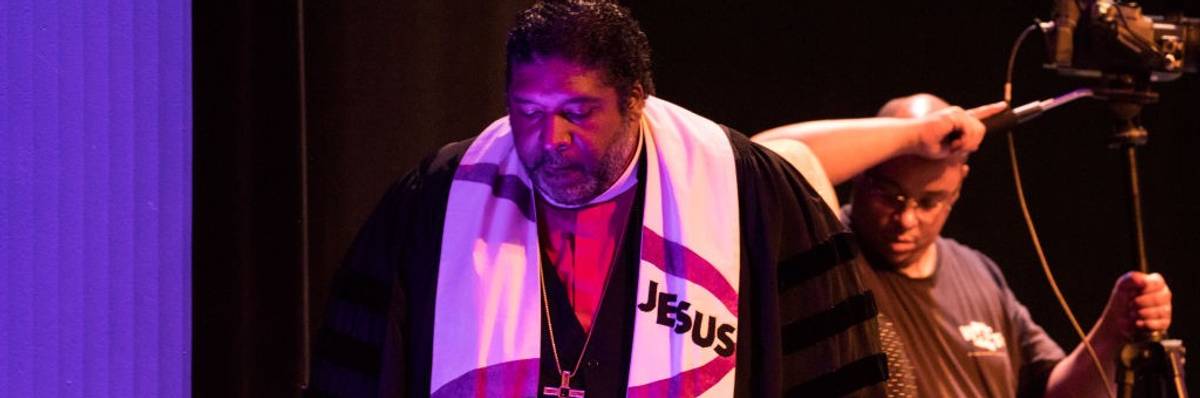
William Barber leaves the stage after preaching at a chapel service at Howard University in 2017.
"We should really be talking about how to abolish the majority of poverty, because we know what would happen if we did have serious living minimum wage and healthcare," Barber said.
William Barber, a bishop and co-chair of the Poor People's Campaign, said in an interview published Thursday that U.S. presidential debates, and the race more broadly, was "failing" the poor, whose needs and concerns he said aren't being addressed.
About 38 million people in the U.S. live in poverty, roughly 11.5% of the population, as determined by the federal government. PPC says that one-third of the electorate, or 85 million people, are poor or low-income.
"We're talking about poverty that is not an anomaly among one group of people. But in fact, is across the country, in every community, in every city," Barber told USA Today. "We should really be talking about how to abolish the majority of poverty, because we know what would happen if we did have serious living minimum wage and healthcare."
Both @KamalaHarris & @realDonaldTrump say they want to represent working people. Why not accept @RevDrBarber’s challenge to debate the causes of America’s exceptional poverty & the policies that could end it. https://t.co/TIjUvOof0O
— Jonathan Wilson-Hartgrove (@wilsonhartgrove) October 3, 2024
PPC was inspired by a 1968 movement of the same name organized by Martin Luther King Jr. and led by allies after his assassination. They set up a 3,000-person protest camp on Washington Mall in the spring of that year, staying for six weeks.
Barber, a Black pastor and political organizer from North Carolina, was among those who led the relaunch in 2018—Poor People's Campaign: A National Call for a Moral Revival—which started with demonstrations in Washington, D.C., and at statehouses across the country.
Barber, who recently wrote a book about white poverty, has said that there's a "deafening silence" on the part of the media with regard to economic justice in the U.S.
Barber told USA Today that the debate moderators, as well as the presidential and vice presidential candidates, have failed to address it. He said Tuesday's vice presidential debate should have featured a question on a living minimum wage.
"To not have that as a major question and drill it down and make these candidates answer the question is a failing, we believe of the debate system," Barber said.
The current federal minimum wage is $7.25, set in 2009. Barber has frequently expressed outrage that Congress hasn't acted to raise it in the last 15 years.
In 2021, Sen. Bernie Sanders (I-Vt.) moved to raise the minimum wage to $15, via an amendment to the Covid-19 stimulus package, but all 50 Republican senators and eight members of the Democratic caucus voted it down.
Barber noted that Minnesota Gov. Tim Walz, the Democratic vice presidential nominee, raised the need to expand the child tax credit and for affordable housing in the debate, but said the moderators should have explicitly asked about the needs of poor people.
"I think there's a great failure of the press, of those who planned the debate, and even the politicians themselves, for not putting millions of people at the center of the political debate," Barber said.
Barber in fact recommended a reform to the debate format in which nonpartisan experts lay out facts on an issue before candidates speak—and people who are affected by an issue, rather than professional moderators, ask the questions.
Dear Common Dreams reader, It’s been nearly 30 years since I co-founded Common Dreams with my late wife, Lina Newhouser. We had the radical notion that journalism should serve the public good, not corporate profits. It was clear to us from the outset what it would take to build such a project. No paid advertisements. No corporate sponsors. No millionaire publisher telling us what to think or do. Many people said we wouldn't last a year, but we proved those doubters wrong. Together with a tremendous team of journalists and dedicated staff, we built an independent media outlet free from the constraints of profits and corporate control. Our mission has always been simple: To inform. To inspire. To ignite change for the common good. Building Common Dreams was not easy. Our survival was never guaranteed. When you take on the most powerful forces—Wall Street greed, fossil fuel industry destruction, Big Tech lobbyists, and uber-rich oligarchs who have spent billions upon billions rigging the economy and democracy in their favor—the only bulwark you have is supporters who believe in your work. But here’s the urgent message from me today. It's never been this bad out there. And it's never been this hard to keep us going. At the very moment Common Dreams is most needed, the threats we face are intensifying. We need your support now more than ever. We don't accept corporate advertising and never will. We don't have a paywall because we don't think people should be blocked from critical news based on their ability to pay. Everything we do is funded by the donations of readers like you. When everyone does the little they can afford, we are strong. But if that support retreats or dries up, so do we. Will you donate now to make sure Common Dreams not only survives but thrives? —Craig Brown, Co-founder |
William Barber, a bishop and co-chair of the Poor People's Campaign, said in an interview published Thursday that U.S. presidential debates, and the race more broadly, was "failing" the poor, whose needs and concerns he said aren't being addressed.
About 38 million people in the U.S. live in poverty, roughly 11.5% of the population, as determined by the federal government. PPC says that one-third of the electorate, or 85 million people, are poor or low-income.
"We're talking about poverty that is not an anomaly among one group of people. But in fact, is across the country, in every community, in every city," Barber told USA Today. "We should really be talking about how to abolish the majority of poverty, because we know what would happen if we did have serious living minimum wage and healthcare."
Both @KamalaHarris & @realDonaldTrump say they want to represent working people. Why not accept @RevDrBarber’s challenge to debate the causes of America’s exceptional poverty & the policies that could end it. https://t.co/TIjUvOof0O
— Jonathan Wilson-Hartgrove (@wilsonhartgrove) October 3, 2024
PPC was inspired by a 1968 movement of the same name organized by Martin Luther King Jr. and led by allies after his assassination. They set up a 3,000-person protest camp on Washington Mall in the spring of that year, staying for six weeks.
Barber, a Black pastor and political organizer from North Carolina, was among those who led the relaunch in 2018—Poor People's Campaign: A National Call for a Moral Revival—which started with demonstrations in Washington, D.C., and at statehouses across the country.
Barber, who recently wrote a book about white poverty, has said that there's a "deafening silence" on the part of the media with regard to economic justice in the U.S.
Barber told USA Today that the debate moderators, as well as the presidential and vice presidential candidates, have failed to address it. He said Tuesday's vice presidential debate should have featured a question on a living minimum wage.
"To not have that as a major question and drill it down and make these candidates answer the question is a failing, we believe of the debate system," Barber said.
The current federal minimum wage is $7.25, set in 2009. Barber has frequently expressed outrage that Congress hasn't acted to raise it in the last 15 years.
In 2021, Sen. Bernie Sanders (I-Vt.) moved to raise the minimum wage to $15, via an amendment to the Covid-19 stimulus package, but all 50 Republican senators and eight members of the Democratic caucus voted it down.
Barber noted that Minnesota Gov. Tim Walz, the Democratic vice presidential nominee, raised the need to expand the child tax credit and for affordable housing in the debate, but said the moderators should have explicitly asked about the needs of poor people.
"I think there's a great failure of the press, of those who planned the debate, and even the politicians themselves, for not putting millions of people at the center of the political debate," Barber said.
Barber in fact recommended a reform to the debate format in which nonpartisan experts lay out facts on an issue before candidates speak—and people who are affected by an issue, rather than professional moderators, ask the questions.
William Barber, a bishop and co-chair of the Poor People's Campaign, said in an interview published Thursday that U.S. presidential debates, and the race more broadly, was "failing" the poor, whose needs and concerns he said aren't being addressed.
About 38 million people in the U.S. live in poverty, roughly 11.5% of the population, as determined by the federal government. PPC says that one-third of the electorate, or 85 million people, are poor or low-income.
"We're talking about poverty that is not an anomaly among one group of people. But in fact, is across the country, in every community, in every city," Barber told USA Today. "We should really be talking about how to abolish the majority of poverty, because we know what would happen if we did have serious living minimum wage and healthcare."
Both @KamalaHarris & @realDonaldTrump say they want to represent working people. Why not accept @RevDrBarber’s challenge to debate the causes of America’s exceptional poverty & the policies that could end it. https://t.co/TIjUvOof0O
— Jonathan Wilson-Hartgrove (@wilsonhartgrove) October 3, 2024
PPC was inspired by a 1968 movement of the same name organized by Martin Luther King Jr. and led by allies after his assassination. They set up a 3,000-person protest camp on Washington Mall in the spring of that year, staying for six weeks.
Barber, a Black pastor and political organizer from North Carolina, was among those who led the relaunch in 2018—Poor People's Campaign: A National Call for a Moral Revival—which started with demonstrations in Washington, D.C., and at statehouses across the country.
Barber, who recently wrote a book about white poverty, has said that there's a "deafening silence" on the part of the media with regard to economic justice in the U.S.
Barber told USA Today that the debate moderators, as well as the presidential and vice presidential candidates, have failed to address it. He said Tuesday's vice presidential debate should have featured a question on a living minimum wage.
"To not have that as a major question and drill it down and make these candidates answer the question is a failing, we believe of the debate system," Barber said.
The current federal minimum wage is $7.25, set in 2009. Barber has frequently expressed outrage that Congress hasn't acted to raise it in the last 15 years.
In 2021, Sen. Bernie Sanders (I-Vt.) moved to raise the minimum wage to $15, via an amendment to the Covid-19 stimulus package, but all 50 Republican senators and eight members of the Democratic caucus voted it down.
Barber noted that Minnesota Gov. Tim Walz, the Democratic vice presidential nominee, raised the need to expand the child tax credit and for affordable housing in the debate, but said the moderators should have explicitly asked about the needs of poor people.
"I think there's a great failure of the press, of those who planned the debate, and even the politicians themselves, for not putting millions of people at the center of the political debate," Barber said.
Barber in fact recommended a reform to the debate format in which nonpartisan experts lay out facts on an issue before candidates speak—and people who are affected by an issue, rather than professional moderators, ask the questions.

