SUBSCRIBE TO OUR FREE NEWSLETTER
Daily news & progressive opinion—funded by the people, not the corporations—delivered straight to your inbox.
5
#000000
#FFFFFF
To donate by check, phone, or other method, see our More Ways to Give page.
Daily news & progressive opinion—funded by the people, not the corporations—delivered straight to your inbox.
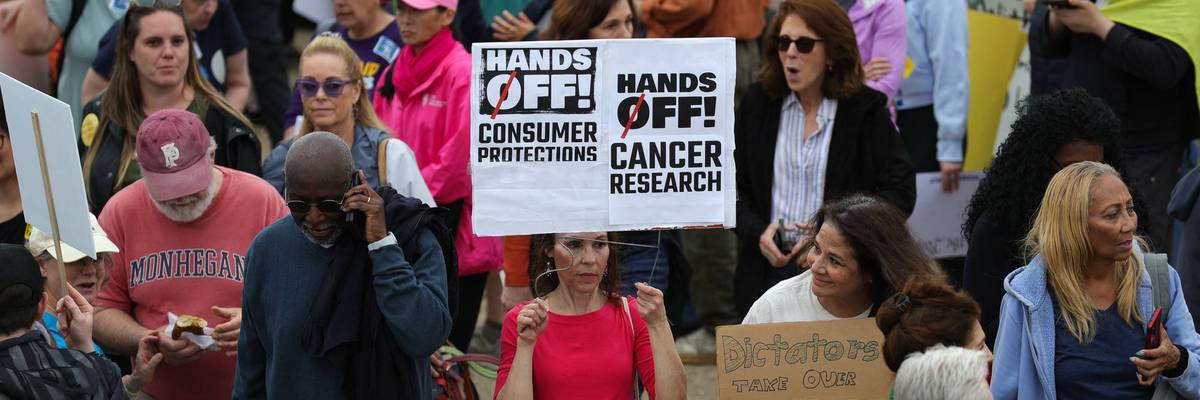
People gather to protest the Trump administration during the "Hands Off" protest on the National Mall in Washington, DC on April 5, 2025.
Nothing can compare to the scale and breadth of Trump 2.0’s across-the-board evisceration of every part of the government that helps with cancer prevention and treatment.
Last week marked one year of me being cancer free. I’ve shared parts of the story of my excruciating recovery on a couple occasions. Still, it’s been truly surreal to embark on this journey back to health while being inundated with report after report of Trump administration policies that seem intent on increasing the suffering caused by cancer. Where normal governments seek to protect people through research, medical innovation, and funding for early treatment and prevention, this administration has slashed research into cancer, cut funding for medical care, and moved to relax standards on how much exposure to carcinogens companies are allowed to inflict on surrounding communities. This is, in short, a pro-cancer government.
Every administration has been guilty of taking actions that jeopardized public health, but there is simply nothing that can compare to the scale and breadth of Trump 2.0’s across-the-board evisceration of every part of the government that helps with cancer prevention and treatment. For half a century, the United States waged a War on Cancer. Since January 2025, it has instead waged war on cancer’s victims.
The most obvious part of the Trump administration’s war on cancer patients is the frontal assault on research seeking to develop new screenings, treatments, and, hopefully, cures for an array of cancers.
On January 21, 2025, his first full day back in office, President Donald Trump imposed a bevy of restrictions on the National Institutes of Health (NIH), including functionally freezing external communications, grant review, and employee travel. By executive fiat, Trump and his right hand man-domestic policy puppet master Russell Vought delayed the disbursement of the NIH’s $47 billion in research funds, including $7 billion under the aegis of the National Cancer Institute (NCI). This consequently forced a pause on the review and approval of new clinical oncology trials. At the end of his second week in office, Trump mandated an instant 15% cap on NIH grant overhead, effectively demanding that the agency spend $4 billion less than planned. After freezing funding until the start of February, the NIH then began ruthlessly, frequently illegally (according to multiple federal court decisions) terminating grants; more than 1,800 were ended between February and June. And while courts have restored many of the improperly terminated grants, there’s a lot less recourse for new grants that are not being issued, leaving many research labs across the country, “running on fumes,” as The Washington Post described it. According to the Post’s analysis, NIH grants this year have fallen by over 50%.
The current suits in the White House would like you to believe the idea of a moonshot to treat cancer and the usage of words like “woman” in scientific research is more controversial than the erosion of decades of medical research and mass defunding of investment in curing one of the most omnipresent diseases in human history.
From the start of this term, the administration has also censored the production and dissemination of federal health research from agencies like the Centers for Disease Control and Prevention (CDC) and the NIH. This includes illegally scrubbing swathes of publicly available data and web resources and requiring approval from the administration for CDC scientists to publish in external journals. The CDC mandated that no research publication was to use a list of supposedly “DEI” terms, including “LGBTQ” and “biologically female.” In other instances, any inclusion of the word “race,” “gender,” “sex,” “pregnancy,” or even “woman” was grounds for censorship. The result has been a chilling of important investigations that impact how we treat cancer; the type of tumor I had (called a carcinoid) occurs most often in older women.
The CDC, though, would not let a researcher publish that last sentence, if it had its way.
On April 1 2025, four NIH institute directors and another acting director were placed on leave. By late April, the chaos of a rampaging DOGE and mass layoffs had already forced out at least 2,500 staff (more than 10% of the agency’s 20,000 headcount) including two dozen of the 320 in-house research physicians at the NIH Clinical Center. After some of the internal administration restrictions were eased, researchers were still dealing with massive backlogs for basic lab equipment. That May, the administration sent a stop work order to the SMART IRB system, an NIH-funded initiative that streamlined institutional review board approval for clinical trials used by more than 1,300 institutions. A career researcher at NIH told Science that “however bad everyone on the outside thinks it is, it is a million times worse.”
All in all, the NIH has seen a proposed 44% funding cut, with the NCI facing a 37% cut. And it isn’t just NIH; there have been major reductions in cancer research funding from the Department of Defense and the Department of Veterans Affairs as well. A $1.5 billion Pentagon-directed health research grant fund, about half of which was devoted for cancer research, was slashed by 57%; funding for kidney, pancreatic, and lung cancer were zeroed out. At the VA, DOGE deployed an inaccurate data tool that terminated numerous grants, including one gene sequencing device that was being used to research cancer treatments.
According to STAT, the term “Cancer Moonshot” is now considered “controversial” at NIH, presumably because it was a Biden initiative. It’s difficult to imagine a more appropriate encapsulation of our ongoing reality: The current suits in the White House would like you to believe the idea of a moonshot to treat cancer and the usage of words like “woman” in scientific research is more controversial than the erosion of decades of medical research and mass defunding of investment in curing one of the most omnipresent diseases in human history.
The war on cancer patients extends far beyond the scientific agencies. A number of agencies are also rolling back environmental and workplace safety regulations that protect us from cancer.
The Environmental Protection Agency (EPA) alone is rolling back limits on a range of carcinogens including formaldehyde, air pollution, greenhouse gas emissions (which include formaldehyde, nitrogen oxide, arsenic, sulfur, and other carcinogenic compounds), asbestos, per- and polyfluoroalkyl substances (also called PFAS or forever chemicals), and vinyl chloride. In a triumphant press release, the Trump EPA celebrated its moves to deregulate a host of chemicals, including dangerous air particulate (called PM 2.5), coal ash, and oil and gas wastewater, all of which are carcinogenic. The EPA also recertified Monsanto’s weedkiller Dicamba, which has been linked to higher risk of liver cancer and leukemia (and also banned twice by federal courts already). One of the chemical industry alums tapped to lead the Office of Chemical Safety and Pollution Prevention, Nancy Beck, is known for pushing for the rollback of bans on carcinogenic solvents. To top it all off, the agency is also down 25% of its staff, so it would be poorly positioned to enforce what standards survive the regulation purge.
Elsewhere, Health and Human Services Secretary Robert F. Kennedy Jr. has decimated the National Institute for Occupational Safety and Health (NIOSH), terminating 85% of its workforce. NIOSH conducted research on how exposure to dangerous chemicals impacted workers’ health, including studying cancer risk among miners and firefighters. The database tracking cancer in firefighters ended enrollment. NIOSH was instrumental in identifying now iconic toxic substances, including carcinogens like asbestos and ethylene oxide, and helping to develop federal workplace safety rules based on those findings.
Even students are being readily placed in harm’s way; the administration’s attack on clean energy programs has blocked school districts’ efforts to replace their diesel buses, and their cancer-causing exhaust, with electric ones. The Department of Interior has announced its intent to bring back the glory days of coal mining, despite coal exhaust spewing toxic air pollutants. To this end, the administration is exempting coal-fired power plants from upgraded air quality regulations. The administration has exempted around 100 industrial sites from Biden-era regulation of cancer-causing air pollutants.
Those are just two fronts in the federal government’s deeply disturbing war on cancer victims. Some 2 million Americans get cancer every year, with more than 600,000 dying from the disease. Thousands upon thousands more will be driven into both of those camps, from all of the policies I’ve mentioned and many, many more. Cuts to the Mine Safety and Health Administration and the Occupational Safety and Health Administration, the Food and Drug Administration’s Food Inspection Service, and the National Oceanic and Atmospheric Administration, which runs an air quality evaluation program that helps to apprise Americans of how safe it is to be outdoors for extended periods, leave all of us more in danger of facing cancer. Medicaid and Medicare cuts, the gutting of consumer protection bodies, and the revolving door with Big Pharma mean that we’ll pay more if we do.
Against this backdrop, the Trump administration sought to burnish its nonexistent cancer-busting image by announcing a $50 million initiative to deploy AI to fight pediatric cancer. The big shiny figure is really a drop in the bucket in terms of impact. Worse, its part and parcel of the White House’s naked embrace of the AI-hype that is driving an industrial buildout that itself causes cancer.
The only logical conclusion to glean from the simultaneous destruction of cancer research, ripping up of the rules and agencies that protect us from it, and willful zeal for fossil fuels (often wrapped up with AI-mania via the data center build out) and exempting them from air quality oversight is that this is a pro-cancer administration. They admitted as much when news broke before Trump was even inaugurated that his EPA would no longer tally the human cost of air pollution.
Whether it’s counted or not, though, it is there. The type of cancer I had is a “mild” one; I still lost a lung, had a vocal cord paralyzed, spent months barely able to get through a day, and still get winded easily. The official position of the US government appears to be that more people should have to endure that.
Dear Common Dreams reader, It’s been nearly 30 years since I co-founded Common Dreams with my late wife, Lina Newhouser. We had the radical notion that journalism should serve the public good, not corporate profits. It was clear to us from the outset what it would take to build such a project. No paid advertisements. No corporate sponsors. No millionaire publisher telling us what to think or do. Many people said we wouldn't last a year, but we proved those doubters wrong. Together with a tremendous team of journalists and dedicated staff, we built an independent media outlet free from the constraints of profits and corporate control. Our mission has always been simple: To inform. To inspire. To ignite change for the common good. Building Common Dreams was not easy. Our survival was never guaranteed. When you take on the most powerful forces—Wall Street greed, fossil fuel industry destruction, Big Tech lobbyists, and uber-rich oligarchs who have spent billions upon billions rigging the economy and democracy in their favor—the only bulwark you have is supporters who believe in your work. But here’s the urgent message from me today. It's never been this bad out there. And it's never been this hard to keep us going. At the very moment Common Dreams is most needed, the threats we face are intensifying. We need your support now more than ever. We don't accept corporate advertising and never will. We don't have a paywall because we don't think people should be blocked from critical news based on their ability to pay. Everything we do is funded by the donations of readers like you. When everyone does the little they can afford, we are strong. But if that support retreats or dries up, so do we. Will you donate now to make sure Common Dreams not only survives but thrives? —Craig Brown, Co-founder |
Last week marked one year of me being cancer free. I’ve shared parts of the story of my excruciating recovery on a couple occasions. Still, it’s been truly surreal to embark on this journey back to health while being inundated with report after report of Trump administration policies that seem intent on increasing the suffering caused by cancer. Where normal governments seek to protect people through research, medical innovation, and funding for early treatment and prevention, this administration has slashed research into cancer, cut funding for medical care, and moved to relax standards on how much exposure to carcinogens companies are allowed to inflict on surrounding communities. This is, in short, a pro-cancer government.
Every administration has been guilty of taking actions that jeopardized public health, but there is simply nothing that can compare to the scale and breadth of Trump 2.0’s across-the-board evisceration of every part of the government that helps with cancer prevention and treatment. For half a century, the United States waged a War on Cancer. Since January 2025, it has instead waged war on cancer’s victims.
The most obvious part of the Trump administration’s war on cancer patients is the frontal assault on research seeking to develop new screenings, treatments, and, hopefully, cures for an array of cancers.
On January 21, 2025, his first full day back in office, President Donald Trump imposed a bevy of restrictions on the National Institutes of Health (NIH), including functionally freezing external communications, grant review, and employee travel. By executive fiat, Trump and his right hand man-domestic policy puppet master Russell Vought delayed the disbursement of the NIH’s $47 billion in research funds, including $7 billion under the aegis of the National Cancer Institute (NCI). This consequently forced a pause on the review and approval of new clinical oncology trials. At the end of his second week in office, Trump mandated an instant 15% cap on NIH grant overhead, effectively demanding that the agency spend $4 billion less than planned. After freezing funding until the start of February, the NIH then began ruthlessly, frequently illegally (according to multiple federal court decisions) terminating grants; more than 1,800 were ended between February and June. And while courts have restored many of the improperly terminated grants, there’s a lot less recourse for new grants that are not being issued, leaving many research labs across the country, “running on fumes,” as The Washington Post described it. According to the Post’s analysis, NIH grants this year have fallen by over 50%.
The current suits in the White House would like you to believe the idea of a moonshot to treat cancer and the usage of words like “woman” in scientific research is more controversial than the erosion of decades of medical research and mass defunding of investment in curing one of the most omnipresent diseases in human history.
From the start of this term, the administration has also censored the production and dissemination of federal health research from agencies like the Centers for Disease Control and Prevention (CDC) and the NIH. This includes illegally scrubbing swathes of publicly available data and web resources and requiring approval from the administration for CDC scientists to publish in external journals. The CDC mandated that no research publication was to use a list of supposedly “DEI” terms, including “LGBTQ” and “biologically female.” In other instances, any inclusion of the word “race,” “gender,” “sex,” “pregnancy,” or even “woman” was grounds for censorship. The result has been a chilling of important investigations that impact how we treat cancer; the type of tumor I had (called a carcinoid) occurs most often in older women.
The CDC, though, would not let a researcher publish that last sentence, if it had its way.
On April 1 2025, four NIH institute directors and another acting director were placed on leave. By late April, the chaos of a rampaging DOGE and mass layoffs had already forced out at least 2,500 staff (more than 10% of the agency’s 20,000 headcount) including two dozen of the 320 in-house research physicians at the NIH Clinical Center. After some of the internal administration restrictions were eased, researchers were still dealing with massive backlogs for basic lab equipment. That May, the administration sent a stop work order to the SMART IRB system, an NIH-funded initiative that streamlined institutional review board approval for clinical trials used by more than 1,300 institutions. A career researcher at NIH told Science that “however bad everyone on the outside thinks it is, it is a million times worse.”
All in all, the NIH has seen a proposed 44% funding cut, with the NCI facing a 37% cut. And it isn’t just NIH; there have been major reductions in cancer research funding from the Department of Defense and the Department of Veterans Affairs as well. A $1.5 billion Pentagon-directed health research grant fund, about half of which was devoted for cancer research, was slashed by 57%; funding for kidney, pancreatic, and lung cancer were zeroed out. At the VA, DOGE deployed an inaccurate data tool that terminated numerous grants, including one gene sequencing device that was being used to research cancer treatments.
According to STAT, the term “Cancer Moonshot” is now considered “controversial” at NIH, presumably because it was a Biden initiative. It’s difficult to imagine a more appropriate encapsulation of our ongoing reality: The current suits in the White House would like you to believe the idea of a moonshot to treat cancer and the usage of words like “woman” in scientific research is more controversial than the erosion of decades of medical research and mass defunding of investment in curing one of the most omnipresent diseases in human history.
The war on cancer patients extends far beyond the scientific agencies. A number of agencies are also rolling back environmental and workplace safety regulations that protect us from cancer.
The Environmental Protection Agency (EPA) alone is rolling back limits on a range of carcinogens including formaldehyde, air pollution, greenhouse gas emissions (which include formaldehyde, nitrogen oxide, arsenic, sulfur, and other carcinogenic compounds), asbestos, per- and polyfluoroalkyl substances (also called PFAS or forever chemicals), and vinyl chloride. In a triumphant press release, the Trump EPA celebrated its moves to deregulate a host of chemicals, including dangerous air particulate (called PM 2.5), coal ash, and oil and gas wastewater, all of which are carcinogenic. The EPA also recertified Monsanto’s weedkiller Dicamba, which has been linked to higher risk of liver cancer and leukemia (and also banned twice by federal courts already). One of the chemical industry alums tapped to lead the Office of Chemical Safety and Pollution Prevention, Nancy Beck, is known for pushing for the rollback of bans on carcinogenic solvents. To top it all off, the agency is also down 25% of its staff, so it would be poorly positioned to enforce what standards survive the regulation purge.
Elsewhere, Health and Human Services Secretary Robert F. Kennedy Jr. has decimated the National Institute for Occupational Safety and Health (NIOSH), terminating 85% of its workforce. NIOSH conducted research on how exposure to dangerous chemicals impacted workers’ health, including studying cancer risk among miners and firefighters. The database tracking cancer in firefighters ended enrollment. NIOSH was instrumental in identifying now iconic toxic substances, including carcinogens like asbestos and ethylene oxide, and helping to develop federal workplace safety rules based on those findings.
Even students are being readily placed in harm’s way; the administration’s attack on clean energy programs has blocked school districts’ efforts to replace their diesel buses, and their cancer-causing exhaust, with electric ones. The Department of Interior has announced its intent to bring back the glory days of coal mining, despite coal exhaust spewing toxic air pollutants. To this end, the administration is exempting coal-fired power plants from upgraded air quality regulations. The administration has exempted around 100 industrial sites from Biden-era regulation of cancer-causing air pollutants.
Those are just two fronts in the federal government’s deeply disturbing war on cancer victims. Some 2 million Americans get cancer every year, with more than 600,000 dying from the disease. Thousands upon thousands more will be driven into both of those camps, from all of the policies I’ve mentioned and many, many more. Cuts to the Mine Safety and Health Administration and the Occupational Safety and Health Administration, the Food and Drug Administration’s Food Inspection Service, and the National Oceanic and Atmospheric Administration, which runs an air quality evaluation program that helps to apprise Americans of how safe it is to be outdoors for extended periods, leave all of us more in danger of facing cancer. Medicaid and Medicare cuts, the gutting of consumer protection bodies, and the revolving door with Big Pharma mean that we’ll pay more if we do.
Against this backdrop, the Trump administration sought to burnish its nonexistent cancer-busting image by announcing a $50 million initiative to deploy AI to fight pediatric cancer. The big shiny figure is really a drop in the bucket in terms of impact. Worse, its part and parcel of the White House’s naked embrace of the AI-hype that is driving an industrial buildout that itself causes cancer.
The only logical conclusion to glean from the simultaneous destruction of cancer research, ripping up of the rules and agencies that protect us from it, and willful zeal for fossil fuels (often wrapped up with AI-mania via the data center build out) and exempting them from air quality oversight is that this is a pro-cancer administration. They admitted as much when news broke before Trump was even inaugurated that his EPA would no longer tally the human cost of air pollution.
Whether it’s counted or not, though, it is there. The type of cancer I had is a “mild” one; I still lost a lung, had a vocal cord paralyzed, spent months barely able to get through a day, and still get winded easily. The official position of the US government appears to be that more people should have to endure that.
Last week marked one year of me being cancer free. I’ve shared parts of the story of my excruciating recovery on a couple occasions. Still, it’s been truly surreal to embark on this journey back to health while being inundated with report after report of Trump administration policies that seem intent on increasing the suffering caused by cancer. Where normal governments seek to protect people through research, medical innovation, and funding for early treatment and prevention, this administration has slashed research into cancer, cut funding for medical care, and moved to relax standards on how much exposure to carcinogens companies are allowed to inflict on surrounding communities. This is, in short, a pro-cancer government.
Every administration has been guilty of taking actions that jeopardized public health, but there is simply nothing that can compare to the scale and breadth of Trump 2.0’s across-the-board evisceration of every part of the government that helps with cancer prevention and treatment. For half a century, the United States waged a War on Cancer. Since January 2025, it has instead waged war on cancer’s victims.
The most obvious part of the Trump administration’s war on cancer patients is the frontal assault on research seeking to develop new screenings, treatments, and, hopefully, cures for an array of cancers.
On January 21, 2025, his first full day back in office, President Donald Trump imposed a bevy of restrictions on the National Institutes of Health (NIH), including functionally freezing external communications, grant review, and employee travel. By executive fiat, Trump and his right hand man-domestic policy puppet master Russell Vought delayed the disbursement of the NIH’s $47 billion in research funds, including $7 billion under the aegis of the National Cancer Institute (NCI). This consequently forced a pause on the review and approval of new clinical oncology trials. At the end of his second week in office, Trump mandated an instant 15% cap on NIH grant overhead, effectively demanding that the agency spend $4 billion less than planned. After freezing funding until the start of February, the NIH then began ruthlessly, frequently illegally (according to multiple federal court decisions) terminating grants; more than 1,800 were ended between February and June. And while courts have restored many of the improperly terminated grants, there’s a lot less recourse for new grants that are not being issued, leaving many research labs across the country, “running on fumes,” as The Washington Post described it. According to the Post’s analysis, NIH grants this year have fallen by over 50%.
The current suits in the White House would like you to believe the idea of a moonshot to treat cancer and the usage of words like “woman” in scientific research is more controversial than the erosion of decades of medical research and mass defunding of investment in curing one of the most omnipresent diseases in human history.
From the start of this term, the administration has also censored the production and dissemination of federal health research from agencies like the Centers for Disease Control and Prevention (CDC) and the NIH. This includes illegally scrubbing swathes of publicly available data and web resources and requiring approval from the administration for CDC scientists to publish in external journals. The CDC mandated that no research publication was to use a list of supposedly “DEI” terms, including “LGBTQ” and “biologically female.” In other instances, any inclusion of the word “race,” “gender,” “sex,” “pregnancy,” or even “woman” was grounds for censorship. The result has been a chilling of important investigations that impact how we treat cancer; the type of tumor I had (called a carcinoid) occurs most often in older women.
The CDC, though, would not let a researcher publish that last sentence, if it had its way.
On April 1 2025, four NIH institute directors and another acting director were placed on leave. By late April, the chaos of a rampaging DOGE and mass layoffs had already forced out at least 2,500 staff (more than 10% of the agency’s 20,000 headcount) including two dozen of the 320 in-house research physicians at the NIH Clinical Center. After some of the internal administration restrictions were eased, researchers were still dealing with massive backlogs for basic lab equipment. That May, the administration sent a stop work order to the SMART IRB system, an NIH-funded initiative that streamlined institutional review board approval for clinical trials used by more than 1,300 institutions. A career researcher at NIH told Science that “however bad everyone on the outside thinks it is, it is a million times worse.”
All in all, the NIH has seen a proposed 44% funding cut, with the NCI facing a 37% cut. And it isn’t just NIH; there have been major reductions in cancer research funding from the Department of Defense and the Department of Veterans Affairs as well. A $1.5 billion Pentagon-directed health research grant fund, about half of which was devoted for cancer research, was slashed by 57%; funding for kidney, pancreatic, and lung cancer were zeroed out. At the VA, DOGE deployed an inaccurate data tool that terminated numerous grants, including one gene sequencing device that was being used to research cancer treatments.
According to STAT, the term “Cancer Moonshot” is now considered “controversial” at NIH, presumably because it was a Biden initiative. It’s difficult to imagine a more appropriate encapsulation of our ongoing reality: The current suits in the White House would like you to believe the idea of a moonshot to treat cancer and the usage of words like “woman” in scientific research is more controversial than the erosion of decades of medical research and mass defunding of investment in curing one of the most omnipresent diseases in human history.
The war on cancer patients extends far beyond the scientific agencies. A number of agencies are also rolling back environmental and workplace safety regulations that protect us from cancer.
The Environmental Protection Agency (EPA) alone is rolling back limits on a range of carcinogens including formaldehyde, air pollution, greenhouse gas emissions (which include formaldehyde, nitrogen oxide, arsenic, sulfur, and other carcinogenic compounds), asbestos, per- and polyfluoroalkyl substances (also called PFAS or forever chemicals), and vinyl chloride. In a triumphant press release, the Trump EPA celebrated its moves to deregulate a host of chemicals, including dangerous air particulate (called PM 2.5), coal ash, and oil and gas wastewater, all of which are carcinogenic. The EPA also recertified Monsanto’s weedkiller Dicamba, which has been linked to higher risk of liver cancer and leukemia (and also banned twice by federal courts already). One of the chemical industry alums tapped to lead the Office of Chemical Safety and Pollution Prevention, Nancy Beck, is known for pushing for the rollback of bans on carcinogenic solvents. To top it all off, the agency is also down 25% of its staff, so it would be poorly positioned to enforce what standards survive the regulation purge.
Elsewhere, Health and Human Services Secretary Robert F. Kennedy Jr. has decimated the National Institute for Occupational Safety and Health (NIOSH), terminating 85% of its workforce. NIOSH conducted research on how exposure to dangerous chemicals impacted workers’ health, including studying cancer risk among miners and firefighters. The database tracking cancer in firefighters ended enrollment. NIOSH was instrumental in identifying now iconic toxic substances, including carcinogens like asbestos and ethylene oxide, and helping to develop federal workplace safety rules based on those findings.
Even students are being readily placed in harm’s way; the administration’s attack on clean energy programs has blocked school districts’ efforts to replace their diesel buses, and their cancer-causing exhaust, with electric ones. The Department of Interior has announced its intent to bring back the glory days of coal mining, despite coal exhaust spewing toxic air pollutants. To this end, the administration is exempting coal-fired power plants from upgraded air quality regulations. The administration has exempted around 100 industrial sites from Biden-era regulation of cancer-causing air pollutants.
Those are just two fronts in the federal government’s deeply disturbing war on cancer victims. Some 2 million Americans get cancer every year, with more than 600,000 dying from the disease. Thousands upon thousands more will be driven into both of those camps, from all of the policies I’ve mentioned and many, many more. Cuts to the Mine Safety and Health Administration and the Occupational Safety and Health Administration, the Food and Drug Administration’s Food Inspection Service, and the National Oceanic and Atmospheric Administration, which runs an air quality evaluation program that helps to apprise Americans of how safe it is to be outdoors for extended periods, leave all of us more in danger of facing cancer. Medicaid and Medicare cuts, the gutting of consumer protection bodies, and the revolving door with Big Pharma mean that we’ll pay more if we do.
Against this backdrop, the Trump administration sought to burnish its nonexistent cancer-busting image by announcing a $50 million initiative to deploy AI to fight pediatric cancer. The big shiny figure is really a drop in the bucket in terms of impact. Worse, its part and parcel of the White House’s naked embrace of the AI-hype that is driving an industrial buildout that itself causes cancer.
The only logical conclusion to glean from the simultaneous destruction of cancer research, ripping up of the rules and agencies that protect us from it, and willful zeal for fossil fuels (often wrapped up with AI-mania via the data center build out) and exempting them from air quality oversight is that this is a pro-cancer administration. They admitted as much when news broke before Trump was even inaugurated that his EPA would no longer tally the human cost of air pollution.
Whether it’s counted or not, though, it is there. The type of cancer I had is a “mild” one; I still lost a lung, had a vocal cord paralyzed, spent months barely able to get through a day, and still get winded easily. The official position of the US government appears to be that more people should have to endure that.