
SUBSCRIBE TO OUR FREE NEWSLETTER
Daily news & progressive opinion—funded by the people, not the corporations—delivered straight to your inbox.
5
#000000
#FFFFFF
To donate by check, phone, or other method, see our More Ways to Give page.


Daily news & progressive opinion—funded by the people, not the corporations—delivered straight to your inbox.
The coalition organizer called on party leaders "to withdraw from negotiations and stand with us and the public lands, waters, and wildlife of the West to build momentum for a progressive permit reform effort."
Amid permitting reform negotiations and votes in the Republican-led Congress this week, dozens of organizations from the US West on Thursday urged Democratic leaders to reject "a reactive capitulation to energy and technology industry demands and the Trump administration's deliberately engineered regulatory chaos."
"There is simply no precedent for what this administration has wrought, and permitting reform proposals under consideration—which scapegoat environmental laws—will only deepen the harm," warned 73 community, conservation, faith, and Indigenous groups in a letter to the top Democrats in each chamber, Sen. Chuck Schumer (D-NY) and Rep. Hakeem Jeffries (D-NY), as well as those on two relevant Senate panels.
In December, 11 Democrats came under fire for voting with nearly all Republicans in the US House of Representatives to advance the Standardizing Permitting and Expediting Economic Development (SPEED) Act. Led by retiring Rep. Jared Golden (D-Maine) and Committee on Natural Resources Chair Bruce Westerman (R-Ark.), it would amend the crucial National Environmental Policy Act, a frequent target of climate polluters and their allies in Congress.
With the SPEED Act pending in the Senate—where the GOP generally needs some Democratic support to advance legislation, due to its narrow majority and the filibuster rule—House Committee on Energy and Commerce Chair Brett Guthrie (R-Ky.) took to the chamber's floor on Wednesday to promote three other bills. The FENCES Act, FIRE Act, and RED Tape Act, he said, "are an essential part of the committee's broader efforts on permitting reform and align with White House permitting priorities."
The House passed the FENCES and RED Tape bills on Thursday. Golden and Democratic Reps. Jim Costa (Calif.), Henry Cuellar (Texas), Don Davis (NC), Adam Gray (Calif.), and Marie Gluesenkamp Perez (Wash.) joined Republicans in backing the former. Those Democrats, plus Rep. Vicente Gonzalez (Texas), also voted with the GOP for the latter.
Meanwhile, in the upper chamber, Republicans on Thursday passed a House-approved resolution to reverse a 20-year moratorium on mining in the watershed of the Boundary Waters Canoe Area Wilderness. Still, Senate Environment and Public Works Ranking Member Sheldon Whitehouse (D-RI) told Politico's E&E News earlier this week that "we're making steady progress" on permitting reform talks, "and it would not be unreasonable to have something to show our caucuses by the August recess."
The coalition of Western groups argued Thursday that "given Congress' ideological composition and alignment with the Trump administration's agenda, any permitting legislation that could conceivably emerge from this Congress and be signed into law by the president would unacceptably erode bedrock community and environmental safeguards, exclude the public from federal decision-making, and diminish the transparency and accountability now demanded of government agencies by federal law."
The groups pointed to various examples, including what critics called President Donald Trump's recent $1 billion "taxpayer-funded bribe" to get TotalEnergies to cancel its planned wind farms in favor of oil and gas projects, as well as his so-called God Squad's unprecedented exemption allowing fossil fuel operations in the Gulf of Mexico to ignore policies intended to protect endangered species. The letter also stresses that "Congress has not checked this abuse—it has enabled it."
"Rather than press forward with ill-fated legislation in this fraught moment, we therefore ask that you stand with us in defense of climate action and the public lands, waters, and wildlife, and communities of the West," the coalition wrote to Whitehouse, Schumer, Jeffries, and Senate Energy and Natural Resources Committee Ranking Member Martin Heinrich (D-NM).
"It is this fight—in this moment—that can build shared trust and set the conditions for constructive legislation that strengthens and revitalizes the federal government's capacity to serve the public interest," the coalition continued. "This means, to us, the build-out, protection, and restoration of green infrastructure (built or natural) and the full integration of ecological and community considerations into climate and energy policy as a precondition of our ability to thrive in kinship with an abundant world."
The letter urging "no deal with [the] devil on permit reform" was authored by Western Environmental Law Center executive director Erik Schlenker-Goodrich, who stressed in a statement that "the first rule of negotiation is that it's impossible to reach workable solutions with bad-faith actors."
"Today's Republican Congress has shown unprecedented hostility to climate, environmental, and community protections," he said. "It is glaringly obvious that any changes to our bedrock environmental laws signed by President Trump would sacrifice far too much and compromise the imperative to foster a just and equitable transition to an economy powered by renewable energy."
Schlenker-Goodrich called on Heinrich and Whitehouse "to withdraw from negotiations and stand with us and the public lands, waters, and wildlife of the West to build momentum for a progressive permit reform effort with stronger bargaining power after the midterm elections" in November.
Other signatories include leaders at the Center for Biological Diversity, Climate Justice Alliance, Friends of the Shasta River, GreenLatinos of New Mexico, Orange County Coastkeeper, Oregon Wild, Sierra Club Montana Chapter, Southeast Alaska Conservation Council, Umpqua Watersheds, Western Watersheds Project, WildEarth Guardians, Wyoming Wilderness Association, and more.
"Deregulatory permitting reform right now only means the fossil fuel industry will be forever dominant in this nation, which is why they are the biggest cheerleader for making a deal now," said Brett Hartl, government affairs director at the Center for Biological Diversity. "Democrats must focus on fighting the lawless Trump administration and the fossil fuel industry, not cut deals with people that only seek to destroy clean energy and a livable future."
After failing to secure victory through overwhelming violence, Israel is increasingly relying on coercive diplomacy to impose political outcomes.
A ceasefire in Lebanon was announced on Thursday by US President Donald Trump, but its reality tells a very different story. The ceasefire was not the product of American diplomacy, nor Israeli strategic calculation. It was imposed—largely as a result of sustained Iranian pressure.
Washington, Tel Aviv, and their allies—including some within Lebanon itself—will continue to deny this reality. Acknowledging Iran’s role would mean admitting that a historic precedent has been set: for the first time, forces opposing the United States and Israel have succeeded in imposing conditions on both.
This is not a minor development. It is a strategic rupture. But it is not the only fundamental shift now underway: Israel’s very approach to war and diplomacy is itself changing.
After failing to secure victory through overwhelming violence, Israel is increasingly relying on coercive diplomacy to impose political outcomes.
Over the past two to three decades, this Israeli strategy has become unmistakably clear: achieving through diplomacy what it has failed to impose on the battlefield.
Israeli ‘diplomacy’ does not conform to the conventional meaning of the term. It is not negotiation between equals, nor a genuine pursuit of peace. Rather, it is diplomacy fused with violence: assassinations, sieges, blockades, political coercion, and the systematic manipulation of internal divisions within opposing societies. It is diplomacy as an extension of war by other means.
Likewise, Israel’s conception of the ‘battlefield’ is fundamentally different. The deliberate targeting of civilians and civilian infrastructure is not incidental, nor merely ‘collateral damage’; it is central to the strategy itself.
Nowhere is this clearer than in Gaza. Following the ongoing genocide, vast swathes of Gaza have been reduced to rubble, with estimates indicating that around 90 percent of the whole of Gaza has been destroyed. According to the Gaza Ministry of Health, women and children consistently account for roughly 70 percent of all of Gaza’s casualties.
This is not collateral damage. It is the deliberate destruction of a civilian population, an act of genocide that is designed to force mass displacement and remake the political and demographic reality in Israel’s favor.
The same logic extends beyond Gaza. It shapes Israel’s wars in Lebanon against Hezbollah and its broader confrontation with Iran.
The United States, Israel’s principal ally, has historically operated within a similar paradigm. From Vietnam to Iraq, civilian populations, infrastructure, and even the environment itself have borne the brunt of American warfare.
It is often argued that Israel turned to 'diplomacy' following its forced withdrawal from southern Lebanon in 2000 under resistance pressure. While this moment was pivotal, it was not the beginning.
Earlier precedents exist. The First Intifada (1987–1993) demonstrated that a sustained popular uprising could not be crushed through brute force alone. Despite Israel’s extensive repression, the revolt endured.
It was in this context that the Oslo Accords emerged—not as a genuine peace process, but as a strategic lifeline. Through Oslo, Israel achieved politically what it could not impose militarily: the pacification of the uprising, the institutionalization of Palestinian political fragmentation, and the transformation of the Palestinian Authority into a mechanism for internal control.
Meanwhile, settlement expansion accelerated, and Israel reaped the global legitimacy of appearing as a ‘peace-seeking’ state.
Yet the last two decades have exposed the limits of this model.
From Lebanon in 2006 to repeated wars on Gaza (2008–09, 2012, 2014, 2021, and the ongoing genocide since 2023), Israel has failed to secure decisive strategic victories. Its ongoing confrontations with Hezbollah and Iran further underscore this failure.
Not only has Israel been unable to achieve its stated military objectives, but it has also failed to translate overwhelming firepower—even genocide—into lasting political gains.
Some interpret this as a shift toward perpetual war under Prime Minister Benjamin Netanyahu. But this reading is incomplete.
Netanyahu understands that these wars cannot be sustained indefinitely. Yet ending them without victory would carry even greater consequences: the collapse of Israel’s deterrence doctrine and, potentially, the unraveling of its broader project of regional dominance.
This dilemma strikes at the heart of Zionist ideology, particularly Ze’ev Jabotinsky’s concept of the ‘Iron Wall’—the belief that overwhelming, unrelenting force would eventually compel indigenous resistance to surrender.
Today, that premise is being tested—and found wanting.
Netanyahu has repeatedly framed current wars as existential, comparable in significance to 1948—the war that resulted in the ethnic cleansing of Palestinians during the Nakba and the establishment of Israel.
Indeed, the parallels are unmistakable: mass displacement, civilian terror, systematic destruction, and unwavering Western backing—once from Britain, now from the United States.
But there is a critical difference: The 1948 war led to the creation of Israel; the current wars are about its survival as an exclusivist settler colonial project.
And herein lies the paradox: the longer these wars continue, the more they expose Israel’s inability to secure decisive outcomes. Yet ending them without victory risks a historic defeat—not only for Netanyahu, but for the ideological foundations of the Israeli state itself.
Israeli society appears to recognize the stakes. Polls throughout 2024 and 2025 have shown overwhelming support among Israeli Jews for continued military campaigns in Gaza and confrontations with Iran and Lebanon.
Public discourse frames this support in terms of ‘security’ and ‘deterrence’. But the underlying reality is deeper: a collective recognition that the long-standing project of military supremacy is faltering.
Having failed to subdue Gaza despite the genocide, Israel is now attempting to achieve through diplomatic maneuvering what it could not secure through war. Proposals for international oversight, stabilization forces, and externally imposed governance structures are all variations of this approach.
But these efforts are unlikely to succeed.
Gaza is no longer isolated. The regional dimension of the conflict has expanded, linking Lebanon, Iran, and other actors into a broader, interconnected front.
In Lebanon, Israel has been repeatedly forced toward ceasefire arrangements not out of choice, but because it failed to defeat Hezbollah or break the will of the Lebanese people.
This dynamic extends to Iran. Following the joint aggression on Iran starting February 28, both the United States and Israel were compelled to accept de-escalation frameworks after failing to achieve rapid or decisive outcomes.
The expectation that Iran could be quickly destabilized—replicating the models of Iraq or Libya—proved illusory. Instead, the confrontation revealed the limits of military escalation and forced a return to negotiations.
This is the essence of Israel’s current predicament.
Diplomacy, in this model, is not an alternative to war—it is a pause within it. A temporary tool used to regroup before the next phase of confrontation.
But in Israel’s case, this aggressive 'diplomacy' is increasingly becoming the only available tool, precisely because its military strategy has failed to deliver victory.
Lebanon was meant to be the exception—a theater where Israel could isolate and defeat Hezbollah. Instead, it became further evidence of strategic failure.
Efforts to separate the fronts—Gaza, Lebanon, Yemen, Iran—have collapsed. Iran has explicitly linked its diplomatic engagement to developments on other fronts, forcing Israel into a broader strategic entanglement it cannot control.
This marks a profound shift.
The foundational pillars of Israeli strategy—overwhelming force, fragmentation of adversaries, narrative control, and political engineering—are no longer functioning as they once did.
Yet Netanyahu continues to project victory, declaring success at regular intervals, invoking deterrence, and framing ongoing wars as strategic achievements.
But these narratives ring hollow.
The reality, increasingly evident to observers across the region and beyond, is that the balance is finally shifting.
For the first time in decades, the trajectory of history is no longer bending in Israel’s favor.
Iran has been insisting on a ceasefire between Israel and Lebanon as a precondition for continuing negotiations about ending the war with the US.
US President Donald Trump announced in a Thursday social media post that the governments of Israel and Lebanon have agreed to a 10-day ceasefire that will begin on Thursday evening.
The president also said that he would be inviting Lebanese President Joseph Aoun and Israeli Prime Minister Benjamin Netanyahu to the White House to establish a more lasting truce between the two countries.
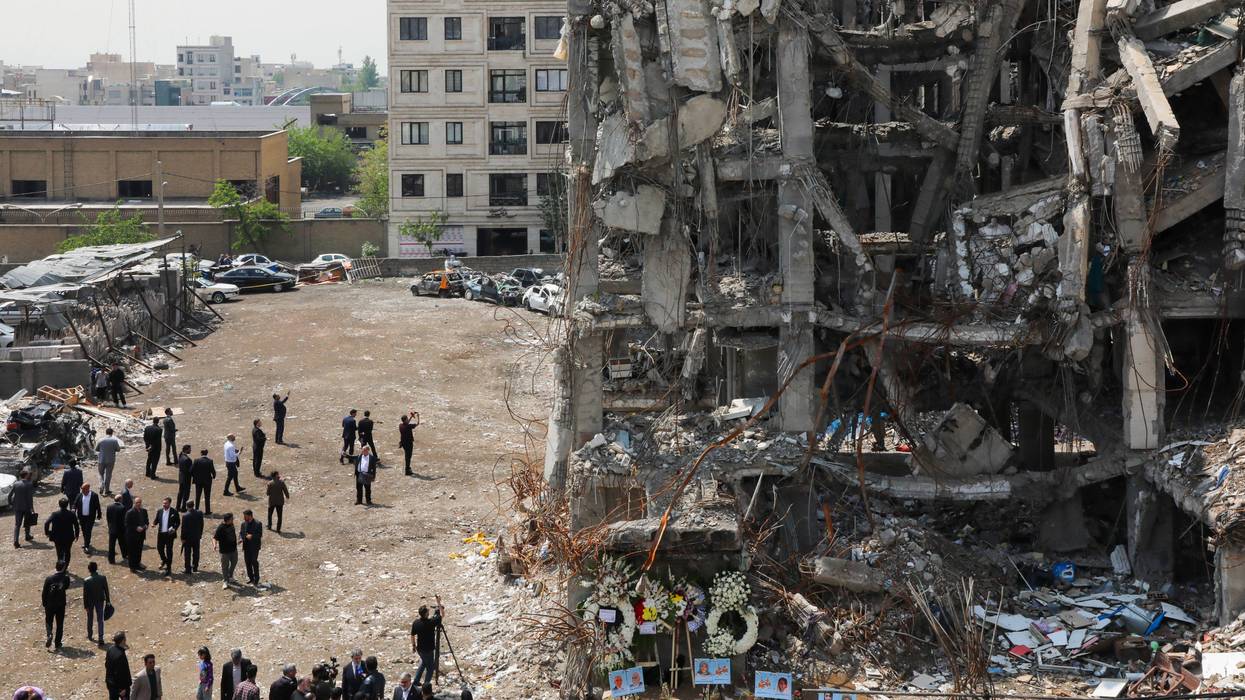
Israel has for weeks has been conducting a relentless bombing campaign and ground invasion in Lebanon that has killed and wounded thousands of people while displacing over 1 million.
The ceasefire announcement does not mean that lasting peace has been achieved, given that the deal was between the Israeli and Lebanese governments but not the political and militant group Hezbollah.
Nicholas Grossman, professor of international relations at the University of Illinois, said that a ceasefire between Israel and Lebanon is "a weird thing to tout, since Lebanon isn't a combatant" and "there is no Lebanese fire for the Lebanese government to cease."
Amichai Stein, diplomatic correspondent for Israel's i24News, reported that members of Netanyahu's Cabinet were "outraged" during a meeting because Trump announced "Israel’s consent to a ceasefire before Security Cabinet approval."
Iran has been insisting on a ceasefire between Israel and Lebanon as a precondition for continuing negotiations about ending the war with the US, which Trump launched illegally in late February without any authorization from Congress.
The US and Israel’s indiscriminate bombing of schools, hospitals, universities, a synagogue shows the truth of the war’s aims. And it's not to help the people of Iran.
Some right-wingers, centrist Democrats, and independents defend the Iran War by citing the Iranian regime’s mass killing of protesters in late 2025 and early 2026. But it doesn’t add up.
The most reliable numbers from the Human Rights Activists News Agency stand around 7,000 people killed, of which over 200 were security forces. The Western media salivated over these numbers, in contrast to the well-documented genocide in Gaza, with some claiming the death toll at 30,000. President Donald Trump has offered no evidence whatsoever to claim 45,000 people were killed. However, the media correctly note that this latest government clampdown was indeed the largest number of protesters killed in the history of the Islamic Republic.
Trump warned that if the Iranian government didn’t stop violence against the protesters, the US would attack Iran. Not too long after, when protests had somewhat died down, the United States launched a second war against Iran during peace negotiations. The stated reasons were all over the place but they can be summed up as follows:
a) Israel was going to attack Iran, Iran would therefore attack US positions, so US attacked first.
b) To diminish Iran nuclear and missile capabilities.
c) To protect Israel from future Iranian attacks.
Last, but not least, this one seemed to stick in people’s minds:
d) Protecting Iranians from their own government.
In the past few weeks, reports confirmed what many had already surmised, completely throwing the “saving Iranians” argument for war out the window. The US was involved in fueling the violence by sending weapons through Kurdish intermediaries to arm Iranian protesters.
The results bore fruit, as intended. The Iranian expert Trita Parsi explained on Democracy Now! that the organized armed elements within the protests attacked civilian infrastructure, mosques, and government forces. This resulted in hundreds of government forces being killed. In response, a far larger number of protesters were killed than in past Iranian protests. The Iranian government is repressive, but this level of violence against protesters indicated something else was at work.
It was the CIA with a tried-and-true method of overthrow and internal political machinations. It called to mind 1953, when Iran was a democracy under Prime Minister Mohammed Mossadegh. Due to his attempts to nationalize the country’s oil, the CIA’s Kermit Roosevelt hatched a plan for a successful coup d’etat after failing a first attempt days earlier.
The CIA paid Iranians to topple statues of the Shah. Pro-democratic Iranians joined in, creating a sense of anarchy. Mossadegh chose not to act against these actions for a day and pro-Shah elements, supported by the US, came into the street shouting “Death to Mossadegh!” Under this contrived sense of disorder, Iranian Colonel Nasiri placed Mossadegh under arrest and the Shah, Mohammed Reza Pahlavi, took power. During the 1970s the Shah became increasingly oppressive (and staunchly backed by the US), leading to the 1979 Islamic Revolution. It was a revolt against historic outside intervention in Iranian politics by the US and Great Britain.
In 1953, the CIA deposed a nationalist democratically elected leader that the US and Great Britain didn’t approve of to get the more pliable ruler. This winter, the US attempted to create a real-life stage play that depicted a fairly oppressive regime that suddenly appeared unrestrained in its use of mass violence against its citizens. The script showed this regime going off the deep end in killing protesters in the thousands within a relatively short period of time. But within this legitimate protest movement, the Kurds (at the behest of the US) distributed weapons that were used to shoot and kill government forces. Imagine, for a second, China arming a US protest movement and hundreds of US police, national guard officers, or ICE members were killed. How would the government respond? With smile emojis?
Last week, the rich, historic Iranian civilization that Donald Trump was supposedly at war to protect, he threatened to annihilate. Well before threatening war crimes against Iran, for Americans to believe that a brutal, unjust war was for the wellbeing of the Iranian people was wildly naïve. As if conducting mass violence and indiscriminate attacks against a people and their society would save them. The Secretary of War said as much, stating clearly that the US would not be concerned about “stupid rules of engagement,” which is pretty much a direct admission to war crimes subsequently committed.
The US and Israel’s indiscriminate bombing of schools, hospitals, universities, a synagogue shows the truth of the war’s aims: to crush any opposition to US empire and Israeli regional hegemony, regardless of civilian mass deaths and infrastructure damage incurred. Just as the 1953 coup of Mossadegh put perceived US imperial interests front and center, so did the fueling of violence in the Iranian protests to paint a picture of an Iranian regime gone mad in its violence towards civilians.
So, to the naïve among us, when your government tells you it is killing people to help them, maybe this time think twice.