SUBSCRIBE TO OUR FREE NEWSLETTER
Daily news & progressive opinion—funded by the people, not the corporations—delivered straight to your inbox.
5
#000000
#FFFFFF
To donate by check, phone, or other method, see our More Ways to Give page.
Daily news & progressive opinion—funded by the people, not the corporations—delivered straight to your inbox.
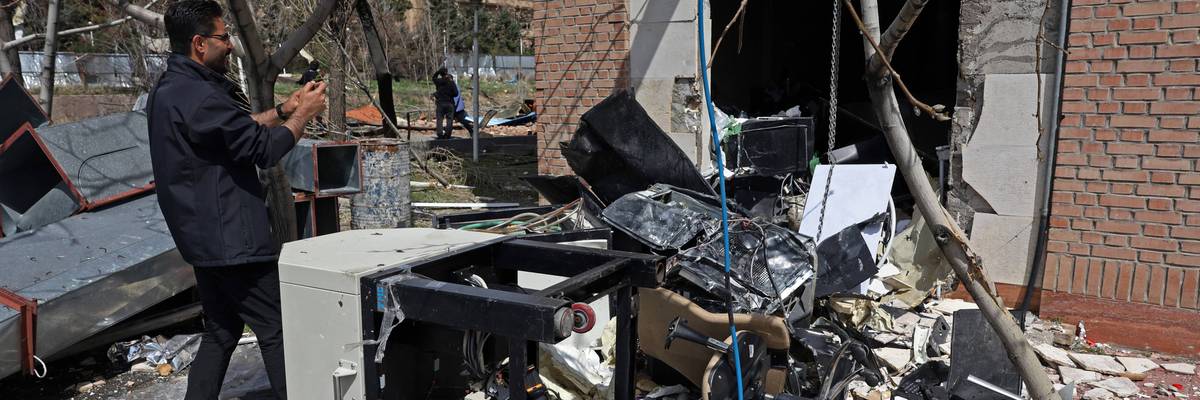
A man takes pictures of the destroyed study equipment lying amid the debris of Shahid Beheshti University following a US-Israeli strike on Tehran on April 4, 2026.
Iran's first vice president called the attack a new "symbol of Trump's madness and ignorance."
A wave of US-Israeli airstrikes on Monday hit and extensively damaged Sharif University of Technology, a leading Iranian educational institution that is widely known as "the MIT of Iran" and seen as one of the world's top engineering schools.
The attack on the Tehran university—one of dozens of education sites bombed by the US and Israel since they launched their war on Iran in late February—sparked outrage inside Iran and around the world. Mohammad Reza Aref, an engineer currently serving as Iran's first vice president, said the attack on Sharif University "is a symbol of [US President Donald] Trump's madness and ignorance."
"He fails to understand that Iran's knowledge is not embedded in concrete to be destroyed by bombs; the true fortress is the will of our professors and elites," Aref wrote. "No barbarity in history has ever been able to strip science from the Iranian people. Science is rooted in our souls, and this fortress will not crumble."
The National Iranian American Council called the bombing "another outrageous, criminal act in an illegal war."
"This was a center of learning, not a military target," the group wrote on social media, highlighting video footage showing a building in ruins. "The increasing use of the Gaza playbook in Iran is deeply disturbing and will only deepen insecurity for the US and Israel. End this war."
US Rep. Yassamin Ansari (D-Ariz.), the lone Iranian American in Congress, noted that Sharif University has "produced a huge number of engineers who’ve gone on to Silicon Valley and founded some of the most successful American tech companies."
"Why are we bombing a university in a city of 10 million people?" Ansari asked.
Another outrageous, criminal act in an illegal war: U.S.-Israeli strikes have bombed one of the world’s most prestigious universities in Sharif University of Technology in Tehran. This was a center of learning, not a military target. The increasing use of the Gaza playbook in… pic.twitter.com/GE6J8WhgMC
— NIAC (@NIACouncil) April 6, 2026
Al Jazeera's Tohid Asadi reported from Tehran that the university was "severely hit, with extensive damage reported in the compound's mosque and laboratories."
Vira Ameli, an Iranian global health researcher and lecturer at the University of Oxford, decried the US-Israeli strike on Sharif University, where she spent time as a postdoctoral fellow.
"To wake to the news of this war crime, at a distance and unable to return, is difficult to articulate," Ameli wrote. "And yet history has made one thing clear: Iran is not a country undone by bombardment."
Iranian authorities say US-Israeli attacks have hit at least 30 of the nation's universities, including the Isfahan University of Technology and the Iran University of Science and Technology. The US and Israel have justified some of the attacks by claiming the universities were involved in military-related activities.
"Would American and Israeli leaders consider their own equivalent institutions fair game? Of course not," journalist Natasha Lennard wrote in a column for The Intercept last week. "By stated US and Israeli rationale, however, were Iran able to launch airstrikes on American soil, direct ties to the US and Israeli military-industrial complex would make valid targets of at least the University of California, Berkeley; the Massachusetts Institute of Technology; and Johns Hopkins University, among dozens of other schools."
Dear Common Dreams reader, It’s been nearly 30 years since I co-founded Common Dreams with my late wife, Lina Newhouser. We had the radical notion that journalism should serve the public good, not corporate profits. It was clear to us from the outset what it would take to build such a project. No paid advertisements. No corporate sponsors. No millionaire publisher telling us what to think or do. Many people said we wouldn't last a year, but we proved those doubters wrong. Together with a tremendous team of journalists and dedicated staff, we built an independent media outlet free from the constraints of profits and corporate control. Our mission has always been simple: To inform. To inspire. To ignite change for the common good. Building Common Dreams was not easy. Our survival was never guaranteed. When you take on the most powerful forces—Wall Street greed, fossil fuel industry destruction, Big Tech lobbyists, and uber-rich oligarchs who have spent billions upon billions rigging the economy and democracy in their favor—the only bulwark you have is supporters who believe in your work. But here’s the urgent message from me today. It's never been this bad out there. And it's never been this hard to keep us going. At the very moment Common Dreams is most needed, the threats we face are intensifying. We need your support now more than ever. We don't accept corporate advertising and never will. We don't have a paywall because we don't think people should be blocked from critical news based on their ability to pay. Everything we do is funded by the donations of readers like you. When everyone does the little they can afford, we are strong. But if that support retreats or dries up, so do we. Will you donate now to make sure Common Dreams not only survives but thrives? —Craig Brown, Co-founder |
A wave of US-Israeli airstrikes on Monday hit and extensively damaged Sharif University of Technology, a leading Iranian educational institution that is widely known as "the MIT of Iran" and seen as one of the world's top engineering schools.
The attack on the Tehran university—one of dozens of education sites bombed by the US and Israel since they launched their war on Iran in late February—sparked outrage inside Iran and around the world. Mohammad Reza Aref, an engineer currently serving as Iran's first vice president, said the attack on Sharif University "is a symbol of [US President Donald] Trump's madness and ignorance."
"He fails to understand that Iran's knowledge is not embedded in concrete to be destroyed by bombs; the true fortress is the will of our professors and elites," Aref wrote. "No barbarity in history has ever been able to strip science from the Iranian people. Science is rooted in our souls, and this fortress will not crumble."
The National Iranian American Council called the bombing "another outrageous, criminal act in an illegal war."
"This was a center of learning, not a military target," the group wrote on social media, highlighting video footage showing a building in ruins. "The increasing use of the Gaza playbook in Iran is deeply disturbing and will only deepen insecurity for the US and Israel. End this war."
US Rep. Yassamin Ansari (D-Ariz.), the lone Iranian American in Congress, noted that Sharif University has "produced a huge number of engineers who’ve gone on to Silicon Valley and founded some of the most successful American tech companies."
"Why are we bombing a university in a city of 10 million people?" Ansari asked.
Another outrageous, criminal act in an illegal war: U.S.-Israeli strikes have bombed one of the world’s most prestigious universities in Sharif University of Technology in Tehran. This was a center of learning, not a military target. The increasing use of the Gaza playbook in… pic.twitter.com/GE6J8WhgMC
— NIAC (@NIACouncil) April 6, 2026
Al Jazeera's Tohid Asadi reported from Tehran that the university was "severely hit, with extensive damage reported in the compound's mosque and laboratories."
Vira Ameli, an Iranian global health researcher and lecturer at the University of Oxford, decried the US-Israeli strike on Sharif University, where she spent time as a postdoctoral fellow.
"To wake to the news of this war crime, at a distance and unable to return, is difficult to articulate," Ameli wrote. "And yet history has made one thing clear: Iran is not a country undone by bombardment."
Iranian authorities say US-Israeli attacks have hit at least 30 of the nation's universities, including the Isfahan University of Technology and the Iran University of Science and Technology. The US and Israel have justified some of the attacks by claiming the universities were involved in military-related activities.
"Would American and Israeli leaders consider their own equivalent institutions fair game? Of course not," journalist Natasha Lennard wrote in a column for The Intercept last week. "By stated US and Israeli rationale, however, were Iran able to launch airstrikes on American soil, direct ties to the US and Israeli military-industrial complex would make valid targets of at least the University of California, Berkeley; the Massachusetts Institute of Technology; and Johns Hopkins University, among dozens of other schools."
A wave of US-Israeli airstrikes on Monday hit and extensively damaged Sharif University of Technology, a leading Iranian educational institution that is widely known as "the MIT of Iran" and seen as one of the world's top engineering schools.
The attack on the Tehran university—one of dozens of education sites bombed by the US and Israel since they launched their war on Iran in late February—sparked outrage inside Iran and around the world. Mohammad Reza Aref, an engineer currently serving as Iran's first vice president, said the attack on Sharif University "is a symbol of [US President Donald] Trump's madness and ignorance."
"He fails to understand that Iran's knowledge is not embedded in concrete to be destroyed by bombs; the true fortress is the will of our professors and elites," Aref wrote. "No barbarity in history has ever been able to strip science from the Iranian people. Science is rooted in our souls, and this fortress will not crumble."
The National Iranian American Council called the bombing "another outrageous, criminal act in an illegal war."
"This was a center of learning, not a military target," the group wrote on social media, highlighting video footage showing a building in ruins. "The increasing use of the Gaza playbook in Iran is deeply disturbing and will only deepen insecurity for the US and Israel. End this war."
US Rep. Yassamin Ansari (D-Ariz.), the lone Iranian American in Congress, noted that Sharif University has "produced a huge number of engineers who’ve gone on to Silicon Valley and founded some of the most successful American tech companies."
"Why are we bombing a university in a city of 10 million people?" Ansari asked.
Another outrageous, criminal act in an illegal war: U.S.-Israeli strikes have bombed one of the world’s most prestigious universities in Sharif University of Technology in Tehran. This was a center of learning, not a military target. The increasing use of the Gaza playbook in… pic.twitter.com/GE6J8WhgMC
— NIAC (@NIACouncil) April 6, 2026
Al Jazeera's Tohid Asadi reported from Tehran that the university was "severely hit, with extensive damage reported in the compound's mosque and laboratories."
Vira Ameli, an Iranian global health researcher and lecturer at the University of Oxford, decried the US-Israeli strike on Sharif University, where she spent time as a postdoctoral fellow.
"To wake to the news of this war crime, at a distance and unable to return, is difficult to articulate," Ameli wrote. "And yet history has made one thing clear: Iran is not a country undone by bombardment."
Iranian authorities say US-Israeli attacks have hit at least 30 of the nation's universities, including the Isfahan University of Technology and the Iran University of Science and Technology. The US and Israel have justified some of the attacks by claiming the universities were involved in military-related activities.
"Would American and Israeli leaders consider their own equivalent institutions fair game? Of course not," journalist Natasha Lennard wrote in a column for The Intercept last week. "By stated US and Israeli rationale, however, were Iran able to launch airstrikes on American soil, direct ties to the US and Israeli military-industrial complex would make valid targets of at least the University of California, Berkeley; the Massachusetts Institute of Technology; and Johns Hopkins University, among dozens of other schools."