SUBSCRIBE TO OUR FREE NEWSLETTER
Daily news & progressive opinion—funded by the people, not the corporations—delivered straight to your inbox.
5
#000000
#FFFFFF
To donate by check, phone, or other method, see our More Ways to Give page.
Daily news & progressive opinion—funded by the people, not the corporations—delivered straight to your inbox.
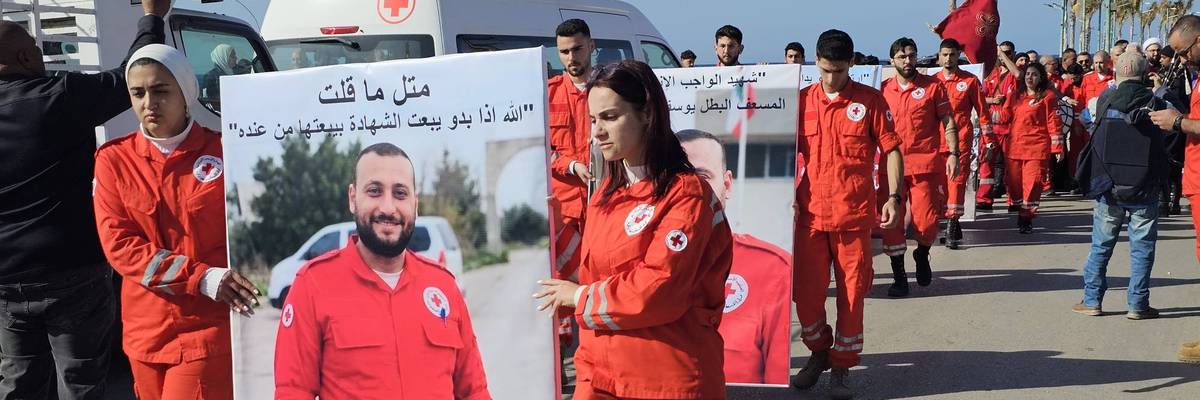
Yousuf Assaf, a paramedic with the Lebanese Red Cross who was killed by an Israeli airstrike on southern Lebanon, is laid to rest with a funeral ceremony held in the city of Tyre, Lebanon on March 11, 2026.
"We cannot accept a world where those who save lives are targeted," said one humanitarian group.
The US-Israeli war on Iran and the resulting regional conflict have unleashed a wave of deadly attacks on healthcare workers and infrastructure across the Middle East, from paramedics in southern Lebanon to medical facilities and ambulances in Tehran.
The international humanitarian group Save the Children estimated on Tuesday that, since the US and Israel started bombing Iran on February 28, the Middle East has seen an average of one attack on healthcare every six hours. Overall, the World Health Organization (WHO) has recorded at least 120 attacks on healthcare since the start of the Iran war—86 in Lebanon, 28 in Iran, and six in Israel.
The head of the WHO said nine paramedics were killed in five separate Israeli attacks on southern Lebanon this past weekend.
"We cannot accept a world where those who save lives are targeted," Nora Ingdal, country director at Save the Children Lebanon, said Tuesday. "Governments have long championed international humanitarian law that protects aid and health workers, and now is the time to act to prevent continued harm in Lebanon and across the wider region."
Iranian officials have said that dozens of hospitals and other healthcare facilities are among the tens of thousands of civilian buildings damaged or destroyed by US-Israeli bombing over the past month, along with dozens of ambulances. Iran's Emergency Medical Services Organization said Tuesday that at least 24 of the nation's healthcare workers have been killed by US-Israeli attacks since late February.
In southern Lebanon, the Israeli assault has been devastating for the country's healthcare system and workers. According to Save the Children, at least 55 of the country's health facilities have been forced to close due to airstrikes and forced displacement orders from the Israeli government.
MedGlobal said Wednesday that Lebanon's "already fragile health system is buckling under relentless pressure" of "systematic and severe" attacks, which the group emphasized are violations of international law.
"Attacks on healthcare workers are not collateral damage. They are alarming, unacceptable violations of international law,” said Dr. Zaher Sahloul, president and co-founder of MedGlobal. “The international community cannot remain silent while Lebanon’s health system is targeted and dismantled—just at the moment when it is needed more than ever to save lives and help the vast numbers of internally displaced people."
Dear Common Dreams reader, It’s been nearly 30 years since I co-founded Common Dreams with my late wife, Lina Newhouser. We had the radical notion that journalism should serve the public good, not corporate profits. It was clear to us from the outset what it would take to build such a project. No paid advertisements. No corporate sponsors. No millionaire publisher telling us what to think or do. Many people said we wouldn't last a year, but we proved those doubters wrong. Together with a tremendous team of journalists and dedicated staff, we built an independent media outlet free from the constraints of profits and corporate control. Our mission has always been simple: To inform. To inspire. To ignite change for the common good. Building Common Dreams was not easy. Our survival was never guaranteed. When you take on the most powerful forces—Wall Street greed, fossil fuel industry destruction, Big Tech lobbyists, and uber-rich oligarchs who have spent billions upon billions rigging the economy and democracy in their favor—the only bulwark you have is supporters who believe in your work. But here’s the urgent message from me today. It's never been this bad out there. And it's never been this hard to keep us going. At the very moment Common Dreams is most needed, the threats we face are intensifying. We need your support now more than ever. We don't accept corporate advertising and never will. We don't have a paywall because we don't think people should be blocked from critical news based on their ability to pay. Everything we do is funded by the donations of readers like you. When everyone does the little they can afford, we are strong. But if that support retreats or dries up, so do we. Will you donate now to make sure Common Dreams not only survives but thrives? —Craig Brown, Co-founder |
The US-Israeli war on Iran and the resulting regional conflict have unleashed a wave of deadly attacks on healthcare workers and infrastructure across the Middle East, from paramedics in southern Lebanon to medical facilities and ambulances in Tehran.
The international humanitarian group Save the Children estimated on Tuesday that, since the US and Israel started bombing Iran on February 28, the Middle East has seen an average of one attack on healthcare every six hours. Overall, the World Health Organization (WHO) has recorded at least 120 attacks on healthcare since the start of the Iran war—86 in Lebanon, 28 in Iran, and six in Israel.
The head of the WHO said nine paramedics were killed in five separate Israeli attacks on southern Lebanon this past weekend.
"We cannot accept a world where those who save lives are targeted," Nora Ingdal, country director at Save the Children Lebanon, said Tuesday. "Governments have long championed international humanitarian law that protects aid and health workers, and now is the time to act to prevent continued harm in Lebanon and across the wider region."
Iranian officials have said that dozens of hospitals and other healthcare facilities are among the tens of thousands of civilian buildings damaged or destroyed by US-Israeli bombing over the past month, along with dozens of ambulances. Iran's Emergency Medical Services Organization said Tuesday that at least 24 of the nation's healthcare workers have been killed by US-Israeli attacks since late February.
In southern Lebanon, the Israeli assault has been devastating for the country's healthcare system and workers. According to Save the Children, at least 55 of the country's health facilities have been forced to close due to airstrikes and forced displacement orders from the Israeli government.
MedGlobal said Wednesday that Lebanon's "already fragile health system is buckling under relentless pressure" of "systematic and severe" attacks, which the group emphasized are violations of international law.
"Attacks on healthcare workers are not collateral damage. They are alarming, unacceptable violations of international law,” said Dr. Zaher Sahloul, president and co-founder of MedGlobal. “The international community cannot remain silent while Lebanon’s health system is targeted and dismantled—just at the moment when it is needed more than ever to save lives and help the vast numbers of internally displaced people."
The US-Israeli war on Iran and the resulting regional conflict have unleashed a wave of deadly attacks on healthcare workers and infrastructure across the Middle East, from paramedics in southern Lebanon to medical facilities and ambulances in Tehran.
The international humanitarian group Save the Children estimated on Tuesday that, since the US and Israel started bombing Iran on February 28, the Middle East has seen an average of one attack on healthcare every six hours. Overall, the World Health Organization (WHO) has recorded at least 120 attacks on healthcare since the start of the Iran war—86 in Lebanon, 28 in Iran, and six in Israel.
The head of the WHO said nine paramedics were killed in five separate Israeli attacks on southern Lebanon this past weekend.
"We cannot accept a world where those who save lives are targeted," Nora Ingdal, country director at Save the Children Lebanon, said Tuesday. "Governments have long championed international humanitarian law that protects aid and health workers, and now is the time to act to prevent continued harm in Lebanon and across the wider region."
Iranian officials have said that dozens of hospitals and other healthcare facilities are among the tens of thousands of civilian buildings damaged or destroyed by US-Israeli bombing over the past month, along with dozens of ambulances. Iran's Emergency Medical Services Organization said Tuesday that at least 24 of the nation's healthcare workers have been killed by US-Israeli attacks since late February.
In southern Lebanon, the Israeli assault has been devastating for the country's healthcare system and workers. According to Save the Children, at least 55 of the country's health facilities have been forced to close due to airstrikes and forced displacement orders from the Israeli government.
MedGlobal said Wednesday that Lebanon's "already fragile health system is buckling under relentless pressure" of "systematic and severe" attacks, which the group emphasized are violations of international law.
"Attacks on healthcare workers are not collateral damage. They are alarming, unacceptable violations of international law,” said Dr. Zaher Sahloul, president and co-founder of MedGlobal. “The international community cannot remain silent while Lebanon’s health system is targeted and dismantled—just at the moment when it is needed more than ever to save lives and help the vast numbers of internally displaced people."