

SUBSCRIBE TO OUR FREE NEWSLETTER
Daily news & progressive opinion—funded by the people, not the corporations—delivered straight to your inbox.
5
#000000
#FFFFFF
To donate by check, phone, or other method, see our More Ways to Give page.
Daily news & progressive opinion—funded by the people, not the corporations—delivered straight to your inbox.
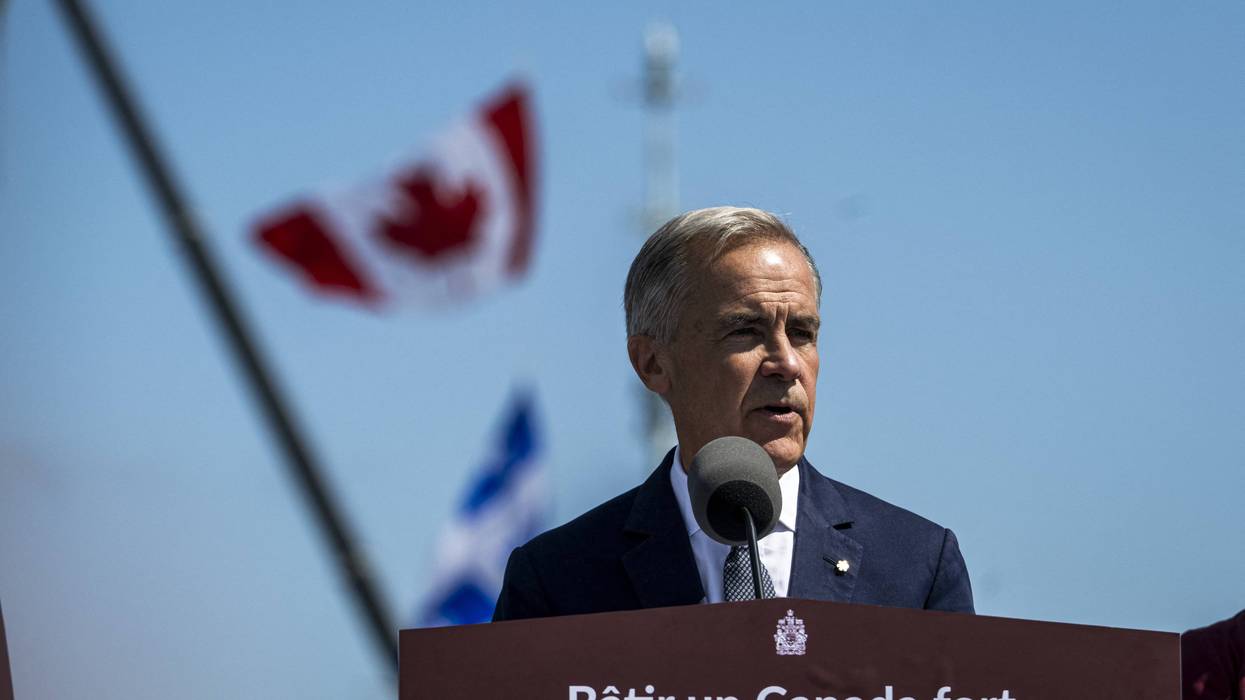
"We can put massive pain on the US," said Ontario Premier Doug Ford.
Politicians from Canada's two biggest political parties vowed on Monday to hit back hard against US President Donald Trump's trade war against their country.
Trade negotiations between the two countries collapsed last week after Trump reportedly sought to restrict Canada from striking trade deals with other nations, while also pressuring the country to scrap requirements aimed at preserving the use of the French language.
Speaking to reporters on Monday, Canadian Prime Minister Mark Carney warned that Trump's aggression would come back to hurt US workers.
"It's not a surprise that the US would take some form of reprisal to our response to their unjustified tariffs," said Carney, a member of the center-left Liberal Party. "But what message does that send to the workers in Michigan and Ohio and Kentucky and Alabama who rely on Canadian demand? We're their largest customer for automobiles, more than the European Union, Japan, Korea."
Mark Carney: "It's not a surprise that the US would take some form of reprisal to our response to their unjustified tariffs, which was on top of other unjustified tariffs. But what message does that send to the workers in Michigan and Ohio and Kentucky and Alabama who rely on… pic.twitter.com/2o5rbEmQAo
— Aaron Rupar (@atrupar) August 24, 2026
Carney also said there was an "attitude at the negotiating table" from US officials that "Canada is a subsidiary of the United States," which is "not something we're going to accept."
Ontario Premier Doug Ford, a member of the rival center-right Progressive Conservative Party, delivered a more strident rebuke to Trump, vowing that Canada's response would deliver a hit to the president's voters.
"The red states, we're going to hit hard," said Ford.
The Ontario premier then outlined all the ways his country can make life more painful for US consumers so long as Trump keeps trying to undermine Canadian sovereignty.
"If it gets really, really bad, I say everything's on the table," Ford said. "We need everyone to be on Team Canada and throw everything and the kitchen sink at them, no matter if it's electricity, if it's fuel, again, if it's potash, if it's uranium. We need to have everything on the table... we can put massive pain on the US. President Trump underestimates us. And that's the biggest mistake."
Ontario Premier Doug Ford: "We need to throw everything and the kitchen sink that them -- electricity, fuel, potash, uranium ... we can put massive pain on the US. President Trump underestimates us. And that's a mistake." pic.twitter.com/IRIidj0iYS
— Aaron Rupar (@atrupar) August 24, 2026
Trump lashed out at both Carney and Ford in a Monday morning Truth Social post.
"The USA will always be far bigger, richer, and stronger than Canada," Trump wrote. "Without the United States, Canada couldn’t survive—it’s where they get all of their money and, because of their current bad leadership, primarily Governor Carney, and his Flunky, Ford, they will not be allowed to keep taking advantage of the United States—their key to survival."

US President Donald Trump on Monday invoked an arcane legal provision to impose 50% tariffs on most imported goods from Canada, a move that critics said will hit US consumers already reeling from an unabated cost-of-living crisis and further strain relations with the nation's second-largest trade partner.
Trump invoked Section 338 of the Tariff Act of 1930, an unprecedented move the White House said is aimed at "offsetting the burden and disadvantage on US commerce from Canada’s discriminatory treatment of US commerce" and "leveling the playing field for crucial American exports—cars, alcohol, and dairy."
The new tariffs exempt energy products, potash, fish, and critical minerals.
“While the administration continues to secure fair and reciprocal trade deals with our trading partners, Canada, unlike other partners and allies, continues to retaliate against the United States for its efforts to rebalance trade and protect US industry in national security-sensitive sectors,” US Trade Representative Jamieson Greer said in a statement.
“Specifically, Canada has taken US alcohol products off Canadian shelves, given better market access to dairy products from the European Union, and has put a cap on US vehicle exports to Canada from companies reshoring to the United States," Greer added. "Today, President Trump took decisive action to hold Canada accountable for its retaliation and discrimination, delivering on his promise to correct trade imbalances and ensure fairness for American workers, farmers, and businesses.”
While the administration's official communications cite economic reasons for the new tariffs, Trump in recent days has repeatedly cited the Canadian wildfires as justification for the move.
“I told them. I mean, you got to stop these fires from coming in, and you know poisoning our air," Trump said of Canada on Sunday evening. "Our air has been poisoned. Maybe they should pay us some damages or something, or we should do some tariffs."
The president's linkage of the wildfires and tariffs drew widespread ridicule, with Democratic New York Gov. Kathy Hochul posting on X, "Only Donald Trump could see wildfire smoke and decide the answer is more tariffs."
Pod Save America co-host Dan Pfeiffer said on social media, "Americans have to pay high prices because Trump doesn’t understand how wind works."
According to We Pay the Tariffs, a small business coalition, Trump’s capricious tariffs have cost American businesses and consumers upward of $317 billion since March 2025.
That month, Trump imposed 25% tariffs on many Canadian goods and 10% on Canadian energy products. The administration later modified or paused some of those tariffs.
Ottawa has criticized the tariffs and rejected the US justification that Canada is unfairly restricting American products.
"I’ll never stop fighting to protect Ontario," Doug Ford, the province's right-wing premier, said in response to Trump's move. "If these tariffs proceed, Canada should respond tariff for tariff, dollar for dollar."
Some Democratic US lawmakers blasted the new tariffs.
"Trump is raising prices on Americans, again, by jacking up tariffs by 50% on Canadian goods bought by Americans," Rep. Ted Lieu (D-Calif.) said on social media. "Democrats will flip the House. And on day one of next term, Democrats will introduce legislation to repeal Trump’s disastrous tariffs. And we will pass it."
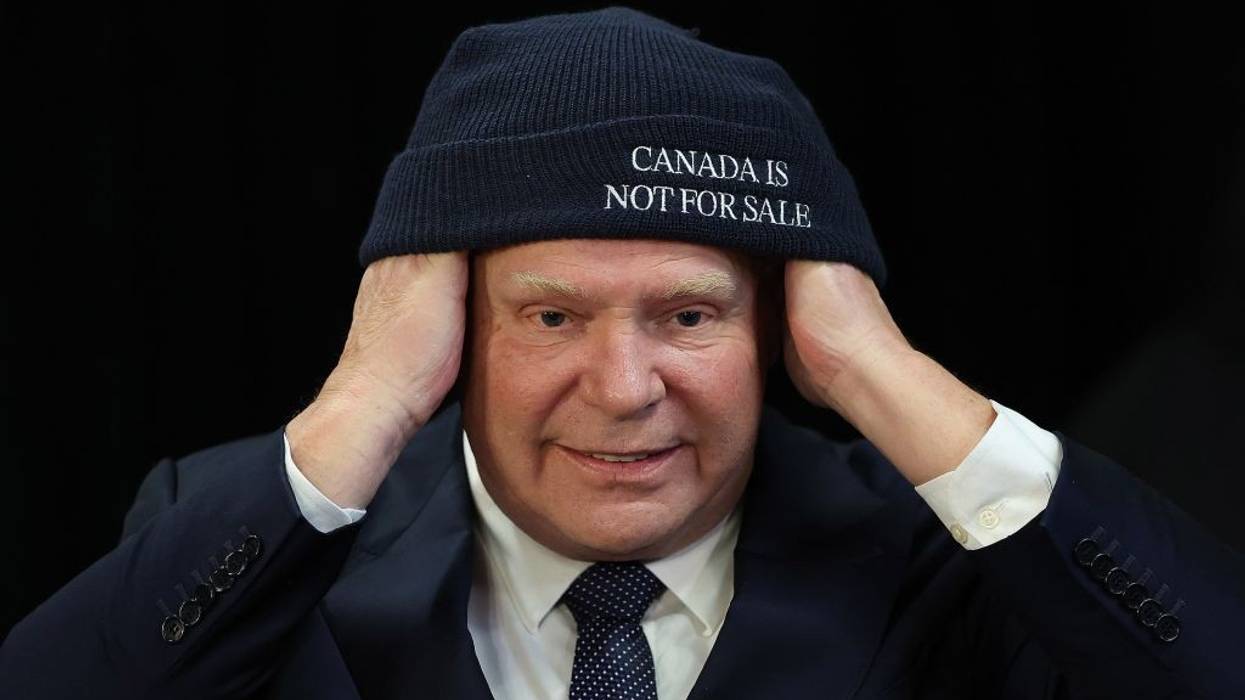
"Canada didn't start this fight with the U.S., but you better believe we're ready to win it," Ontario Premier Doug Ford said.
Ontario Premier Doug Ford said Monday that his government will exclude American companies from provincial contracts and cancel a massive deal with Elon Musk's Starlink satellite internet service in retaliation for U.S. President Donald Trump's imposition of 25% tariffs on Canadian goods.
"Starting today and until U.S. tariffs are removed, Ontario is banning American companies from provincial contracts," Ford—who leads the Progressive Conservative Party of Ontario—said on social media.
"Every year, the Ontario government and its agencies spend $30 billion on procurement, alongside our $200 billion plan to build Ontario," he continued. "U.S.-based businesses will now lose out on tens of billions of dollars in new revenues."
"They only have President Trump to blame," added Ford, who once professed his "unwavering" support for the Republican during his first White House term. "We're going one step further. We'll be ripping up the province's contract with Starlink. Ontario won't do business with people hellbent on destroying our economy. Canada didn't start this fight with the U.S., but you better believe we're ready to win it."
"I don't care if it's a toothpick. We need to purchase from Canada and Ontario."
Last November, Ontario and Starlink signed a C$100 million (USD$68.6 million) deal to provide high-speed internet service for around 15,000 eligible homes and businesses in remote rural communities in northern parts of the province by June 2025.
However, Ford on Monday accused Musk—who gave Trump's campaign tens of millions of dollars and heads the president's Department of Government Efficiency (DOGE)—of being "part of the Trump team that wants to destroy families, incomes, destroy businesses" by waging a trade war.
"He wants to take food off the table of people, hard-working people, and I'm not going to tolerate it," Ford said of the world's richest person. "We just aren't going to be using American companies."
"And no matter if we are building a hospital, if we're building anything, if we're building a dog house, I want to make sure we are using Ontario steel, Canadian products, Canadian wood, Ontario wood," he added. "I don't care if it's a toothpick. We need to purchase from Canada and Ontario."
Ford also ordered the Liquor Control Board of Ontario (LCBO) to remove U.S.-imported alcohol products from store shelves in retaliation for the tariffs.
"Every year, LCBO sells nearly $1 billion worth of American wine, beer, spirits, and seltzers," he said on Sunday. "Not anymore."
Musk reacted to the loss of the Starlink contract with Ontario with a two-word post on his X social media platform saying, "Oh well."
Ford's move followed Canadian Prime Minister Justin Trudeau's announcement Saturday of retaliatory tariffs targeting Republican-led states and Trump allies after the U.S. leader said he would impose levies of 25% on Canadian and Mexican imports and 10% on goods from China.
"Canadians understand that we need to respond to this," explained Trudeau, who is set to resign once his Liberal Party selects a new leader. "We need to respond in a way that is appropriate, that is measured but forceful, that meets the moment."
Trump singled out Canadian energy for a reduced 10% tariff. On Monday, he announced a deal with Mexican President Claudia Sheinbaum to pause U.S. tariffs for one month in exchange for the deployment of 10,000 Mexican troops to the country's northern border to target drug trafficking and, according to Trump, prevent migrants from entering the United States.
Frustration with Trump's policies and actions—which include ongoing calls to make Canada the "51st state"—was on display over the weekend as Canadian fans attending National Basketball Association and National Hockey League games against visiting U.S. rivals loudly booed pregame performances of "The Star-Spangled Banner."
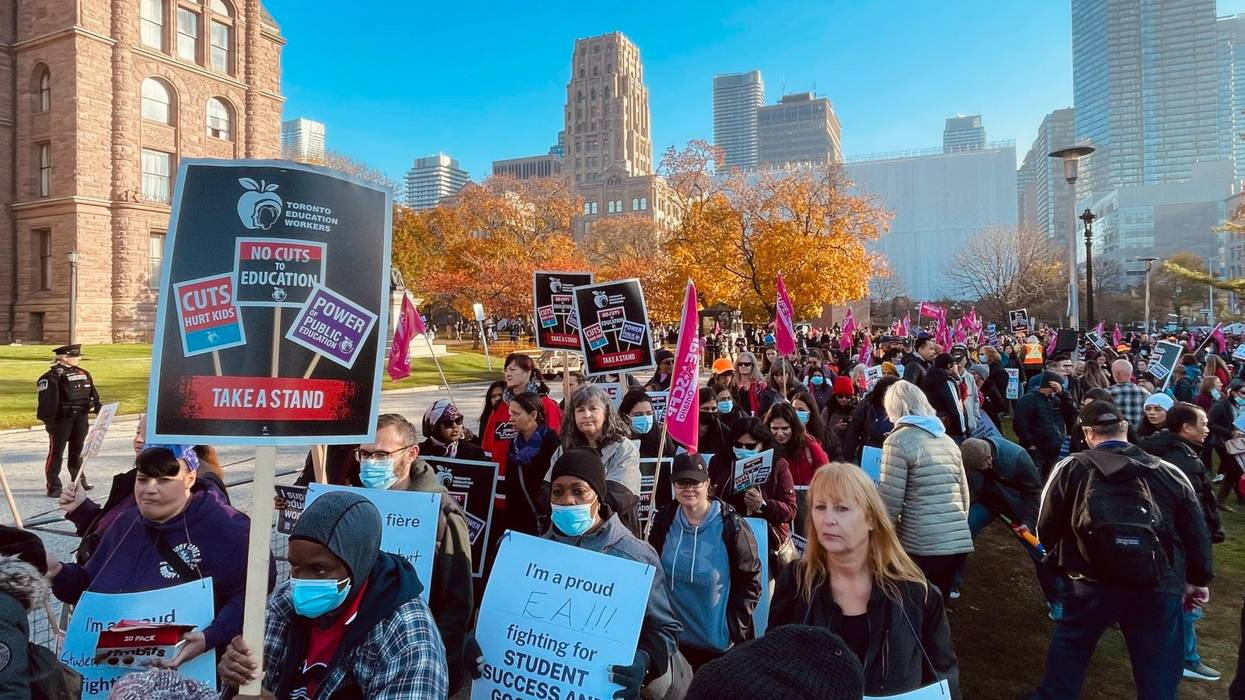
Defying new legislation fast-tracked by right-wing Ontario Premier Doug Ford outlawing strikes, more than 55,000 education workers in the Canadian province hit the picket lines Friday, vowing to stay in the streets for "as long as it takes" to secure a contract they feel is fair.
"We need our voices to be heard and for the government to realize this is not acceptable."
The Canadian Union of Public Employees (CUPE) launched what it called "a wake-up call and a call to arms for organized labor across Canada" after Ontario's Progressive Conservative government on Thursday enacted Bill 28--the Keeping Students in Class Act--which imposes contracts on CUPE members and prohibits them from striking on pain of a $3,000(USD) daily fine per employee and up to a $371,000(USD) penalty for the union.
The new law also utilizes the notwithstanding clause to shield against constitutional challenges. The controversial legal mechanism has only been invoked twice in Ontario's history--both times under Ford.
Liberal Canadian Prime Minister Justin Trudeau called Bill 28 an "attack on one of the most basic rights available, that of collective bargaining."
CUPE national president Mark Hancock said in a statement that "this isn't just about education workers, this is about the rights of all working people across the country."
"The message from our leaders here in Ontario is clear," Hancock added. "Our members are united, and they intend to fight--and they have Canada's largest union in their corner and we are going to fight alongside them."
CUPE national secretary-treasurer Candace Rennick said that "now is a moment for us to ask ourselves what kind of union we want to be, in the face of the worst piece of legislation we've ever seen leveled at the labor movement."
"Our members have spoken," she added. "They are prepared to fight. They aren't part of the largest union in the country for nothing. We are going to have their backs, and we'll stand with them for as long as it takes."
According to the Ontario Federation of Labour (OFL):
The Charter of Rights and Freedoms enshrines Canadians' right to a free and fair collective bargaining process, and the Supreme Court of Canada has found that the right to exercise economic sanctions (i.e., the right to strike) forms an integral part of that process. In addition to violating workers' constitutional right to strike, the Keeping Students in Class Act enforces a concessionary contract on Ontario's 55,000 education workers--the lowest paid workers in the education system--many of whom are women workers and workers of color.
The bill unilaterally imposes woefully low wage increases--well below inflation--on low-income employees who have previously been subjected to three years of 1% increases... inadequate protections against job cuts; no paid prep time for education workers who work directly with students; a cut to the sick leave/short-term disability plan; and many other imposed terms which penalize employees. All told the imposed compensation changes amount to a mere $200 in the pockets of workers earning on average $39,000 and facing 7% inflation.
Karen Brown, president of the Elementary Teachers' Federation of Ontario, said that by enacting a law that forces a contract on CUPE members, the Ford administration has chosen the "most draconian manner of legislating away two fundamental rights protected by the Canadian Charter of Rights and Freedoms: the right to bargain collectively, and the right to strike."
"The Ford government has signaled it is uninterested in reaching collective agreements that are negotiated freely and fairly," she added. "And its oppressive use of the notwithstanding clause is another flagrant abuse of power--one that continues to attack democracy by trampling on Ontarians' constitutional rights."
Thousands of demonstrators turned out in Toronto's Queen's Park on Friday to denounce the Ford administration and show solidarity with the striking workers.
"We need our voices to be heard and for the government to realize this is not acceptable," Maria Gallant, a school secretary, told CBC News. "We are just asking to be paid what we deserve, nothing more."
Protesters also rallied outside the office of Education Minister Stephen Lecce in Vaughan.
"You cannot rip away the rights of workers and expect... that we are just going to take it sitting down," Laura Walton, president of CUPE's Ontario School Board Council of Unions, told Global News.
Others expressed support for the strike on social media.
Birgit Uwaila Umaigba, an intensive care unit and emergency room nurse who is also clinical course director at Centennial College in Toronto, dropped by a picket line to "protect our democracy."
"Doug Ford and his retrogressive conservative government crossed the line by enacting Bill 28 and banning 55,000 CUPE members from exercising their fundamental right to strike," she tweeted.
OFL announced a "Solidarity Saturday" day of action in the province, calling Bill 28 "a full-frontal attack on basic labor freedoms in Ontario."
"Today is a dark day for Ontario workers. By introducing this legislation before education workers have even exercised their charter-protected right to strike, the Ford government is attempting to short-circuit the bargaining process and strip workers of a fundamental freedom," OFL president Patty Coates said in a statement.
"Doug Ford and his government are once again telling workers across the province that their rights don't matter," she added.
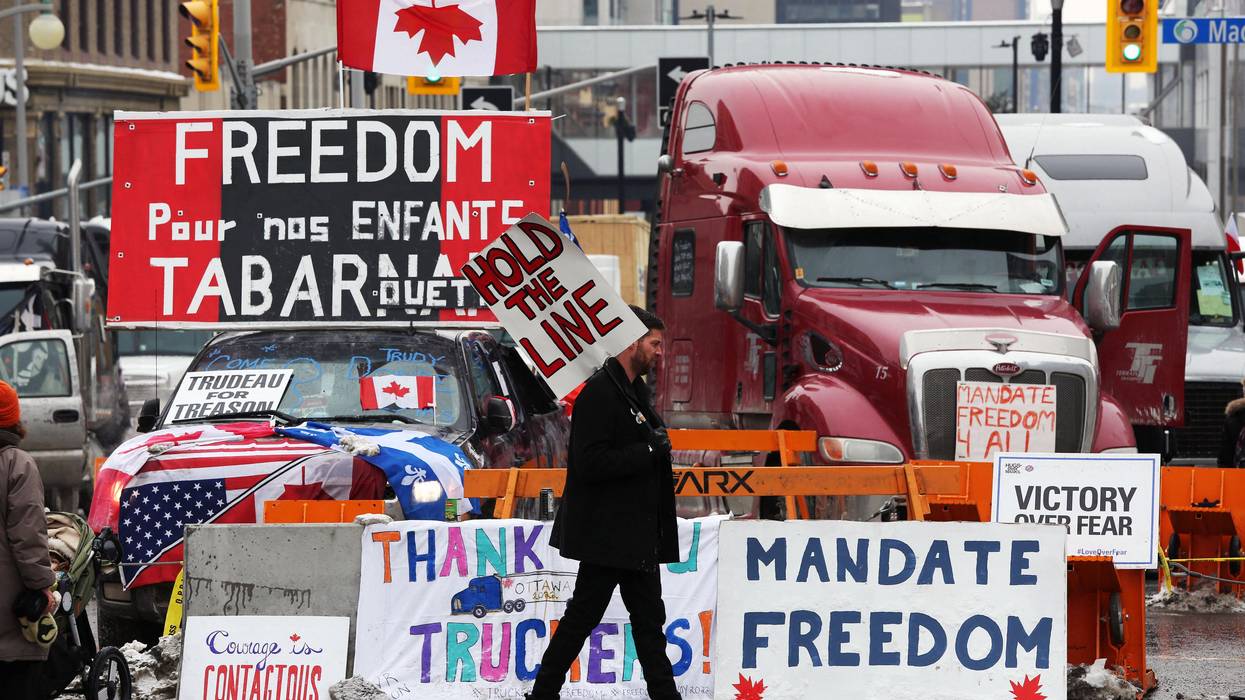
And the winner is ... no, not Will Smith. Someone even less deserving - Tamara Lich and the folks from the trucker convoy.
As Ontarians find themselves in the grip of a menacing sixth wave of the pandemic, the Ford government's ending of COVID restrictions turns out to be pretty much what the "freedom" crowd demanded.
Indeed, the throng of anti-vaxxers, white supremacists and other assorted hate-mongers who held Ottawa hostage for three weeks are a key part of Doug Ford's base, and he's managed to quietly deliver them a victory while seemingly just lifting constraints because the COVID situation has improved.
Except that it hasn't. And it's absurd that the premier is trying to pass things off as fine when they're not. Estimated infection levels are now almost equal to the Omicron peak in early January and hospitalizations across the province are up 40 percent this week.
Ford insists that the province can "ramp up" to 3,000 ICU beds if needed. But all those beds won't help without nurses to staff them, and the province has the lowest number of nurses per capita of any province in Canada.
Ontario recently announced $5,000 retention bonuses for nurses but that won't compensate for the fact that wage increases for nurses, along with most of the provincial public sector, have been capped by the Ford government at 1 percent -- when inflation is running at close to 6 per cent.
Of course, the convoy mob didn't get everything it wanted - the Senate and governor general never acted on their demand to remove Justin Trudeau and form a new government with the protesters themselves. But it did win its central demand to end vaccine mandates and passports. Ontario, as well as most other provinces, have obliged.
As a result, the same folks who frolicked in hot tubs and bouncy castles in front of the Parliament buildings for three never-ending weeks, bringing fear and misery to Ottawa residents, can now shop maskless (and unvaccinated) in grocery stores right next to the rest of us. Freeeee-dom!
Or to paraphrase a Janis Joplin song: Freedom's just another word for being able to pick up a highly transmissible variant while also picking up broccoli.
Placating the broader anti-vax crowd involves a delicate balancing act for Canada's premiers -- with particularly high stakes for Doug Ford in Ontario, where sentiment is strong on both sides of the public health issue and where an election looms on June 2.
Ford has been playing a wily game of vaccine poker. After the free-roaming white-supremacist crowd took control of Ottawa, honking all night, attacking sniveling opponents of freedom who wore masks, and exhibiting a lack of toilet-training in front of the monument to Canada's war dead, Ford termed the behavior "unacceptable" and "an occupation."
This was clearly the minimum required for the premier to avoid alienating the vast majority of Ontarians who, if they happened to own bouncy castles, used them in the privacy of their own homes.
At the same time, Ford was winking his support to the convoy crowd. A committee set up to engage all three levels of government in ending the siege hadn't been able to start, the feds reported, because the Ford government hadn't sent a representative.
And claims by Ontario's solicitor general that the province had dispatched 1,500 OPP officers to help out in Ottawa turned out to be wildly exaggerated. It was maybe 200 max, according to Ottawa police.
When the Trudeau government invoked the Emergencies Act - probably unnecessary if all levels of government had properly enforced the laws at their disposal - the focus of public debate shifted. Ford was able to fade back into the background on the issue, while quickly giving the anti-vax crowd exactly what they wanted.
It looks like Ford may get away with his high-stakes poker - unless the rest of the population realizes that they've been thrown under some giant trucks by a premier intent on delivering a juicy bone to some of the most boorish and unhinged members of his base.
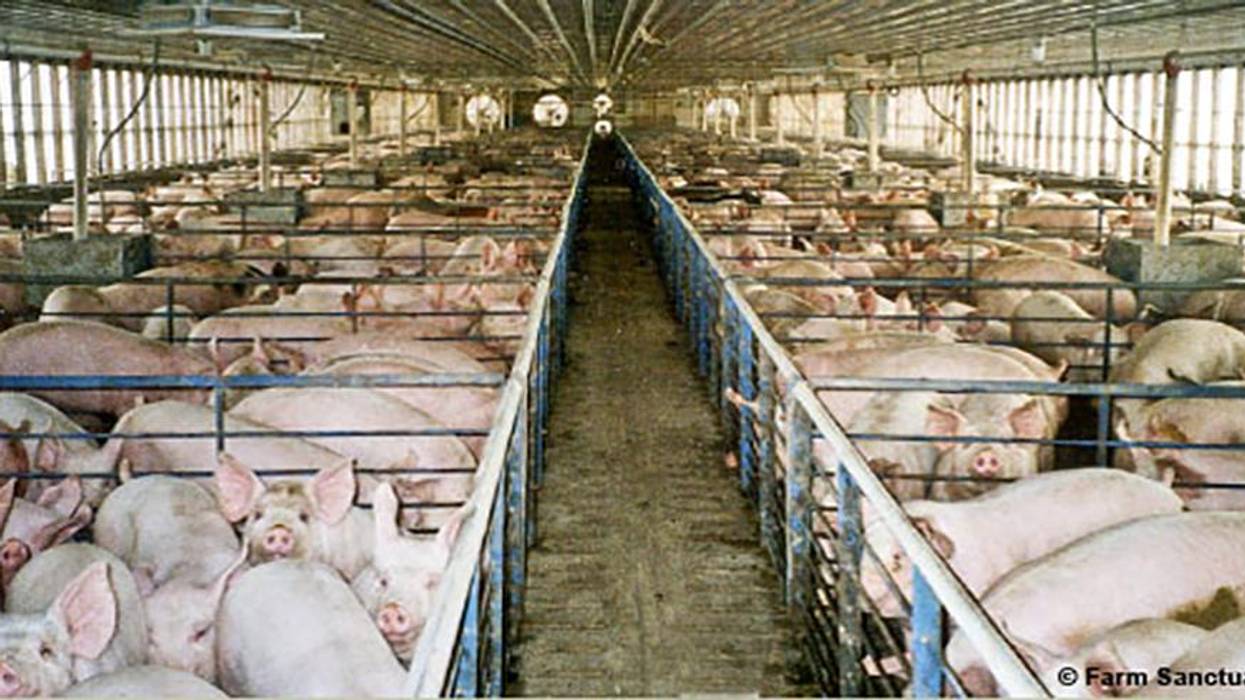
Many people--meat-eaters included--object to the factory farm practice of confining pigs for virtually their entire lives to metal cages so small they can't even turn around.
"Factory farms exist in a realm largely beyond public scrutiny or control, with almost nothing to protect the animals from miserable conditions imposed by an industry extracting maximum profit from the animals it harvests."
That's why the Canadian pork industry, sensitive about its public image, decided to eliminate the practice--a move hailed by Canada's Humane Society as "a watershed moment for farm animals in Canada."
This led to a rare round of positive coverage for the beleaguered industry, with the media reporting that the move would please Canadian consumers and bring Canadian animal welfare practices in line with more advanced European standards.
All that happened back in 2014. Yet, six years later, millions of pigs in Canada continue to spend their lives locked in these narrow cages--because the ban doesn't actually come into effect until 2024.
In fact, that leisurely 10-year phase-in period seems about to get longer. The pork industry has decided it needs more time and has indicated its desire to grant itself a further five-year extension.
This is possible because the industry is allowed to make its own rules governing its animals. But it means sows in Canada will continue their lifelong captivity until 2029--a full 15 years after it was announced the practice was to be ended, due to concerns about animal welfare.
Factory farms exist in a realm largely beyond public scrutiny or control, with almost nothing to protect the animals from miserable conditions imposed by an industry extracting maximum profit from the animals it harvests.
And Doug Ford's government just made it easier for the industry to shield its operations from public view, passing legislation last month aimed at cracking down on trespassing activists and journalists who often work undercover on industrial farms in order to take photos and videos.
Such videos, which abound on social media, have helped generate public alarm about the plight of farm animals. One undercover video, aired last month on CTV's national investigative program W5, included graphic footage of adult pigs being hit with heavy objects and baby pigs squealing and squirming in pain as workers cut off their tails and castrate them.
Unlike Europe, Australia, and New Zealand, Canada's laws governing animal welfare have barely evolved over the last century, even though the open pastures of traditional family farms have largely been replaced by the confining cages of today's industrial farms.
Instead of updating our animal welfare laws, Ottawa has allowed the industry to draw up its own "codes of practice," which are effectively guidelines with no clear penalties for lack of compliance.
The writing of the codes is overseen by the National Farm Animal Care Council--a private body, funded by government, but dominated by the meat industry and other "stakeholders" in the food supply chain.
The council allows only minimal input from animal welfare groups. Indeed, any group that opposes eating animals is automatically excluded from sitting on its committees.
Once the committees have drawn up their codes, they invite public feedback. But, as University of Alberta law professor Peter Sankoff observes, there's no evidence the public feedback has any impact, beyond providing the whole process with "a veneer of public legitimacy."
Of course, one set of "stakeholders" left entirely out of the process are the animals themselves. And while they can't talk, they do feel.
As renowned anthropologist Jane Goodall notes: "Farm animals feel pleasure and sadness, excitement, and resentment, depression, fear and pain."
The intensity of animal emotions has been captured on videos of rescued farm animals experiencing their first taste of freedom. They run, romp and play--even enormous adult pigs--and certainly appear to be experiencing something akin to joy.
Of course, any dog owner can confirm that animals feel emotions. And any dog owner would gasp at the thought of their dog trapped in a confining cage, 24 hours a day, unable to even turn around.
But the factory farm industry is counting on us not making the connection. And the best way to ensure that, as Doug Ford knows, is to prevent us from seeing photos of locked-up pigs looking every bit as sad and scared as our own dogs would be in those cages.

Announcing plans for new labour legislation, a beaming Premier Doug Ford assured us earlier this month that "we're going to make sure we're competitive around the world."
At first glance, that statement might lead us to believe the premier, especially given his commitment to act "for the people," was vowing Ontario would make sure its workers got as good a deal, or better, than workers elsewhere in the world.
But that's not what he meant at all.
In fact, he meant just the opposite -- that he would ensure our workers got a worse deal than workers elsewhere.
That is the perverse thinking behind the economic philosophy that has dominated North American politics in recent decades: that workers must offer themselves up at the lowest possible wage with the fewest possible benefits in order to create an attractive investment climate for businesses that might otherwise move elsewhere.
Despite the persistence of this theory, there's little evidence to support it: most low-wage countries remain that way, while the high-wage nations of Europe and Scandinavia continue to excel in global competitiveness.
Undeterred, Doug Ford is rolling back labour legislation, updated last year after a two-year review with extensive public consultations, and replacing it with a bill hastily assembled behind closed doors, with heavy business input.
Gone is the minimum wage hike to $15 an hour. So, just like that, faster than you can say "for the people," Ford has cancelled what amounted to a $2,000 annual pay increase that was headed for the pockets of the lowest-paid people.
He's also cancelling the two paid sick days a year, even though 145 countries (most of the world's nations) already offer some form of paid sick leave. Think how competitive we'll be without it! That should give us a leg-up on Guatemala and Botswana!
Business commentators argued that the higher minimum wage would drive businesses elsewhere, presumably leaving Canadian customers happily ordering their coffee-to-go from far-away places. Commentators made the same argument last year, when the minimum wage was raised to $14 an hour. However, Ontario's unemployment rate fell to 5.4 per cent, its lowest level in 18 years.
Killing the $15 minimum wage is another victory in the long-running class war, sometimes called neo-liberalism, in which business-funded think-tanks have shaped the public debate, convincing us we must design our economy to please business interests.
And we've done that, slashing taxes on corporations and the rich, signing trade deals designed to protect corporate rights, weakening labour laws and making it harder for workers to organize into unions.
The result has been . . . well, pretty much what you'd expect when all economic laws have been redesigned to benefit the elite.
In his new book, The Age of Increasing Inequality, Dalhousie University economist Lars Osberg notes that the incomes of the top 1 per cent have doubled since 1982.
Meanwhile, the bottom half of Canadians, some 13.5 million people, are earning less than they did in 1982 (in inflation-adjusted dollars), Osberg shows. Only Canada's social safety net -- child, disability, welfare benefits, etc. -- prevents them from actually being worse off than they were in the early 1980s.
Of course, the neo-liberals have been shredding the safety net as well.
Ford has moved quickly to diminish Ontario's safety net, ending the Basic Income project and making cuts to social assistance. Among other things, it now reportedly takes longer for those on disability to qualify for a wheelchair. Ford is planning an additional $6 billion in spending cuts.
In an analysis done before last spring's election, economic consultant Edgardo Sepulveda projected that the NDP's platform would reduce inequality "moderately" and the Liberal platform would reduce it "slightly," but Ford's PC platform would move the province in exactly the opposite direction, increasing inequality "significantly."
Given the speed and scope of Ford's changes already, Sepulveda now believes that inequality in the province will increase "even more and faster."
So, after decades of losing ground to the elite, millions of Canadians will find themselves falling behind deeper and faster under Doug Ford.
On the bright side, think of how competitive we'll be. In the race to the bottom, nobody beats Ontario!