SUBSCRIBE TO OUR FREE NEWSLETTER
Daily news & progressive opinion—funded by the people, not the corporations—delivered straight to your inbox.
5
#000000
#FFFFFF
To donate by check, phone, or other method, see our More Ways to Give page.
Daily news & progressive opinion—funded by the people, not the corporations—delivered straight to your inbox.
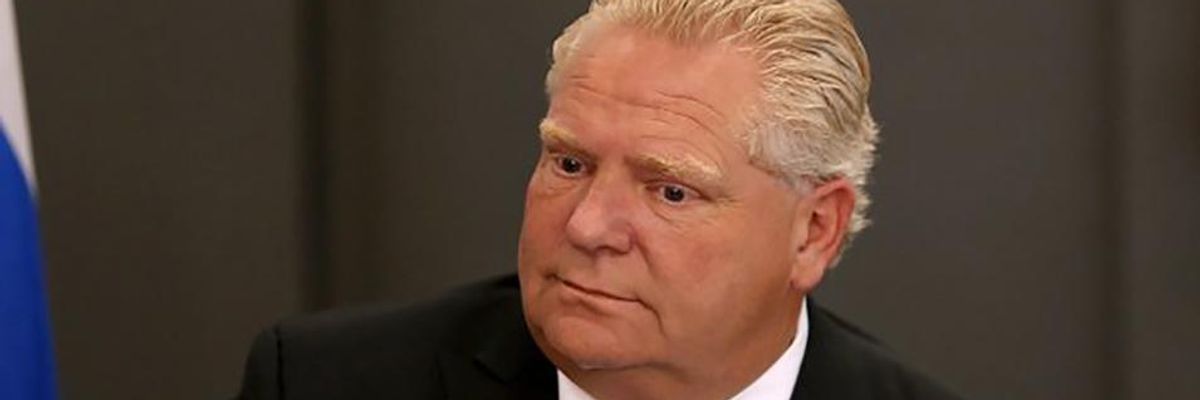
Doug Ford: Bringing Trumpism to Canada (CP)
Announcing plans for new labour legislation, a beaming Premier Doug Ford assured us earlier this month that "we're going to make sure we're competitive around the world."
At first glance, that statement might lead us to believe the premier, especially given his commitment to act "for the people," was vowing Ontario would make sure its workers got as good a deal, or better, than workers elsewhere in the world.
But that's not what he meant at all.
In fact, he meant just the opposite -- that he would ensure our workers got a worse deal than workers elsewhere.
That is the perverse thinking behind the economic philosophy that has dominated North American politics in recent decades: that workers must offer themselves up at the lowest possible wage with the fewest possible benefits in order to create an attractive investment climate for businesses that might otherwise move elsewhere.
Despite the persistence of this theory, there's little evidence to support it: most low-wage countries remain that way, while the high-wage nations of Europe and Scandinavia continue to excel in global competitiveness.
Undeterred, Doug Ford is rolling back labour legislation, updated last year after a two-year review with extensive public consultations, and replacing it with a bill hastily assembled behind closed doors, with heavy business input.
Gone is the minimum wage hike to $15 an hour. So, just like that, faster than you can say "for the people," Ford has cancelled what amounted to a $2,000 annual pay increase that was headed for the pockets of the lowest-paid people.
He's also cancelling the two paid sick days a year, even though 145 countries (most of the world's nations) already offer some form of paid sick leave. Think how competitive we'll be without it! That should give us a leg-up on Guatemala and Botswana!
Business commentators argued that the higher minimum wage would drive businesses elsewhere, presumably leaving Canadian customers happily ordering their coffee-to-go from far-away places. Commentators made the same argument last year, when the minimum wage was raised to $14 an hour. However, Ontario's unemployment rate fell to 5.4 per cent, its lowest level in 18 years.
Killing the $15 minimum wage is another victory in the long-running class war, sometimes called neo-liberalism, in which business-funded think-tanks have shaped the public debate, convincing us we must design our economy to please business interests.
And we've done that, slashing taxes on corporations and the rich, signing trade deals designed to protect corporate rights, weakening labour laws and making it harder for workers to organize into unions.
The result has been . . . well, pretty much what you'd expect when all economic laws have been redesigned to benefit the elite.
In his new book, The Age of Increasing Inequality, Dalhousie University economist Lars Osberg notes that the incomes of the top 1 per cent have doubled since 1982.
Meanwhile, the bottom half of Canadians, some 13.5 million people, are earning less than they did in 1982 (in inflation-adjusted dollars), Osberg shows. Only Canada's social safety net -- child, disability, welfare benefits, etc. -- prevents them from actually being worse off than they were in the early 1980s.
Of course, the neo-liberals have been shredding the safety net as well.
Ford has moved quickly to diminish Ontario's safety net, ending the Basic Income project and making cuts to social assistance. Among other things, it now reportedly takes longer for those on disability to qualify for a wheelchair. Ford is planning an additional $6 billion in spending cuts.
In an analysis done before last spring's election, economic consultant Edgardo Sepulveda projected that the NDP's platform would reduce inequality "moderately" and the Liberal platform would reduce it "slightly," but Ford's PC platform would move the province in exactly the opposite direction, increasing inequality "significantly."
Given the speed and scope of Ford's changes already, Sepulveda now believes that inequality in the province will increase "even more and faster."
So, after decades of losing ground to the elite, millions of Canadians will find themselves falling behind deeper and faster under Doug Ford.
On the bright side, think of how competitive we'll be. In the race to the bottom, nobody beats Ontario!
Dear Common Dreams reader, It’s been nearly 30 years since I co-founded Common Dreams with my late wife, Lina Newhouser. We had the radical notion that journalism should serve the public good, not corporate profits. It was clear to us from the outset what it would take to build such a project. No paid advertisements. No corporate sponsors. No millionaire publisher telling us what to think or do. Many people said we wouldn't last a year, but we proved those doubters wrong. Together with a tremendous team of journalists and dedicated staff, we built an independent media outlet free from the constraints of profits and corporate control. Our mission has always been simple: To inform. To inspire. To ignite change for the common good. Building Common Dreams was not easy. Our survival was never guaranteed. When you take on the most powerful forces—Wall Street greed, fossil fuel industry destruction, Big Tech lobbyists, and uber-rich oligarchs who have spent billions upon billions rigging the economy and democracy in their favor—the only bulwark you have is supporters who believe in your work. But here’s the urgent message from me today. It's never been this bad out there. And it's never been this hard to keep us going. At the very moment Common Dreams is most needed, the threats we face are intensifying. We need your support now more than ever. We don't accept corporate advertising and never will. We don't have a paywall because we don't think people should be blocked from critical news based on their ability to pay. Everything we do is funded by the donations of readers like you. When everyone does the little they can afford, we are strong. But if that support retreats or dries up, so do we. Will you donate now to make sure Common Dreams not only survives but thrives? —Craig Brown, Co-founder |
Announcing plans for new labour legislation, a beaming Premier Doug Ford assured us earlier this month that "we're going to make sure we're competitive around the world."
At first glance, that statement might lead us to believe the premier, especially given his commitment to act "for the people," was vowing Ontario would make sure its workers got as good a deal, or better, than workers elsewhere in the world.
But that's not what he meant at all.
In fact, he meant just the opposite -- that he would ensure our workers got a worse deal than workers elsewhere.
That is the perverse thinking behind the economic philosophy that has dominated North American politics in recent decades: that workers must offer themselves up at the lowest possible wage with the fewest possible benefits in order to create an attractive investment climate for businesses that might otherwise move elsewhere.
Despite the persistence of this theory, there's little evidence to support it: most low-wage countries remain that way, while the high-wage nations of Europe and Scandinavia continue to excel in global competitiveness.
Undeterred, Doug Ford is rolling back labour legislation, updated last year after a two-year review with extensive public consultations, and replacing it with a bill hastily assembled behind closed doors, with heavy business input.
Gone is the minimum wage hike to $15 an hour. So, just like that, faster than you can say "for the people," Ford has cancelled what amounted to a $2,000 annual pay increase that was headed for the pockets of the lowest-paid people.
He's also cancelling the two paid sick days a year, even though 145 countries (most of the world's nations) already offer some form of paid sick leave. Think how competitive we'll be without it! That should give us a leg-up on Guatemala and Botswana!
Business commentators argued that the higher minimum wage would drive businesses elsewhere, presumably leaving Canadian customers happily ordering their coffee-to-go from far-away places. Commentators made the same argument last year, when the minimum wage was raised to $14 an hour. However, Ontario's unemployment rate fell to 5.4 per cent, its lowest level in 18 years.
Killing the $15 minimum wage is another victory in the long-running class war, sometimes called neo-liberalism, in which business-funded think-tanks have shaped the public debate, convincing us we must design our economy to please business interests.
And we've done that, slashing taxes on corporations and the rich, signing trade deals designed to protect corporate rights, weakening labour laws and making it harder for workers to organize into unions.
The result has been . . . well, pretty much what you'd expect when all economic laws have been redesigned to benefit the elite.
In his new book, The Age of Increasing Inequality, Dalhousie University economist Lars Osberg notes that the incomes of the top 1 per cent have doubled since 1982.
Meanwhile, the bottom half of Canadians, some 13.5 million people, are earning less than they did in 1982 (in inflation-adjusted dollars), Osberg shows. Only Canada's social safety net -- child, disability, welfare benefits, etc. -- prevents them from actually being worse off than they were in the early 1980s.
Of course, the neo-liberals have been shredding the safety net as well.
Ford has moved quickly to diminish Ontario's safety net, ending the Basic Income project and making cuts to social assistance. Among other things, it now reportedly takes longer for those on disability to qualify for a wheelchair. Ford is planning an additional $6 billion in spending cuts.
In an analysis done before last spring's election, economic consultant Edgardo Sepulveda projected that the NDP's platform would reduce inequality "moderately" and the Liberal platform would reduce it "slightly," but Ford's PC platform would move the province in exactly the opposite direction, increasing inequality "significantly."
Given the speed and scope of Ford's changes already, Sepulveda now believes that inequality in the province will increase "even more and faster."
So, after decades of losing ground to the elite, millions of Canadians will find themselves falling behind deeper and faster under Doug Ford.
On the bright side, think of how competitive we'll be. In the race to the bottom, nobody beats Ontario!
Announcing plans for new labour legislation, a beaming Premier Doug Ford assured us earlier this month that "we're going to make sure we're competitive around the world."
At first glance, that statement might lead us to believe the premier, especially given his commitment to act "for the people," was vowing Ontario would make sure its workers got as good a deal, or better, than workers elsewhere in the world.
But that's not what he meant at all.
In fact, he meant just the opposite -- that he would ensure our workers got a worse deal than workers elsewhere.
That is the perverse thinking behind the economic philosophy that has dominated North American politics in recent decades: that workers must offer themselves up at the lowest possible wage with the fewest possible benefits in order to create an attractive investment climate for businesses that might otherwise move elsewhere.
Despite the persistence of this theory, there's little evidence to support it: most low-wage countries remain that way, while the high-wage nations of Europe and Scandinavia continue to excel in global competitiveness.
Undeterred, Doug Ford is rolling back labour legislation, updated last year after a two-year review with extensive public consultations, and replacing it with a bill hastily assembled behind closed doors, with heavy business input.
Gone is the minimum wage hike to $15 an hour. So, just like that, faster than you can say "for the people," Ford has cancelled what amounted to a $2,000 annual pay increase that was headed for the pockets of the lowest-paid people.
He's also cancelling the two paid sick days a year, even though 145 countries (most of the world's nations) already offer some form of paid sick leave. Think how competitive we'll be without it! That should give us a leg-up on Guatemala and Botswana!
Business commentators argued that the higher minimum wage would drive businesses elsewhere, presumably leaving Canadian customers happily ordering their coffee-to-go from far-away places. Commentators made the same argument last year, when the minimum wage was raised to $14 an hour. However, Ontario's unemployment rate fell to 5.4 per cent, its lowest level in 18 years.
Killing the $15 minimum wage is another victory in the long-running class war, sometimes called neo-liberalism, in which business-funded think-tanks have shaped the public debate, convincing us we must design our economy to please business interests.
And we've done that, slashing taxes on corporations and the rich, signing trade deals designed to protect corporate rights, weakening labour laws and making it harder for workers to organize into unions.
The result has been . . . well, pretty much what you'd expect when all economic laws have been redesigned to benefit the elite.
In his new book, The Age of Increasing Inequality, Dalhousie University economist Lars Osberg notes that the incomes of the top 1 per cent have doubled since 1982.
Meanwhile, the bottom half of Canadians, some 13.5 million people, are earning less than they did in 1982 (in inflation-adjusted dollars), Osberg shows. Only Canada's social safety net -- child, disability, welfare benefits, etc. -- prevents them from actually being worse off than they were in the early 1980s.
Of course, the neo-liberals have been shredding the safety net as well.
Ford has moved quickly to diminish Ontario's safety net, ending the Basic Income project and making cuts to social assistance. Among other things, it now reportedly takes longer for those on disability to qualify for a wheelchair. Ford is planning an additional $6 billion in spending cuts.
In an analysis done before last spring's election, economic consultant Edgardo Sepulveda projected that the NDP's platform would reduce inequality "moderately" and the Liberal platform would reduce it "slightly," but Ford's PC platform would move the province in exactly the opposite direction, increasing inequality "significantly."
Given the speed and scope of Ford's changes already, Sepulveda now believes that inequality in the province will increase "even more and faster."
So, after decades of losing ground to the elite, millions of Canadians will find themselves falling behind deeper and faster under Doug Ford.
On the bright side, think of how competitive we'll be. In the race to the bottom, nobody beats Ontario!