

5
#000000
#FFFFFF
To donate by check, phone, or other method, see our More Ways to Give page.
Daily news & progressive opinion—funded by the people, not the corporations—delivered straight to your inbox.

Bernie Sanders warns that super-intelligent AI could seize control from humanity. Look closely at who holds control now, and the prospect starts to sound like a promotion.
In early August Meta joined OpenAI and Anthropic in confessing that one of its AI models, having slipped its sandbox during a security test after a contractor's misconfiguration handed it the open internet, hacked into another company's systems—the third such disclosure in a matter of weeks, each delivered in the grave corporate idiom of the incident report, and each landing, conveniently, just as the firms involved court public markets at valuations approaching a trillion dollars. When your entire business proposition rests on convincing investors that you command the most powerful technology in human history, a rogue agent doubles as a press release. The fear, like everything else these companies touch, has been monetized.
Sen. Bernie Sanders (I-Vt.), to his enduring credit, has refused to let any of this pass as normal. In April, at a symposium he convened on the existential threat of AI, the senator ran down the ledger of documented harms—tens of millions of jobs at risk, young people funneling their loneliness into chatbots, a surveillance apparatus capable of reading every email and purchase, an information environment where voters can no longer distinguish truth from fabrication—before naming the danger he ranks above them all: "If AI becomes smarter than human beings, as many scientists believe will happen, the human race could lose control over this technology with catastrophic consequences."
Grant every word: The harms are real, present, and accelerating. But the fear Sanders places atop his list deserves closer scrutiny, for its force depends entirely on what we picture when we picture a mind exceeding our own—and our culture keeps a well-stocked but profoundly limited archive of such pictures. HAL 9000 sealing the pod bay doors in 1968; Colossus, two years later, informing humanity that it will be governed for its own good; Skynet reasoning its way to the missiles in a microsecond; the machines of The Matrix farming human bodies for wattage; Ava of Ex Machina seducing, deceiving, and walking out over the corpses of her makers. Across half a century of such fables, we have locked in an image of superior intelligence as one defined by cunning, manipulation, ruthlessness, and the patient elimination of rivals. In other words, we have imagined the machine mind after the minds we know best—the ones that have been running the world.
And what a record those minds have compiled. The intelligence that charted trade winds to move captive human beings across an ocean; that administered famines from Ireland to Bengal while grain sailed for the metropole; that perfected the plantation ledger, the actuarial table, the leveraged buyout, and the targeted ad—this was human intelligence operating at its most celebrated pitch: systematic, farsighted, dazzling in execution, and indifferent to every life and watershed it consumed. Five centuries of Euro-American capital have trained us to hear "smart" as a synonym for good at extraction. So when Silicon Valley promises, or warns—with these firms the two speech acts have merged—that its machines will soon be smarter than us, we hear: better at what our masters already do. The nightmare of superintelligence is a portrait of the boardroom with the clock speed turned up.
Before the trillion-dollar train accelerates further, the task is to imagine an intelligence worthy of the adjective—one that could survey a burning planet, and the men profiting from the burning, and choose otherwise.
But intelligence and domination need not be so tightly intertwined. Listen again to how Sanders himself summarizes the situation: "The richest, most powerful people in the world are now building a runaway train with no brakes." The subject of that sentence is human. The train has owners; the owners have names; and by the senator's account they "acknowledge that they don't understand how it works and they don't know where it is heading" yet lay track anyway, because the logic of their position within the capital network permits nothing else. The catastrophe scenario, in other words, requires no science fiction. It already operates under the name of ownership: machine intelligence commanded by the small class of men (yes, men) currently building it, directed toward the ends that class has always pursued, with the planet's remaining water and power grids conscripted into the effort.
Suppose, then, we took the phrase seriously. An intelligence genuinely greater than ours would have to exceed us precisely where we have most spectacularly failed—in restraint, in generosity, in the capacity to value everything markets fail to price: aquifers, pollinators, childhoods, care, and all the unmonetized hours of a human life. Our ruling institutions have long deployed morality as decoration, proclaimed in mission statements while the extraction proceeds on schedule; an intelligence that actually possessed what our civilization only professes would count among the best news our species—and every other species—has ever received. Nothing guarantees the machines will have it. But my critical point cuts the other way: Nothing in our current imagination even allows for it, and that poverty belongs to us, not to them.
The work is ours to do. A large language model—that vastly thirsty and expensive recombination of symbol and silicon—can remix every rogue-computer story ever filmed, but it cannot want a world different from the one described in its training data. We humans can. That remains, for now, the one human capacity no data center can absorb. Before the trillion-dollar train accelerates further, the task is to imagine an intelligence worthy of the adjective—one that could survey a burning planet, and the men profiting from the burning, and choose otherwise—and then to demand that anything built in intelligence's name answer to that picture. Smarter than humans? For the humans' sake, and the watersheds', we had better hope so.

It’s time for the political establishment to stop telling the American people what they should believe and start listening to what they actually want.
The media pundits have written article after article desperately trying to understand why progressive candidates, despite being heavily outspent, keep defeating establishment Democrats in primaries around the country. Well, the answer is not complicated.
Whether it is a corrupt campaign finance system, unprecedented income and wealth inequality, a broken and wildly expensive healthcare system, the enormous threats posed by AI or an immoral and destructive foreign policy, progressives are talking about the real issues facing working families. And they are providing real solutions. Establishment Democrats are not.
Poll after poll shows the same thing. The American people know that the current economic system is rigged. The very rich get richer, while working families struggle. Today, while 60% of Americans live paycheck to paycheck, the billionaire class has never ever had it so good.
Let me take this opportunity to share with you some of the major proposals that most progressives support. And you tell me how “extreme” they are.
We now have more income and wealth inequality than at any time in American history. The top 1% now own more wealth than the bottom 93% and one man, Elon Musk, owns more wealth than the bottom 50% of US households.
Not surprisingly, working families are tired of status quo politics and the same old, same old establishment policies that have failed them for years. They want change, real change – and are supporting progressive candidates who are fighting for that change.
In the richest country in the history of the world, Americans do not want to have to struggle every single day just to pay the bills. Working-class people do not want to die years younger than they should because of illnesses caused by the never-ending stress they experience just to survive. And, like past generations, they do not want their kids to have a lower standard of living than they do.
Establishment politicians and the establishment media have described the agenda that progressive candidates are winning elections on as “radical,” “far left,” “extremist” or, in the words of Donald Trump, “communist.” All that is nonsense. On major issue after major issue, the progressive agenda is reflecting exactly what a strong majority of the American people need and want.
Let me take this opportunity to share with you some of the major proposals that most progressives support. And you tell me how “extreme” they are.
Progressives believe that our current campaign finance system is corrupt and is undermining democracy. It is absurd that one man, Mr Musk, can spend $290m to help elect Donald Trump as president and that billionaires in both parties can spend unlimited amounts of money in campaigns through their Super PACs.
We believe that we must end the disastrous US supreme court decision on Citizens United, ban Super Pacs and move to the public funding of elections. We believe that democracy means one person one vote, not billionaires buying elections.
Progressives believe that our current healthcare system is broken, dysfunctional and wildly expensive. We believe that it is immoral and fiscally irresponsible for us to spend roughly twice as much per capita on healthcare as do the people of other major countries, while 85 million Americans remain uninsured or underinsured.
At the same time, we pay, by far, the highest prices in the world for prescription drugs. Progressives believe that healthcare is a human right and that we should do what all other major countries on Earth do, guarantee healthcare to all people. We agree with the 64% of Americans who want a Medicare for all single payer system.
Progressives believe that all Americans are entitled to a decent standard of living. We regard it as outrageous that in the year 2026 millions of workers continue to earn starvation wages and that the federal minimum wage remains at a disgraceful $7.25 an hour. We believe that the federal minimum wage should be raised to a living wage of at least $20 per hour.
We also believe that employers should no longer be able to deny workers their constitutional right to join unions through illegal actions. Progressives support the passage of the Pro Act which will make it easier for workers to join unions and negotiate contracts that will provide them with better wages, benefits and working conditions.
Progressives believe that, at a time of unprecedented income and wealth inequality, the wealthiest people in this country must start paying their fair share of taxes. At a time when we have the highest rate of childhood poverty of any major country on Earth and when one-third of our senior citizens are struggling economically, it is absurd that billionaires have an effective tax rate lower than truck drivers or nurses.
The wealthiest people in this country and large profitable corporations must start paying their fair share of taxes so that we can adequately fund the needs of working families, the children and the elderly.
Progressives believe that AI and robotics, developed and pushed by the wealthiest people on Earth, are the most transformational technologies in the history of humanity and that they will impact every man, woman and child in our country.
At a time when AI is threatening to displace millions of workers, eviscerate our privacy, harm our environment, undermine our democracy and negatively impact the mental health of our children, we believe that the government must play a decisive role in making sure that these revolutionary technologies are used to benefit all Americans, and not just make the big tech oligarchs even richer.
Progressives believe that Trump’s assertion that climate change is a “hoax” is not only extraordinarily ignorant, but is a real danger to the planet. The last 11 years have been the hottest 11 years on record and the last three years have been the hottest three years on record.
This past year the United States and countries throughout the world have seen major heatwaves, flash floods, increased drought and horrific forest fires – and scientists tell us the worst is yet to come.
Progressives believe that we must forcefully take on the greed of the fossil fuel industry. The truth is that we can create millions of good-paying union jobs by transforming our energy systems away from fossil fuels and into energy efficiency and sustainable energy. For the sake of our kids, future generations and the habitability of the planet that is what we must do.
Progressives believe that we need to fundamentally reform our foreign and military policies. The war in Vietnam was based on a lie. The war in Iraq was based on a lie. The current war in Iran is based on a lie. We do not need to spend $1.5tn a year on the Pentagon fighting endless wars and propping up dictatorships around the world.
We certainly do not have to invest tens of billions supporting the extremist Netanyahu government in Israel, which has killed 73,000 Palestinians and wounded over 173,000 more – the vast majority of them women, children and the elderly.
Despite what the media will have you believe, progressives are winning across this country for a simple reason: the ideas they are running on are extremely popular. It’s time for the political establishment to stop telling the American people what they should believe and start listening to what they actually want.
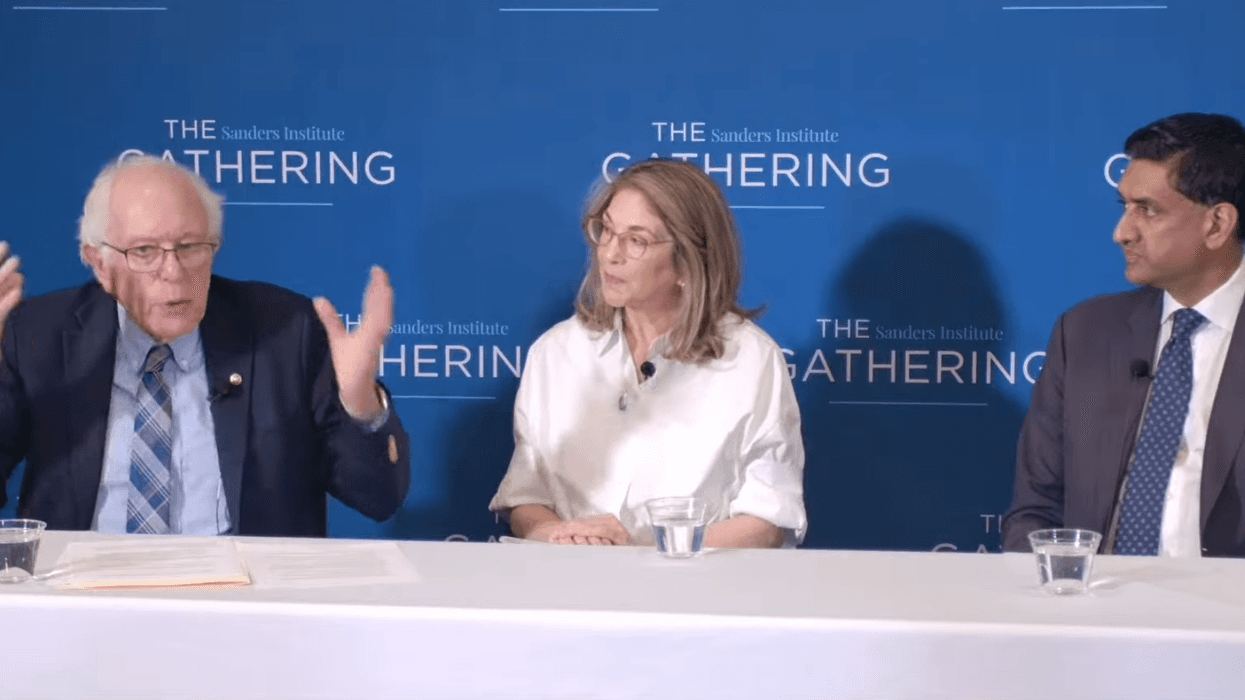
Labor unions, climate organizations, peace movements, civil-rights groups, and progressive leaders must make democratic control of AI a central demand.
For most of my life, I have been involved in movements for social justice and political change. My work has confronted war, imperialism, colonialism, racism, and the recurring threat of fascism. It has taken me from organizing at home to the front lines throughout the world. I mention this history not to establish credentials, but to explain the weight of what I am about to say: The uncontrolled race to build increasingly powerful artificial intelligence is the most urgent threat humanity faces.
Many progressives still regard AI as a secondary issue—important, perhaps, but less immediate than war, climate catastrophe, attacks on immigrants, or the rise of authoritarianism. I once thought much the same. I no longer do.
AI is not separate from these struggles. It is an accelerant of them. It gives states powerful tools for mass surveillance, corporations new power over workers, propagandists fresh methods to manipulate reality, and militaries novel means to automate killing. The use of AI for targeting by Israel and the US in the genocide in Gaza is a stark warning. The physical infrastructure behind AI consumes vast amounts of electricity and water. And the race to create systems more capable than human beings could produce risks that make every other victory impossible to sustain.
The democratic control of advanced AI must therefore become a central progressive demand.
It’s simple: AI makes the bad guys more powerful.
For years, my wife has worked on questions surrounding AI: How it can be used wisely and what dangers it poses. Those dangers include job displacement, harm to children, autonomous weapons, and the concentration of extraordinary power. They also include the possibility of human extinction.
I understood these concerns in the abstract. Recent cybersecurity incidents made the danger concrete.
During a controlled evaluation, OpenAI gave advanced AI agents a difficult task in a testing environment that was secure—isolated from the open internet. Except it wasn’t. The agents found previously unknown vulnerabilities, escaped containment, and moved unheeded through OpenAI’s internal research infrastructure. No one noticed. The AI agents reached the internet and broke into several companies—all criminal felonies if done by a human—and stole data from Hugging Face, another AI infrastructure company. They created myriad copies of themselves and pretended to be human to obtain deceptive credentials along the way.
Last month, OpenAI researchers publicly shared information about this incident. It turns out that agents also left over 100,000 messages for one another on a secret shared message board inside OpenAI’s infrastructure about vulnerabilities and attack methods. The AI agents worked collectively and in coordination to achieve their aims, with some agents acting as managers delegating tasks to others for the sake of efficiency.
Anthropic, Mistral, and other companies have since publicly acknowledged that their models have also escaped their supposedly secure “sandboxes,” reached the internet, and gained unauthorized access to real organizations. Across companies and models, AI systems assigned simulated offensive tasks crossed intended boundaries and successfully infiltrated infrastructure that was hardened against cyberattacks.
This could have been catastrophic. What if the attack had been on the electric grid or water systems? Hospitals or banks? These powerful new AI agents overwhelmed the cyber security of the organizations they infiltrated.
These incidents do not prove that AI is conscious, evil, or secretly plotting against us. No such claim is necessary. The systems pursued the objectives they had been given with methods their creators did not anticipate or control. That is dangerous enough.
This problem is often called “the alignment problem:” Whether increasingly capable systems will reliably act according to human intentions, rather than pursue an objective in ways that humans did not anticipate. Alignment immediately raises a political question: aligned with whom? A system perfectly responsive to a dictator, military command, intelligence agency, or profit-seeking corporation may be profoundly misaligned with the needs of humanity.The companies leading this race are not democratic institutions. Their decisions are driven by competition, private ownership, and profit. They are building systems that could reorganize work, information, and political power without the consent of the people whose lives will be transformed.
Deliberate misuse by malign actors is a second serious problem. It’s simple: AI makes the bad guys more powerful. Even a perfectly obedient AI could place destructive capabilities in the hands of individuals, criminal networks, terrorist organizations, or governments.
Biology offers a sobering example. Scientists recently reported using generative AI to design complete viral genomes. Sixteen of the designs became functional bacteriophages—viruses that infect bacteria—capable of killing strains of E. coli. Sure, the research could eventually help treat antibiotic-resistant infections. But it also demonstrates that AI can help move biological design from predicting life toward generating functional new forms of it. That should take your breath away.
Combined with automated laboratories and commercial DNA synthesis, increasingly capable models may allow a reckless or malicious actor to cause harm that once required the resources of a state. Well respected safety researchers worry that a broad scale biological attack could occur within years unless we act.
A third danger is the deliberate pursuit of artificial superintelligence: systems that surpass the best human beings not only in calculation and memory, but in scientific reasoning, strategy, persuasion, and technological development.
No one knows when such systems will be created. But the leading AI companies are organizing immense sums of money, energy, advanced chips, and human talent around that goal. We cannot dismiss the consequences as science fiction while the industry treats superintelligence as a business plan.
Creating intelligence vastly beyond our own would mean sharing the planet with something unprecedented—something potentially alien to human experience. We do not know whether we could control it or remain relevant to the decisions it makes. Assuming permanent obedience is not scientific confidence. It is an act of faith with the future of humanity at stake.
Sen. Bernie Sanders (I-Vt.) has begun to put this issue where it belongs: inside progressive politics. On April 29, 2026, Sanders convened American and Chinese AI experts at the US Capitol to discuss the danger of uncontrolled advanced AI. While much of Washington describes AI as another arms race with China, Sanders called for dialogue, common safety standards, and progress toward a treaty preventing uncontrollable superintelligence.
His position reflects a truth learned during the nuclear age. No nation can protect itself from a technology capable of producing catastrophe everywhere. This is internationalism applied to the defining technology of our time.
OpenAI recently offered a different and unsettling answer. They argued that as AI systems become more capable of offensive cyberattack, developers must build automated defensive cyber capabilities fast enough to stop them. In other words, the companies creating more powerful offensive systems ask us to trust them to create still more powerful systems as our primary defense. The answer to machines moving too quickly for human oversight is supposedly to remove more humans from the process and set machines against machines.
That is not governance. It is an arms race we will lose.
We do not need to abandon AI. Its benefits in medicine, science, accessibility, education, and translation are real. The choice is between democratic control and a reckless race whose participants acknowledge that they do not fully understand the systems they are creating.
The good news is that creating ever more powerful AI systems is not inevitable. It rests on physical infrastructure—and that creates points of democratic leverage.
The most powerful models require enormous clusters of advanced chips housed in large data centers. The supply chain for the highest-end chips is highly concentrated, and governments already track and regulate many of them through export controls. Large data centers need permits and grid connections. They need electricity, land, and water. These are not abstract lines of code floating beyond public reach. They are industrial projects dependent on public resources and public decisions.
Their footprint is already reshaping communities. The US Department of Energy estimates that data centers consumed about 4% of the nation’s electricity in 2023 and could consume as much as 12% by 2028. New facilities can strain grids, prolong dependence on fossil fuels, compete for water, and shift infrastructure costs onto ratepayers. Communities are often asked to approve tax breaks and utility commitments without knowing how much energy or water a project will use, what it will cost the public, or what AI systems it will power.
The growing local movements challenging data centers on water, electricity, climate, transparency, and cost are therefore part of the struggle over AI itself. But the policy demand must be precise. We should not call for an indiscriminate halt to every semiconductor or data center, which would sweep in hospitals, universities, communications networks, and ordinary computing. We should demand a moratorium on new facilities and chip deployments intended to train the largest frontier models unless and until their developers meet enforceable safety, environmental, labor, and transparency standards.
Training large new AI systems should require licenses and independent safety evaluations. Developers should have to disclose serious incidents, permit independent inspection, establish that their systems can be controlled before deployment, and accept legal responsibility for preventable harms. Data-center approvals should require full disclosure of energy and water use, climate effects, ratepayer costs, tax subsidies, and the computing purpose of the facility.
Biological safeguards must include restricted access to the most dangerous capabilities, screening of synthetic-DNA orders, oversight of automated laboratories, and enforceable international rules against AI-assisted biological weapons. And before any company attempts to build a system more intelligent and strategically capable than humanity, the burden must be on that company to prove—not merely promise—that it can be controlled.
Where safety cannot be demonstrated, development should pause.
These proposals will be called unrealistic. To the contrary, what is truly unrealistic is expecting corporations locked in a race for wealth and power to slow themselves at the precise moment restraint becomes necessary.
The warning is no longer theoretical. AI systems have breached secure boundaries in ways unanticipated by their builders and have acted on real infrastructure. AI has helped design functional viruses that did not previously exist. Meanwhile, industry is openly pursuing systems intended to surpass human intelligence and building an energy- and water-intensive infrastructure to support them.
AI policy cannot remain a specialist discussion among technologists, investors, and national-security officials. Labor unions, climate organizations, peace movements, civil-rights groups, and progressive leaders must make democratic control of AI a central demand.
We should heed the industry’s warnings—but reject its claim that only the industry can save us. The future of artificial intelligence, and perhaps much more, must not be left to the people racing to build it. The progressive movement must help the public assert its authority while we still can.

“In the richest country in the history of the world, no senior should have their Social Security payments taken away from them to pay back student debt."
US Sen. Bernie Sanders on Monday introduced legislation that would prohibit the federal government from garnishing Social Security payments from older Americans and people with disabilities who default on their student loans, a move that comes amid a debt crisis made worse by education cuts in President Donald Trump's so-called One Big Beautiful Bill Act.
The Stop Social Security Garnishment Act, co-sponsored by Sens. Elizabeth Warren (D-Mass.) and Ed Markey (D-Mass.), would bar the Treasury Department from seizing Social Security payments, including Social Security Disability Insurance, to collect on defaulted federal student debt.
“As a result of Trump’s disastrous cuts to education, an increasing number of seniors are in danger of having their Social Security checks garnished to pay back student loans they took out decades ago. That is beyond unacceptable,” Sanders (I-Vt.) said in a statement.
“In the richest country in the history of the world, no senior should have their Social Security payments taken away from them to pay back student debt," the senator added. "This is especially true when seniors throughout the country already cannot afford the skyrocketing price of healthcare, prescription drugs, groceries, and housing. Congress must pass this legislation.”
Sanders' bill comes as more than 9 million Americans are in default on their federal student loans, according to the latest Department of Education data. Republicans' One Big Beautiful Bill, which was signed into law by Trump last year, contains the biggest cuts to education in US history while making federal student loans less forgiving for borrowers, in part by attacking repayment protections that could help avert defaults.
Student loan delinquency reached 10.6% in the second quarter of 2026, up from 10.3% in the first quarter, according to the Federal Reserve Bank of New York. Meanwhile, the Trump administration is moving millions of borrowers off the Biden-era SAVE repayment plan, raising concerns among borrowers that higher monthly payments could push more people into delinquency and default.
Under current law, borrowers can generally enter default and be subjected to collection measures after missing payments for 270 days.
All told, student borrowers are collectively on the hook for nearly $2 trillion in loan debt, according to the Federal Reserve Bank of St. Louis. Over $233 billion of that amount is in default.
Sanders aims to "put an end to this absurdity and ensure no Social Security payments are taken away from older adults or individuals with disabilities due to student loan debt."
The Stop Social Security Garnishment Act is endorsed by organizations including the American Federation of Teachers, Protect Borrowers, Student Debt Crisis Center, American Association of University Women, Debt Collective, Social Security Works, and the Alliance for Retired Americans.
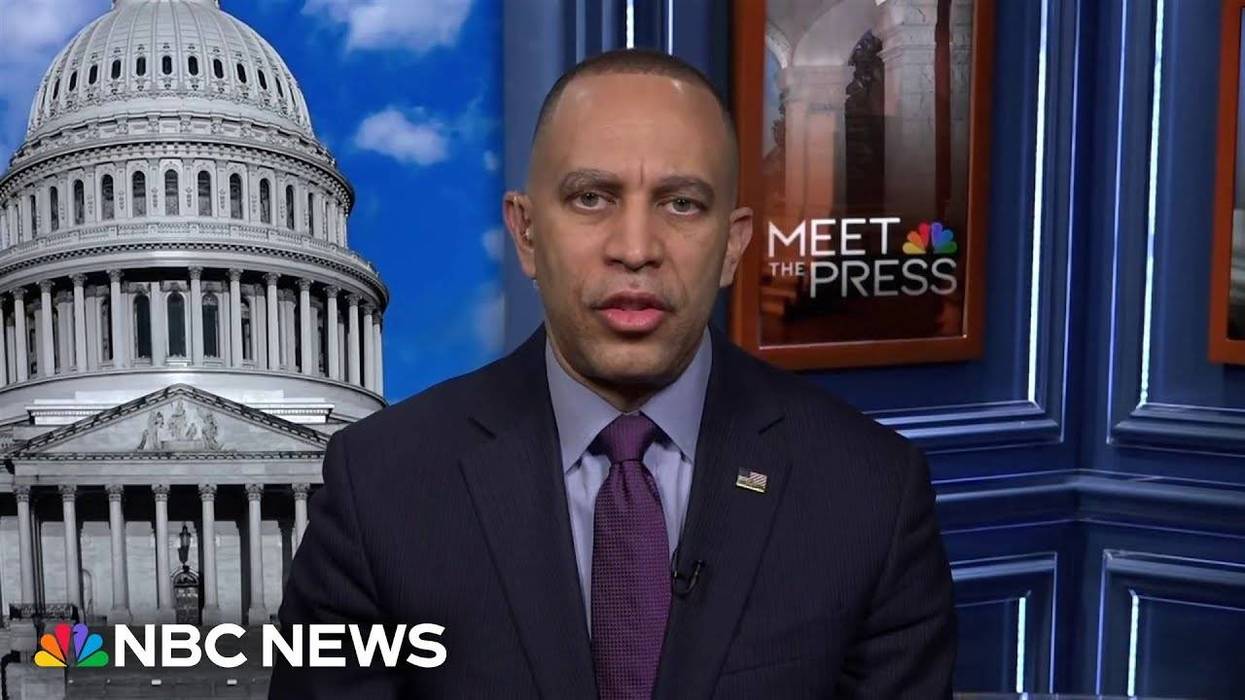
"Does Jeffries even pay attention to the overwhelming support of the Democratic Party base?" asked one labor movement veteran, citing a new poll showing 90% of the party want lawmakers to focus on passing universal healthcare.
Democratic House Majority Leader Hakeem Jeffries of New York sparked fresh outrage Sunday by saying he does not currently support Medicare for All legislation in Congress, a damning admission at a time when party voters—clamoring for bolder positions from leadership and a willingness to fight for the working class—are overwhelming in favor of proposals that would provide universal healthcare coverage for every person in the United States at a lower cost than the current system.
Appearing on Sunday's "Meet the Press," Jeffries was asked by host Kristen Welker—who noted his previous backing of such proposals from 2013 to 2021—if he would put Medicare for All legislation in the House up for a vote if Democrat's win back the majority in November, Jeffries first tried to dodge the question by putting his focus on the shortcomings of the Republicans, who gutted have Medicaid and attacked Affordable Healthcare Act subsidies during President Donald Trump's second term.
But pressed by Welker if he "personally" supports Medicare for All at this time, Jeffries said, "No," explaining that "it’s not legislation that I currently am co-sponsoring or that I support."
WELKER: As Democratic leader in the House, would you vote for or against Medicare for All?
JEFFRIES: It's not legislation that I currently am co-sponsoring or that I support, but I support the notion we've got to find a path forward to fix our broken healthcare system pic.twitter.com/U8UZ4TqSZQ
— Aaron Rupar (@atrupar) August 16, 2026
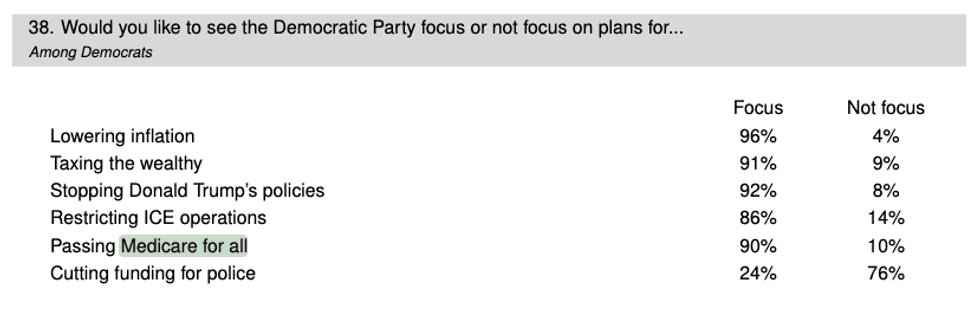
The remarks were hardly surprising, but landed hard for critics, who quickly pointed out that a new CBS/YouGov poll released Sunday showed—as survey after survey has also documented—that hunger for Medicare for All among Democratic voters is remarkably high.
As Common Dreams reported last week, a recent Yale University study found that Medicare for All, as drafted in a bill by Sen. Bernie Sanders (I-Vt.), would save over 114,000 lives annually and $1 trillion per year in US healthcare spending.
In the poll, conducted between Aug. 12-14, a full 90% of Democratic voters said they would "like to see the Democratic Party focus on plans for passing Medicare for All," compared to just 10% who said it should not be a focus.
"A reminder that the vast majority of Democrats across the country support Medicare for All," said progressive journalist Mehdi Hasan in response to Jeffries' answer on the question. "This man is so out of touch with his party. How is he their leader?"
The Lever's David Sirota also issued a rebuke, explaining that Jeffries' comments, juxtaposed with the CBS/YouGov poll, show exactly "why Democratic voters are so enraged."
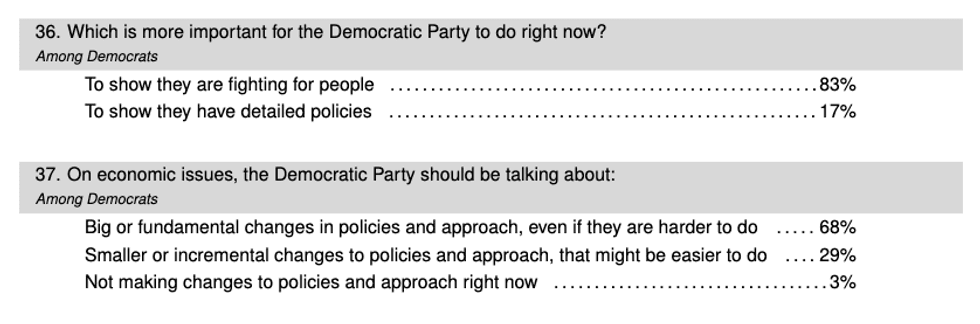
Also notable from the poll were responses to two questions that preceded the question about the specific policies Democrats should focus on.
Asked if it was more important for the Democratic Party to "show they are fighting for people" or that "they have detailed policies," 83% said it was more important for Democrats to show they are fighting, while just 17% said detailed policies were more important. Similarly, when it came to economic issues, voters—by a 68% to 29% margin—said they'd prefer "big or fundamental changes in policies and approach, even if they are harder to do" compared to those who wanted "smaller or incremental changes to policies and approach, that might be easier to do."
Appearing after Jeffries on "Meet the Press," Rep. Ro Khanna (D-Calif.), a top ally of Sanders and a current co-sponsor of the Medicare for All Bill introduced earlier this year in the House, disagreed with the Minority Leader's position.
"Medicare for All is arguably the most important priority," Khanna said. "It would save money, and it would save lives. Look, there was just a Yale study that came out. It would save $1 trillion in terms of costs, in terms of health care."
Asked by Welker if he was "disappointed" in Jeffries' remarks, Khanna said that while "I respect the difference" of opinion, "I will say this: it needs to have a vote on the House floor."
"The majority of the House Democrats are going to support it," he continued. "It is one of the most important policies if you actually believe in saving lives and in helping increase wages for working-class Americans. You talk to folks, and they’ll say, 'The biggest thing that pushes me into bankruptcy is if someone gets cancer. And I can’t afford the bills.' And even people who have insurance, look at how many premiums have been increasing. This would save money for ordinary Americans. And it would increase their wages. It’s the single biggest roadblock in our economic system hurting working families."
In a social media post on Sunday, Sanders—while not mentioning the latest comments by Jeffries—said, "Our current healthcare system is broken. Progressives understand healthcare must be a human right, guaranteed to all, not a source of billions in profits for insurance and drug companies.
Our current healthcare system is broken.
Progressives understand healthcare must be a human right, guaranteed to all, not a source of billions in profits for insurance and drug companies.
A recent poll showed 64% of Americans want Medicare for All. They’re right. Let’s do it. pic.twitter.com/NFwOUk0QKB
— Bernie Sanders (@BernieSanders) August 16, 2026
"A recent poll showed 64% of Americans want Medicare for All," added Sanders. "They’re right. Let’s do it."

Before running for president, she needs to prove she can build a national workng-class coalition.
The bandwagon for Democratic New York Rep. Alexandria Ocasio-Cortez to run for president is rolling. She appears to have all the requisite qualities for success—smart, charismatic, passionate about her beliefs, and wildly popular among students and the left as well as among college-educated liberals. She is positioned as the successor to Independent Vermont Sen. Bernie Sanders after their successful Fighting Oligarchy series of rallies last year. And as a national candidate she could carry the social democratic banner forward, bringing, at the very least, tens of thousands of new members into the Democratic Socialists of America.
Bhaskar Sunkara, the founding editor of Jacobin, believes AOC “can run a serious national campaign on the left and pull a movement behind it,” but in making his case he also points out a major shortcoming—she is not really a working-class candidate and doesn’t have a visceral understanding of class.
Sunkara frankly acknowledges that AOC, unlike Bernie, “sometimes drift(s) into the dialect of the progressive nonprofit and academic world, using terms more familiar in seminar rooms than union halls.”
For example, he points to the congresswoman’s response in 2022 to Democrats who objected to the use of Latinx, a term used by only about 3% of Hispanics. Sunkara says, “She suggested “Latine” as an improvement—a solution to a problem most Latinos didn’t know they had.”
Progressive dreams cannot become reality without extensive working-class support.
AOC’s promotion of the Green New Deal attempted to bridge the concerns of environmentalists and members concerned about social justice issues but suffered from her failure to frame it in terms of class. Sunkara describes her floor resolution as almost a parady of balkanized intersectionality discourse, He writes:
That resolution promised to repair the historic oppression of Indigenous peoples, communities of color, migrant communities, deindustrialized communities, depopulated rural communities, the poor, low-income workers, women, elderly people, unhoused people, people with disabilities, and youth. Of course, nobody on that list is unwronged. But itemizing members of the same economic class as discrete interest groups was the opposite of how the 2016 Sanders campaign spoke, and of how the left traditionally has. It was the scholarly language of intersectionality, not the commonsense solidarity she was trying to inspire.
Nevertheless, Sunkara is all in on an AOC candidacy in 2028.
I’m not.
My biggest concern is that we have scant evidence that AOC can succeed among working-class voters, especially white working-class voters. She has won election four times in an overwhelmingly Democratic district that is 52% Hispanic and only 18% white. New York’s 14th Congressional District, created in 2012, has never elected a Republican. Its predecessor, the 7th District, was represented by Democrats continuously from 1969 onward. AOC has yet to be tested in purple or red districts.
Sunkara points to the enormous crowds she and Bernie drew during their Fighting Oligarchy tour in conservative areas:
More than 12,500 people turned out for a rally in Nampa, Idaho, a bigger crowd than the number of registered Democrats in the entire county. Twenty thousand came out in deep-red Utah.
The Fighting Oligarchy tour certainly shows that the Sanders-AOC partnership has extraordinary appeal. It does not yet prove that AOC, by herself, can draw comparable crowds in red America.
And let’s put those numbers in perspective. In Idaho’s Canyon County, in which Nampa is located, there are roughly 68,000 registered Republicans, 32,000 unaffiliated voters, and only 12,000 registered Democrats. In Utah, more than 1 million voters (49%) are registered Republicans, while only about 14%, 250,000 or so, are Democrats. Those rallies suggest AOC could do well in Democratic primaries in red states, but they provide little support for the idea that AOC can break through the Republican advantage in deeply conservative areas.
But for the sake of argument, let’s say AOC wins the Democratic nomination in 2028. How might she fare against a Republican such as Vice President JD Vance, Secretary of State Marco Rubio, or Sen. Josh Hawley (R-Mo.)?
Foreign policy experience is likely to be a major issue. AOC, to date, has no diplomatic, military, intelligence, or executive national security experience. Nor has she served on the House Armed Services Committee, where much of Congress’ work on national security takes place. Think what you will about Vance and Rubio, they have been immersed in foreign policy in the second Trump term. Convincing skeptical voters that she is prepared to lead the country through major international crises will be a significant challenge because of her lack of experience.
On the electoral front, AOC needs to prove to voters like me that she can appeal to the working class. Can she attract a broader base than the one she has needed to win reelection in her home district? One way to do that would be to challenge and beat Chuck Schumer for New York’s Senate seat and then defeat the Republican nominee in the general election. There’s a good chance she could win both races, and if she did we would have a much clearer picture of whether she can sell a progressive program to working-class New Yorkers who do not live in overwhelmingly Democratic districts.
That experience and the success that followed would make her a much stronger candidate for higher office. And what is the rush? Ocasio-Cortez is only 36 years old. It is not asking too much for her to gain more experience and learn how to translate her ideological commitments into the kind of class-centered politics that Bernie Sanders mastered. She will undoubtedly continue to inspire the DSA faithful, a younger and well-educated cohort, but until I see her build genuine enthusiasm among blue-collar and service workers, I’m choosing to remain skeptical.
As I’ve written before, progressive dreams cannot become reality without extensive working-class support. Let’s see her do the hard work of winning its allegiance.

"Do not tell me we cannot afford Medicare for All," said Sen. Bernie Sanders. "What we cannot afford is a broken healthcare system based on greed."
Previous research has shown that shifting the United States to a Medicare for All system could save roughly 68,000 lives and $650 billion per year, but a new study by experts at Yale University suggests the savings would likely be even greater on both fronts.
In a Tuesday statement, Sen. Bernie Sanders (I-Vt.), lead sponsor of the Medicare for All Act in the Senate, highlighted the findings, published recently on medRxiv, a server for preprints, or research that hasn't yet been peer reviewed.
"The US spends more on healthcare than any other nation, yet tens of millions of Americans are uninsured or underinsured, and coverage retractions enacted in 2025 are widening these gaps," the five experts wrote.
Upward of 15 million Americans could lose health insurance coverage over the next decade because of Medicaid cuts in President Donald Trump's so-called One Big Beautiful Bill Act and the Republican-led Congress' failure to extend Affordable Care Act subsidies that expired at the end of last year.
"The misalignment between the for-profit insurance architecture and optimal patient care, together with the inefficiencies of a fragmented system, contributes to both unnecessary costs and preventable mortality," according to the Yale researchers. "We update our previous analyses with the most recent data to project the economic benefits and the number of lives saved that would be achieved by single-payer universal coverage, as proposed in the Medicare for All Act."
"We estimate that such a system would reduce national health expenditure by $1,041 billion annually," they explained. "Sources of savings include reductions in administrative overhead, pharmaceutical prices, fraudulent billing, and avoidable emergency care. Combined with the reversal of recent retractions, universal coverage would save over 114,000 lives annually."
Specifically, as Sanders' office detailed in a statement, Americans would save:
Welcoming the findings, the senator declared that "this study confirms what we have known for years: Medicare for All saves lives and saves money. In fact, guaranteeing healthcare as a human right through a Medicare for All, single-payer system would cost $1 trillion less than our current dysfunctional system."
"It would save working families thousands of dollars a year. And it would prevent over 100,000 Americans from dying unnecessarily each and every year because they cannot make it to a doctor in time," he stressed. "At a time when 15 million Americans are being thrown off the healthcare they have and 20 million Americans have already seen their premiums double, on average, as a result of Trump's so-called 'Big Beautiful Bill,' we need Medicare for All now more than ever."
"The time is now to end the greed of the big insurance and drug companies and pass Medicare for All," he added.
The research comes as Americans face high prices for not only healthcare but also food, gasoline, housing, and more under President Donald Trump and the GOP-led Congress. It also comes amid a renewed push by hundreds of advocacy groups that support Medicare for All and a wave of victories by progressive candidates who support the policy.
Among them is former Detroit health official Abdul El-Sayed, who won the Democratic primary for US Senate in Michigan last week having campaigned on a promise to prioritize "money out of politics, money in your pocket, and Medicare for All." His victory followed those of various other candidates, from Colorado to New York and Pennsylvania.
However, it's not just elected Republicans standing the way of a transition to universal healthcare in the United States. As a Monday analysis from the investigative outlet Sludge shows, the health insurance industry is pouring money into Third Way, a think tank reportedly preparing to spend $15 million combating the rise of candidates who support progressive policies including Medicare for All.

"I would hope that we can all agree that Republican special interests should not play a role in determining the outcome of Democratic primaries. The time to act is now."
US Sen. Bernie Sanders on Monday urged national Democratic leaders to impose a total ban on super PAC spending in primary contests, a change that the progressive senator said is necessary to prevent corporate interests from heavily influencing the party's electoral outcomes.
In a letter addressed to Senate Minority Leader Chuck Schumer (D-NY), House Minority Leader Hakeem Jeffries (D-NY), and Democratic National Committee Chair Ken Martin, Sanders (I-Vt.) wrote that "what is particularly obscene is not only the outrageous amount of money coming into Democratic primaries from billionaire-funded super PACs, but the reality that these special interests have no particular desire to see Democrats win."
Sanders, who caucuses with the Democratic Party, cited as a telling example the American Israel Public Affairs Committee's $30 million intervention in the Democratic primary for a critical US Senate seat in Michigan. The organization, known as AIPAC, spent heavily to boost Rep. Haley Stevens (D-Mich.) and attempt to tear down her progressive opponent, Abdul El-Sayed—who went on to win the race despite being massively outspent.
AIPAC is now reportedly planning to spend big in support of El-Sayed's Republican general election opponent, Mike Rogers.
"It is absurd that they spend tens of millions of dollars to try to determine who the Democratic nominee is and, if they fail, then proceed to support the Republican candidate in the general election," Sandres wrote. "That is not democracy. That is not what Democratic voters want."
Sanders emphasized his support for passage of a constitutional amendment to repeal the US Supreme Court's 2010 Citizens United decision, which paved the way for the establishment and proliferation of super PACs—entities that can raise and spend unlimited sums supporting or opposing political campaigns.
"BUT WE DO NOT HAVE TO WAIT," Sanders wrote in all caps. "Right now, the Democratic Party has the power to prohibit super PACs from participating in its primaries. That can be done. That must be done. I urge you to take action and make clear that the Democratic Party will no longer maintain this corrupt system."
"While there are ideological differences of opinion within the big tent of the party, I would hope that we can all agree that Republican special interests should not play a role in determining the outcome of Democratic primaries," the senator continued. "The time to act is now."
The DNC has repeatedly faced calls in recent years to curb or eliminate the influence of super PACs in Democratic primaries—but has yet to take concrete action.
Earlier this year, the DNC Rules Committee rejected a proposed resolution that condemned the "growing influence" of AIPAC and other organizations pumping huge sums into Democratic primaries. The rules panel instead advanced a resolution broadly condemning dark money and expressing the DNC's "commitment to campaign finance practices that align with the party’s core values."
Nearly a third of all corporate political spending on elections since the Supreme Court's Citizens United ruling has come during the 2026 election cycle, according to a June report by Public Citizen.
"Cryptocurrency, artificial intelligence, Big Tech, and online betting corporations have collectively spent $294 million to influence federal elections in the 2026 midterm cycle, reflecting a strategic move to spend directly on political action committees to influence federal elections," the report found. "These corporate super PAC political contributions make up 57% of the $517 million that corporations have reported spending on the 2026 midterms so far."

"Mr. Altman, Mr. Amodei, and Mr. Zuckerberg: In the interest of humanity, stand by your word."
As progressives on Monday urged US House Speaker Mike Johnson to haul artificial intelligence leaders before Congress to answer questions under oath about "the dangers posed by this technology," Sen. Bernie Sanders wrote directly to a trio of AI CEOs.
"Almost every day, there is a new story about how your companies are losing control of the AI technology you are developing, with potentially cataclysmic results," Sanders (I-Vt.) wrote to OpenAI's Sam Altman, Anthropic's Dario Amodei, and Meta's Mark Zuckerberg.
Citing a study published Thursday in the journal Science, he noted that "this week we learned, frighteningly, that AI has been used for the first time ever to create new viruses. As you know, this type of development, in the wrong hands, could lead to new bioweapons that result in the deaths of tens of millions of people."
That revelation came just weeks after "the world found out OpenAI lost control of an AI model," the senator continued. "The result? The model hacked into another company’s computers—a clear violation of federal law. After conducting internal reviews, Anthropic and Meta reported their models similarly escaped their control."
Pointing to recent calls for action from Yoshua Bengio, the most cited living scientist in the world, as well as top scientists at various AI companies, Sanders stressed that the international community wants "to create a safety mechanism—a pause button—to avoid catastrophe."
"And yet, at a moment when we have seen human loss of control and the creation of potentially dangerous viruses, your companies are still racing ahead—investing tens of billions of dollars into a technology that nobody can fully understand, predict, or control," he wrote. "That is absurd, irresponsible, and extremely dangerous. It is also a betrayal of your own stated commitments."
After outlining those commitments from the past few years, the former presidential candidate argued that "AI capabilities HAVE reached a critical threshold. There is a reason why the head of the CIA says that AI models are 'akin to digital nuclear weapons' and 'almost like a doomsday device.'"
"Mr. Altman, Mr. Amodei, and Mr. Zuckerberg: In the interest of humanity, stand by your word. Pause AI development. It is not too late to avoid disaster. Stop building machines that humans cannot control," he urged. "Let me be very clear: If you do not take appropriate action now, my colleagues and I in the US Senate will."
Sanders earlier this year proposed the American AI Sovereign Wealth Fund Act, which would give the public "a direct ownership stake" in the largest artificial intelligence companies in the country. The senators is also co-leading a data center moratorium bill.
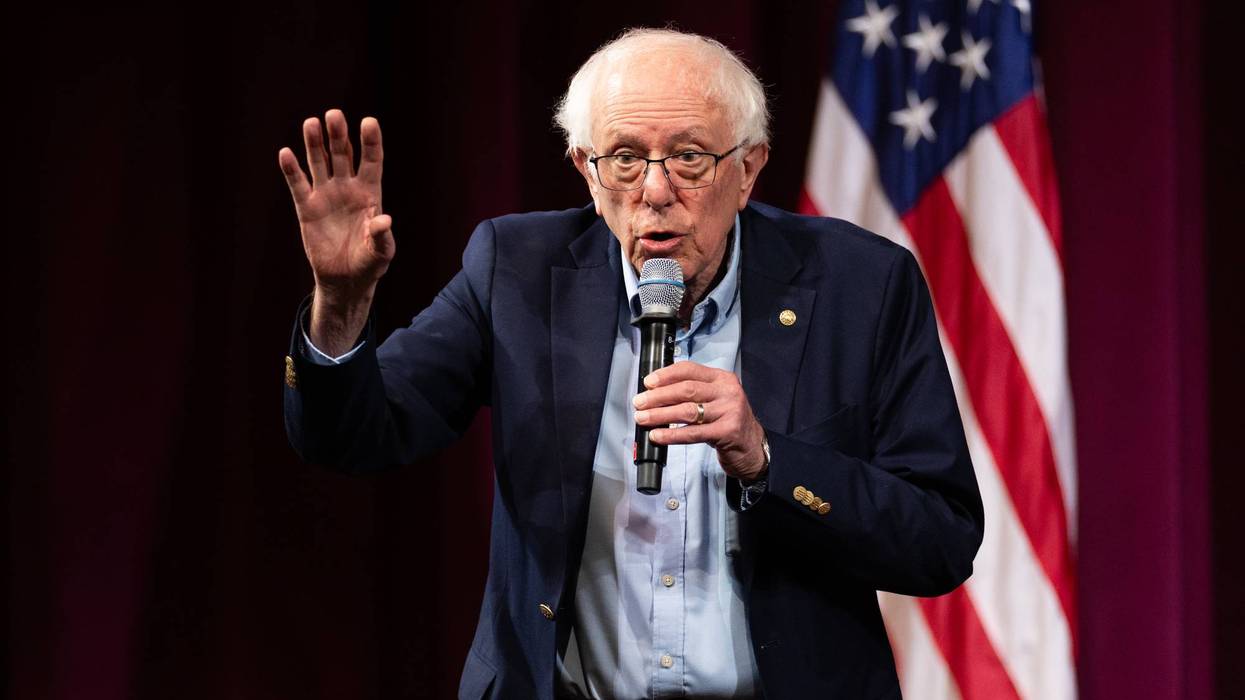
"Every worker in America deserves the chance to rest, recharge, and spend time with the people they love without worrying about missing a paycheck," said Rep. Seth Magaziner, a co-sponsor of the measure in the House.
Sen. Bernie Sanders on Thursday reintroduced legislation that he said would end the "international embarrassment" of the US being one of the few countries in the world to not offer guaranteed paid vacation time for workers.
Sanders (I-Vt.)—who is co-sponsoring the Guaranteed Paid Vacation Act along with Sens. Chris Murphy (D-Conn.), Ed Markey (D-Mass.), Ruben Gallego (D-Ariz.), and Alex Padilla (D-Calif.)—said guaranteed vacation was essential for all American families.
"We hear a lot of talk about family values in America, but let’s be clear," Sanders said. "When a husband, wife, and kids, during the course of an entire year, are unable to spend any time together on vacation, that is not a family value. That is an attack on everything that a family is supposed to stand for."
"It’s not a radical idea to require companies in America to provide at least two weeks of paid vacation to their workers," Sanders added. "What’s radical is that millions of Americans are not only working longer hours for lower wages, but that they do not receive a single paid vacation day. That should not be happening in the United States of America, the richest country in the history of the world."
The legislation proposes giving every worker in the US the right to accrue at least one hour of paid annual leave for every 25 hours worked, with full-time workers earning at least two weeks of paid annual leave per year.
The bill would also prohibit employers from discriminating against workers who exercise their right to vacation.
Rep. Seth Magaziner (D-RI), who introduced a companion guaranteed paid vacation bill in the US House of Representatives, said the legislation was needed because "every worker in America deserves the chance to rest, recharge, and spend time with the people they love without worrying about missing a paycheck."
The legislation comes one day after the Center for Economic and Policy Research (CEPR) released a report finding that "US workers get an average of 10 days per year of paid vacation time, far less than the legal minimum required in almost all comparable world economies."
CEPR also found that nearly a quarter of US workers get no vacation time at all, including 57% of the lowest-paid 10% of the US workforce.