

SUBSCRIBE TO OUR FREE NEWSLETTER
Daily news & progressive opinion—funded by the people, not the corporations—delivered straight to your inbox.
5
#000000
#FFFFFF
To donate by check, phone, or other method, see our More Ways to Give page.
Daily news & progressive opinion—funded by the people, not the corporations—delivered straight to your inbox.

Capitalism has elected AI as the next tool to distribute and dismantle labor, create a new power structure in the world, and repress social and political movements.
AI is being diffused throughout society under chatbots, models, and agents which are explicitly reactionary and create communicative and physical walls to defend the status quo.
Capitalism has elected AI as the next tool to distribute and dismantle labor, create a new power structure in the world, and repress social and political movements. Unchecked, it will bring us right up to a collapse brought on by war and climate chaos.
Forget about the Terminator stories of Artificial General Intelligence and Artificial Superintelligence. These are closer to sci-fi than to reality. We don’t need to speculate about things that don’t exist in the AI realm. What we do need to look at are the things that already exist and are being deployed massively.
The main objective of AI is the automation of historical automation itself. AI holds an irresistible promise for capitalist elites: to be able to automatically direct most of the instructions that guide human activity, reducing the power of social classes other than the owners of the algorithms. Complete economic and social planning for the rich. In particular, they want to reduce the power that the working class has exercised in the past, the power to push toward the future and gain the political, social, and economic transformations that reduce or eliminate inequality and injustice.
Data centers today are nightmare factories.
A key and complementary objective of AI is to create an overwhelming monopoly over knowledge, codified via Large Language Models, Computer Vision, Convolutional Neural Networks, and other Machine “Learning” models. This monopoly is being designed to utterly transform social relations and install a reactionary hegemony that widely surpasses neoliberal capitalism and feeds a far-right dystopia.
The third essential objective has to do with the control of violence and political repression. For that effect, AI provides different tools to be used in declared and now mostly-undeclared states of war. During the Gaza genocide, human targets were chosen with AI, its models were used to determine the biggest impacts for sequences of targets in order to achieve maximum infrastructure and human suffering consequences. Obviously, AI is used to maximize efficiency in all war logistics, calculating payloads, schedules, and material distribution. In Ukraine, most of the war is being conducted with drones, many of them autonomous and with self-selecting target capabilities powered by AI. Automated killing machines that don’t question orders or targets are not only available, but already deployed in different war fronts. On the other hand, automated political repression and persecution in the streets and protests is growing, though it is currently at the data gathering and training phase. In the USA, Immigration and Customs Enforcement is deploying different apps developed by companies like Palantir to maximize social disruption and to capture the most vulnerable people in the country.
There is huge pressure to prevent any meaningful regulation of AI, in particular for AI used by police and the military. Surveillance with facial (FRT) and body recognition is used outdoors to map out movements and participants in protests and actions. Mapping of movement connections and alliances can be done via online pattern recognition, as well as out in the streets. Automatic protest repression combined with purposeful miscommunication and disinformation might make the usual protests simply nonviable.
And of course, AI can is being used for hacking by private companies and states. Considering the hackable systems now in place throughout society and the economy—banking systems, social security, electric and transport systems, aviation and navigation systems, pension management, surveillance apparatus, healthcare systems and, of course, all the internet and the data in public and private servers—massively disruptive events at large or small scale are inevitable. Many political and social movements will be targeted. This can mean accounts erased, financial assets blockaded, and growing personal political repression via the suppression of communication capacities. This can also happen at a much bigger scale, targeting cities, countries or entire regions.
For the most important investments and political efforts, AI is being introduced as a labor replacement tool, a cultural hegemony monopoly creator, a military and surveillance weapon. Most of this is being done with people actively engaging and inviting the models into their everyday life (even more than it already was). The resistance to large data center projects is important and inspiring, but the overwhelming threat of AI goes well beyond its emissions, water consumption, and land occupation (although they plan on multiplying by many factors the current numbers, especially in Europe). Data centers today are nightmare factories.
So far, AI hasn’t been able to deliver on a key aspect: successfully automated processes that allow for the mass firing of people, substituted by effective algorithms. This is clear: 95% of all investment made by companies in AI has led to no profit, which is making capitalists nervous. But it hasn’t in any meaningful way stopped its spread.
When we say AI, we mean Machine Learning, Robotics, and Expert Systems. Currently AI is mostly a process of recognition, classification, and very high probability calculation, based on massive amounts of data with a good human interface. The interface is the most important trick for the general public. The public debate surrounding this issue is deeply anti-historical and anti-materialist, almost entirely it is white noise.
AI is not replicating or reproducing human intelligence. It is trying to encode human activities into repeatable procedures that can create reproducible algorithms. As it is not imitating our biological intelligence, it is trying to imitate what it can more or less “comprehend” about the previously referred algorithms—it is copying labor and social relations, their mechanisms and their predictable outcomes. Like other abstractions that rule our lives, such as money, algorithms produce real outcomes. AI ushers an irresistible promise for capitalist elites: to be able to automatically direct most of the instructions that guide human activity, reducing the power of social relations, in particular the power of the working class to impose political, social, and economic transformations that reduce inequality and injustice.
AI’s neural networks don’t mimic the human brain at all, but instead automate the “labor of perception,” classifying and interpreting written, numeric, and visual data and establishing associations. This creates a synthesis of knowledge, of the collective form of knowledge that comes from social cooperation. As explained before, another of its objectives has been to establish a monopoly over knowledge, scrapped from every website, database, online encyclopedia, and bite it is fed. It is then no wonder that Elon Musk and the far-right are going after Wikipedia.
These are some of the reasons why attempting to hard-code ethical rules or constraints into these models will not work, as they will not change the underlying political and economic functions of the data it is trained under and the algorithms generated and fabricated. Of course we understand that language itself is an algorithm, all the data as well and, of course, the internet as well. But with AI, we’re talking about a new level of control. The fundamental abstract purposes of AI as it exists now are the extension of quantification, control, and exploitation. The Labor Theory of Automation posits that AI is the result of a set of technological advancements that have abstracted automation to the point where it can automate itself. As we now have the technical ability to make such machines and capitalism has the economic incentive to massively deploy them, they want to use it to reorganize the division of labor even further in their favor. It is the apex of automation: Automation of Automation.
Facing such seemingly insurmountable odds, social and ruptural movements cannot but ask what to do about AI. There are basically two options: Drop out of the grid or acquire tech capabilities that allow us to resist the onslaught of these algorithms of collapse.

"I look forward to hearing about how you and your other oligarch friends are going to provide working people with a magnificent life that you promise," the Vermont senator said in a sardonic video.
The world's richest man, Elon Musk, continues to insist that the artificial intelligence technology he profits from will create an economic utopia free from poverty, where work is optional and saving money is unnecessary.
But at a time of unprecedented wealth inequality that the Trump administration Musk supports has helped to accelerate, Sen. Bernie Sanders (I-Vt.) expressed incredulity about how Musk envisions such a future coming about.
Musk, the CEO of SpaceX and Tesla, made his comments on his social media app X, in response to billionaire investor Ray Dalio, who'd announced that he and his wife were contributing to an initiative backed by the Trump administration to create savings accounts for children born between 2025 and 2028.
Dalio mentioned that the computer billionaire Michael Dell and his wife had also pledged $6.25 billion to the effort.
Unprompted, Musk responded: "It is certainly a nice gesture of the Dells, but there will be no poverty in the future, and so no need to save money. There will be universal high income."
It's a theory that Musk has proposed repeatedly of late. Last month, while on a podcast, he suggested that thanks to rapidly accelerating AI and robot technology, all labor will soon be automated, making the need for wages obsolete: "In less than 20 years, working will be optional. Working at all will be optional. Like a hobby."
Earlier this week, he postulated—in almost Marxian fashion—that automation would do away with the need for money as a store of value.
“I think money disappears as a concept, honestly,” he told another podcast. “It’s kind of strange, but in a future where anyone can have anything, you no longer need money as a database for labor allocation. If AI and robotics are big enough to satisfy all human needs, then money is no longer necessary. Its relevance declines dramatically.”
Social media users have had a field day with Musk's fanciful predictions. One noted that it was a bit strange that a person who believed money would soon lose all value recently strong-armed Tesla shareholders into giving him a nearly $1 trillion pay package, the biggest corporate compensation plan in history. Another simply asked, "Are you high on ketamine?"
But perhaps the most blistering reaction came from Sanders, one of Musk's most steadfast adversaries, who posted a sardonic response video on Thursday.
"I was delighted to hear that through the rapid advancement in artificial intelligence and robotics that you are funding, you will be bringing about utopia to the world," the senator said. "You have told us that poverty will be wiped out, work will be optional, there will be universal high income, and that everyone will have the best medical care, food, home, transport, and everything else. That is wonderful news."
"I just have a couple of questions. How will this utopia come about?" he continued. "If young people can't find the entry-level jobs that used to exist, and they are unemployed without income, when are they going to get the free housing you talk about? If manufacturing workers lose their jobs because robots take their place, when are they going to get the free healthcare you promise? If a young nurse with kids loses her job, how is she going to get the food she needs to feed her family?"
Sanders then turned his attention to the fact that Musk spent an unprecedented amount of more than $270 million to help elect President Donald Trump, who earlier this year enacted historic cuts to the social safety net to fund tax breaks that overwhelmingly benefit the rich, in what has been described as the greatest upward transfer of wealth in US history.
"I look forward to hearing about how you and your other oligarch friends are going to provide working people with a magnificent life that you promise," he continued. "Because let's not forget, Donald Trump, the guy you got elected, is kicking 15 million people off their healthcare, doubling insurance premiums for more than 20 million, and is making massive cuts to nutrition assistance and education for kids across the country."
Sanders concluded, "With that track record, I can't wait to hear how your plan to provide universal high income for every American is going to be implemented."

A call for a new labor Bill of Rights in the age of automation.
Ask the warehouse worker training her replacement robot if progress feels inevitable.
Automation is not destiny. It is design, and design can be changed.
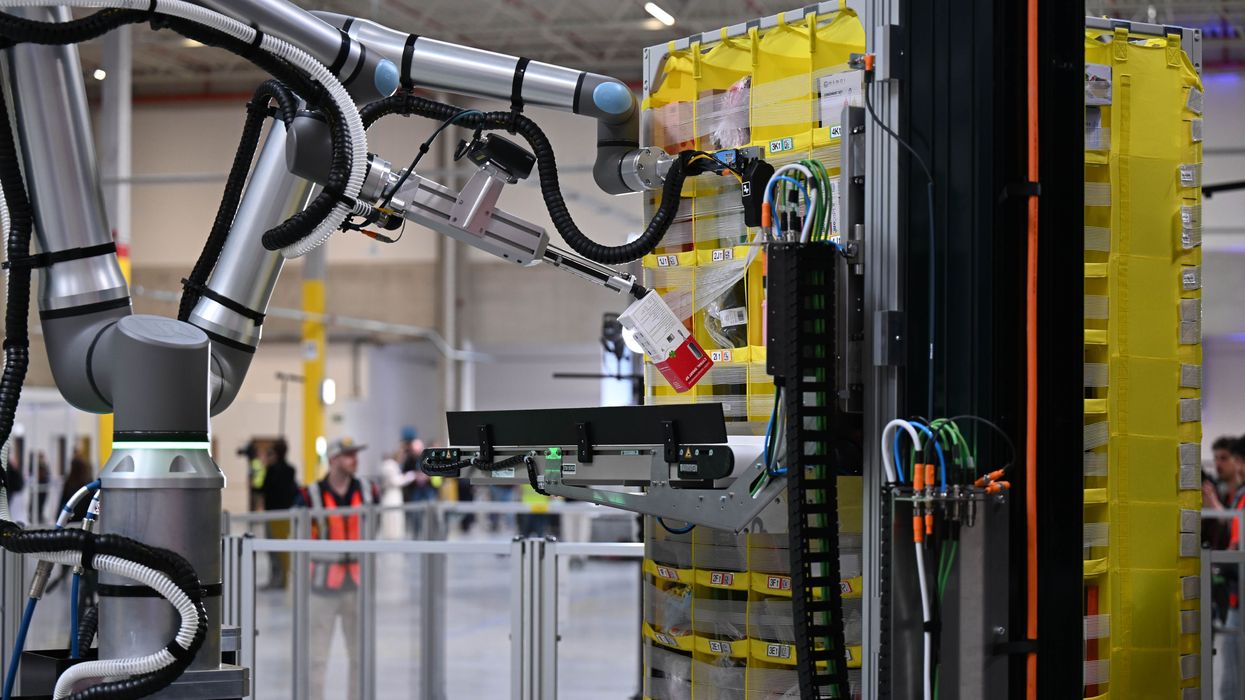
Internal Amazon documents reveal plans to replace more than half a million warehouse workers with robots by 2033. Executives call it innovation. Investors call it efficiency. The workers who made the company what it is call it what it feels like: erasure disguised as progress.
If Amazon can erase 500,000 jobs without consequence, every company will follow. Walmart is rolling out automated checkout. Target is testing robotic fulfillment. UPS and FedEx are developing delivery drones. Each step is described as modernization, but modernization without accountability becomes abandonment.
If we fail to govern this transition, we will inherit an economy that no longer needs its citizens.
The United States cannot afford another era of abandonment. Since 1979, productivity has risen by more than 80%, while hourly pay for most workers has barely moved. Automation threatens to widen that divide until it defines the economy itself.
Technology is not the enemy. The problem is who it serves. Every robot that replaces a worker transfers income from wages to shareholders. Every algorithm that eliminates a job turns public innovation into private accumulation. The challenge before us is not to resist progress but to govern it.
In this political moment, that may sound impossible. Washington is consumed by austerity and spectacle. The Trump administration’s second term has stripped worker protections, defunded training programs, and rewarded corporations that offshore or automate without oversight. But political cycles end, and public memory lasts. As the country heads toward the 2026 midterms and the 2028 presidential election, progressives have a rare opening to propose something larger than repair. We can build a new social contract for the automated age—a Labor Bill of Rights that reclaims the meaning of work and the purpose of progress.
That contract should rest on three pillars: profit sharing, a national transition fund, and public oversight.
The first pillar is profit sharing for automation gains.
When technology increases productivity, a share of those gains should go to the workers who make that productivity possible. France has required large firms to share profits with employees since 1967. Germany ensures worker representation on corporate boards, which prevents modernization from becoming a zero-sum game between labor and capital.
The United States could enact a federal profit-sharing mandate for companies with more than 250 employees or over $1 billion in annual revenue. When automation reduces a company’s payroll by more than 5% in a given year, that company would distribute at least 5% of its net profits as direct employee bonuses or shares. This could be structured through the tax code as a refundable surtax on undistributed automation profits.
If a company eliminates thousands of jobs to cut costs, it would still owe a share of its gains to the people and places that built its success. The rule would keep disposable income in circulation, prevent automation from collapsing demand, and ensure that the people who make automation possible continue to benefit from it.
The second pillar is a national automation transition fund.
Corporations that profit from replacing human labor should help finance the transition for those affected. The fund would be financed by an automation contribution: a 1-2% levy on the annual revenue of large firms that automate more than 5% of their workforce in any 12-month period. The Department of Labor would administer the fund through three channels.
First, wage insurance would guarantee workers at least 70% of their prior income for up to two years while they retrain or find new employment. Second, community investment grants would go directly to counties or cities experiencing major automation-driven job loss, funding small business development, infrastructure, and public employment programs. Third, an innovation dividend would fund training in fields that cannot easily be automated, such as healthcare, renewable energy, and education.
The fund could be modeled on unemployment insurance, with employer contributions adjusted annually based on automation activity. For example, if Amazon eliminated 500,000 jobs averaging $35,000 annually, a 2% contribution on its revenue—roughly $12 billion per year—would cover retraining, income support, and regional stabilization. This policy would turn automation from a corporate windfall into a shared investment in the country’s future.
The third pillar is public oversight of large-scale automation.
Just as environmental laws require companies to study and disclose the effects of pollution, corporations that plan to replace significant numbers of workers should disclose the social impacts of automation before acting. Any company planning to eliminate more than 250 jobs in a single year through automation should file an automation impact assessment with the Department of Labor.
The coming decade will decide whether automation serves democracy or displaces it.
The report would detail expected job losses, affected regions, and projected cost savings. It would also include a transition plan describing how the company will use part of those savings to fund retraining, relocation assistance, or community support. The Department of Labor would then coordinate with local governments and unions to review the plan, identify gaps, and recommend mitigation measures.
Failure to file or implement such a plan would carry penalties scaled to company size and profits. Repeat offenders could lose access to federal contracts, tax credits, or receive fines proportional to earnings. Transparency alone changes incentives. Once corporations must account for the social cost of their decisions, they begin to consider the communities they affect.
Together, these pillars would reattach innovation to justice. Profit sharing would reconnect wages and productivity. The transition fund would convert private efficiency gains into public stability. Oversight would replace secrecy with accountability.
None of this is radical. It is the next step in the unfinished project of democracy. When Franklin Roosevelt proposed an Economic Bill of Rights in 1944, he named the right to a useful job, to fair wages, to security, and to education as the foundations of freedom. We never completed that work. The next generation of progressives can.
That opportunity will not come from Congress as it stands. It will come from a national movement that links labor, climate, and democracy into one fight for a livable economy. The 2026 midterms will likely mark the beginning of that realignment, as voters look for something larger than a defense against decline. The 2028 election could be the first since the New Deal where a coalition wins not by promising safety, but by promising transformation.
Technology does not determine our future. Politics does. A robot can replace a worker, but it cannot replace the dignity of work or the shared purpose of a nation. If we fail to govern this transition, we will inherit an economy that no longer needs its citizens. If we succeed, we can create one where technology frees people from insecurity, not from income.
The wealth created by automation rests on a foundation built by the public. The internet that powers online retail began as a government project. The logistics networks that deliver goods rely on public roads and ports. The data that trains artificial intelligence is drawn from our collective lives. The returns should flow back into the society that made them possible.
The coming decade will decide whether automation serves democracy or displaces it. Progressives have a rare chance to lead with vision instead of reaction. The task is not to slow innovation but to make it answer to the people. The future of work must belong to workers—and that future begins when we decide that technology will serve humanity, not replace it.
"Are you going to simply dump these workers out on the street, or will you treat them with the dignity they deserve?" Sen. Bernie Sanders asked Jeff Bezos.
US Sen. Bernie Sanders on Tuesday demanded answers from Amazon as the corporate behemoth moved ahead with plans to lay off around 14,000 employees, with reports indicating the job cuts are just the start of a sweeping effort to replace workers with robots and artificial intelligence models in the coming years.
In a letter to Jeff Bezos, Amazon's billionaire founder and executive chairman, Sanders (I-Vt.) asked if the company has any plans to "provide help and support for the many hundreds of thousands of workers you will be replacing with robots and AI." The senator, a longtime critic of Amazon's treatment of warehouse workers, noted that the Amazon is poised to benefit substantially from tax breaks included in US President Donald Trump's signature budget law.
"Are you going to simply dump these workers out on the street, or will you treat them with the dignity they deserve?" Sanders asked Bezos, one of the richest men in the world. "Will you be providing a decent severance package for them? Will Amazon be maintaining their healthcare benefits? Will Amazon offer them a secure retirement plan? Or, will most of the savings and tax breaks simply be used to further enrich yourself and Amazon's wealthy stockholders?"
Sanders' letter came in the wake of Amazon's announcement that it is slashing its global workforce by roughly 14,000 employees, with additional cuts expected next year.
Reuters, which first reported the news, noted that the layoffs "offer an early look at the possibly broad effects of AI on workforces."
"Amazon CEO Andy Jassy flagged the potential for such losses in June, saying increased use of AI tools and agents would lead to more corporate job cuts, particularly through automating routine tasks," the outlet observed.
The layoffs followed explosive New York Times reporting that revealed Amazon's internal plans to replace more than half a million jobs with robots.
"At facilities designed for superfast deliveries, Amazon is trying to create warehouses that employ few humans at all," the Times reported. "And documents show that Amazon's robotics team has an ultimate goal to automate 75% of its operations."
It's not clear whether Amazon has any plans to provide substantive relief to workers and communities harmed by large-scale automation. Rather, the company appears focused on muting the public relations impact of mass job cuts.
The Times story notes that "documents show the company has considered building an image as a 'good corporate citizen' through greater participation in community events such as parades and Toys for Tots" as part of an anticipated need to "mitigate the fallout in communities that may lose jobs."
"Given all the support that you have received from the taxpayers of this country, don't you think that it might be appropriate to treat the American workers you are displacing with respect and compassion?"
Sanders, who has voiced alarm over the rapid development of AI technology and its implications for workers and humanity at large, warned in his letter Tuesday that "if Amazon succeeds on its massive automation plan, it will have a profound impact on blue-collar workers throughout America and will likely be used as a model by large corporations throughout America, including Walmart and UPS, to displace tens of millions of jobs."
Addressing Bezos directly, Sanders wrote that "the federal government has been very generous to you and Amazon," noting that the company has repeatedly avoided federal income taxes despite massive profits. The senator added that US taxpayers have effectively subsidized Amazon as the company pays delivery drivers, warehouse workers, and other employees such low wages that they're forced to rely on public assistance to get by.
"Given all the support that you have received from the taxpayers of this country, don't you think that it might be appropriate to treat the American workers you are displacing with respect and compassion?" Sanders asked Bezos. "I look forward to hearing back from you as soon as possible as to how you will protect the workers you are displacing."