SUBSCRIBE TO OUR FREE NEWSLETTER
Daily news & progressive opinion—funded by the people, not the corporations—delivered straight to your inbox.
5
#000000
#FFFFFF
To donate by check, phone, or other method, see our More Ways to Give page.
Daily news & progressive opinion—funded by the people, not the corporations—delivered straight to your inbox.
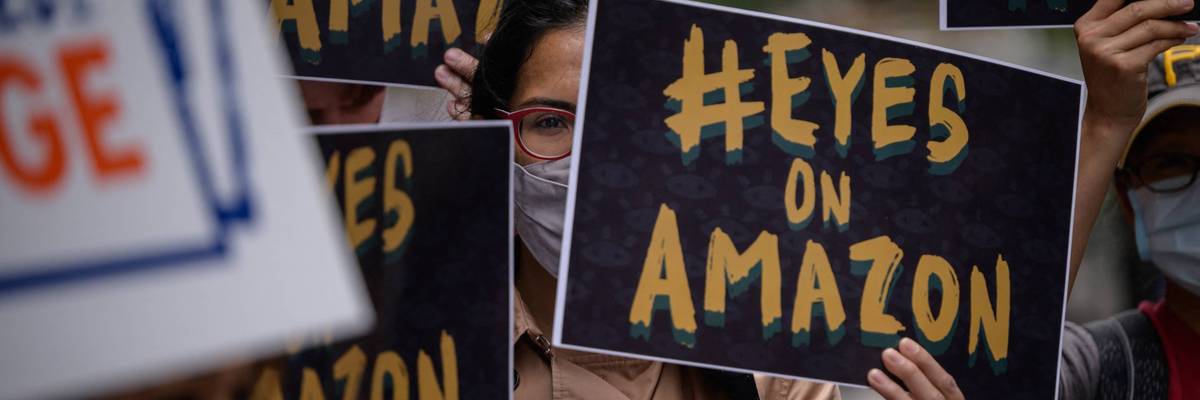
Amazon workers and "community allies" attend a rally outside the office of BlackRock in Manhattan, to protest against Amazon's working conditions and company policies in New York on May 24, 2021.
Will there be a popular uprising against AI and the vast AI-based robotic machinery that’s taking over both the means of production and the means of information?
Ted Gioia has a popular Substack called “The Honest Broker.” Although, as an author, his books tend to focus on music and popular culture, he writes eloquently about a wide range of topics and offers insightful commentary about the global forced march toward technocratic lifestyle and governance that we’re now immersed in. In one posting, “25 Propositions about the New Romanticism,” Gioia posits that there is a new movement afoot mimicking (or, better, reflecting) the Romantic Period of the 18th century. This movement coincided with the first industrial revolution and, as a counterweight to that trend, saw a great shift toward impulses to re-enchant the world via poetry, art, and music, and reconnecting to nature. Gioia writes:
More than two years ago, I predicted the rise of a New Romanticism—a movement to counter the intense rationalization and expanding technological control of society. Rationalist and algorithmic models were dominating every sphere of life at that midpoint in the Industrial Revolution—and people started resisting the forces of progress. Companies grew more powerful, promising productivity and prosperity. But Blake called them “dark Satanic mills” and Luddites started burning down factories—a drastic and futile step, almost the equivalent of throwing away your smartphone. Even as science and technology produced amazing results, dysfunctional behaviors sprang up everywhere. The pathbreaking literary works from the late 1700s reveal the dark side of the pervasive techno-optimism—Goethe’s novel about Werther’s suicide, the Marquis de Sade’s nasty stories, and all those gloomy Gothic novels. What happened to the Enlightenment? As the new century dawned, the creative class (as we would call it today) increasingly attacked rationalist currents that had somehow morphed into violent, intrusive forces in their lives—an 180° shift in the culture. For Blake and others, the name Newton became a term of abuse. Artists, especially poets and musicians, took the lead in this revolt. They celebrated human feeling and emotional attachments—embracing them as more trustworthy, more flexible, more desirable than technology, profits, and cold calculation.
He goes on to posit that we’re poised for a return to that modality and points out that the notion of a New Romanticism has spread “like a wildfire,” citing influencers such as Ross Barkan, Santiago Ramos, and Kate Alexandra. Gioia sees what he describes as cultural trends at the leading edge of this transformation citing popular TV series such as Pluribus and Yellowstone. But is this really happening or has Gioia just stumbled on a pocket of cultural resistance and pushback against technocracy that’s primarily a pocket of unified self-expression rather than something representing deep and substantive cultural and societal change?
Let’s be clear about what’s happening here: robots and AI are taking over our culture, our politics, our way of life, and our relationships to each other as social beings. They’re becoming the advance guard for a new and unprecedented technocratic form of governance—the apotheosis of Western scientific materialism. Further, these new forms of governance are being carried out by unelected Big Tech overlords operating behind the scenes and in the backrooms of a mediated society well out of public view.
The tech takeover is such a massive appropriation of our social, political, and cultural life—and indeed our own biological substrate—that stoic acceptance might not be the way to go this time around.
I certainly hope that Gioia is right about a major cultural rejection of technocracy. There are indeed hopeful signs. The fundamental human values that make societies work and cohere have gotten steadily shunted aside by the technocracy takeover of culture and education—essentially becoming a new value system. This behind-the-scenes power shift has been amplified and compounded by an over-emphasis in education on STEM, corporate modalities, neo-Darwinian utilitarianism, and the continuing erosion of the humanities that began decades ago. So yes, without a doubt, we need to get “back to the garden” and return to a wider and deeper set of the kind of core values that ultimately hold societies together. Without positive shared values, societies become rudderless and fall into a kind of benighted chaos. All we need to do is look around.
All of that said, in his Substack post, Gioia missed an important component of this transition—if indeed it is coming to pass (and we can only hope). Throwing off technocracy and emerging from our involuntary digital cages also means reconnecting with the natural world, a fundamental human relationship that’s now increasingly mediated by digital devices. The need for this reconnection, this existential about-face, was a key aspect of the romanticism of the 18th century. In literature, for example, the Romantic poets were rather obsessed with it as poet Robert Bly points out in his stellar book News of the Universe (I highly recommend it.) In allowing our daily life to be shifted into an increasingly claustrophobic and self-reinforcing digital cage, we have abandoned not only our connection to the natural world but also to each other. Connecting to nature also lets us tap into the mystery of the universe, which despite human folly remains nonetheless fully intact even if absurdly rationalized by scientific reductionism. Carl Sagan and Albert Einstein were both scientists who could appreciate this. We need more like them.
In the 80s and 90s, science fiction movies and literature commonly offered themes of “robot wars” where humans were pitted against the dominance of an ugly dystopian society. Will this be our future courtesy of Elon Musk and his cohorts? Or, alternatively, will there be a mass uprising against AI and the vast AI-based robotic machinery that’s taking over both the means of production and the means of information? We humans are known for our adaptability and stoicism in difficult situations such as world wars and major disasters. That stoicism and sense of “accepting what can’t be changed” seems to be part of our psychological and perhaps even biological makeup. But the tech takeover is such a massive appropriation of our social, political, and cultural life—and indeed our own biological substrate—that stoic acceptance might not be the way to go this time around.
In the next few years, it most certainly will have finally dawned on the mass of humanity, especially in advanced Western nations, that something is badly amiss. Many will realize at a visceral level that their everyday lives are trapped in a claustrophobia-inducing closed-circuit technocratic system and control grid that robs them of autonomy and freedom while purporting to do the opposite.
I totally agree that a new romanticism is a very necessary sea change at this strange time in human history but am perhaps a bit less optimistic that it will happen—at least over the next few years. The forces of technocracy seem too powerful at the moment to be countered because so many of the necessities of everyday life depend on our attachment to this digital realm. This includes paying bills, financial maintenance, government-related necessities such as getting a license renewed, and so much more. Further, technological dependency keeps getting ratcheted up by the self-appointed masters of the universe represented by Big Tech’s unchallenged and ever-growing power. That said, I sincerely hope I’m wrong about this and Gioia is right. Time will tell.
Dear Common Dreams reader, It’s been nearly 30 years since I co-founded Common Dreams with my late wife, Lina Newhouser. We had the radical notion that journalism should serve the public good, not corporate profits. It was clear to us from the outset what it would take to build such a project. No paid advertisements. No corporate sponsors. No millionaire publisher telling us what to think or do. Many people said we wouldn't last a year, but we proved those doubters wrong. Together with a tremendous team of journalists and dedicated staff, we built an independent media outlet free from the constraints of profits and corporate control. Our mission has always been simple: To inform. To inspire. To ignite change for the common good. Building Common Dreams was not easy. Our survival was never guaranteed. When you take on the most powerful forces—Wall Street greed, fossil fuel industry destruction, Big Tech lobbyists, and uber-rich oligarchs who have spent billions upon billions rigging the economy and democracy in their favor—the only bulwark you have is supporters who believe in your work. But here’s the urgent message from me today. It's never been this bad out there. And it's never been this hard to keep us going. At the very moment Common Dreams is most needed, the threats we face are intensifying. We need your support now more than ever. We don't accept corporate advertising and never will. We don't have a paywall because we don't think people should be blocked from critical news based on their ability to pay. Everything we do is funded by the donations of readers like you. When everyone does the little they can afford, we are strong. But if that support retreats or dries up, so do we. Will you donate now to make sure Common Dreams not only survives but thrives? —Craig Brown, Co-founder |
Ted Gioia has a popular Substack called “The Honest Broker.” Although, as an author, his books tend to focus on music and popular culture, he writes eloquently about a wide range of topics and offers insightful commentary about the global forced march toward technocratic lifestyle and governance that we’re now immersed in. In one posting, “25 Propositions about the New Romanticism,” Gioia posits that there is a new movement afoot mimicking (or, better, reflecting) the Romantic Period of the 18th century. This movement coincided with the first industrial revolution and, as a counterweight to that trend, saw a great shift toward impulses to re-enchant the world via poetry, art, and music, and reconnecting to nature. Gioia writes:
More than two years ago, I predicted the rise of a New Romanticism—a movement to counter the intense rationalization and expanding technological control of society. Rationalist and algorithmic models were dominating every sphere of life at that midpoint in the Industrial Revolution—and people started resisting the forces of progress. Companies grew more powerful, promising productivity and prosperity. But Blake called them “dark Satanic mills” and Luddites started burning down factories—a drastic and futile step, almost the equivalent of throwing away your smartphone. Even as science and technology produced amazing results, dysfunctional behaviors sprang up everywhere. The pathbreaking literary works from the late 1700s reveal the dark side of the pervasive techno-optimism—Goethe’s novel about Werther’s suicide, the Marquis de Sade’s nasty stories, and all those gloomy Gothic novels. What happened to the Enlightenment? As the new century dawned, the creative class (as we would call it today) increasingly attacked rationalist currents that had somehow morphed into violent, intrusive forces in their lives—an 180° shift in the culture. For Blake and others, the name Newton became a term of abuse. Artists, especially poets and musicians, took the lead in this revolt. They celebrated human feeling and emotional attachments—embracing them as more trustworthy, more flexible, more desirable than technology, profits, and cold calculation.
He goes on to posit that we’re poised for a return to that modality and points out that the notion of a New Romanticism has spread “like a wildfire,” citing influencers such as Ross Barkan, Santiago Ramos, and Kate Alexandra. Gioia sees what he describes as cultural trends at the leading edge of this transformation citing popular TV series such as Pluribus and Yellowstone. But is this really happening or has Gioia just stumbled on a pocket of cultural resistance and pushback against technocracy that’s primarily a pocket of unified self-expression rather than something representing deep and substantive cultural and societal change?
Let’s be clear about what’s happening here: robots and AI are taking over our culture, our politics, our way of life, and our relationships to each other as social beings. They’re becoming the advance guard for a new and unprecedented technocratic form of governance—the apotheosis of Western scientific materialism. Further, these new forms of governance are being carried out by unelected Big Tech overlords operating behind the scenes and in the backrooms of a mediated society well out of public view.
The tech takeover is such a massive appropriation of our social, political, and cultural life—and indeed our own biological substrate—that stoic acceptance might not be the way to go this time around.
I certainly hope that Gioia is right about a major cultural rejection of technocracy. There are indeed hopeful signs. The fundamental human values that make societies work and cohere have gotten steadily shunted aside by the technocracy takeover of culture and education—essentially becoming a new value system. This behind-the-scenes power shift has been amplified and compounded by an over-emphasis in education on STEM, corporate modalities, neo-Darwinian utilitarianism, and the continuing erosion of the humanities that began decades ago. So yes, without a doubt, we need to get “back to the garden” and return to a wider and deeper set of the kind of core values that ultimately hold societies together. Without positive shared values, societies become rudderless and fall into a kind of benighted chaos. All we need to do is look around.
All of that said, in his Substack post, Gioia missed an important component of this transition—if indeed it is coming to pass (and we can only hope). Throwing off technocracy and emerging from our involuntary digital cages also means reconnecting with the natural world, a fundamental human relationship that’s now increasingly mediated by digital devices. The need for this reconnection, this existential about-face, was a key aspect of the romanticism of the 18th century. In literature, for example, the Romantic poets were rather obsessed with it as poet Robert Bly points out in his stellar book News of the Universe (I highly recommend it.) In allowing our daily life to be shifted into an increasingly claustrophobic and self-reinforcing digital cage, we have abandoned not only our connection to the natural world but also to each other. Connecting to nature also lets us tap into the mystery of the universe, which despite human folly remains nonetheless fully intact even if absurdly rationalized by scientific reductionism. Carl Sagan and Albert Einstein were both scientists who could appreciate this. We need more like them.
In the 80s and 90s, science fiction movies and literature commonly offered themes of “robot wars” where humans were pitted against the dominance of an ugly dystopian society. Will this be our future courtesy of Elon Musk and his cohorts? Or, alternatively, will there be a mass uprising against AI and the vast AI-based robotic machinery that’s taking over both the means of production and the means of information? We humans are known for our adaptability and stoicism in difficult situations such as world wars and major disasters. That stoicism and sense of “accepting what can’t be changed” seems to be part of our psychological and perhaps even biological makeup. But the tech takeover is such a massive appropriation of our social, political, and cultural life—and indeed our own biological substrate—that stoic acceptance might not be the way to go this time around.
In the next few years, it most certainly will have finally dawned on the mass of humanity, especially in advanced Western nations, that something is badly amiss. Many will realize at a visceral level that their everyday lives are trapped in a claustrophobia-inducing closed-circuit technocratic system and control grid that robs them of autonomy and freedom while purporting to do the opposite.
I totally agree that a new romanticism is a very necessary sea change at this strange time in human history but am perhaps a bit less optimistic that it will happen—at least over the next few years. The forces of technocracy seem too powerful at the moment to be countered because so many of the necessities of everyday life depend on our attachment to this digital realm. This includes paying bills, financial maintenance, government-related necessities such as getting a license renewed, and so much more. Further, technological dependency keeps getting ratcheted up by the self-appointed masters of the universe represented by Big Tech’s unchallenged and ever-growing power. That said, I sincerely hope I’m wrong about this and Gioia is right. Time will tell.
Ted Gioia has a popular Substack called “The Honest Broker.” Although, as an author, his books tend to focus on music and popular culture, he writes eloquently about a wide range of topics and offers insightful commentary about the global forced march toward technocratic lifestyle and governance that we’re now immersed in. In one posting, “25 Propositions about the New Romanticism,” Gioia posits that there is a new movement afoot mimicking (or, better, reflecting) the Romantic Period of the 18th century. This movement coincided with the first industrial revolution and, as a counterweight to that trend, saw a great shift toward impulses to re-enchant the world via poetry, art, and music, and reconnecting to nature. Gioia writes:
More than two years ago, I predicted the rise of a New Romanticism—a movement to counter the intense rationalization and expanding technological control of society. Rationalist and algorithmic models were dominating every sphere of life at that midpoint in the Industrial Revolution—and people started resisting the forces of progress. Companies grew more powerful, promising productivity and prosperity. But Blake called them “dark Satanic mills” and Luddites started burning down factories—a drastic and futile step, almost the equivalent of throwing away your smartphone. Even as science and technology produced amazing results, dysfunctional behaviors sprang up everywhere. The pathbreaking literary works from the late 1700s reveal the dark side of the pervasive techno-optimism—Goethe’s novel about Werther’s suicide, the Marquis de Sade’s nasty stories, and all those gloomy Gothic novels. What happened to the Enlightenment? As the new century dawned, the creative class (as we would call it today) increasingly attacked rationalist currents that had somehow morphed into violent, intrusive forces in their lives—an 180° shift in the culture. For Blake and others, the name Newton became a term of abuse. Artists, especially poets and musicians, took the lead in this revolt. They celebrated human feeling and emotional attachments—embracing them as more trustworthy, more flexible, more desirable than technology, profits, and cold calculation.
He goes on to posit that we’re poised for a return to that modality and points out that the notion of a New Romanticism has spread “like a wildfire,” citing influencers such as Ross Barkan, Santiago Ramos, and Kate Alexandra. Gioia sees what he describes as cultural trends at the leading edge of this transformation citing popular TV series such as Pluribus and Yellowstone. But is this really happening or has Gioia just stumbled on a pocket of cultural resistance and pushback against technocracy that’s primarily a pocket of unified self-expression rather than something representing deep and substantive cultural and societal change?
Let’s be clear about what’s happening here: robots and AI are taking over our culture, our politics, our way of life, and our relationships to each other as social beings. They’re becoming the advance guard for a new and unprecedented technocratic form of governance—the apotheosis of Western scientific materialism. Further, these new forms of governance are being carried out by unelected Big Tech overlords operating behind the scenes and in the backrooms of a mediated society well out of public view.
The tech takeover is such a massive appropriation of our social, political, and cultural life—and indeed our own biological substrate—that stoic acceptance might not be the way to go this time around.
I certainly hope that Gioia is right about a major cultural rejection of technocracy. There are indeed hopeful signs. The fundamental human values that make societies work and cohere have gotten steadily shunted aside by the technocracy takeover of culture and education—essentially becoming a new value system. This behind-the-scenes power shift has been amplified and compounded by an over-emphasis in education on STEM, corporate modalities, neo-Darwinian utilitarianism, and the continuing erosion of the humanities that began decades ago. So yes, without a doubt, we need to get “back to the garden” and return to a wider and deeper set of the kind of core values that ultimately hold societies together. Without positive shared values, societies become rudderless and fall into a kind of benighted chaos. All we need to do is look around.
All of that said, in his Substack post, Gioia missed an important component of this transition—if indeed it is coming to pass (and we can only hope). Throwing off technocracy and emerging from our involuntary digital cages also means reconnecting with the natural world, a fundamental human relationship that’s now increasingly mediated by digital devices. The need for this reconnection, this existential about-face, was a key aspect of the romanticism of the 18th century. In literature, for example, the Romantic poets were rather obsessed with it as poet Robert Bly points out in his stellar book News of the Universe (I highly recommend it.) In allowing our daily life to be shifted into an increasingly claustrophobic and self-reinforcing digital cage, we have abandoned not only our connection to the natural world but also to each other. Connecting to nature also lets us tap into the mystery of the universe, which despite human folly remains nonetheless fully intact even if absurdly rationalized by scientific reductionism. Carl Sagan and Albert Einstein were both scientists who could appreciate this. We need more like them.
In the 80s and 90s, science fiction movies and literature commonly offered themes of “robot wars” where humans were pitted against the dominance of an ugly dystopian society. Will this be our future courtesy of Elon Musk and his cohorts? Or, alternatively, will there be a mass uprising against AI and the vast AI-based robotic machinery that’s taking over both the means of production and the means of information? We humans are known for our adaptability and stoicism in difficult situations such as world wars and major disasters. That stoicism and sense of “accepting what can’t be changed” seems to be part of our psychological and perhaps even biological makeup. But the tech takeover is such a massive appropriation of our social, political, and cultural life—and indeed our own biological substrate—that stoic acceptance might not be the way to go this time around.
In the next few years, it most certainly will have finally dawned on the mass of humanity, especially in advanced Western nations, that something is badly amiss. Many will realize at a visceral level that their everyday lives are trapped in a claustrophobia-inducing closed-circuit technocratic system and control grid that robs them of autonomy and freedom while purporting to do the opposite.
I totally agree that a new romanticism is a very necessary sea change at this strange time in human history but am perhaps a bit less optimistic that it will happen—at least over the next few years. The forces of technocracy seem too powerful at the moment to be countered because so many of the necessities of everyday life depend on our attachment to this digital realm. This includes paying bills, financial maintenance, government-related necessities such as getting a license renewed, and so much more. Further, technological dependency keeps getting ratcheted up by the self-appointed masters of the universe represented by Big Tech’s unchallenged and ever-growing power. That said, I sincerely hope I’m wrong about this and Gioia is right. Time will tell.