

SUBSCRIBE TO OUR FREE NEWSLETTER
Daily news & progressive opinion—funded by the people, not the corporations—delivered straight to your inbox.
5
#000000
#FFFFFF
To donate by check, phone, or other method, see our More Ways to Give page.
Daily news & progressive opinion—funded by the people, not the corporations—delivered straight to your inbox.

The threat of election-denying candidates is particularly acute in Arizona, where they are running for governor, secretary of state, and attorney general.
As President Donald Trump continues to push Republicans to aggressively gerrymander ahead of the 2026 midterm elections, a new analysis has found more than 50 candidates running for key offices who have in the past engaged in efforts to nullify election results.
As reported by NPR on Monday, election watchdog States United Action has released a report showing that election-denying candidates are running for offices in 23 states where, if victorious, they would have a direct role in certifying future elections.
States United classifies election deniers as candidates who meet one of five criteria: Falsely claiming that Trump won the 2020 election, spreading conspiracy theories about the election results, refusing to certify the 2020 election, supporting litigation to overturn election results, and refusing to concede a race after being defeated.
In total, States United found at least 53 such candidates running for positions this year, including secretaries of state and governorships, that would put them in position to try to block or impede the certification of elections.
The threat is particularly acute in Arizona, where election deniers are running for governor, secretary of state, and attorney general.
This prospective Arizona election denial ticket is headlined by MAGA hardliner Andy Biggs, who voted against certification of the 2020 election results as a US congressman and who is running to unseat incumbent Democratic Gov. Katie Hobbs.
States United CEO Joanna Lydgate told NPR that her organization is tracking election deniers running for office to "provide voters with the most accurate information possible" and "understand exactly what these candidates stand for and whether they fundamentally believe in free and fair elections in this country."
As election deniers are trying to win key offices throughout the US, the Trump administration is working to get more directly involved in purging voter rolls ahead of the midterms.
According to a Monday report from CNN, "Republicans and the Trump administration are now testing the scope of the federal law that imposes that ban on 'systematic' removal programs within three months of an election, as President Donald Trump pushes for more aggressive reviews of voter rolls for non-citizens and other ineligible voters."
What this means is that states could in theory purge voter rolls just weeks ahead of elections, giving people removed from the rolls almost no time to file challenges.
Wren Orey, director of the Bipartisan Policy Center’s Elections Project, told CNN that purging voter rolls less than three months before an election means there's a high risk that "voters won’t have adequate time or notice to be able to provide the documents that they’ll need ahead of the election."
"Maybe their birth certificate doesn’t meet the requirements," Orey explained. "Maybe they don’t have one handy, maybe they don’t have a passport. That could take months to get."
Brent Ferguson, the senior director of strategic litigation at Campaign Legal Center, told CNN that he was particularly disturbed by the Trump White House's involvement in this effort to manage voter rolls.
"It sets up a situation where the federal government itself is the actor trying to purge voters from the rolls in the days before the election," Ferguson said, "which is clearly illegal."
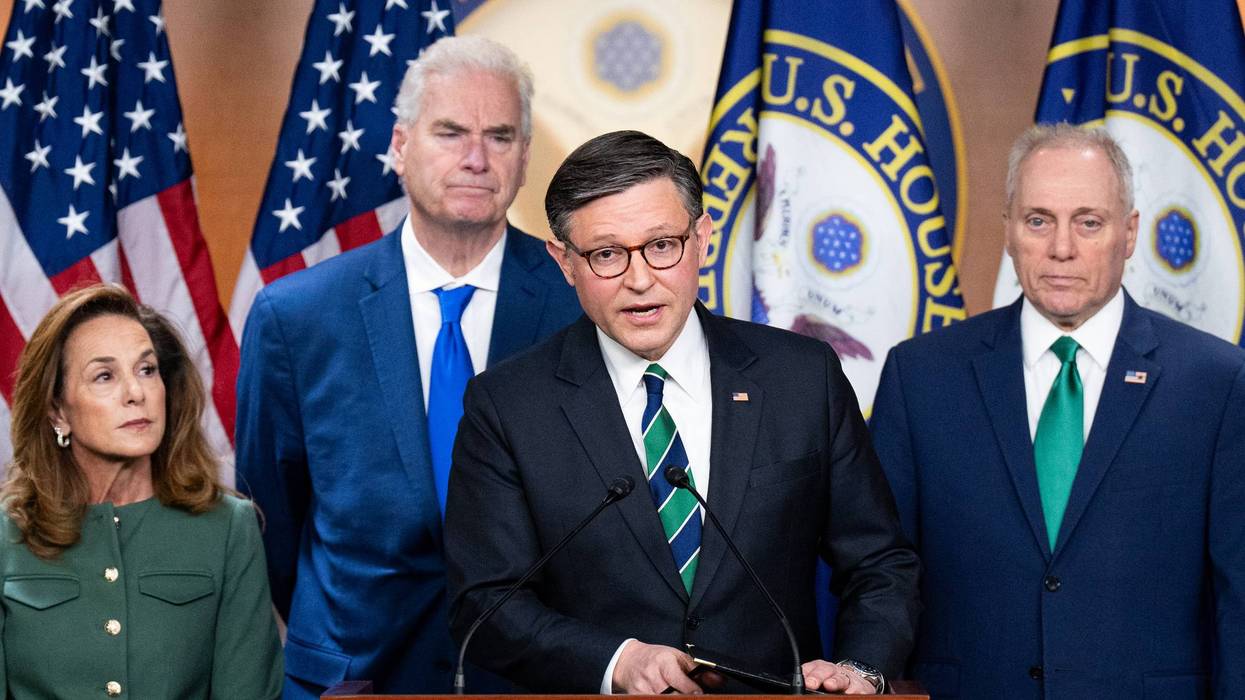
"The so-called 'balanced budget amendment' is the Republicans’ latest backdoor attempt at gutting Americans’ hard-earned benefits," said one Democratic lawmaker.
Nearly every member of the House Republican caucus voted Wednesday in favor of a proposed constitutional amendment that experts say would result in massive cuts to Social Security, Medicare, nutrition assistance, and other key federal programs.
The proposed amendment, led by Rep. Andy Biggs (R-Ariz.), would effectively prohibit the federal government from deficit spending, with an exception for declared wars. The final House vote on the amendment was 211-207, well short of the two-thirds support required for passage of a constitutional amendment.
Every Republican who took part in Wednesday's vote backed the proposed amendment. Just one Democrat—Rep. Henry Cuellar of Texas—joined the GOP in voting yes.
The vote came as congressional Republicans, and a handful of Democrats, continued to reject efforts to halt a war that is costing US taxpayers roughly $1 billion a day—a price tag that some in the GOP have openly embraced.
The vote also came less than a year after congressional Republicans and President Donald Trump approved a sprawling reconciliation package that delivered another round of tax cuts primarily to the richest Americans and large corporations, while enacting unprecedented cuts to Medicaid and federal nutrition assistance.
Nonpartisan analysts have estimated that the GOP budget law would add more than $4 trillion to the national debt over the next decade.
“American families don’t need a lecture on fiscal responsibility from the same politicians who just added $4 trillion to the debt with their so-called ‘Big Beautiful Bill’—one of the most expensive pieces of legislation in American history,” said Rep. Brendan Boyle (D-Pa.), the top Democrat on the House Budget Committee. “When it comes to cutting taxes for billionaires, they have never had a problem blowing up the deficit. This amendment is nothing more than a show to cover up their hypocrisy on the debt.”
Rep. John Larson (D-Conn.) said following Wednesday's vote that "the so-called 'balanced budget amendment' is the Republicans’ latest backdoor attempt at gutting Americans’ hard-earned benefits."
"It would force drastic cuts to Medicare, Social Security, food assistance, veterans’ benefits, and other programs American families depend on," said Larson. "My Republican colleagues can say this amendment is about fiscal responsibility all they want, but the reality is that the budget they passed last year ballooned our deficit by $4 trillion to pay for tax cuts for the wealthy and give ICE a slush fund larger than most nations' militaries."
"Not only would it effectively bar tax increases, but it would allow unlimited tax cuts, thus forcing huge, unacceptable program cuts. It should be roundly rejected."
Ahead of the amendment vote, the Center on Budget and Policy Priorities (CBPP) warned that the amendment's passage and ratification by US states would "immediately devastate programs that are appropriated annually, such as housing assistance, education, and scientific and medical research."
"And eventually it would require cutting programs such as Social Security, Medicare, and food assistance," the think tank added. "Claims that these programs would ultimately be protected ring hollow, given their share of the budget. If policymakers decide to shield those programs from cuts, the amendment would require lawmakers to devastate the rest of the federal budget—including Medicaid, food assistance, housing assistance, education, scientific and medical research, farm aid, national parks, transportation, airport security, mine safety—since revenue increases would be so hard to achieve."
Under the proposed amendment, two-thirds support in each chamber of Congress would be required to approve any new tax or increase in the tax rate, hamstringing lawmakers' ability to raise revenue.
"Ultimately, meeting longstanding and broadly popular commitments to seniors’ retirement and healthcare, and managing the future risks associated with higher debt, will require substantially more revenue," said CBPP's Brendan Duke. "This constitutional amendment moves in the opposite direction. Not only would it effectively bar tax increases, but it would allow unlimited tax cuts, thus forcing huge, unacceptable program cuts. It should be roundly rejected."
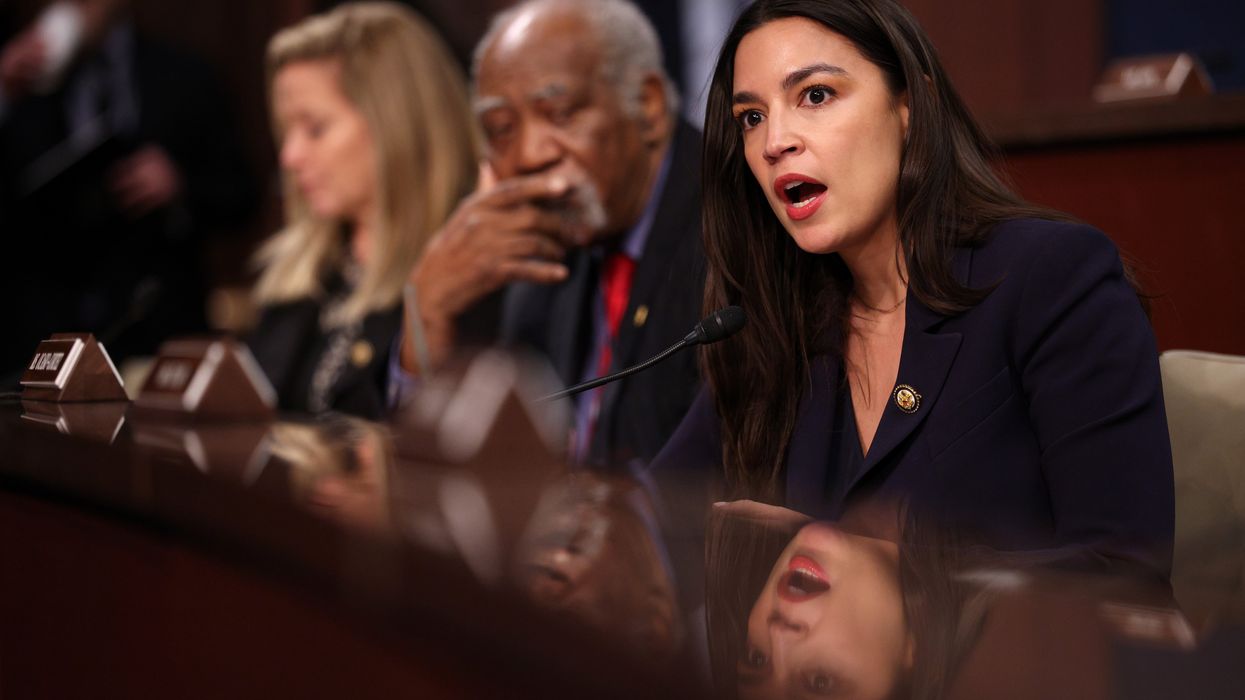
"The fact is, we work for everybody. If Republican politicians can't get that we work for the public, then the public should give them the boot," said the Democrat from New York.
U.S. Rep. Alexandria Ocasio-Cortez, a Democrat from New York, had sharp words for Republican Rep. Andy Biggs of Arizona and two other Arizona elected officials, following reporting that the trio was scheduled to speak at a town hall on Tuesday evening—which only Republicans were allowed to attend.
"It's only 'free speech' if you agree with them. Everyone else gets stripped from their community's town hall," wrote Ocasio-Cortez on X in response to the reporting. "The fact is, we work for everybody. If Republican politicians can't get that we work for the public, then the public should give them the boot."
According to a flyer posted to the Legislative District 12 Republican Committee website, Biggs, Arizona Senate President Warren Petersen (R-12), and Maricopa County Sheriff Jerry Sheridan were slated to speak at a town hall event in Chandler, Arizona on Tuesday evening.
Camaron Stevenson, chief political correspondent for the outlet The Copper Courier, posted a screenshot of the flyer on X on Tuesday, alongside a screenshot of an email from the First Vice Chair of the Arizona Legislative District 12 Republican Committee Patty Porter that reads: "Tonight's townhall is a private event. I have been reminded that only members of the Republican Party will be admitted into the venue."
According to The Phoenix New Times, Porter did not answer queries about why the event was being called a "townhall"—the spelling used by Porter and on the flyer—if it is private.
Neither Petersen nor Biggs responded to requests for comment, according to the outlet, though Biggs called Stevenson's social media post saying that he is "hosting" the town hall "false." He did not address the Republican-only nature of the event, per the New Times.
Stevenson on Tuesday shared a video of an Independent voter who said he registered for the town hall but was turned away after they reviewed his voting history.
This news out of Arizona follows multiple instances where GOP lawmakers have faced angry crowds at town halls, with constituents showing up to express concerns about President Donald Trump's efforts to slash federal programs and personnel.
House Speaker Mike Johnson (R-La.) has encouraged Republican lawmakers to skip the town halls, according to The Associated Press. "They're professional protesters," Johnson said at a news conference in early March. "So why would we give them a forum to do that right now?"
Democrats have sought to capitalize on the development. Minnesota Gov. and 2024 vice presidential candidate Tim Walz recently launched a town hall tour targeting GOP districts and the Democratic National Committee is targeting vulnerable House Republicans with ads that say the lawmakers "won't talk to his/her constituents," according to Tuesday reporting from Axios.
Ocasio-Cortez is set to join Sen. Bernie Sanders (I-Vt.) for five stops of his "Fighting Oligarchy" tour in Arizona, Colorado, and Nevada from Thursday through Saturday.
This article has been updated to correct the quote in the headline.

"Invasion and great replacement theory rhetoric, both deeply rooted in white nationalist and antisemitic tropes, are no longer a bug on the Hill, they are a regular feature," said one campaigner.
Republican U.S. lawmakers who embrace and amplify racist, xenophobic, and antisemitic conspiracy theories about undocumented immigrants are helping to stoke deadly politically motivated violence, according to a report published Friday by a coalition of advocacy groups.
The report—titled Bigoted Conspiracy Caucus—"exposes the normalization of xenophobic 'great replacement' and 'invasion' conspiracies within the 118th Congress, documenting their historical roots and widespread promotion by members of Congress."
"The great replacement conspiracy claims Jews are orchestrating the replacement of white Christian Americans with nonwhite immigrants, people of color, or others who they think are inferior and 'easier to control,'" the report states. "Today's versions may generally avoid referencing race and religion explicitly, instead emphasizing culture, immigration status, or political power."
"Invasion conspiracies describe immigrants as 'invaders' who pose an existential threat to American 'culture,' or 'traditions,' and implicitly call for hate-fueled attacks to counter this imagined threat," the publication continues.
The report details how "invasion" rhetoric "has metastasized and spread within the 118th Congress," and how "it is not only immigration hardliners" who are engaging in it.
"As of publication, the 118th Congress has held more than 30 congressional hearings where bigoted conspiracies of cultural replacement or an invasion were espoused" and dozens of "immigration hardliners, far-right figures, and members of SPLC-designated anti-immigrant hate groups were called to testify, the paper notes, referring to the Southern Poverty Law Center, which designates and monitors hate groups.
"In total, there have been 1,411 unique social media posts from official congressional accounts promoting the same bigoted conspiracies," the report's authors wrote.
Examples cited in the report include Rep. Andy Biggs (R-Ariz.) producing an ominous video titled " Alien Invasion" and Rep. Matt Gaetz (R-Fla.) publishing an xenophobic opinion piece in his official capacity on the far-right new website Daily Caller, which in 2017 published a video encouraging running over protesters with cars. This, just months before James Fields, a neo-Nazi supporter of former President Donald Trump's anti-immigrant policies, used his car to murder civil rights activist Heather Heyer at a white supremacist rally in Charlottesville, Virginia.
The report details how right-wing lawmakers also engage in "coded versions of replacement-style ideas," including by "warning of supposed nefarious plots to import a new voting bloc of immigrants as well as intentionally importing a number so large it will change the demographics in favor of the Democrats, who are often alleged to be behind the scheme."
For example, House Homeland Security Committee Chair Mark Green (R-Tenn.) appeared on Fox News and asserted that President Joe Biden "is more concerned about future votes for his party than he is the security of the American people." Rep. Marjorie Taylor Greene (R-Ga.) declared on social media that Biden and Homeland Security Secretary Alejandro Mayorkas "have spent nearly four years working to systematically replace the American people."
The report shows that "this rhetoric has gone beyond posting and public comments and has shown up in official legislation."
Examples include Rep. Lance Gooden (R-Texas) introducing the " No Tax Dollars for the United Nations' Immigration Invasion Act," which would ban the federal government from funding crucial U.N. refugee and migrant agencies that the U.S. has backed with bipartisan support for over 70 years, and Rep. Jodey Arrington's (R-Texas) resolution to invoke the Constitution's invasion clause to give states "sovereign power to repel an invasion." Arrington's proposal is backed by at least 50 GOP colleagues.
Lawmakers' "great replacement" and "invasion" rhetoric has had deadly consequences. The report highlights the massacres in Pittsburgh, Buffalo, Christchurch, Poway, and El Paso. The mass shooting in Texas—in which another white supremacist Trump supporter gunned down dozens of mostly Latino people in a Walmart after penning a manifesto citing the great replacement theory—took place five years ago Saturday.
The report argues that anti-immigrant rhetoric threatens democracy by adding "fuel to election deniers' claims that elections cannot be trusted because the ballot box is polluted with fraudulent undocumented immigrant votes." When given false legitimacy by lawmakers, this erodes "public trust in elections and gives justification for overturning unfavorable results."
"The 'great replacement' and 'invasion' conspiracies are a danger to individuals, communities, and democracy itself."
The eight groups that produced the report are: America's Voice, American-Arab Anti-Discrimination Committee, Bend the Arc: Jewish Action, Help Refugees & Asylum-Seekers (HIAS), Jewish Council for Public Affairs, Presente.org, Southern Poverty Law Center, and Western States Center.
"The 'great replacement' and 'invasion' conspiracies are a danger to individuals, communities, and democracy itself," Rabbi Jason Kimelman-Block, Washington director of Bend the Arc: Jewish Action, said in a statement Friday. "These lies have inspired violence and mass murder in places such as El Paso, Pittsburgh, and Buffalo."
"But instead of calling out and marginalizing these reckless falsehoods, far too many members of Congress have instead amplified them and brought them into the mainstream for their own cynical gain," he added. "It is long past time to hold these elected officials accountable for their recklessness. American Jews will not be silent in the face of this threat not only to our safety, but to the safety of so many communities in our broader American family."
HIAS vice president of U.S. policy and advocacy Naomi Steinberg said that "invasion and great replacement theory rhetoric, both deeply rooted in white nationalist and antisemitic tropes, are no longer a bug on the Hill, they are a regular feature."
"It is incumbent upon all of us to speak up to denounce this language every time we hear it and to insist upon good faith, fact-based debates about how to address immigration challenges in the U.S.," she added, "rather than the dangerous hate-slinging that has taken over the immigration debate in the halls of Congress and on campaign trails around the country."

The far-right Opposed-to-Big-Government cultists are dead set on destroying the working class.
While Kevin McCarthy’s struggle to become Speaker of the House of Representatives appears to be about personality and struggles within the House Republican caucus, it’s really about something much larger: the fate and future of American “big government” and the middle class it created.
Ever since the Reagan Revolution, the phrase “big government” has been on the lips of Republican politicians. They utter it like a curse at every opportunity.
It seems paradoxical: Republicans complain about “big government,” but then go on to support more and more government money for expanding prisons and a bloated Pentagon budget. Once you understand their worldview, however, it all makes perfect sense.
First, some background.
From the founding of our republic through the early 1930s the American middle class was relatively small. It was almost entirely made up of the professional and mercantile class: doctors, lawyers, shop-owners and the like. Only a tiny percentage of Americans were what we would today call middle class.
Factory workers, farmers, carpenters, plumbers, and pretty much all manner of “unskilled laborers” were the working poor rather than the middle class. Most neighborhoods across America had a quality of life even lower than what today we would call “ghettos.”
As recently as 1900, for example, women couldn’t vote, senators were appointed by the wealthiest power brokers in the states, and poverty stalked America.
There was no minimum wage; when workers tried to organize unions, police would help employers beat or even murder their ringleaders; and social safety net programs like unemployment insurance, Social Security, public schools, Medicare, food and housing supports, and Medicaid didn’t exist.
There was no income tax to pay for such programs, and federal receipts were a mere 3 percent of GDP (today its around 20 percent). As the President’s Council of Economic Advisors noted in their 2000 Annual Report:
“To appreciate how far we have come, it is instructive to look back on what American life was like in 1900. At the turn of the century, fewer than 10 percent of homes had electricity, and fewer than 2 percent of people had telephones. An automobile was a luxury that only the very wealthy could afford.
“Many women still sewed their own clothes and gave birth at home. Because chlorination had not yet been introduced and water filtration was rare, typhoid fever, spread by contaminated water, was a common affliction. One in 10 children died in infancy. Average life expectancy in the United States was a mere 47 years.
“Fewer than 14 percent of Americans graduated from high school. ... Widowhood was far more common than divorce. The average household had close to five members, and a fifth of all households had seven or more. …
“Average income per capita, in 1999 dollars, was about $4,200. … The typical workweek in manufacturing was about 50 hours, 20 percent longer than the average today.”
The Republican Great Depression of the 1930s, though, was a huge wake-up call for American voters, answered by President Franklin D. Roosevelt.
His New Deal programs brought us, for the first time, “big government” and the people loved it. They elected him President of the United States four times!
FDR created Social Security, unemployment insurance, guaranteed the right to unionize, outlawed child labor, regulated big business by creating the Securities and Exchange Commission (SEC) and other agencies, and funded infrastructure across the country from roads to bridges to dams and power stations.
He raised taxes on the morbidly rich all the way up to 90% and used that money to build schools and hospitals across the nation. He brought electricity to rural parts of the country, and put literally millions to work in various “big government” programs.
“Big government,” in other words, created the modern American middle-class.
By the 1950s a strong middle class representing almost half of Americans had emerged for the first time in American history.
By the late 1970s it was around 65 percent of us.
And that’s when the billionaires (then merely multimillionaires) decided enough was enough and got to work.
In 1980, David Koch ran for vice president with the Libertarian Party, an organization created by the real estate lobby to give an air of legitimacy to their efforts to outlaw rent control and end government regulation of their industry.
His platform included a whole series of positions that were specifically designed to roll back and gut FDR’s “big government” programs (along with those added on by both Nixon and LBJ’s Great Society) that had created and then sustained America’s 20th century middle class:
— “We urge the repeal of federal campaign finance laws, and the immediate abolition of the despotic Federal Election Commission.
— “We favor the abolition of Medicare and Medicaid programs.
— “We oppose any compulsory insurance or tax-supported plan to provide health services, including those which finance abortion services.
— “We also favor the deregulation of the medical insurance industry.
— “We favor the repeal of the fraudulent, virtually bankrupt, and increasingly oppressive Social Security system. Pending that repeal, participation in Social Security should be made voluntary.
— “We propose the abolition of the governmental Postal Service.
— “We oppose all personal and corporate income taxation, including capital gains taxes.
— “We support the eventual repeal of all taxation.
— “As an interim measure, all criminal and civil sanctions against tax evasion should be terminated immediately.
— “We support repeal of all law which impede the ability of any person to find employment, such as minimum wage laws.
— “We advocate the complete separation of education and State. Government schools lead to the indoctrination of children and interfere with the free choice of individuals. Government ownership, operation, regulation, and subsidy of schools and colleges should be ended.
— “We condemn compulsory education laws … and we call for the immediate repeal of such laws.
— “We support the repeal of all taxes on the income or property of private schools, whether profit or non-profit.
— “We support the abolition of the Environmental Protection Agency.”
— “We support abolition of the Department of Energy.
— “We call for the dissolution of all government agencies concerned with transportation, including the Department of Transportation.
— “We demand the return of America’s railroad system to private ownership. We call for the privatization of the public roads and national highway system.
— “We specifically oppose laws requiring an individual to buy or use so-called ‘self-protection’ equipment such as safety belts, air bags, or crash helmets.
— “We advocate the abolition of the Federal Aviation Administration.
— “We advocate the abolition of the Food and Drug Administration.
— “We support an end to all subsidies for child-bearing built into our present laws, including all welfare plans and the provision of tax-supported services for children.
— “We oppose all government welfare, relief projects, and ‘aid to the poor’ programs. All these government programs are privacy-invading, paternalistic, demeaning, and inefficient. The proper source of help for such persons is the voluntary efforts of private groups and individuals.
— “We call for the privatization of the inland waterways, and of the distribution system that brings water to industry, agriculture and households.
— “We call for the repeal of the Occupational Safety and Health Act.
— “We call for the abolition of the Consumer Product Safety Commission.
— “We support the repeal of all state usury laws.”
Today’s challenges to Kevin McCarthy are mostly coming from members of the Republican House Freedom Caucus, pretty much a reinvention of the Tea Party Caucus, funded in substantial part by rightwing billionaires and CEOs who share the late David Koch’s worldview.
The world is made up of “makers” and “takers,” they’ll tell you. The billionaire “job creators” shouldn’t be taxed to support the “moochers” who demand everything from union rights to a living wage to free college.
Why, these Freedom Caucus members ask, should their billionaire patrons be forced — at the barrel of an IRS agent’s gun! — to pay taxes to support the ungrateful masses through “big government” programs? Isn’t it up to each of us to make our own fortunes? Wasn’t Darwin right?
These Republicans believe our government should really only have a few simple mandates: maintain a strong military, tough cops, and a court system to protect their economic empires.
That’s why they’ll support massive prison expansions and nosebleed levels of pentagon spending but (metaphorically) fight to the death to prevent an expansion of Social Security or food stamps.
And that’s why they hate Kevin McCarthy.
In the past, McCarthy has shown a willingness to compromise and negotiate with Democrats. Most recently, as Congressman Chip Roy pointed out on the House floor yesterday when nominating Byron Donalds to replace McCarthy, he failed to block the $1.7 trillion omnibus bill through Congress that was loaded with what rightwing billionaires consider “freebies” for “taker” and “moocher” Americans.
It appears all or nearly all of the Freedom Caucus members, dancing to the tune first played by David Koch, don’t believe in our current form of American government. They want us to go back to the pre-1930s America, before FDR’s New Deal.
Those were the halcyon days when workers cowered before their employers, women and minorities knew their places, and government didn’t interfere with the business of dynasty-building even when it meant poisoning entire communities and crushing small businesses.
They appear to agree with the majority of the Supreme Court Republicans who recently began dismantling the “big government” administrative state by ending the EPA’s power to regulate greenhouse gasses.
They’ve already succeeded, over the past 40 years of the Reagan Revolution, at whittling the middle class down from 65 percent of us to around 45 percent of us: NPR commemorated it in 2015 with the headline: “The Tipping Point: Most Americans No Longer Are Middle Class.”
Now they want even more poverty for workers and more riches for their morbidly rich funders, and don’t believe that “moderate” Republicans will get them there. As Ginni Thomas and a pantheon of “conservative” luminaries wrote yesterday in an open letter opposing McCarthy’s speakership:
“[H]e has failed to answer for, or commit to halting, his coordinated efforts in the 2022 elections to promote moderate Republican candidates over conservatives.”
The “conservative” Republicans have already announced that once they get their act together in Congress with a new speaker, their first order of business is going to be to cut more taxes on billionaires.
While the battle for House Speaker appears to be about personality, it’s really about ideology and policy. It’s about the future of “big government” and whether or not we will continue to have an American middle class.
And as long as Libertarian-leaning billionaires continue pouring cash into the campaigns and lifestyles of Republican members of Congress, this battle that’s been going on for over 40 years to tear apart the American middle-class is not going to end or go away any day soon.
Members of the House Select Committee to Investigate the January 6th Attack on the United States Capitol are expected to finalize decisions on criminal referrals during a virtual meeting Sunday afternoon.
CBS News' Margaret Brennan inquired about the panel's plans earlier Sunday, when Rep. Adam Schiff (D-Calif.)--a member of the subcommittee created to deal with outstanding issues, including potential referrals--to the U.S. Department of Justice (DOJ)--appeared on "Face the Nation."
Pointing to reporting that the committee is considering referrals for former President Donald Trump, ex-DOJ official Jeffrey Clark, right-wing attorney John Eastman, former Trump lawyer Rudy Giuliani, and ex-White House chief of staff Mark Meadows, she asked, "Is there a consensus on whether to send a referral for criminal prosecution to the Justice Department, and would doing that be anything more than symbolic?"
"I think we are in common agreement about what our approach should be. I'm not ready or authorized at this point to tell you what that is. We are, as a subcommittee--several of us that were charged with making the recommendation about referrals--gonna be making that recommendation to full committee today," Schiff said, adding that the decisions will be included in a panel report set to be released later this month.
Schiff continued:
What I can tell you about the process is we're looking at: What is the quantum of evidence that we have against individuals? What is the impact of making a referral? Are we gonna create some suggestion by referring some, that others, there wasn't sufficient evidence, when we don't know, for example, what evidence is in the position of the Justice Department?
So, if we do make referrals, we want to be very careful about how we do them. But I think we're all certainly in agreement that there is evidence of criminality here and we want to make sure that the Justice Department is aware of that.
In the wake of Trump's announcement last month that he is seeking the GOP's presidential nomination for 2024--despite his various legal issues and inciting last year's deadly Capitol attack with his "Big Lie" about the 2020 contest--Attorney General Merrick Garland appointed Jack Smith, a longtime federal prosecutor, as special counsel to oversee ongoing investigations involving the twice-impeached former president.
The DOJ notably does not need a referral from Congress to bring charges. Referencing the department's probes, Brennan asked Schiff, "So what does the committee sending a referral do other than look political?"
"Well, look, we have been far out ahead in most respects of the Justice Department in conducting our investigation," the congressman responded. "I think they have made use of the evidence that we have presented in open hearings. I think they'll make use of the evidence that we present in our report to further their investigations."
"And I think it makes an important statement, not a political one, but a statement about the evidence of an attack on the institutions of our democracy and the peaceful transfer of power, that Congress examining an attack on itself is willing to report criminality," he added. "So I think it's an important decision in its own right if we go forward with it and one that the department ought to give due consideration to."
Committee Chairman Rep. Bennie Thompson (D-Miss.) had confirmed to reporters on Thursday that the committee planned to make decisions about criminal referrals during Sunday's meeting.
"I think the more we looked at the body of evidence that we had collected," he said, "we just felt that while we're not in the business of investigating people for criminal activities, we just couldn't overlook some of them."
The panel's only two Republicans--Vice Chair Liz Cheney (Wyo.) and Rep. Adam Kinzinger (Ill.)--are both leaving office in a few weeks and the GOP is set to take control of the House. Rep. Kevin McCarthy (R-Calif.), who hopes to be the next speaker, has vowed to hold hearings investigating the committee.
The Hill reported Sunday that McCarthy and the other four members of Congress who ignored subpoenas from the committee--GOP Reps. Andy Biggs (Ariz.), Mo Brooks (Ala.), Jim Jordan (Ohio), and Reps. Scott Perry (Pa.)--could be referred to the House Ethics Committee rather than the DOJ.
Rep. Jamie Raskin (D-Md.), a constitutional law expert who chairs the subcommittee focusing on referrals, pointed to the relevant part of the U.S. Constitution.
"The speech or debate clause makes it clear that Congress doesn't hold members of Congress accountable in the judiciary or other places in the government," he said. "Members of Congress are only held accountable through Article 1 in their own chambers for their actions."
This post has been updated with reporting about the five House Republicans who defied subpoenas from the panel.