SUBSCRIBE TO OUR FREE NEWSLETTER
Daily news & progressive opinion—funded by the people, not the corporations—delivered straight to your inbox.
5
#000000
#FFFFFF
To donate by check, phone, or other method, see our More Ways to Give page.
Daily news & progressive opinion—funded by the people, not the corporations—delivered straight to your inbox.
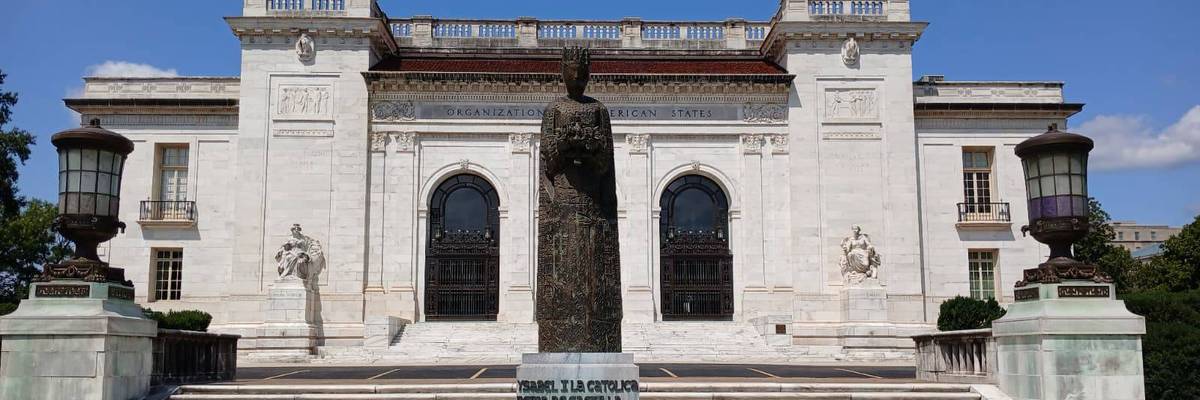
The headquarters of the Organization of American States is shown in Washington, DC.
This is the first challenge against the Trump administration on protest crackdowns by an international court, and one of the first legal challenges generally.
Tuesday, the Inter-American Commission on Human Rights, or IACHR, at the Organization of American States, a body historically committed to investigating crimes against humanity committed by governments in the Americas, held a hearing in Washington, DC against the Trump administration for its treatment of protests held against Immigration and Customs Enforcement, or ICE, crackdowns in the US.
The delegation, represented by Thomas Becker and Nicholas Rodelo, for the University Network for Human Rights, presented evidence of attacks of rights to free assembly and free expression by the Trump administration.
Becker has previously successfully prosecuted a civil lawsuit against former Bolivian President and US ally, Gonzalo Sanchez de Lozada, over 2003 crackdowns and extrajudicial killings of protesters.
This is the first challenge against the Trump administration on protest crackdowns by an international court, and one of the first legal challenges generally. Speakers included Antonio Romanucci, the attorney representing the family of Renee Good, and former counsel of George Floyd; Reverend David Black, who was struck in the head by federal agents at the Broadview Detention Facility; and Naureen Shah, the director of government affairs at the American Civil Liberties Union (ACLU).
Speakers and observers at the hearing argued that the commission must be empowered to investigate fully and act decisively, warning that the region is entering a new era of authoritarianism even as many of its democracies remain young and fragile.
During the hearing, video evidence and testimony were presented documenting the alleged abuses, prompting a response from State Department lawyers who argued that the incidents represented isolated cases still under investigation, that the United States has rights the commission should respect, and that the IACHR ought to focus its attention elsewhere in the hemisphere, a suggestion that drew scrutiny given that the US has faced far fewer cases before the commission than many other member states.
State Department representatives further contended that federal agents operating under significant stress could not be expected to act "perfectly," and maintained that any agents found to have violated standards would face penalties, though they were unable to answer specific questions from commissioners about ongoing cases or offer evidence of any such penalties actually being imposed, saying only that they would "write down" the questions and respond later.
The commission and the civil society delegation renewed a request—thus far denied by Washington—for an IACHR delegation to visit the United States, likely Chicago, to assess conditions on the ground.
Petitioners also singled out National Security Presidential Memorandum-7 (NSPM-7) as a central mechanism of the crackdown, arguing it chills freedom of expression by recasting protesters and dissidents, including anti-capitalist, "anti-Christian," and anti-fascist activists, as "terrorists." Blacklists of prominent leftist actors have also been compiled, with state resources used to prosecute them. "This is the new McCarthyism," the delegation added.
They pointed out that resources once dedicated to investigating internal abuse by immigration enforcement agents have instead been slashed, citing an internal FBI memo halting investigations into Department of Homeland Security officers, and that officials tasked with oversight are now regarded within the agencies as "internal adversaries" rather than watchdogs.
"These are the exact same tactics used by Latin American dictatorships from the 1970s," said Becker. "These tactics have been propped up by the US for decades, and are now coming back here, to be used against Americans," he added. The commission was created in the wake of the rise of military dictatorships in Latin America, backed by the US during the Cold War, including Augusto Pinochet in Chile, Rafael Videla in Argentina, and Hugo Banzer in Bolivia.
Becker also argued, "This is not the first time that agents backed by the US government target priests," alluding to the past abuses and killings of religious opposition leaders in Central America.
Speaking to Drop Site News, Dr. James Cavallaro, former president of IACHR and law faculty at Columbia, Stanford, and Harvard, added that "there is a conviction from those in power that they can suppress dissent" and rule through power and violence to "impose their ideology," where "opposition must be crushed."
This is the first time the commission has held any hearing of this type concerning domestic repression against the US government, which was the main force behind the founding and funding of the IACHR and the Organization of American States (OAS). “For years, the commission has heard testimony about attacks on protesters carried out by some of the region’s most repressive dictatorships. Now, it is the United States that will be called to answer for these abuses,” said Cavallaro.
The US government, including figures in the current administration like Secretary of State Marco Rubio, has historically been supportive of the IACHR and the OAS, but may see the IACHR as a new target, as it continues its campaign against international legal organizations including the International Criminal Court.
Locke Bowman, attorney for Reverend David Black, shared, "What happened to Rev. Black was emblematic of the physical abuse that ICE and CBP [Customs and Border Patrol] officers directed at conscientious folks in Chicago, Minneapolis, Portland, and elsewhere around the country who bore witness to the Trump administration's cruel immigration policies with their voices, their prayers, and their cellphone cameras."
He added: "There has been no accountability whatsoever for the officers responsible for the pervasive violations of free speech and human dignity. We turn to the Inter-American Commission to ask that the commission join us in demanding accountability."
At the hearing, the University Network for Human Rights also published a detailed report, submitted as part of its formal petition to the commission, laying out documented instances of excessive force, free expression violations, and lack of accountability tied to the crackdown on ICE protests.
The commission is now expected to weigh whether the evidence and testimony presented warrant further inquiry, including a possible on-the-ground visit to the United States, before issuing findings or referring the matter further within the inter-American human rights system.
The last hearing against the US government, sponsored by the ACLU, was held in the context of dozens of extrajudicial killings by US forces in the Caribbean and Pacific, against "drug boats," which experts say violate US and international law, violate local sovereignty, and kill civilians without due process, all without helping to solve the drug crisis. Previously, the IACHR had held proceedings in the context of detainee treatment at Guantánamo Bay, among other cases.
Speakers and observers at the hearing argued that the commission must be empowered to investigate fully and act decisively, warning that the region is entering a new era of authoritarianism even as many of its democracies remain young and fragile. Crime and migration are increasingly being used as pretexts to suspend democratic norms, enabling interference in elections; extrajudicial killings; bans on opposition parties; declared states of exception; suspended protest rights; the jailing of dissidents; militarized policing; and the dismantling of checks on military, intelligence, and presidential power.
This is the most serious test facing democracy in Latin America since the Cold War, with echoes of the Reagan-era doctrine that once propped up authoritarian allies across the region. Now, the United States is again playing that role, installing, arming, backing, and protecting governments that suppress dissent, and reaching for sanctions, tariffs, and even support for coups to keep them in power.
Dear Common Dreams reader, It’s been nearly 30 years since I co-founded Common Dreams with my late wife, Lina Newhouser. We had the radical notion that journalism should serve the public good, not corporate profits. It was clear to us from the outset what it would take to build such a project. No paid advertisements. No corporate sponsors. No millionaire publisher telling us what to think or do. Many people said we wouldn't last a year, but we proved those doubters wrong. Together with a tremendous team of journalists and dedicated staff, we built an independent media outlet free from the constraints of profits and corporate control. Our mission has always been simple: To inform. To inspire. To ignite change for the common good. Building Common Dreams was not easy. Our survival was never guaranteed. When you take on the most powerful forces—Wall Street greed, fossil fuel industry destruction, Big Tech lobbyists, and uber-rich oligarchs who have spent billions upon billions rigging the economy and democracy in their favor—the only bulwark you have is supporters who believe in your work. But here’s the urgent message from me today. It's never been this bad out there. And it's never been this hard to keep us going. At the very moment Common Dreams is most needed, the threats we face are intensifying. We need your support now more than ever. We don't accept corporate advertising and never will. We don't have a paywall because we don't think people should be blocked from critical news based on their ability to pay. Everything we do is funded by the donations of readers like you. When everyone does the little they can afford, we are strong. But if that support retreats or dries up, so do we. Will you donate now to make sure Common Dreams not only survives but thrives? —Craig Brown, Co-founder |
Tuesday, the Inter-American Commission on Human Rights, or IACHR, at the Organization of American States, a body historically committed to investigating crimes against humanity committed by governments in the Americas, held a hearing in Washington, DC against the Trump administration for its treatment of protests held against Immigration and Customs Enforcement, or ICE, crackdowns in the US.
The delegation, represented by Thomas Becker and Nicholas Rodelo, for the University Network for Human Rights, presented evidence of attacks of rights to free assembly and free expression by the Trump administration.
Becker has previously successfully prosecuted a civil lawsuit against former Bolivian President and US ally, Gonzalo Sanchez de Lozada, over 2003 crackdowns and extrajudicial killings of protesters.
This is the first challenge against the Trump administration on protest crackdowns by an international court, and one of the first legal challenges generally. Speakers included Antonio Romanucci, the attorney representing the family of Renee Good, and former counsel of George Floyd; Reverend David Black, who was struck in the head by federal agents at the Broadview Detention Facility; and Naureen Shah, the director of government affairs at the American Civil Liberties Union (ACLU).
Speakers and observers at the hearing argued that the commission must be empowered to investigate fully and act decisively, warning that the region is entering a new era of authoritarianism even as many of its democracies remain young and fragile.
During the hearing, video evidence and testimony were presented documenting the alleged abuses, prompting a response from State Department lawyers who argued that the incidents represented isolated cases still under investigation, that the United States has rights the commission should respect, and that the IACHR ought to focus its attention elsewhere in the hemisphere, a suggestion that drew scrutiny given that the US has faced far fewer cases before the commission than many other member states.
State Department representatives further contended that federal agents operating under significant stress could not be expected to act "perfectly," and maintained that any agents found to have violated standards would face penalties, though they were unable to answer specific questions from commissioners about ongoing cases or offer evidence of any such penalties actually being imposed, saying only that they would "write down" the questions and respond later.
The commission and the civil society delegation renewed a request—thus far denied by Washington—for an IACHR delegation to visit the United States, likely Chicago, to assess conditions on the ground.
Petitioners also singled out National Security Presidential Memorandum-7 (NSPM-7) as a central mechanism of the crackdown, arguing it chills freedom of expression by recasting protesters and dissidents, including anti-capitalist, "anti-Christian," and anti-fascist activists, as "terrorists." Blacklists of prominent leftist actors have also been compiled, with state resources used to prosecute them. "This is the new McCarthyism," the delegation added.
They pointed out that resources once dedicated to investigating internal abuse by immigration enforcement agents have instead been slashed, citing an internal FBI memo halting investigations into Department of Homeland Security officers, and that officials tasked with oversight are now regarded within the agencies as "internal adversaries" rather than watchdogs.
"These are the exact same tactics used by Latin American dictatorships from the 1970s," said Becker. "These tactics have been propped up by the US for decades, and are now coming back here, to be used against Americans," he added. The commission was created in the wake of the rise of military dictatorships in Latin America, backed by the US during the Cold War, including Augusto Pinochet in Chile, Rafael Videla in Argentina, and Hugo Banzer in Bolivia.
Becker also argued, "This is not the first time that agents backed by the US government target priests," alluding to the past abuses and killings of religious opposition leaders in Central America.
Speaking to Drop Site News, Dr. James Cavallaro, former president of IACHR and law faculty at Columbia, Stanford, and Harvard, added that "there is a conviction from those in power that they can suppress dissent" and rule through power and violence to "impose their ideology," where "opposition must be crushed."
This is the first time the commission has held any hearing of this type concerning domestic repression against the US government, which was the main force behind the founding and funding of the IACHR and the Organization of American States (OAS). “For years, the commission has heard testimony about attacks on protesters carried out by some of the region’s most repressive dictatorships. Now, it is the United States that will be called to answer for these abuses,” said Cavallaro.
The US government, including figures in the current administration like Secretary of State Marco Rubio, has historically been supportive of the IACHR and the OAS, but may see the IACHR as a new target, as it continues its campaign against international legal organizations including the International Criminal Court.
Locke Bowman, attorney for Reverend David Black, shared, "What happened to Rev. Black was emblematic of the physical abuse that ICE and CBP [Customs and Border Patrol] officers directed at conscientious folks in Chicago, Minneapolis, Portland, and elsewhere around the country who bore witness to the Trump administration's cruel immigration policies with their voices, their prayers, and their cellphone cameras."
He added: "There has been no accountability whatsoever for the officers responsible for the pervasive violations of free speech and human dignity. We turn to the Inter-American Commission to ask that the commission join us in demanding accountability."
At the hearing, the University Network for Human Rights also published a detailed report, submitted as part of its formal petition to the commission, laying out documented instances of excessive force, free expression violations, and lack of accountability tied to the crackdown on ICE protests.
The commission is now expected to weigh whether the evidence and testimony presented warrant further inquiry, including a possible on-the-ground visit to the United States, before issuing findings or referring the matter further within the inter-American human rights system.
The last hearing against the US government, sponsored by the ACLU, was held in the context of dozens of extrajudicial killings by US forces in the Caribbean and Pacific, against "drug boats," which experts say violate US and international law, violate local sovereignty, and kill civilians without due process, all without helping to solve the drug crisis. Previously, the IACHR had held proceedings in the context of detainee treatment at Guantánamo Bay, among other cases.
Speakers and observers at the hearing argued that the commission must be empowered to investigate fully and act decisively, warning that the region is entering a new era of authoritarianism even as many of its democracies remain young and fragile. Crime and migration are increasingly being used as pretexts to suspend democratic norms, enabling interference in elections; extrajudicial killings; bans on opposition parties; declared states of exception; suspended protest rights; the jailing of dissidents; militarized policing; and the dismantling of checks on military, intelligence, and presidential power.
This is the most serious test facing democracy in Latin America since the Cold War, with echoes of the Reagan-era doctrine that once propped up authoritarian allies across the region. Now, the United States is again playing that role, installing, arming, backing, and protecting governments that suppress dissent, and reaching for sanctions, tariffs, and even support for coups to keep them in power.
Tuesday, the Inter-American Commission on Human Rights, or IACHR, at the Organization of American States, a body historically committed to investigating crimes against humanity committed by governments in the Americas, held a hearing in Washington, DC against the Trump administration for its treatment of protests held against Immigration and Customs Enforcement, or ICE, crackdowns in the US.
The delegation, represented by Thomas Becker and Nicholas Rodelo, for the University Network for Human Rights, presented evidence of attacks of rights to free assembly and free expression by the Trump administration.
Becker has previously successfully prosecuted a civil lawsuit against former Bolivian President and US ally, Gonzalo Sanchez de Lozada, over 2003 crackdowns and extrajudicial killings of protesters.
This is the first challenge against the Trump administration on protest crackdowns by an international court, and one of the first legal challenges generally. Speakers included Antonio Romanucci, the attorney representing the family of Renee Good, and former counsel of George Floyd; Reverend David Black, who was struck in the head by federal agents at the Broadview Detention Facility; and Naureen Shah, the director of government affairs at the American Civil Liberties Union (ACLU).
Speakers and observers at the hearing argued that the commission must be empowered to investigate fully and act decisively, warning that the region is entering a new era of authoritarianism even as many of its democracies remain young and fragile.
During the hearing, video evidence and testimony were presented documenting the alleged abuses, prompting a response from State Department lawyers who argued that the incidents represented isolated cases still under investigation, that the United States has rights the commission should respect, and that the IACHR ought to focus its attention elsewhere in the hemisphere, a suggestion that drew scrutiny given that the US has faced far fewer cases before the commission than many other member states.
State Department representatives further contended that federal agents operating under significant stress could not be expected to act "perfectly," and maintained that any agents found to have violated standards would face penalties, though they were unable to answer specific questions from commissioners about ongoing cases or offer evidence of any such penalties actually being imposed, saying only that they would "write down" the questions and respond later.
The commission and the civil society delegation renewed a request—thus far denied by Washington—for an IACHR delegation to visit the United States, likely Chicago, to assess conditions on the ground.
Petitioners also singled out National Security Presidential Memorandum-7 (NSPM-7) as a central mechanism of the crackdown, arguing it chills freedom of expression by recasting protesters and dissidents, including anti-capitalist, "anti-Christian," and anti-fascist activists, as "terrorists." Blacklists of prominent leftist actors have also been compiled, with state resources used to prosecute them. "This is the new McCarthyism," the delegation added.
They pointed out that resources once dedicated to investigating internal abuse by immigration enforcement agents have instead been slashed, citing an internal FBI memo halting investigations into Department of Homeland Security officers, and that officials tasked with oversight are now regarded within the agencies as "internal adversaries" rather than watchdogs.
"These are the exact same tactics used by Latin American dictatorships from the 1970s," said Becker. "These tactics have been propped up by the US for decades, and are now coming back here, to be used against Americans," he added. The commission was created in the wake of the rise of military dictatorships in Latin America, backed by the US during the Cold War, including Augusto Pinochet in Chile, Rafael Videla in Argentina, and Hugo Banzer in Bolivia.
Becker also argued, "This is not the first time that agents backed by the US government target priests," alluding to the past abuses and killings of religious opposition leaders in Central America.
Speaking to Drop Site News, Dr. James Cavallaro, former president of IACHR and law faculty at Columbia, Stanford, and Harvard, added that "there is a conviction from those in power that they can suppress dissent" and rule through power and violence to "impose their ideology," where "opposition must be crushed."
This is the first time the commission has held any hearing of this type concerning domestic repression against the US government, which was the main force behind the founding and funding of the IACHR and the Organization of American States (OAS). “For years, the commission has heard testimony about attacks on protesters carried out by some of the region’s most repressive dictatorships. Now, it is the United States that will be called to answer for these abuses,” said Cavallaro.
The US government, including figures in the current administration like Secretary of State Marco Rubio, has historically been supportive of the IACHR and the OAS, but may see the IACHR as a new target, as it continues its campaign against international legal organizations including the International Criminal Court.
Locke Bowman, attorney for Reverend David Black, shared, "What happened to Rev. Black was emblematic of the physical abuse that ICE and CBP [Customs and Border Patrol] officers directed at conscientious folks in Chicago, Minneapolis, Portland, and elsewhere around the country who bore witness to the Trump administration's cruel immigration policies with their voices, their prayers, and their cellphone cameras."
He added: "There has been no accountability whatsoever for the officers responsible for the pervasive violations of free speech and human dignity. We turn to the Inter-American Commission to ask that the commission join us in demanding accountability."
At the hearing, the University Network for Human Rights also published a detailed report, submitted as part of its formal petition to the commission, laying out documented instances of excessive force, free expression violations, and lack of accountability tied to the crackdown on ICE protests.
The commission is now expected to weigh whether the evidence and testimony presented warrant further inquiry, including a possible on-the-ground visit to the United States, before issuing findings or referring the matter further within the inter-American human rights system.
The last hearing against the US government, sponsored by the ACLU, was held in the context of dozens of extrajudicial killings by US forces in the Caribbean and Pacific, against "drug boats," which experts say violate US and international law, violate local sovereignty, and kill civilians without due process, all without helping to solve the drug crisis. Previously, the IACHR had held proceedings in the context of detainee treatment at Guantánamo Bay, among other cases.
Speakers and observers at the hearing argued that the commission must be empowered to investigate fully and act decisively, warning that the region is entering a new era of authoritarianism even as many of its democracies remain young and fragile. Crime and migration are increasingly being used as pretexts to suspend democratic norms, enabling interference in elections; extrajudicial killings; bans on opposition parties; declared states of exception; suspended protest rights; the jailing of dissidents; militarized policing; and the dismantling of checks on military, intelligence, and presidential power.
This is the most serious test facing democracy in Latin America since the Cold War, with echoes of the Reagan-era doctrine that once propped up authoritarian allies across the region. Now, the United States is again playing that role, installing, arming, backing, and protecting governments that suppress dissent, and reaching for sanctions, tariffs, and even support for coups to keep them in power.