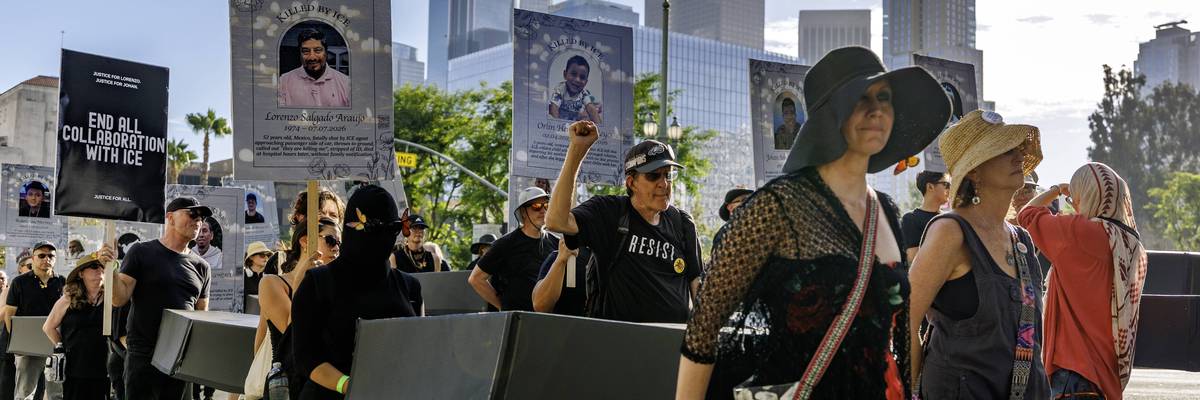
Anti-ICE protesters carry cardboard coffins through downtown Los Angeles on July 25, 2026 to remember people killed by Trump administration immigration enforcers.
'We Will Not Forget Them': Nationwide Vigils Demand Justice for People Killed by ICE
Protesters rallied against the Trump administration's deadly anti-immigrant crackdown in the wake of the killings of Lorenzo Salgado Araujo, Johan Sebastían Guerrero, Juan Jairo Coronilla Durán, and others.
Protesters gathered in cities and towns across the United States on Saturday at vigils to remember and demand justice for people killed by US Immigration and Customs Enforcement and other federal agents during President Donald Trump's deadly crackdown on immigrants and their defenders.
The July 25 Day of Action was organized by advocacy groups and volunteers across the country, with support from the Disappeared in America project hosted by Public Citizen, the National Day Laborer Organizing Network, The Workers Circle, Detention Watch Network, and the League of United Latin American Citizens (LULAC).
The vigils brought together clergy, activists, progressive advocates, and other concerned and outraged citizens, who remembered Lorenzo Salgado Araujo, Johan Sebastían Guerrero, Juan Jairo Coronilla Durán, and the dozens of people who have died in ICE custody during Trump's second term.
“Lorenzo Salgado Araujo was a husband, a father of three, and a small business owner who built his American dream with his own hands. Johan Sebastían Guerrero was killed in front of his partner and his toddler,” LULAC CEO Juan Proaño said in a statement. “ICE has now taken the lives of immigrants and US citizens alike, and if they can kill Lorenzo and Johan, they can kill anyone."
In the Twin Cities area of Minnesota, vigils honored the immigrants killed by ICE, as well as Renee Good and Alex Pretti, two US citizens fatally shot by Department of Homeland Security agents in January.
“They weren’t doing anything wrong. They were trying to help their neighbors, simple as that," said Lisa Erbes of Indivisible Twin Cities. "They were legally observing what ICE was doing, and they were both killed for it, and that could have happened to me. It could have happened to probably every single person who is here right now. Any of us could have been Renee or Alex."
This weekend marked six months since Pretti, a 37-year-old nurse, was shot by US Customs and Border Protection agents in Minneapolis.
"No one has been held accountable, no apologies, not a single phone call from any governmental official, hospital personnel, or the police," Susan Pretti, Alex's mother, wrote Saturday on social media.
“Six months of pain, a roller-coaster of trauma over and over," she added. "I wonder how to move forward. Will I ever get over this loss and this pain? Will I ever be able to enjoy life again?”
In Chicago—where Trump deployed hundreds of federal enforcers during Operation Midway Blitz—at least hundreds of people gathered in Grant Park and marched down Michigan Avenue.
“There’s collective trauma that impacted our communities that no one can understand unless you were here and felt the helicopters and saw the unpredictability of neighbors getting snatched off the streets,” 46-year-old demonstrator Melody Rose of Rogers Park told the Chicago Tribune. “All of us, especially those who have been directly impacted and seen what that’s like, have to keep showing up and spreading the word because this isn’t over and it could be us any day."
United Church of Rogers Park pastor Rev. Hannah Kardon told Chicago rallygoers: “Remember the dead and demand the kind of world where we never would have lost them in the first place. We will not forget them, and we will live differently because of them.”
Los Angeles-area demonstrations included a march by hundreds of people in downtown LA, where protesters carried cardboard coffins representing lives lost to Trump's crackdown.
"Our communities will never be the same," protester Joseph Morales told KABC. "Even though we're strong and we hold each other together, our communities are not the same, and we grieve that loss."
STOP KILLING US!
Justice for All
Disappeared in America Coalition Vigil for ICE slain immigrant in America!
Los Angeles Coffin Protest #StopKillingUs #USDemocracy #JusticeForAll #SomosLorenzo #DondeEstan #USDemocracy pic.twitter.com/KnqeTBRTHh
— Ruben Garcia (@goRubenRuben) July 26, 2026
In Pasadena, around 50 people turned out to protest the ICE killings.
“We were originally told, ‘Oh they’re going to go after the criminals, the people who are the worst of the worst.’ That’s a lie; that is not what’s happening," 61-year-old organizer Andra Clarke—who held a sign reading "Neighbors Say ICE Out"—told the Los Angeles Times.
“They’re targeting communities, they’re targeting people of color. It’s fascism," she added. "Anybody who cares about humanity should care about what’s happening.”
Around 100 protesters rallied outside ICE's downtown Atlanta field office, including Gail Maclin, who told Atlanta News First that her Senegalese husband is among the 675,000 people forcibly deported during Trump's second term.
“I lost my housing. I’ve lost my car. I’ve lost all my worldly possessions," she said. "I still have Amari, but Amari’s not here—he’s in Senegal."
Among the approximately 150 people who attended a vigil in the Silicon Valley city of Mountain View—headquarters of Google, where workers have protested the company's complicity in Trump's deadly crackdown—were members of the Raging Grannies, a longtime activist group known for their protest songs.
"People are being targeted here, and are afraid," Raging Granny Ruth Robertson told CBS News Bay Area. "They're afraid to go out of their houses, they're afraid to go to work."
A crowd of demonstrators gathered for a roadside vigil along Route 29 in Centreville, Virginia, a suburb of Washington, DC.
Rev. David Miller of the Unitarian Universalist Congregation of Fairfax told protesters: “I think that there is a moral obligation for us to speak up about our values. These values are not being represented well by this administration and certainly not by the way that ICE has been acting in our communities.”
Julio Hernandez, the director of the Congregation Action Network, told Centreville vigilgoers that “we're here to tell the story of our community being terrorized and torn apart, families being separated, children living in fear."
“We're here to ask the community to be aware of what's happening and also asking ICE to get out of our communities,” he added.
We are at a crossroads
This country and this world are at a monumental crossroads. In a few short weeks, US voters will have an opportunity to beat back the forces of fascism and confront the billionaires who are rigging the economy, our media system, and our democracy, making it increasingly impossible for ordinary people to get by. We’re not just talking about the election. We’re talking about what must be done once these fascist elements are vanquished from power. We need a bolder set of solutions than what either major party has so far been willing to offer and a working-class movement ready to fight like hell for it. Trump didn't emerge from nowhere. The conditions that fueled MAGA authoritarianism were created by decades of radical neoliberal economic policies and a corrupt political system dominated by corporate interests. They slashed taxes on the super-rich, promising that the benefits would trickle down. They said giveaways to the corporate titans would make life more affordable for the rest of us. It was all bullshit. And when a bitter, betrayed populace searches for someone to blame, right-wing demagogues have little trouble finding scapegoats. People know when they're being lied to, but you won't hear any of this from the corporate media. Only independent journalism—powered and funded by people who believe in building a better world—can deliver truly trustworthy daily news. Our Fall Campaign is underway, and we need your help. To power our newsroom through the rest of the year, we need to raise $125,000 by midnight on October 31. So if you share our vision, please contribute whatever you can to sustain our work. |
Protesters gathered in cities and towns across the United States on Saturday at vigils to remember and demand justice for people killed by US Immigration and Customs Enforcement and other federal agents during President Donald Trump's deadly crackdown on immigrants and their defenders.
The July 25 Day of Action was organized by advocacy groups and volunteers across the country, with support from the Disappeared in America project hosted by Public Citizen, the National Day Laborer Organizing Network, The Workers Circle, Detention Watch Network, and the League of United Latin American Citizens (LULAC).
The vigils brought together clergy, activists, progressive advocates, and other concerned and outraged citizens, who remembered Lorenzo Salgado Araujo, Johan Sebastían Guerrero, Juan Jairo Coronilla Durán, and the dozens of people who have died in ICE custody during Trump's second term.
“Lorenzo Salgado Araujo was a husband, a father of three, and a small business owner who built his American dream with his own hands. Johan Sebastían Guerrero was killed in front of his partner and his toddler,” LULAC CEO Juan Proaño said in a statement. “ICE has now taken the lives of immigrants and US citizens alike, and if they can kill Lorenzo and Johan, they can kill anyone."
In the Twin Cities area of Minnesota, vigils honored the immigrants killed by ICE, as well as Renee Good and Alex Pretti, two US citizens fatally shot by Department of Homeland Security agents in January.
“They weren’t doing anything wrong. They were trying to help their neighbors, simple as that," said Lisa Erbes of Indivisible Twin Cities. "They were legally observing what ICE was doing, and they were both killed for it, and that could have happened to me. It could have happened to probably every single person who is here right now. Any of us could have been Renee or Alex."
This weekend marked six months since Pretti, a 37-year-old nurse, was shot by US Customs and Border Protection agents in Minneapolis.
"No one has been held accountable, no apologies, not a single phone call from any governmental official, hospital personnel, or the police," Susan Pretti, Alex's mother, wrote Saturday on social media.
“Six months of pain, a roller-coaster of trauma over and over," she added. "I wonder how to move forward. Will I ever get over this loss and this pain? Will I ever be able to enjoy life again?”
In Chicago—where Trump deployed hundreds of federal enforcers during Operation Midway Blitz—at least hundreds of people gathered in Grant Park and marched down Michigan Avenue.
“There’s collective trauma that impacted our communities that no one can understand unless you were here and felt the helicopters and saw the unpredictability of neighbors getting snatched off the streets,” 46-year-old demonstrator Melody Rose of Rogers Park told the Chicago Tribune. “All of us, especially those who have been directly impacted and seen what that’s like, have to keep showing up and spreading the word because this isn’t over and it could be us any day."
United Church of Rogers Park pastor Rev. Hannah Kardon told Chicago rallygoers: “Remember the dead and demand the kind of world where we never would have lost them in the first place. We will not forget them, and we will live differently because of them.”
Los Angeles-area demonstrations included a march by hundreds of people in downtown LA, where protesters carried cardboard coffins representing lives lost to Trump's crackdown.
"Our communities will never be the same," protester Joseph Morales told KABC. "Even though we're strong and we hold each other together, our communities are not the same, and we grieve that loss."
STOP KILLING US!
Justice for All
Disappeared in America Coalition Vigil for ICE slain immigrant in America!
Los Angeles Coffin Protest #StopKillingUs #USDemocracy #JusticeForAll #SomosLorenzo #DondeEstan #USDemocracy pic.twitter.com/KnqeTBRTHh
— Ruben Garcia (@goRubenRuben) July 26, 2026
In Pasadena, around 50 people turned out to protest the ICE killings.
“We were originally told, ‘Oh they’re going to go after the criminals, the people who are the worst of the worst.’ That’s a lie; that is not what’s happening," 61-year-old organizer Andra Clarke—who held a sign reading "Neighbors Say ICE Out"—told the Los Angeles Times.
“They’re targeting communities, they’re targeting people of color. It’s fascism," she added. "Anybody who cares about humanity should care about what’s happening.”
Around 100 protesters rallied outside ICE's downtown Atlanta field office, including Gail Maclin, who told Atlanta News First that her Senegalese husband is among the 675,000 people forcibly deported during Trump's second term.
“I lost my housing. I’ve lost my car. I’ve lost all my worldly possessions," she said. "I still have Amari, but Amari’s not here—he’s in Senegal."
Among the approximately 150 people who attended a vigil in the Silicon Valley city of Mountain View—headquarters of Google, where workers have protested the company's complicity in Trump's deadly crackdown—were members of the Raging Grannies, a longtime activist group known for their protest songs.
"People are being targeted here, and are afraid," Raging Granny Ruth Robertson told CBS News Bay Area. "They're afraid to go out of their houses, they're afraid to go to work."
A crowd of demonstrators gathered for a roadside vigil along Route 29 in Centreville, Virginia, a suburb of Washington, DC.
Rev. David Miller of the Unitarian Universalist Congregation of Fairfax told protesters: “I think that there is a moral obligation for us to speak up about our values. These values are not being represented well by this administration and certainly not by the way that ICE has been acting in our communities.”
Julio Hernandez, the director of the Congregation Action Network, told Centreville vigilgoers that “we're here to tell the story of our community being terrorized and torn apart, families being separated, children living in fear."
“We're here to ask the community to be aware of what's happening and also asking ICE to get out of our communities,” he added.
Protesters gathered in cities and towns across the United States on Saturday at vigils to remember and demand justice for people killed by US Immigration and Customs Enforcement and other federal agents during President Donald Trump's deadly crackdown on immigrants and their defenders.
The July 25 Day of Action was organized by advocacy groups and volunteers across the country, with support from the Disappeared in America project hosted by Public Citizen, the National Day Laborer Organizing Network, The Workers Circle, Detention Watch Network, and the League of United Latin American Citizens (LULAC).
The vigils brought together clergy, activists, progressive advocates, and other concerned and outraged citizens, who remembered Lorenzo Salgado Araujo, Johan Sebastían Guerrero, Juan Jairo Coronilla Durán, and the dozens of people who have died in ICE custody during Trump's second term.
“Lorenzo Salgado Araujo was a husband, a father of three, and a small business owner who built his American dream with his own hands. Johan Sebastían Guerrero was killed in front of his partner and his toddler,” LULAC CEO Juan Proaño said in a statement. “ICE has now taken the lives of immigrants and US citizens alike, and if they can kill Lorenzo and Johan, they can kill anyone."
In the Twin Cities area of Minnesota, vigils honored the immigrants killed by ICE, as well as Renee Good and Alex Pretti, two US citizens fatally shot by Department of Homeland Security agents in January.
“They weren’t doing anything wrong. They were trying to help their neighbors, simple as that," said Lisa Erbes of Indivisible Twin Cities. "They were legally observing what ICE was doing, and they were both killed for it, and that could have happened to me. It could have happened to probably every single person who is here right now. Any of us could have been Renee or Alex."
This weekend marked six months since Pretti, a 37-year-old nurse, was shot by US Customs and Border Protection agents in Minneapolis.
"No one has been held accountable, no apologies, not a single phone call from any governmental official, hospital personnel, or the police," Susan Pretti, Alex's mother, wrote Saturday on social media.
“Six months of pain, a roller-coaster of trauma over and over," she added. "I wonder how to move forward. Will I ever get over this loss and this pain? Will I ever be able to enjoy life again?”
In Chicago—where Trump deployed hundreds of federal enforcers during Operation Midway Blitz—at least hundreds of people gathered in Grant Park and marched down Michigan Avenue.
“There’s collective trauma that impacted our communities that no one can understand unless you were here and felt the helicopters and saw the unpredictability of neighbors getting snatched off the streets,” 46-year-old demonstrator Melody Rose of Rogers Park told the Chicago Tribune. “All of us, especially those who have been directly impacted and seen what that’s like, have to keep showing up and spreading the word because this isn’t over and it could be us any day."
United Church of Rogers Park pastor Rev. Hannah Kardon told Chicago rallygoers: “Remember the dead and demand the kind of world where we never would have lost them in the first place. We will not forget them, and we will live differently because of them.”
Los Angeles-area demonstrations included a march by hundreds of people in downtown LA, where protesters carried cardboard coffins representing lives lost to Trump's crackdown.
"Our communities will never be the same," protester Joseph Morales told KABC. "Even though we're strong and we hold each other together, our communities are not the same, and we grieve that loss."
STOP KILLING US!
Justice for All
Disappeared in America Coalition Vigil for ICE slain immigrant in America!
Los Angeles Coffin Protest #StopKillingUs #USDemocracy #JusticeForAll #SomosLorenzo #DondeEstan #USDemocracy pic.twitter.com/KnqeTBRTHh
— Ruben Garcia (@goRubenRuben) July 26, 2026
In Pasadena, around 50 people turned out to protest the ICE killings.
“We were originally told, ‘Oh they’re going to go after the criminals, the people who are the worst of the worst.’ That’s a lie; that is not what’s happening," 61-year-old organizer Andra Clarke—who held a sign reading "Neighbors Say ICE Out"—told the Los Angeles Times.
“They’re targeting communities, they’re targeting people of color. It’s fascism," she added. "Anybody who cares about humanity should care about what’s happening.”
Around 100 protesters rallied outside ICE's downtown Atlanta field office, including Gail Maclin, who told Atlanta News First that her Senegalese husband is among the 675,000 people forcibly deported during Trump's second term.
“I lost my housing. I’ve lost my car. I’ve lost all my worldly possessions," she said. "I still have Amari, but Amari’s not here—he’s in Senegal."
Among the approximately 150 people who attended a vigil in the Silicon Valley city of Mountain View—headquarters of Google, where workers have protested the company's complicity in Trump's deadly crackdown—were members of the Raging Grannies, a longtime activist group known for their protest songs.
"People are being targeted here, and are afraid," Raging Granny Ruth Robertson told CBS News Bay Area. "They're afraid to go out of their houses, they're afraid to go to work."
A crowd of demonstrators gathered for a roadside vigil along Route 29 in Centreville, Virginia, a suburb of Washington, DC.
Rev. David Miller of the Unitarian Universalist Congregation of Fairfax told protesters: “I think that there is a moral obligation for us to speak up about our values. These values are not being represented well by this administration and certainly not by the way that ICE has been acting in our communities.”
Julio Hernandez, the director of the Congregation Action Network, told Centreville vigilgoers that “we're here to tell the story of our community being terrorized and torn apart, families being separated, children living in fear."
“We're here to ask the community to be aware of what's happening and also asking ICE to get out of our communities,” he added.