5
#000000
#FFFFFF
To donate by check, phone, or other method, see our More Ways to Give page.
Daily news & progressive opinion—funded by the people, not the corporations—delivered straight to your inbox.
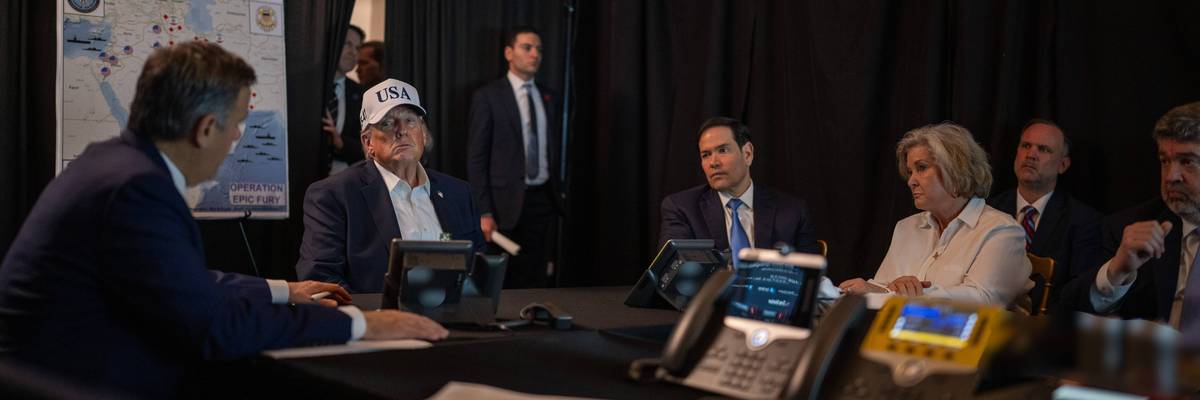
US President Donald Trump (C) oversees "Operation Epic Fury" with (L-R) Central Intelligence Agency Director John Ratcliffe, US Secretary of State Marco Rubio, and then-White House Chief of Staff Susie Wiles at Mar-a-Lago on February 28, 2026 in Palm Beach, Florida.
The American People registered their disapproval of Trumpism at the ballot box. Will they now go further and demand that the powers that made him so dangerous be stripped from the presidency, or will they just hand them to someone else?
Last Tuesday's election was a stunning defeat for President Donald Trump. Democrats won both houses of Congress, including Senate races in states they haven't won in generations. Americans went to the polls angry about rising prices, government corruption, rising authoritarianism, and a war with Iran they never wanted. Those frustrations are deeply connected. But this moment can, and should, be an opportunity to do more than move beyond President Trump and his movement. It's an opportunity for people across the country to question how we got here, and what needs to change about American power.
Already, the administration responsible for the war are trying to distance themselves from it. Vice President JD Vance is blaming the Iran war for the Republican defeat. On Election Day President Trump himself went on Fox News to declare he's planning to end military aid to Israel, though he openly admitted that his motivation for making the announcement was to deny his opponents a "bad talking point." Republicans seem to be coalescing around a scapegoat in Secretary of War Pete Hegseth, in a move reminiscent to George W. Bush's firing of Donald Rumsfeld after the midterm disaster of 2006. A vote for Hegseth's impeachment may come as early as next week, if he isn't forced out sooner.
This kind of double-talk is nothing new from this administration. Trump ran against disastrous wars of choice. Then he started a new one. It's no surprise that now he's talking about peace again. But this is about much more than Donald Trump's hypocrisy.
War makes the government more powerful while it makes ordinary people less secure. The question is whether the disease of American militarism is terminal, or whether we're finally ready to do something about it.
If Trump disappeared tomorrow, the Office of the Presidency would still have the dangerous power to start wars without any legal authority to do so. American military power would still be deployed around the world, threatening other nations. Paramilitary forces like Immigration and Customs Enforcement (ICE) and Customs and Border Patrol would still be terrorizing American cities in violation of US law. The American People registered their disapproval of Trumpism at the ballot box. Will they now go further and demand that the powers be stripped from the presidency, or will they just hand them to someone else?
Nearly 60 years ago, Dr. Martin Luther King Jr. asked Americans a similar question in his speech at Riverside Church in New York City, "Beyond Vietnam." King didn't just want to end that war. He wanted the American People to confront the racism, extreme materialism, and militarism that made it possible.
King had seen hope in President Lyndon Johnson's War on Poverty. As Vietnam escalated, he watched the effort to help poor Americans get pushed aside. The war consumed the money, attention, and political will that those programs needed to succeed. King came to see Vietnam as an enemy of poor people here at home, not only of the people being killed overseas.
President Trump returned to the White House promising to bring prices down. Instead, his war with Iran has made everything more expensive. The price of gasoline, diesel fuel, groceries, everything from fertilizer to electronics, has skyrocketed. Mortgage rates and other borrowing costs are higher than they were before the war. Businesses struggling to predict energy prices and interest rates have a harder time deciding whether to expand or hire. They put off opening a new location, buying equipment, or taking a chance on another employee. Those decisions affect real jobs and make planning a future harder for families, too.
And Americans know it. They were promised economic relief. Now they're paying for a war they did not ask for.
Now the same administration that brought us the war in Iran is asking to spend even more tax dollars on the military. The United States spent about $954 billion on its military in 2025. Now Trump is proposing $1.5 trillion in defense funding for 2027, while seeking cuts to domestic programs. After seeing what this administration has done with a near trillion dollar war budget, why would anyone believe that giving it $500 billion more will make life better for Americans?
This isn't a problem Trump invented. The United States helped overthrow Iran's prime minister in 1953. It fought in Vietnam, invaded Iraq and Afghanistan, and supplied the weapons Israel used to destroy of Gaza. It's undermined democracy in Latin America, Africa, and Asia, repeatedly backing dictatorships and interfering with other countries' governments. Republicans and Democrats have both taken part.
For generations America has operated as if it has a special right to decide the future of other countries. US leaders condemn invasions and violations of sovereignty when someone else commits them, and make exceptions when the United States does the same. It's not imperialism, it's spreading democracy, even when the people on the receiving end haven't asked for our help.
Racism has always helped make this possible, and it's more apparent than ever. Trump's talk about "shithole countries" and his bans on immigration from Muslim countries are blatant and vulgar, but they're not entirely new. For US policy, some people's lives and rights have always counted for less than the lives and rights of "others." That attitude doesn't stay overseas. We see it when ICE and Border Patrol agents terrorize immigrant neighborhoods, when police treat protesters as enemies, and when troops are sent into American cities. The government decides certain communities, ethnicities, or ideologies are dangerous, then it uses that fear to justify using extraordinary violence against them. This has been the case for a long time. The Trump administration just glorifies the cruelty instead of hiding it.
All of this becomes more frightening when we consider how much power is concentrated in the presidency. People worry about Trump having his finger on the nuclear button, and should. But why should anyone have that power? A president can authorize the use of nuclear weapons without asking anyone's permission. Author Elaine Scarry calls this a "Thermonuclear Monarchy." Changing the president doesn't change that fact.
Nuclear weapons are just the clearest example. The federal government funds research at universities, healthcare for millions, and humanitarian work around the world. Those programs can do real good. But we've seen the Trump administration use those funds to threaten universities' research funding unless they capitulate to political demands. It threatens nonprofits for exercising protected speech. If one administration can threaten the survival of institutions by withholding money, people naturally start worrying about whether they can afford to speak up.
The damage spreads. University leaders watch what they say. Businesses look for favors and lavish praise on the leader. Members of Congress avoid challenging their own president. Organizations that need federal money learn to keep quiet. Power can corrupt the people who hold it, but it can also corrupt everyone who needs something from them.
James Madison warned that no nation could preserve its freedom in the midst of continual warfare. He knew war increases executive power and creates opportunities for corruption. If, to borrow a phrase from anti-war writer Randolph Bourne, "War is the health of the State," then America is a sick nation.
Dr. King warned in "Beyond Vietnam" that "a nation that continues year after year to spend more money on military defense than on programs of social uplift is approaching spiritual death." Nearly 60 years later, we're still making those choices. War makes the government more powerful while it makes ordinary people less secure. The question is whether the disease of American militarism is terminal, or whether we're finally ready to do something about it.
Tuesday's election gives the next Congress a chance to act. It can challenge the Iran war, take back its constitutional authority over war and spending, put limits on presidential nuclear power, and protect public institutions from political punishment. It can ask why so much public money keeps going toward weapons while Americans struggle with everyday expenses.
But the election also gives us a chance to change the argument itself. If people concerned about war, corruption, freedom, and affordability don't recognize how those issues fit together, politicians who started or supported this war will keep claiming to be the ones who can deliver peace. We need more than a different set of promises from the people in charge.
King understood that ending Vietnam wouldn't be enough if America just went back to doing the same thing somewhere else. Defeating Trump won't be enough either. We've spent generations expanding our military reach and handing presidents powers that no one person should have, all while convincing ourselves that America can be trusted to use them responsibly.
We shouldn't have to wait for the next Donald Trump to recognize how dangerous that is.
This country and this world are at a monumental crossroads. US voters have an opportunity to beat back the forces of fascism and confront the billionaires who are rigging the economy, our media system, and our democracy, making it increasingly impossible for ordinary people to get by. We’re not just talking about the election. We’re talking about what must be done once these fascist elements are vanquished from power. We need a bolder set of solutions than what either major party has so far been willing to offer and a working-class movement ready to fight like hell for it. Trump didn't emerge from nowhere. The conditions that fueled MAGA authoritarianism were created by decades of radical neoliberal economic policies and a corrupt political system dominated by corporate interests. They slashed taxes on the super-rich, promising that the benefits would trickle down. They said giveaways to the corporate titans would make life more affordable for the rest of us. It was all bullshit. And when a bitter, betrayed populace searches for someone to blame, right-wing demagogues have little trouble finding scapegoats. People know when they're being lied to, but you won't hear any of this from the corporate media. Only independent journalism—powered and funded by people who believe in building a better world—can deliver truly trustworthy daily news. If you share our vision, please contribute whatever you can to sustain our work. |
Last Tuesday's election was a stunning defeat for President Donald Trump. Democrats won both houses of Congress, including Senate races in states they haven't won in generations. Americans went to the polls angry about rising prices, government corruption, rising authoritarianism, and a war with Iran they never wanted. Those frustrations are deeply connected. But this moment can, and should, be an opportunity to do more than move beyond President Trump and his movement. It's an opportunity for people across the country to question how we got here, and what needs to change about American power.
Already, the administration responsible for the war are trying to distance themselves from it. Vice President JD Vance is blaming the Iran war for the Republican defeat. On Election Day President Trump himself went on Fox News to declare he's planning to end military aid to Israel, though he openly admitted that his motivation for making the announcement was to deny his opponents a "bad talking point." Republicans seem to be coalescing around a scapegoat in Secretary of War Pete Hegseth, in a move reminiscent to George W. Bush's firing of Donald Rumsfeld after the midterm disaster of 2006. A vote for Hegseth's impeachment may come as early as next week, if he isn't forced out sooner.
This kind of double-talk is nothing new from this administration. Trump ran against disastrous wars of choice. Then he started a new one. It's no surprise that now he's talking about peace again. But this is about much more than Donald Trump's hypocrisy.
War makes the government more powerful while it makes ordinary people less secure. The question is whether the disease of American militarism is terminal, or whether we're finally ready to do something about it.
If Trump disappeared tomorrow, the Office of the Presidency would still have the dangerous power to start wars without any legal authority to do so. American military power would still be deployed around the world, threatening other nations. Paramilitary forces like Immigration and Customs Enforcement (ICE) and Customs and Border Patrol would still be terrorizing American cities in violation of US law. The American People registered their disapproval of Trumpism at the ballot box. Will they now go further and demand that the powers be stripped from the presidency, or will they just hand them to someone else?
Nearly 60 years ago, Dr. Martin Luther King Jr. asked Americans a similar question in his speech at Riverside Church in New York City, "Beyond Vietnam." King didn't just want to end that war. He wanted the American People to confront the racism, extreme materialism, and militarism that made it possible.
King had seen hope in President Lyndon Johnson's War on Poverty. As Vietnam escalated, he watched the effort to help poor Americans get pushed aside. The war consumed the money, attention, and political will that those programs needed to succeed. King came to see Vietnam as an enemy of poor people here at home, not only of the people being killed overseas.
President Trump returned to the White House promising to bring prices down. Instead, his war with Iran has made everything more expensive. The price of gasoline, diesel fuel, groceries, everything from fertilizer to electronics, has skyrocketed. Mortgage rates and other borrowing costs are higher than they were before the war. Businesses struggling to predict energy prices and interest rates have a harder time deciding whether to expand or hire. They put off opening a new location, buying equipment, or taking a chance on another employee. Those decisions affect real jobs and make planning a future harder for families, too.
And Americans know it. They were promised economic relief. Now they're paying for a war they did not ask for.
Now the same administration that brought us the war in Iran is asking to spend even more tax dollars on the military. The United States spent about $954 billion on its military in 2025. Now Trump is proposing $1.5 trillion in defense funding for 2027, while seeking cuts to domestic programs. After seeing what this administration has done with a near trillion dollar war budget, why would anyone believe that giving it $500 billion more will make life better for Americans?
This isn't a problem Trump invented. The United States helped overthrow Iran's prime minister in 1953. It fought in Vietnam, invaded Iraq and Afghanistan, and supplied the weapons Israel used to destroy of Gaza. It's undermined democracy in Latin America, Africa, and Asia, repeatedly backing dictatorships and interfering with other countries' governments. Republicans and Democrats have both taken part.
For generations America has operated as if it has a special right to decide the future of other countries. US leaders condemn invasions and violations of sovereignty when someone else commits them, and make exceptions when the United States does the same. It's not imperialism, it's spreading democracy, even when the people on the receiving end haven't asked for our help.
Racism has always helped make this possible, and it's more apparent than ever. Trump's talk about "shithole countries" and his bans on immigration from Muslim countries are blatant and vulgar, but they're not entirely new. For US policy, some people's lives and rights have always counted for less than the lives and rights of "others." That attitude doesn't stay overseas. We see it when ICE and Border Patrol agents terrorize immigrant neighborhoods, when police treat protesters as enemies, and when troops are sent into American cities. The government decides certain communities, ethnicities, or ideologies are dangerous, then it uses that fear to justify using extraordinary violence against them. This has been the case for a long time. The Trump administration just glorifies the cruelty instead of hiding it.
All of this becomes more frightening when we consider how much power is concentrated in the presidency. People worry about Trump having his finger on the nuclear button, and should. But why should anyone have that power? A president can authorize the use of nuclear weapons without asking anyone's permission. Author Elaine Scarry calls this a "Thermonuclear Monarchy." Changing the president doesn't change that fact.
Nuclear weapons are just the clearest example. The federal government funds research at universities, healthcare for millions, and humanitarian work around the world. Those programs can do real good. But we've seen the Trump administration use those funds to threaten universities' research funding unless they capitulate to political demands. It threatens nonprofits for exercising protected speech. If one administration can threaten the survival of institutions by withholding money, people naturally start worrying about whether they can afford to speak up.
The damage spreads. University leaders watch what they say. Businesses look for favors and lavish praise on the leader. Members of Congress avoid challenging their own president. Organizations that need federal money learn to keep quiet. Power can corrupt the people who hold it, but it can also corrupt everyone who needs something from them.
James Madison warned that no nation could preserve its freedom in the midst of continual warfare. He knew war increases executive power and creates opportunities for corruption. If, to borrow a phrase from anti-war writer Randolph Bourne, "War is the health of the State," then America is a sick nation.
Dr. King warned in "Beyond Vietnam" that "a nation that continues year after year to spend more money on military defense than on programs of social uplift is approaching spiritual death." Nearly 60 years later, we're still making those choices. War makes the government more powerful while it makes ordinary people less secure. The question is whether the disease of American militarism is terminal, or whether we're finally ready to do something about it.
Tuesday's election gives the next Congress a chance to act. It can challenge the Iran war, take back its constitutional authority over war and spending, put limits on presidential nuclear power, and protect public institutions from political punishment. It can ask why so much public money keeps going toward weapons while Americans struggle with everyday expenses.
But the election also gives us a chance to change the argument itself. If people concerned about war, corruption, freedom, and affordability don't recognize how those issues fit together, politicians who started or supported this war will keep claiming to be the ones who can deliver peace. We need more than a different set of promises from the people in charge.
King understood that ending Vietnam wouldn't be enough if America just went back to doing the same thing somewhere else. Defeating Trump won't be enough either. We've spent generations expanding our military reach and handing presidents powers that no one person should have, all while convincing ourselves that America can be trusted to use them responsibly.
We shouldn't have to wait for the next Donald Trump to recognize how dangerous that is.