

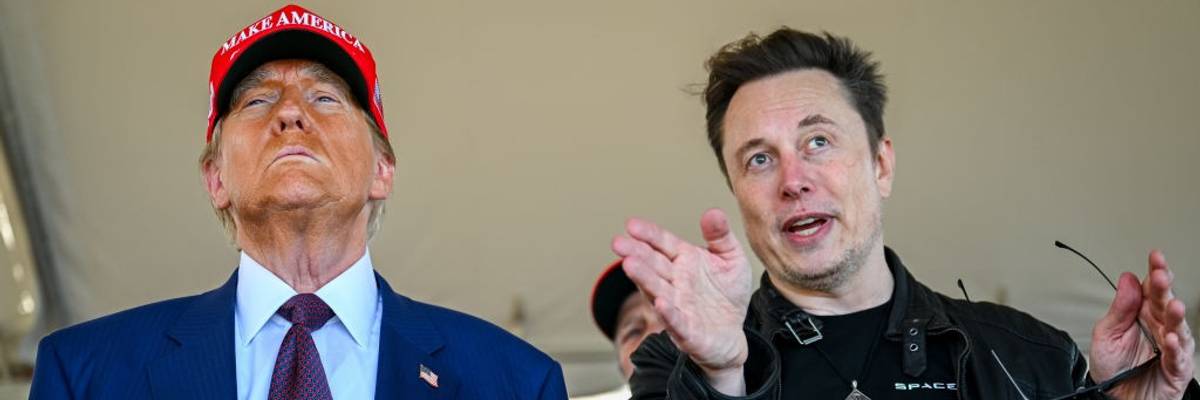
Elon Musk speaks with US President-elect Donald Trump as they watch the launch of the sixth test flight of the SpaceX Starship rocket on November 19, 2024 in Brownsville, Texas.
The Pentagon Is Stealing From the Working Poor to Pay for War and Enrich Contractors
The average US taxpayer in 2025 had over $4,000 taken out of their paychecks to fund the Pentagon; in the coming years, that amount is set to rise as Congress considers a $1.5 trillion war budget for 2027.
In an era of high prices for fuel, food, and housing, an extra $4,000 could make a lifesaving difference for many families. But instead, that’s what the average household had to shell out for the Pentagon last year.
That’s right: The average US taxpayer in 2025 had over $4,000 taken out of their paychecks to fund the Pentagon, according to the National Priorities Project at the Institute for Policy Studies. In the coming years, that amount is set to rise as Congress considers a $1.5 trillion war budget for 2027.
For the growing number of working poor in the United States, that money can mean the difference between making rent or falling behind, or between being able to afford an emergency trip to the doctor or going without care.
Money directed to the Pentagon represents nothing but betrayal for many Americans. A large majority oppose our wars, especially the latest conflict in Iran. And roughly half of the Pentagon’s budget flows to for-profit contractors, fueling the billionaire (and now even trillionaire) class.
The person who lost SNAP and the farmer who lost their income alike will be asked to foot the bill for the $1.5 trillion war budget.
Take SpaceX, one of many companies built on government contracts funded by taxpayer dollars. Elon Musk’s company would not exist without US taxpayers. As early Tesla investor Ross Gerber put it, “There would not be (Tesla and SpaceX) if it weren’t for the government.”
Early investments and contracts from the US government helped propel SpaceX to success, while continued awards from the Pentagon provided the stable revenue that made the government one of Musk’s largest customers. The company is now valued at more than $1 trillion. Private investors alone did not make Musk a trillionaire—taxpayers across the United States did.
But Musk isn’t the only person who made himself rich off the backs of American workers.
Lockheed Martin receives over 70% of its revenue from US government contracts. The numbers for Raytheon and General Dynamics are similar. These military contractors simply would not exist without the taxpayers—and a new $1.5 trillion budget would send hundreds of billions of dollars more to people who already have more than most Americans could even conceptualize.
At the same time, while taxpayers are subsidizing the military-industrial complex, the jobs those industries are allegedly providing are in decline, with the war industry creating over 2 million fewer jobs than it did 40 years ago.
Worse still, under the so-called “Big Beautiful Bill” Republicans passed a year ago, the money for these ever-rising Pentagon budgets comes directly from the Supplemental Nutrition Assistance Program (SNAP), Medicaid, and other programs that help Americans make ends meet.
Under those cuts, millions of Americans—including children—have lost SNAP benefits already. And that’s impacting not just families but the farmers who helped feed them.
SNAP benefits were “guaranteed money in the pockets of farmers,” said Reese Amxy, a policy organizer at the Illinois Stewardship Alliance. But 150,000 people in the state have already lost eligibility.
It’s not just Illinois. Arizona has seen the steepest decline, with 50% of recipients—nearly half a million—already losing benefits. Louisiana (21%), Florida (20%), Oklahoma (16%), Virginia (16%), Texas (14%), Wyoming (13%), and Arkansas (12%) round out the rest of the hardest hit states so far.
Yet the person who lost SNAP and the farmer who lost their income alike will be asked to foot the bill for the $1.5 trillion war budget. This is Robin Hood in reverse. Worse still, the weapons those taxes buy are often to use to kill children like ours in Gaza and Iran.
The weapons and tech CEOs that would benefit from the massive war budget, and the politicians bought off by them, seek to keep this cycle going next year at an even grander scale. Americans need to demand their lawmakers say no more Pentagon spending—and invest in the things that actually keep our communities safe instead.
We are at a crossroads
This country and this world are at a monumental crossroads. In a few short weeks, US voters will have an opportunity to beat back the forces of fascism and confront the billionaires who are rigging the economy, our media system, and our democracy, making it increasingly impossible for ordinary people to get by. We’re not just talking about the election. We’re talking about what must be done once these fascist elements are vanquished from power. We need a bolder set of solutions than what either major party has so far been willing to offer and a working-class movement ready to fight like hell for it. Trump didn't emerge from nowhere. The conditions that fueled MAGA authoritarianism were created by decades of radical neoliberal economic policies and a corrupt political system dominated by corporate interests. They slashed taxes on the super-rich, promising that the benefits would trickle down. They said giveaways to the corporate titans would make life more affordable for the rest of us. It was all bullshit. And when a bitter, betrayed populace searches for someone to blame, right-wing demagogues have little trouble finding scapegoats. People know when they're being lied to, but you won't hear any of this from the corporate media. Only independent journalism—powered and funded by people who believe in building a better world—can deliver truly trustworthy daily news. Our Fall Campaign is underway, and we need your help. To power our newsroom through the rest of the year, we need to raise $125,000 by midnight on October 31. So if you share our vision, please contribute whatever you can to sustain our work. |
In an era of high prices for fuel, food, and housing, an extra $4,000 could make a lifesaving difference for many families. But instead, that’s what the average household had to shell out for the Pentagon last year.
That’s right: The average US taxpayer in 2025 had over $4,000 taken out of their paychecks to fund the Pentagon, according to the National Priorities Project at the Institute for Policy Studies. In the coming years, that amount is set to rise as Congress considers a $1.5 trillion war budget for 2027.
For the growing number of working poor in the United States, that money can mean the difference between making rent or falling behind, or between being able to afford an emergency trip to the doctor or going without care.
Money directed to the Pentagon represents nothing but betrayal for many Americans. A large majority oppose our wars, especially the latest conflict in Iran. And roughly half of the Pentagon’s budget flows to for-profit contractors, fueling the billionaire (and now even trillionaire) class.
The person who lost SNAP and the farmer who lost their income alike will be asked to foot the bill for the $1.5 trillion war budget.
Take SpaceX, one of many companies built on government contracts funded by taxpayer dollars. Elon Musk’s company would not exist without US taxpayers. As early Tesla investor Ross Gerber put it, “There would not be (Tesla and SpaceX) if it weren’t for the government.”
Early investments and contracts from the US government helped propel SpaceX to success, while continued awards from the Pentagon provided the stable revenue that made the government one of Musk’s largest customers. The company is now valued at more than $1 trillion. Private investors alone did not make Musk a trillionaire—taxpayers across the United States did.
But Musk isn’t the only person who made himself rich off the backs of American workers.
Lockheed Martin receives over 70% of its revenue from US government contracts. The numbers for Raytheon and General Dynamics are similar. These military contractors simply would not exist without the taxpayers—and a new $1.5 trillion budget would send hundreds of billions of dollars more to people who already have more than most Americans could even conceptualize.
At the same time, while taxpayers are subsidizing the military-industrial complex, the jobs those industries are allegedly providing are in decline, with the war industry creating over 2 million fewer jobs than it did 40 years ago.
Worse still, under the so-called “Big Beautiful Bill” Republicans passed a year ago, the money for these ever-rising Pentagon budgets comes directly from the Supplemental Nutrition Assistance Program (SNAP), Medicaid, and other programs that help Americans make ends meet.
Under those cuts, millions of Americans—including children—have lost SNAP benefits already. And that’s impacting not just families but the farmers who helped feed them.
SNAP benefits were “guaranteed money in the pockets of farmers,” said Reese Amxy, a policy organizer at the Illinois Stewardship Alliance. But 150,000 people in the state have already lost eligibility.
It’s not just Illinois. Arizona has seen the steepest decline, with 50% of recipients—nearly half a million—already losing benefits. Louisiana (21%), Florida (20%), Oklahoma (16%), Virginia (16%), Texas (14%), Wyoming (13%), and Arkansas (12%) round out the rest of the hardest hit states so far.
Yet the person who lost SNAP and the farmer who lost their income alike will be asked to foot the bill for the $1.5 trillion war budget. This is Robin Hood in reverse. Worse still, the weapons those taxes buy are often to use to kill children like ours in Gaza and Iran.
The weapons and tech CEOs that would benefit from the massive war budget, and the politicians bought off by them, seek to keep this cycle going next year at an even grander scale. Americans need to demand their lawmakers say no more Pentagon spending—and invest in the things that actually keep our communities safe instead.
- ‘Don't Give the Pentagon $1 Trillion,’ Critics Say as House Passes Record US Military Spending Bill ›
- The Outrageous Price We Pay for a Pentagon Budget From Hell ›
- $60 Billion in Waste and Fraud Easily Found Where Trump Refuses to Cut: The Pentagon ›
- Dwight Was Right: Congress Must Say No to Military Contractors ›
- 'People Over Pentagon' Proposal Would Take $100 Billion From Pentagon to Fund Social Programs ›
- Is the Pentagon Spending Taxpayer Money on Alien Tech? ›
In an era of high prices for fuel, food, and housing, an extra $4,000 could make a lifesaving difference for many families. But instead, that’s what the average household had to shell out for the Pentagon last year.
That’s right: The average US taxpayer in 2025 had over $4,000 taken out of their paychecks to fund the Pentagon, according to the National Priorities Project at the Institute for Policy Studies. In the coming years, that amount is set to rise as Congress considers a $1.5 trillion war budget for 2027.
For the growing number of working poor in the United States, that money can mean the difference between making rent or falling behind, or between being able to afford an emergency trip to the doctor or going without care.
Money directed to the Pentagon represents nothing but betrayal for many Americans. A large majority oppose our wars, especially the latest conflict in Iran. And roughly half of the Pentagon’s budget flows to for-profit contractors, fueling the billionaire (and now even trillionaire) class.
The person who lost SNAP and the farmer who lost their income alike will be asked to foot the bill for the $1.5 trillion war budget.
Take SpaceX, one of many companies built on government contracts funded by taxpayer dollars. Elon Musk’s company would not exist without US taxpayers. As early Tesla investor Ross Gerber put it, “There would not be (Tesla and SpaceX) if it weren’t for the government.”
Early investments and contracts from the US government helped propel SpaceX to success, while continued awards from the Pentagon provided the stable revenue that made the government one of Musk’s largest customers. The company is now valued at more than $1 trillion. Private investors alone did not make Musk a trillionaire—taxpayers across the United States did.
But Musk isn’t the only person who made himself rich off the backs of American workers.
Lockheed Martin receives over 70% of its revenue from US government contracts. The numbers for Raytheon and General Dynamics are similar. These military contractors simply would not exist without the taxpayers—and a new $1.5 trillion budget would send hundreds of billions of dollars more to people who already have more than most Americans could even conceptualize.
At the same time, while taxpayers are subsidizing the military-industrial complex, the jobs those industries are allegedly providing are in decline, with the war industry creating over 2 million fewer jobs than it did 40 years ago.
Worse still, under the so-called “Big Beautiful Bill” Republicans passed a year ago, the money for these ever-rising Pentagon budgets comes directly from the Supplemental Nutrition Assistance Program (SNAP), Medicaid, and other programs that help Americans make ends meet.
Under those cuts, millions of Americans—including children—have lost SNAP benefits already. And that’s impacting not just families but the farmers who helped feed them.
SNAP benefits were “guaranteed money in the pockets of farmers,” said Reese Amxy, a policy organizer at the Illinois Stewardship Alliance. But 150,000 people in the state have already lost eligibility.
It’s not just Illinois. Arizona has seen the steepest decline, with 50% of recipients—nearly half a million—already losing benefits. Louisiana (21%), Florida (20%), Oklahoma (16%), Virginia (16%), Texas (14%), Wyoming (13%), and Arkansas (12%) round out the rest of the hardest hit states so far.
Yet the person who lost SNAP and the farmer who lost their income alike will be asked to foot the bill for the $1.5 trillion war budget. This is Robin Hood in reverse. Worse still, the weapons those taxes buy are often to use to kill children like ours in Gaza and Iran.
The weapons and tech CEOs that would benefit from the massive war budget, and the politicians bought off by them, seek to keep this cycle going next year at an even grander scale. Americans need to demand their lawmakers say no more Pentagon spending—and invest in the things that actually keep our communities safe instead.
- ‘Don't Give the Pentagon $1 Trillion,’ Critics Say as House Passes Record US Military Spending Bill ›
- The Outrageous Price We Pay for a Pentagon Budget From Hell ›
- $60 Billion in Waste and Fraud Easily Found Where Trump Refuses to Cut: The Pentagon ›
- Dwight Was Right: Congress Must Say No to Military Contractors ›
- 'People Over Pentagon' Proposal Would Take $100 Billion From Pentagon to Fund Social Programs ›
- Is the Pentagon Spending Taxpayer Money on Alien Tech? ›