SUBSCRIBE TO OUR FREE NEWSLETTER
Daily news & progressive opinion—funded by the people, not the corporations—delivered straight to your inbox.
5
#000000
#FFFFFF
To donate by check, phone, or other method, see our More Ways to Give page.
Daily news & progressive opinion—funded by the people, not the corporations—delivered straight to your inbox.
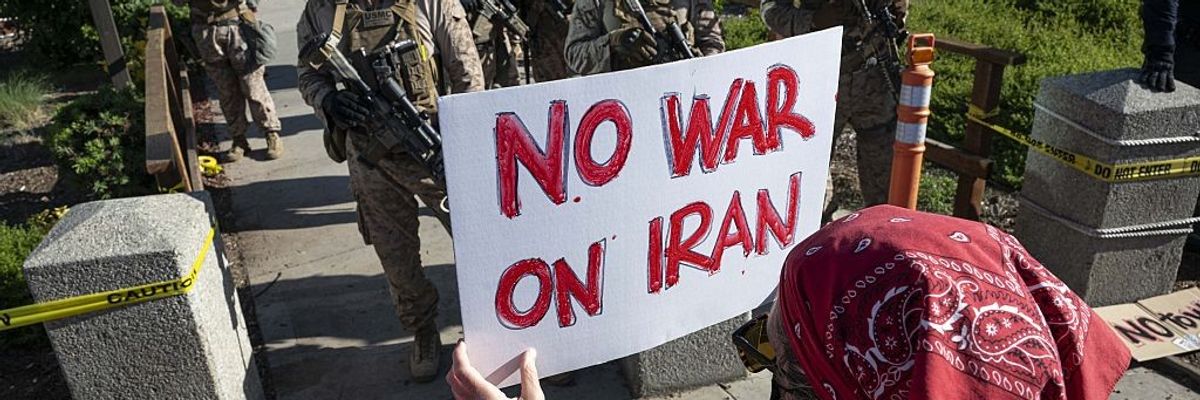
A Protester holds a sign in front of United States Marine Corps soldiers outside of the Federal Building in downtown Los Angeles during the "No War On Iran" protest after conflicts arise with Iran and Israel on June 19, 2025 in Los Angeles, United States.
The popular protests in Iran are just, but rolling back the regime through US intervention, rather than through the actions of the Iranian people themselves, cannot plausibly be described as support for democracy.
Multiple things can be true at once. The Iranian people are engaged in a legitimate popular struggle against an entrenched political elite that has failed to meet their material needs and has answered demands for freedom and dignity with unconscionable violence and repression. At the same time, the US has no political, legal, or moral basis to intervene in Iran. The dire state of the country, as is true of Venezuela and Cuba, the two other nations targeted by the latest neo-neoconservative regime change enthusiasts blinded by imperial hubris and a fetishization of military power, is in significant part the result of Washington’s own policies.
Since 1979, the US has pursued policies aimed at ensuring the failure of the Iranian Revolution. In the decades that followed, and with particular acceleration under the Trump administration, this effort crystallized into a sanctions regime designed not to promote democracy or human rights but to drive ordinary Iranians into a state of immiseration. This strategy, deployed against governments that Washington unilaterally deems problematic, occasionally for defensible reasons but far more often for refusing to subordinate themselves to US imperial and corporate power, has been linked to an estimated 38 million deaths worldwide since 1971.
In Iran, as elsewhere, this policy has rested on the cynical belief that mass suffering will produce political unrest advantageous to the interests of the United States and, in this case, of Israel as well. The quiet part was said out loud by Sen. John Fetterman (D-Pa.), who mocked the government’s recent inability to quell economic discontent through modest financial inducements and celebrated this as “a testament to how our nation and Israel broke Iran.”
The disregard for international law, democratic principles, and human life that underpins this slow violence (see for example Madeleine Albright’s 1996 insistence that sanctions killing as many as half a million Iraqi children was “worth it”) is more evident today than ever. The hypocrisy of an administration that has enabled a genocide in Gaza, decapitated a government in pursuit of oil, threatens to militarily seize the territory of a sovereign country, and condemns repression in Iran while defending public execution of Renee Good by Immigration and Customs Enforcement is not lost on anyone.
US intervention would both co-opt the movement and almost certainly foreclose any real possibility of justice or democracy.
Beyond sanctions, the template for deeper US involvement in Iran appears poised to follow a familiar, troubling playbook. If Washington moves toward directing regime change under the guise of “supporting” Iranian freedom, the most likely beneficiary would be the exiled son of the former Shah, who has not lived in the country for decades. Such an intervention would amount to a second US-backed ouster of an Iranian government to reinstall a member of the Pahlavi dynasty.
The Shah’s son, who has cultivated warm ties with Donald Trump and Benjamin Netanyahu, and has been rebuffed by Iranian human rights activists, does not represent a pathway toward Iran’s democratization. The pursuit of US intervention today then might well produce consequences as calamitous and as unpredictable as those unleashed in 1953. This broader history must therefore remain central to any serious assessment of the current crisis in Iran.
Before Venezuela possessed the largest proven oil reserves in the world, that distinction belonged to Iran. More than a century ago, a weak, illegitimate, and cash-strapped Qajar Dynasty sold the rights to petroleum prospecting to British mining magnate William Knox D’Arcy, a speculative venture in a country with no existing oil industry and no guarantee of viable deposits. At the time, petroleum had not yet come to grease the wheels of the West or serve as the engine of its industrial and military power.
As a result, the 1901 oil concession was not met with the same resistance that had greeted earlier attempts by the Qajars to treat the country as their personal fiefdom, outsourcing development and selling national resources to the highest foreign bidder. The Iranian people had long resisted such Western encroachment, repeatedly forcing their government to retreat from foreign contracts. Yet popular pressure failed to materialize for what would become the most consequential concession of all, one that laid the foundation for decades of imperial intervention in Iran.
The discovery of a vast sea of oil in 1908 prompted the creation of the Anglo-Persian Oil Company (rebranded the Anglo-Iranian Oil Company in 1935 and again as British Petroleum in 1954). By 1914, citing financial uncertainty for the company and a desire to modernize the British naval fleet from domestic coal to more efficient foreign oil, the British government moved to acquire a majority stake in APOC. The timing proved decisive. The world war that followed fueled a global oil boom, and Iranian production expanded rapidly, with APOC supplying a substantial share of Britain’s wartime needs.
After the war, in 1925, a coup ended Qajar rule, and Minister of War Reza Khan crowned himself Shah, inaugurating the Pahlavi Dynasty. He renegotiated the oil concession on marginally better terms, but the increased revenues enriched the Pahlavi elite far more than ordinary Iranians. The result was a growing inequality that fed a revived anti-imperial consciousness.
British control, combined with a failure to defend national sovereignty, radicalized Iranians across social classes. Nowhere was this discontent more acute than among exploited oil workers, who lived and labored in squalid, dangerous conditions, excluded from advancement and constrained by a rigid colonial hierarchy that starkly contrasted with the privileged lives of foreign staff.
That the Shah served at the pleasure of British commercial interests became evident in 1941, when London, and Moscow, deposed him, citing his perceived closeness to Germany, and installed his son, Mohammad Reza Pahlavi, to secure oil for the war effort and keep it from falling into German hands. For good measure, British and Soviet forces occupied the country for the next five years.
After the war and occupation, Iranians renewed their demands for sovereignty, beginning with reclaiming what they saw as their inalienable birthright: control of the natural wealth beneath their soil. Mohammad Mossadegh embodied this struggle. A European-trained lawyer and leader of the National Front coalition, he became the first fully democratically elected prime minister in 1951, sidelining the authority of the Shah and riding a wave of widespread popular support. His ascent was so significant to both Iran and to broader geopolitics that it prompted Time Magazine to name him “Man of the Year” and hail him as the “Iranian George Washington” by 1952.
The events of 1979, shaped by the blowback from 1953, also set the US on a trajectory of deeper imperial entanglement.
Yet he committed what, in the early Cold War, was an unforgivable offense: He nationalized Iran’s own natural resources. This move was wildly popular. The depth of exploitation was evident in that the Anglo-Iranian Oil Company made more in profits in 1950 than it had paid Iran in royalties over nearly the entire previous half century. Mossadegh insisted he was willing to compensate the company, a practice consistent with recent nationalizations, not only in places like Mexico but in Britain itself, which had nationalized its coal industry under the Labour government in 1947. The British nonetheless refused any negotiated settlement.
London instead responded with economic warfare, imposing a de facto embargo designed to starve Mossadegh’s government, obstruct his reform agenda, and grind the population into submission, not unlike more recent sanctions regimes. The campaign only intensified nationalist fervor; some of Mossadegh’s allies declared it preferable for Iran’s oil to be destroyed “by an atom bomb” than to remain under British control. When economic coercion failed, London turned to overthrowing the government, a plot Mossadegh uncovered, leading to the expulsion of British personnel from the country.
In Washington, Downing Street found willing accomplices. The pretext for intervention was that the economic turmoil, engineered by British policies, might in turn create a political vacuum that the Soviets or domestic communists would exploit. In reality, CIA documents acknowledged that Mossadegh was not a communist but a committed nationalist, and that Iran’s communist party was marginal, among the population and within the military. Despite this intelligence, the United States turned toward regime change, establishing the first ever model for covert coups that would follow around the world.
In 1953, after the CIA fomented an artificial uprising and Mossadegh was arrested by a US-backed military loyalist, the Shah, who had fled the country in anticipation of a failed plan, was restored to power. For their trouble, American oil companies were granted a 40% share in the new consortium that controlled Iranian oil, while another 40% went to British Petroleum.
Lacking popular legitimacy, the Shah depended heavily on US backing to maintain control. His rule was enforced through the expansion of the secret police, SAVAK, which functioned as an instrument of state terror rooted in surveillance, repression, and torture. US arms transfers helped sustain this coercive order. By the end of the Shah’s reign, US weapons sales to Iran were in the billions annually, with cumulative purchases over the decade perhaps as high as $20 billion.
As the regime poured staggering resources into armaments, it failed to adequately provide for the well-being of its population. The economic shocks of the 1970s drove millions into the slum-like peripheries of cities like Tehran. These dispossessed joined a broad coalition of women, religious clerics, merchants, laborers, students, and activists who mobilized against the monarchy. Political ferment deepened as President Jimmy Carter, in a display of strategic myopia, publicly toasted the Shah, praising Iran as an “island of stability,” and crediting his “great leadership,” asserting that he had the “respect and the admiration and love” of his people.
That the revolution which soon followed would assume an Islamic character, or culminate in the creation of a theocratic state, was not predetermined. It drew on the influence of the exiled religious figure, soon to be Supreme Leader, Ayatollah Khomeini, as well as an Islamic political vocabulary shaped by Ali Shariati, whose synthesis of Marxism, Iranian history, and Shi’a Islam resonated widely. Yet it was driven above all by a general popular discontent. As in revolutions everywhere, ideology supplied meaning, but material conditions set the stage. Iranian scholar Hamid Dabashi captures this reality in his observation that “Khomeini may not have led a revolution for the price of melon, but many of his followers thought they did.”
If there was a shared ideological thread running through the protests then, it was anti-imperialism. Demonstrators rejected the forced Westernization and authoritarian secularism of the Pahlavi state and rallied behind the slogan “Neither East nor West,” an expression of Third World nationalism and assertion of self-determination. So too did the memory of Mohammad Mossadegh animate the uprising. His figure, representing a crushed experiment in democracy and an anti-imperialist past, remained deeply embedded in Iranian political consciousness.
The Pahlavi government met this movement with escalating violence. This repression, historian Ervand Abrahamian writes, “placed a sea of blood between the Shah and the people,” ensuring the monarchy could not survive and hastening the defection of the military. The revolution soon set in motion events that culminated in the student seizure of the US Embassy in Tehran over fears that Washington intended to rehabilitate, and reinstate, the Shah after admitting him for cancer treatment. The result was a prolonged 444-day standoff that institutionalized mutual hostility and cast a long shadow over both countries and the region.
This animus deepened as the US backed Iraq in its invasion of Iran soon after the revolution. The eight-year war killed roughly 1 million people and revealed Washington’s willingness to bleed regional powers to maintain its geopolitical influence. Continued US support for Israel and the Islamic Republic’s resistance further solidified the adversarial relationship.
The events of 1979, shaped by the blowback from 1953, also set the US on a trajectory of deeper imperial entanglement. These moves included a tightening partnership with Saudi Arabia, a more direct response to the Soviet invasion of Afghanistan, and laid the foundations for the Gulf War. Taken together, they created the conditions for the catastrophic, mass murderous “War on Terror” that was to come, revealing a direct line from US policy toward Iran to the wider architecture of American empire across the Greater Middle East.
The popular protests in Iran are just, and the exceedingly violent response is an affront to the most basic principles of human rights and dignity. But rolling back the regime through US intervention, rather than through the actions of the Iranian people themselves, cannot plausibly be described as support for democracy. It represents the opposite. It is an attempt to reimpose a former client state and reclaim a strategic foothold lost in 1979, in service of a broader ideological project aimed at reasserting US hegemony in the region and beyond.
The Iranian people deserve freedom, and have the right to determine their own political destiny. The horrific slaughter of protesters and imprisonment of dissidents must end. Yet US intervention would both co-opt the movement and almost certainly foreclose any real possibility of justice or democracy.
The precedent here is unmistakable. There was once what was presented as a compelling case for removing Saddam Hussein, given his record of atrocities. But regime change in Iraq, pursued under the ulterior aims of an imperial America; carried out through lies, deceit, and illegality; and urged on by an exile elite with no local legitimacy, became one of the defining crimes of the century. To follow a similar course in Iran today would not only risk replicating those failures. It would reopen wounds that remain painfully fresh, even as they are all too easily forgotten.
Dear Common Dreams reader, It’s been nearly 30 years since I co-founded Common Dreams with my late wife, Lina Newhouser. We had the radical notion that journalism should serve the public good, not corporate profits. It was clear to us from the outset what it would take to build such a project. No paid advertisements. No corporate sponsors. No millionaire publisher telling us what to think or do. Many people said we wouldn't last a year, but we proved those doubters wrong. Together with a tremendous team of journalists and dedicated staff, we built an independent media outlet free from the constraints of profits and corporate control. Our mission has always been simple: To inform. To inspire. To ignite change for the common good. Building Common Dreams was not easy. Our survival was never guaranteed. When you take on the most powerful forces—Wall Street greed, fossil fuel industry destruction, Big Tech lobbyists, and uber-rich oligarchs who have spent billions upon billions rigging the economy and democracy in their favor—the only bulwark you have is supporters who believe in your work. But here’s the urgent message from me today. It's never been this bad out there. And it's never been this hard to keep us going. At the very moment Common Dreams is most needed, the threats we face are intensifying. We need your support now more than ever. We don't accept corporate advertising and never will. We don't have a paywall because we don't think people should be blocked from critical news based on their ability to pay. Everything we do is funded by the donations of readers like you. When everyone does the little they can afford, we are strong. But if that support retreats or dries up, so do we. Will you donate now to make sure Common Dreams not only survives but thrives? —Craig Brown, Co-founder |
Multiple things can be true at once. The Iranian people are engaged in a legitimate popular struggle against an entrenched political elite that has failed to meet their material needs and has answered demands for freedom and dignity with unconscionable violence and repression. At the same time, the US has no political, legal, or moral basis to intervene in Iran. The dire state of the country, as is true of Venezuela and Cuba, the two other nations targeted by the latest neo-neoconservative regime change enthusiasts blinded by imperial hubris and a fetishization of military power, is in significant part the result of Washington’s own policies.
Since 1979, the US has pursued policies aimed at ensuring the failure of the Iranian Revolution. In the decades that followed, and with particular acceleration under the Trump administration, this effort crystallized into a sanctions regime designed not to promote democracy or human rights but to drive ordinary Iranians into a state of immiseration. This strategy, deployed against governments that Washington unilaterally deems problematic, occasionally for defensible reasons but far more often for refusing to subordinate themselves to US imperial and corporate power, has been linked to an estimated 38 million deaths worldwide since 1971.
In Iran, as elsewhere, this policy has rested on the cynical belief that mass suffering will produce political unrest advantageous to the interests of the United States and, in this case, of Israel as well. The quiet part was said out loud by Sen. John Fetterman (D-Pa.), who mocked the government’s recent inability to quell economic discontent through modest financial inducements and celebrated this as “a testament to how our nation and Israel broke Iran.”
The disregard for international law, democratic principles, and human life that underpins this slow violence (see for example Madeleine Albright’s 1996 insistence that sanctions killing as many as half a million Iraqi children was “worth it”) is more evident today than ever. The hypocrisy of an administration that has enabled a genocide in Gaza, decapitated a government in pursuit of oil, threatens to militarily seize the territory of a sovereign country, and condemns repression in Iran while defending public execution of Renee Good by Immigration and Customs Enforcement is not lost on anyone.
US intervention would both co-opt the movement and almost certainly foreclose any real possibility of justice or democracy.
Beyond sanctions, the template for deeper US involvement in Iran appears poised to follow a familiar, troubling playbook. If Washington moves toward directing regime change under the guise of “supporting” Iranian freedom, the most likely beneficiary would be the exiled son of the former Shah, who has not lived in the country for decades. Such an intervention would amount to a second US-backed ouster of an Iranian government to reinstall a member of the Pahlavi dynasty.
The Shah’s son, who has cultivated warm ties with Donald Trump and Benjamin Netanyahu, and has been rebuffed by Iranian human rights activists, does not represent a pathway toward Iran’s democratization. The pursuit of US intervention today then might well produce consequences as calamitous and as unpredictable as those unleashed in 1953. This broader history must therefore remain central to any serious assessment of the current crisis in Iran.
Before Venezuela possessed the largest proven oil reserves in the world, that distinction belonged to Iran. More than a century ago, a weak, illegitimate, and cash-strapped Qajar Dynasty sold the rights to petroleum prospecting to British mining magnate William Knox D’Arcy, a speculative venture in a country with no existing oil industry and no guarantee of viable deposits. At the time, petroleum had not yet come to grease the wheels of the West or serve as the engine of its industrial and military power.
As a result, the 1901 oil concession was not met with the same resistance that had greeted earlier attempts by the Qajars to treat the country as their personal fiefdom, outsourcing development and selling national resources to the highest foreign bidder. The Iranian people had long resisted such Western encroachment, repeatedly forcing their government to retreat from foreign contracts. Yet popular pressure failed to materialize for what would become the most consequential concession of all, one that laid the foundation for decades of imperial intervention in Iran.
The discovery of a vast sea of oil in 1908 prompted the creation of the Anglo-Persian Oil Company (rebranded the Anglo-Iranian Oil Company in 1935 and again as British Petroleum in 1954). By 1914, citing financial uncertainty for the company and a desire to modernize the British naval fleet from domestic coal to more efficient foreign oil, the British government moved to acquire a majority stake in APOC. The timing proved decisive. The world war that followed fueled a global oil boom, and Iranian production expanded rapidly, with APOC supplying a substantial share of Britain’s wartime needs.
After the war, in 1925, a coup ended Qajar rule, and Minister of War Reza Khan crowned himself Shah, inaugurating the Pahlavi Dynasty. He renegotiated the oil concession on marginally better terms, but the increased revenues enriched the Pahlavi elite far more than ordinary Iranians. The result was a growing inequality that fed a revived anti-imperial consciousness.
British control, combined with a failure to defend national sovereignty, radicalized Iranians across social classes. Nowhere was this discontent more acute than among exploited oil workers, who lived and labored in squalid, dangerous conditions, excluded from advancement and constrained by a rigid colonial hierarchy that starkly contrasted with the privileged lives of foreign staff.
That the Shah served at the pleasure of British commercial interests became evident in 1941, when London, and Moscow, deposed him, citing his perceived closeness to Germany, and installed his son, Mohammad Reza Pahlavi, to secure oil for the war effort and keep it from falling into German hands. For good measure, British and Soviet forces occupied the country for the next five years.
After the war and occupation, Iranians renewed their demands for sovereignty, beginning with reclaiming what they saw as their inalienable birthright: control of the natural wealth beneath their soil. Mohammad Mossadegh embodied this struggle. A European-trained lawyer and leader of the National Front coalition, he became the first fully democratically elected prime minister in 1951, sidelining the authority of the Shah and riding a wave of widespread popular support. His ascent was so significant to both Iran and to broader geopolitics that it prompted Time Magazine to name him “Man of the Year” and hail him as the “Iranian George Washington” by 1952.
The events of 1979, shaped by the blowback from 1953, also set the US on a trajectory of deeper imperial entanglement.
Yet he committed what, in the early Cold War, was an unforgivable offense: He nationalized Iran’s own natural resources. This move was wildly popular. The depth of exploitation was evident in that the Anglo-Iranian Oil Company made more in profits in 1950 than it had paid Iran in royalties over nearly the entire previous half century. Mossadegh insisted he was willing to compensate the company, a practice consistent with recent nationalizations, not only in places like Mexico but in Britain itself, which had nationalized its coal industry under the Labour government in 1947. The British nonetheless refused any negotiated settlement.
London instead responded with economic warfare, imposing a de facto embargo designed to starve Mossadegh’s government, obstruct his reform agenda, and grind the population into submission, not unlike more recent sanctions regimes. The campaign only intensified nationalist fervor; some of Mossadegh’s allies declared it preferable for Iran’s oil to be destroyed “by an atom bomb” than to remain under British control. When economic coercion failed, London turned to overthrowing the government, a plot Mossadegh uncovered, leading to the expulsion of British personnel from the country.
In Washington, Downing Street found willing accomplices. The pretext for intervention was that the economic turmoil, engineered by British policies, might in turn create a political vacuum that the Soviets or domestic communists would exploit. In reality, CIA documents acknowledged that Mossadegh was not a communist but a committed nationalist, and that Iran’s communist party was marginal, among the population and within the military. Despite this intelligence, the United States turned toward regime change, establishing the first ever model for covert coups that would follow around the world.
In 1953, after the CIA fomented an artificial uprising and Mossadegh was arrested by a US-backed military loyalist, the Shah, who had fled the country in anticipation of a failed plan, was restored to power. For their trouble, American oil companies were granted a 40% share in the new consortium that controlled Iranian oil, while another 40% went to British Petroleum.
Lacking popular legitimacy, the Shah depended heavily on US backing to maintain control. His rule was enforced through the expansion of the secret police, SAVAK, which functioned as an instrument of state terror rooted in surveillance, repression, and torture. US arms transfers helped sustain this coercive order. By the end of the Shah’s reign, US weapons sales to Iran were in the billions annually, with cumulative purchases over the decade perhaps as high as $20 billion.
As the regime poured staggering resources into armaments, it failed to adequately provide for the well-being of its population. The economic shocks of the 1970s drove millions into the slum-like peripheries of cities like Tehran. These dispossessed joined a broad coalition of women, religious clerics, merchants, laborers, students, and activists who mobilized against the monarchy. Political ferment deepened as President Jimmy Carter, in a display of strategic myopia, publicly toasted the Shah, praising Iran as an “island of stability,” and crediting his “great leadership,” asserting that he had the “respect and the admiration and love” of his people.
That the revolution which soon followed would assume an Islamic character, or culminate in the creation of a theocratic state, was not predetermined. It drew on the influence of the exiled religious figure, soon to be Supreme Leader, Ayatollah Khomeini, as well as an Islamic political vocabulary shaped by Ali Shariati, whose synthesis of Marxism, Iranian history, and Shi’a Islam resonated widely. Yet it was driven above all by a general popular discontent. As in revolutions everywhere, ideology supplied meaning, but material conditions set the stage. Iranian scholar Hamid Dabashi captures this reality in his observation that “Khomeini may not have led a revolution for the price of melon, but many of his followers thought they did.”
If there was a shared ideological thread running through the protests then, it was anti-imperialism. Demonstrators rejected the forced Westernization and authoritarian secularism of the Pahlavi state and rallied behind the slogan “Neither East nor West,” an expression of Third World nationalism and assertion of self-determination. So too did the memory of Mohammad Mossadegh animate the uprising. His figure, representing a crushed experiment in democracy and an anti-imperialist past, remained deeply embedded in Iranian political consciousness.
The Pahlavi government met this movement with escalating violence. This repression, historian Ervand Abrahamian writes, “placed a sea of blood between the Shah and the people,” ensuring the monarchy could not survive and hastening the defection of the military. The revolution soon set in motion events that culminated in the student seizure of the US Embassy in Tehran over fears that Washington intended to rehabilitate, and reinstate, the Shah after admitting him for cancer treatment. The result was a prolonged 444-day standoff that institutionalized mutual hostility and cast a long shadow over both countries and the region.
This animus deepened as the US backed Iraq in its invasion of Iran soon after the revolution. The eight-year war killed roughly 1 million people and revealed Washington’s willingness to bleed regional powers to maintain its geopolitical influence. Continued US support for Israel and the Islamic Republic’s resistance further solidified the adversarial relationship.
The events of 1979, shaped by the blowback from 1953, also set the US on a trajectory of deeper imperial entanglement. These moves included a tightening partnership with Saudi Arabia, a more direct response to the Soviet invasion of Afghanistan, and laid the foundations for the Gulf War. Taken together, they created the conditions for the catastrophic, mass murderous “War on Terror” that was to come, revealing a direct line from US policy toward Iran to the wider architecture of American empire across the Greater Middle East.
The popular protests in Iran are just, and the exceedingly violent response is an affront to the most basic principles of human rights and dignity. But rolling back the regime through US intervention, rather than through the actions of the Iranian people themselves, cannot plausibly be described as support for democracy. It represents the opposite. It is an attempt to reimpose a former client state and reclaim a strategic foothold lost in 1979, in service of a broader ideological project aimed at reasserting US hegemony in the region and beyond.
The Iranian people deserve freedom, and have the right to determine their own political destiny. The horrific slaughter of protesters and imprisonment of dissidents must end. Yet US intervention would both co-opt the movement and almost certainly foreclose any real possibility of justice or democracy.
The precedent here is unmistakable. There was once what was presented as a compelling case for removing Saddam Hussein, given his record of atrocities. But regime change in Iraq, pursued under the ulterior aims of an imperial America; carried out through lies, deceit, and illegality; and urged on by an exile elite with no local legitimacy, became one of the defining crimes of the century. To follow a similar course in Iran today would not only risk replicating those failures. It would reopen wounds that remain painfully fresh, even as they are all too easily forgotten.
Multiple things can be true at once. The Iranian people are engaged in a legitimate popular struggle against an entrenched political elite that has failed to meet their material needs and has answered demands for freedom and dignity with unconscionable violence and repression. At the same time, the US has no political, legal, or moral basis to intervene in Iran. The dire state of the country, as is true of Venezuela and Cuba, the two other nations targeted by the latest neo-neoconservative regime change enthusiasts blinded by imperial hubris and a fetishization of military power, is in significant part the result of Washington’s own policies.
Since 1979, the US has pursued policies aimed at ensuring the failure of the Iranian Revolution. In the decades that followed, and with particular acceleration under the Trump administration, this effort crystallized into a sanctions regime designed not to promote democracy or human rights but to drive ordinary Iranians into a state of immiseration. This strategy, deployed against governments that Washington unilaterally deems problematic, occasionally for defensible reasons but far more often for refusing to subordinate themselves to US imperial and corporate power, has been linked to an estimated 38 million deaths worldwide since 1971.
In Iran, as elsewhere, this policy has rested on the cynical belief that mass suffering will produce political unrest advantageous to the interests of the United States and, in this case, of Israel as well. The quiet part was said out loud by Sen. John Fetterman (D-Pa.), who mocked the government’s recent inability to quell economic discontent through modest financial inducements and celebrated this as “a testament to how our nation and Israel broke Iran.”
The disregard for international law, democratic principles, and human life that underpins this slow violence (see for example Madeleine Albright’s 1996 insistence that sanctions killing as many as half a million Iraqi children was “worth it”) is more evident today than ever. The hypocrisy of an administration that has enabled a genocide in Gaza, decapitated a government in pursuit of oil, threatens to militarily seize the territory of a sovereign country, and condemns repression in Iran while defending public execution of Renee Good by Immigration and Customs Enforcement is not lost on anyone.
US intervention would both co-opt the movement and almost certainly foreclose any real possibility of justice or democracy.
Beyond sanctions, the template for deeper US involvement in Iran appears poised to follow a familiar, troubling playbook. If Washington moves toward directing regime change under the guise of “supporting” Iranian freedom, the most likely beneficiary would be the exiled son of the former Shah, who has not lived in the country for decades. Such an intervention would amount to a second US-backed ouster of an Iranian government to reinstall a member of the Pahlavi dynasty.
The Shah’s son, who has cultivated warm ties with Donald Trump and Benjamin Netanyahu, and has been rebuffed by Iranian human rights activists, does not represent a pathway toward Iran’s democratization. The pursuit of US intervention today then might well produce consequences as calamitous and as unpredictable as those unleashed in 1953. This broader history must therefore remain central to any serious assessment of the current crisis in Iran.
Before Venezuela possessed the largest proven oil reserves in the world, that distinction belonged to Iran. More than a century ago, a weak, illegitimate, and cash-strapped Qajar Dynasty sold the rights to petroleum prospecting to British mining magnate William Knox D’Arcy, a speculative venture in a country with no existing oil industry and no guarantee of viable deposits. At the time, petroleum had not yet come to grease the wheels of the West or serve as the engine of its industrial and military power.
As a result, the 1901 oil concession was not met with the same resistance that had greeted earlier attempts by the Qajars to treat the country as their personal fiefdom, outsourcing development and selling national resources to the highest foreign bidder. The Iranian people had long resisted such Western encroachment, repeatedly forcing their government to retreat from foreign contracts. Yet popular pressure failed to materialize for what would become the most consequential concession of all, one that laid the foundation for decades of imperial intervention in Iran.
The discovery of a vast sea of oil in 1908 prompted the creation of the Anglo-Persian Oil Company (rebranded the Anglo-Iranian Oil Company in 1935 and again as British Petroleum in 1954). By 1914, citing financial uncertainty for the company and a desire to modernize the British naval fleet from domestic coal to more efficient foreign oil, the British government moved to acquire a majority stake in APOC. The timing proved decisive. The world war that followed fueled a global oil boom, and Iranian production expanded rapidly, with APOC supplying a substantial share of Britain’s wartime needs.
After the war, in 1925, a coup ended Qajar rule, and Minister of War Reza Khan crowned himself Shah, inaugurating the Pahlavi Dynasty. He renegotiated the oil concession on marginally better terms, but the increased revenues enriched the Pahlavi elite far more than ordinary Iranians. The result was a growing inequality that fed a revived anti-imperial consciousness.
British control, combined with a failure to defend national sovereignty, radicalized Iranians across social classes. Nowhere was this discontent more acute than among exploited oil workers, who lived and labored in squalid, dangerous conditions, excluded from advancement and constrained by a rigid colonial hierarchy that starkly contrasted with the privileged lives of foreign staff.
That the Shah served at the pleasure of British commercial interests became evident in 1941, when London, and Moscow, deposed him, citing his perceived closeness to Germany, and installed his son, Mohammad Reza Pahlavi, to secure oil for the war effort and keep it from falling into German hands. For good measure, British and Soviet forces occupied the country for the next five years.
After the war and occupation, Iranians renewed their demands for sovereignty, beginning with reclaiming what they saw as their inalienable birthright: control of the natural wealth beneath their soil. Mohammad Mossadegh embodied this struggle. A European-trained lawyer and leader of the National Front coalition, he became the first fully democratically elected prime minister in 1951, sidelining the authority of the Shah and riding a wave of widespread popular support. His ascent was so significant to both Iran and to broader geopolitics that it prompted Time Magazine to name him “Man of the Year” and hail him as the “Iranian George Washington” by 1952.
The events of 1979, shaped by the blowback from 1953, also set the US on a trajectory of deeper imperial entanglement.
Yet he committed what, in the early Cold War, was an unforgivable offense: He nationalized Iran’s own natural resources. This move was wildly popular. The depth of exploitation was evident in that the Anglo-Iranian Oil Company made more in profits in 1950 than it had paid Iran in royalties over nearly the entire previous half century. Mossadegh insisted he was willing to compensate the company, a practice consistent with recent nationalizations, not only in places like Mexico but in Britain itself, which had nationalized its coal industry under the Labour government in 1947. The British nonetheless refused any negotiated settlement.
London instead responded with economic warfare, imposing a de facto embargo designed to starve Mossadegh’s government, obstruct his reform agenda, and grind the population into submission, not unlike more recent sanctions regimes. The campaign only intensified nationalist fervor; some of Mossadegh’s allies declared it preferable for Iran’s oil to be destroyed “by an atom bomb” than to remain under British control. When economic coercion failed, London turned to overthrowing the government, a plot Mossadegh uncovered, leading to the expulsion of British personnel from the country.
In Washington, Downing Street found willing accomplices. The pretext for intervention was that the economic turmoil, engineered by British policies, might in turn create a political vacuum that the Soviets or domestic communists would exploit. In reality, CIA documents acknowledged that Mossadegh was not a communist but a committed nationalist, and that Iran’s communist party was marginal, among the population and within the military. Despite this intelligence, the United States turned toward regime change, establishing the first ever model for covert coups that would follow around the world.
In 1953, after the CIA fomented an artificial uprising and Mossadegh was arrested by a US-backed military loyalist, the Shah, who had fled the country in anticipation of a failed plan, was restored to power. For their trouble, American oil companies were granted a 40% share in the new consortium that controlled Iranian oil, while another 40% went to British Petroleum.
Lacking popular legitimacy, the Shah depended heavily on US backing to maintain control. His rule was enforced through the expansion of the secret police, SAVAK, which functioned as an instrument of state terror rooted in surveillance, repression, and torture. US arms transfers helped sustain this coercive order. By the end of the Shah’s reign, US weapons sales to Iran were in the billions annually, with cumulative purchases over the decade perhaps as high as $20 billion.
As the regime poured staggering resources into armaments, it failed to adequately provide for the well-being of its population. The economic shocks of the 1970s drove millions into the slum-like peripheries of cities like Tehran. These dispossessed joined a broad coalition of women, religious clerics, merchants, laborers, students, and activists who mobilized against the monarchy. Political ferment deepened as President Jimmy Carter, in a display of strategic myopia, publicly toasted the Shah, praising Iran as an “island of stability,” and crediting his “great leadership,” asserting that he had the “respect and the admiration and love” of his people.
That the revolution which soon followed would assume an Islamic character, or culminate in the creation of a theocratic state, was not predetermined. It drew on the influence of the exiled religious figure, soon to be Supreme Leader, Ayatollah Khomeini, as well as an Islamic political vocabulary shaped by Ali Shariati, whose synthesis of Marxism, Iranian history, and Shi’a Islam resonated widely. Yet it was driven above all by a general popular discontent. As in revolutions everywhere, ideology supplied meaning, but material conditions set the stage. Iranian scholar Hamid Dabashi captures this reality in his observation that “Khomeini may not have led a revolution for the price of melon, but many of his followers thought they did.”
If there was a shared ideological thread running through the protests then, it was anti-imperialism. Demonstrators rejected the forced Westernization and authoritarian secularism of the Pahlavi state and rallied behind the slogan “Neither East nor West,” an expression of Third World nationalism and assertion of self-determination. So too did the memory of Mohammad Mossadegh animate the uprising. His figure, representing a crushed experiment in democracy and an anti-imperialist past, remained deeply embedded in Iranian political consciousness.
The Pahlavi government met this movement with escalating violence. This repression, historian Ervand Abrahamian writes, “placed a sea of blood between the Shah and the people,” ensuring the monarchy could not survive and hastening the defection of the military. The revolution soon set in motion events that culminated in the student seizure of the US Embassy in Tehran over fears that Washington intended to rehabilitate, and reinstate, the Shah after admitting him for cancer treatment. The result was a prolonged 444-day standoff that institutionalized mutual hostility and cast a long shadow over both countries and the region.
This animus deepened as the US backed Iraq in its invasion of Iran soon after the revolution. The eight-year war killed roughly 1 million people and revealed Washington’s willingness to bleed regional powers to maintain its geopolitical influence. Continued US support for Israel and the Islamic Republic’s resistance further solidified the adversarial relationship.
The events of 1979, shaped by the blowback from 1953, also set the US on a trajectory of deeper imperial entanglement. These moves included a tightening partnership with Saudi Arabia, a more direct response to the Soviet invasion of Afghanistan, and laid the foundations for the Gulf War. Taken together, they created the conditions for the catastrophic, mass murderous “War on Terror” that was to come, revealing a direct line from US policy toward Iran to the wider architecture of American empire across the Greater Middle East.
The popular protests in Iran are just, and the exceedingly violent response is an affront to the most basic principles of human rights and dignity. But rolling back the regime through US intervention, rather than through the actions of the Iranian people themselves, cannot plausibly be described as support for democracy. It represents the opposite. It is an attempt to reimpose a former client state and reclaim a strategic foothold lost in 1979, in service of a broader ideological project aimed at reasserting US hegemony in the region and beyond.
The Iranian people deserve freedom, and have the right to determine their own political destiny. The horrific slaughter of protesters and imprisonment of dissidents must end. Yet US intervention would both co-opt the movement and almost certainly foreclose any real possibility of justice or democracy.
The precedent here is unmistakable. There was once what was presented as a compelling case for removing Saddam Hussein, given his record of atrocities. But regime change in Iraq, pursued under the ulterior aims of an imperial America; carried out through lies, deceit, and illegality; and urged on by an exile elite with no local legitimacy, became one of the defining crimes of the century. To follow a similar course in Iran today would not only risk replicating those failures. It would reopen wounds that remain painfully fresh, even as they are all too easily forgotten.