SUBSCRIBE TO OUR FREE NEWSLETTER
Daily news & progressive opinion—funded by the people, not the corporations—delivered straight to your inbox.
5
#000000
#FFFFFF
To donate by check, phone, or other method, see our More Ways to Give page.
Daily news & progressive opinion—funded by the people, not the corporations—delivered straight to your inbox.
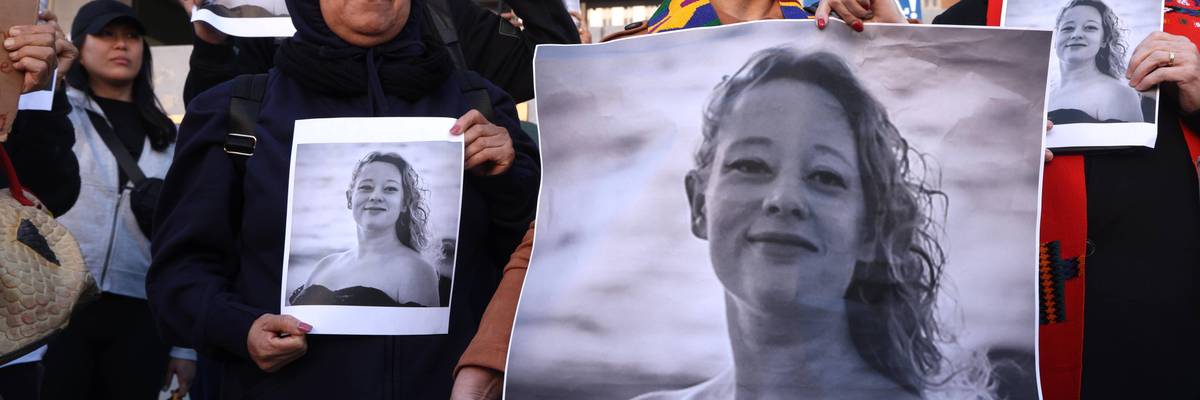
Ampara Rincon, second from right, her husband Pastor Carlos Rincon, right, and other protesters, hold photos of Renee Nicole Good, the day after her shooting death Wednesday by an ICE agent in Minneapolis, in front of the Federal Building in downtown Los Angeles on January 8, 2026.
The offing of Renee Nicole Good didn’t differ in kind from the deaths inflicted on dissidents by the Iranian state.
The pro-democracy protesters in Iran deserved so much better. They deserved the support of a democratic United States that could sincerely urge the rule of law and habeas corpus (allowing people to legally challenge their detentions) be respected, not to speak of freedom of speech, the press, and assembly in accordance with the Constitution. Unfortunately, President Donald J. Trump has forfeited any claim to respect for such rights or a principled foreign policy and so has proved strikingly ineffective in aiding those protesters.
The arbitrary arrests and killings committed by agents of Trump’s authoritarian-style rule differ only in number, not in kind, from the detainments and killings of protesters carried out by the basij (or pro-regime street militias) in Iran. In fact, they rendered hisprotests and bluster about Iran the height of hypocrisy. Above all, the killing of Renee Nicole Good in her car in Minneapolis by a Trumpian Immigration and Customs Enforcement (ICE) agent haunted his response, providing the all-too-grim Iranian regime with an easy rebuttal to American claims of moral superiority.
Trump’s threats of intervention in Iran came after the latest round of demonstrations and strikes there this winter. In late December, bazaar merchants in Iran decried the collapse of the nation’s currency, the rial. For many years, it had been under severe pressure thanks to Trump’s “maximum pressure” sanctions, renewed European sanctions over Iran’s nuclear enrichment program, and incompetent government financial policies. In December, the rial fell to 1.4 million to the dollar—and no, that is not a misprint—having lost 40% of its value over the course of the previous year. Inflation was already running at 42%, harming those on fixed incomes, while the rial’s decline particularly hurt the ability of Iranians to afford imported goods.
Such currency instability contributed to economic stagnation, as many merchants went on strike and halted commercial transactions altogether, given the heavy losses they were suffering. For the rest of December and early January, those striking traders were joined by professionals, workers, and students nationwide, some of whom wanted not just a better economy, but a less authoritarian government. The government responded, of course, with grimly repressive tactics, but the size of the crowds only grew, even in the capital, Tehran, while some of the protesters began demanding an end to the Islamic Republic.
Trump’s America now stands on increasingly shaky ground when it accuses other regimes of atrocities.
A turning point came on January 8, when security force thugs began shooting down demonstrators en masse and stacking up bodies. Until then, the demonstrations had been largely peaceful (though instances of vandalism had been reported), but the government began alleging that more than 100 police had been killed. Human Rights Watch reported that “verified footage shows some protesters engaging in acts of violence.” That some dissidents had turned to violence, however, can’t in any way justify the scale of the slaughter by security forces that followed.
By mid-January, human rights organizations were estimating that thousands of demonstrators had been mown down by the Iranian police and military. Even Iran’s clerical leader, Ali Khamenei, confirmed that thousands were dead, though ludicrously enough, he blamed Donald Trump for instigating their acts. On January 9, perhaps as a cover for its police and military sniping into crowds, the government cut the country’s internet off, while denouncing all protesters as “rioters” and “terrorists.”
And here’s the truly sad thing: While such unhinged rhetorical excesses were once the province of dictatorships and other authoritarian regimes like those in Iran and North Korea, the White House is now competing with Tehran and Pyongyang on a remarkably even playing field. The Trump White House, for instance, excused the dispatch of the National Guard to Portland, Oregon, last year on the grounds of a “Radical left reign of terror,” “antifa-led hellfire,” and “lunatics” committing widespread mayhem in that city, even deploying “explosives.” Of course, Trump’s image of Portland as an apocalyptic, anarchist free-fire zone bore no relation to reality, but it did bear an eerie relation to the language of the authoritarian regimes in Iran and North Korea.
That means Trump’s America now stands on increasingly shaky ground when it accuses other regimes of atrocities. Similarly, Washington’s full-throated backing of Israel’s genocidal actions against Palestinians in Gaza raised questions about its alleged support for populations in the Global South demanding freedom. Nor could Trump’s naked power grab in Venezuela, explicitly carried out for the sake of stealing that country’s petroleum, have been reassuring to the inhabitants of a petrostate like Iran.
The killing of poet and mother of three Renee Nicole Good, a Christian who had done mission work, by a belligerent ICE agent on January 7 in Minneapolis and similar killings (which continue, as with Alex Pretti) don’t, of course, compare in scale to Tehran’s grim treatment of Iranian protesters in January. This country may, however, be considered closer to such a—can I even use the word?—model, if we include those who were brutalized and killed once Trump offshored them to the notorious CECOT mega-prison and torture facility in El Salvador (about which, by the way, right-wing Oracle CEO Larry Ellison’s new propaganda outlet, CBS News, attempted to avoid informing us).
We may come closer still if we include Iranian-American dissidents and those of other nationalities deported by Trump, after he arbitrarily denied them asylum, raising questions about the fate of hundreds or possibly thousands of activists being returned to despotic home countries–or sometimes to third countries like South Sudan in the midst of civil war. That the Trump regime (like the Iranian one) is willing to sacrifice massive numbers of people for the sake of ideology is clear. Oxfam estimates that Trump’s destruction of the US Agency for International Development led to the deaths of 200,000 children globally in 2025 (and that, of course, isn’t even counting dead adults).
The point, however, is not equivalency in scale. There’s an anecdote from the 1930s about then-media-magnate Max Aitkin (also known as Lord Beaverbrook), a British-Canadian politician. He was said to be at a cocktail party conversing with an attractive woman, when the conversation turned to ethics. He then asked her if she would sleep with someone for a million British pounds. She replied that she would. He then asked, “Would you sleep with someone for five pounds?” She replied indignantly, “Certainly not, what sort of woman do you think I am?” And he observed dryly, “Madame, we have already established that. Now we are just haggling about the price.”
In the same vein, we’ve already established that Trump’s minions are lawless kidnappers and killers—now we’re just haggling about the number of their victims (so far) compared to those of other authoritarian regimes. In truth, the offing of Renee Nicole Good didn’t differ in kind from the deaths inflicted on dissidents by the Iranian state. She was murdered by an ICE agent in a fit of pique for a nonviolent protest. He (or one of his compatriots) then muttered of that gentle Christian, “Fucking bitch!”
Even the spin the Iranian and American governments put on their crackdowns was essentially indistinguishable. Ayatollah Ali Khamenei called the Iranian protesters “saboteurs” and “vandals.” Similarly, cartoonish Department of Homeland Security Secretary Kristi Noem and ghoulish White House Deputy Chief of Staff for Policy Stephen Miller denounced Renee Nicole Good as a “domestic terrorist,” while the spineless Speaker of the House Mike Johnson (R-La.) accused her of “impeding law enforcement.” Administration officials also denounced her as a “professional agitator” and President Trump justified her killing, saying that her actions had been “tough.”
Such allegations fly in the face of the straightforward record offered from the many videos of the incident released by bystanders and even by the killer, which show that an inoffensive Good said, “I’m not mad at you, dude,” just before her life was taken. In other words, the Trump regime vindicated ICE on that killing on the same grounds that Khamenei and his officials excused the carnage against protesters in Iran.
The Good slaying came on the heels of numerous Trump administration attempts to provoke civil unrest by illegally sending the National Guard into the cities of Los Angeles, Portland, Washington, DC, Memphis, New Orleans, and Chicago, all politically controlled by Democrats, allegedly to “protect” masked, armed ICE goons. The intent was to erode the 1888 Posse Comitatus Act, which prohibits using federal troops in local law enforcement. Nevertheless, National Guardsmen in Los Angeles detained American citizens. Even ICE does not have any statutory authority to arrest, order around, or tear-gas citizens not reasonably suspected of immigration offenses or of violence toward persons or property. (Nor are the plainclothes members of the basij paramilitary in Iran, loyal to Khamenei’s person, properly considered “law enforcement.”)
Though it’s not mentioned in our news world, it couldn’t be clearer that Ayatollah Trump and Ayatollah Khamenei share a bloodthirsty perspective on “law and order.”
Yet ICE now routinely arrests (and in Good’s case executed) Americans doing no harm, while attempting to interfere with their right to assemble peaceably or record public actions. As one such victim told journalist Anne Applebaum of The Atlantic, “My name is George Retes Jr. I’m 25 years old. I was born and raised here in Ventura, California. I’m a father of two, and yeah, I’m a US citizen. The day I was arrested by ICE agents was July 10.” Similarly, Immigration and Customs Enforcement agents, sometimes basing themselves at historic sites of genocide against Indigenous nations, have arrested some of their members, whose families began coming to North America 30,000 years ago.
Such ironies have not been lost on Iranian officials. As Foreign Minister Abbas Araghchi said in Beirut recently, speaking of Good’s death: “We have seen Trump trying to deploy the National Guard in his own country. In the last two days we saw how [ICE] killed a 37-year-old woman.” He then added, “And we found Trump is the one who defended this action by the police. But in his dealings with the Iranians, we see him telling the government if you shoot a bullet against those protesters, then I’ll come for you.”
The autocrats in Tehran proved all too capable of bringing Trump around to their point of view, at least for a moment. In mid-January, after he had spent a week threatening war against Iran’s ayatollahs over their atrocities, he heard Araghchi’s interview on Fox News and abruptly executed an about-face. “They said people were shooting at them with guns, and they were shooting back,” Trump remarked. “And you know, it’s one of those things. But they told me that there’ll be no executions, and so I hope that’s true.”
Though it’s not mentioned in our news world, it couldn’t be clearer that Ayatollah Trump and Ayatollah Khamenei share a bloodthirsty perspective on “law and order.”
Trump has no principles, and so he didn’t back off even temporarily in mid-January from initiating a war on Iran on ethical grounds. Instead, the leaders of Saudi Arabia, Qatar, and Oman, who have cultivated close relationships with the American president, argued that bombing Iran could work against the protesters, uniting the country against a foreign attacker. They also worried about the regional instability and disruption to oil markets that a US strike might bring about. After all, in the summer of 2025, after Trump ordered the bombing of Iranian nuclear sites, that country struck out at al-Udeid Air Force Base in Qatar, which is leased to the US military.
Above all, however, at that moment of indecision, Trump seemed unable to imagine a way personally to profit from an assault on Iran, unlike Venezuela.
In short, Trump is the least plausible critic imaginable when it comes to the Islamic Republic’s human rights record. After all, how can an administration promoting a fundamentalist attack on science and sexual rights lecture fundamentalist Iran? How can an administration that arranged for Immigration and Customs Enforcement to balloon into a $75 billion agency, that routinely disregards the First, Fourth, and Sixth Amendments, criticize Iran for maintaining a force of 90,000 pro-regime basij militiamen? How can Trump, with his white Protestant nationalism dedicated to expelling untold numbers of Hispanic Catholics, lecture Iran over deporting 1.5 million Afghans in 2025?
Notoriously, US administrations apply a hectoring human-rights discourse only to states they view as enemies, not to friendly ones. Absolute monarchies, autocracies, or dictatorships that routinely jail, torture, and execute dissidents like Saudi Arabia, the United Arab Emirates, Egypt, and El Salvador are neither singled out for public denunciation nor threatened by the White House, as long as they are seen as serving Washington’s interests.
The extremist government of Israeli Prime Minister Benjamin Netanyahu, still committing genocide against Palestinians in Gaza and assiduously pursuing the crime of apartheid in the Palestinian West Bank, is showered with praise and billions of taxpayer dollars in weaponry. State Department spokespeople deal with such Himalayan-sized hypocrisy by a studied silence or by weasel words (which some of them may later repent).
Trumpism can’t possibly succeed in the necessary work of human-rights advocacy because his American form of fascism doesn’t believe in constitutional or human rights, not abroad or, for that matter, at home.
Don’t misunderstand. I’m not arguing that what’s happening in Iran is no different from tolerated atrocities elsewhere and therefore should be disregarded. The egregious violence of the Iranian government toward protesters this winter far outstripped even what’s grimly normal in that country. In the much more sustained and widespread demonstrations of the Green Movement in Iran in 2009, the agents of the ayatollahs killed between 70 and 200 people. Now, the government itself admits that its victims are in the thousands.
Nothing hurts more than the image of idealistic young Iranians pawing through corpses searching for loved ones. Nothing would please me more than to see Iran move toward democracy. The problem is that Trumpism can’t possibly succeed in the necessary work of human-rights advocacy because his American form of fascism doesn’t believe in constitutional or human rights, not abroad or, for that matter, at home. In short, if Donald Trump can’t denounce the killing of Renee Nicole Good, his denunciations of the killings in Iran ring fatally hollow.
Dear Common Dreams reader, It’s been nearly 30 years since I co-founded Common Dreams with my late wife, Lina Newhouser. We had the radical notion that journalism should serve the public good, not corporate profits. It was clear to us from the outset what it would take to build such a project. No paid advertisements. No corporate sponsors. No millionaire publisher telling us what to think or do. Many people said we wouldn't last a year, but we proved those doubters wrong. Together with a tremendous team of journalists and dedicated staff, we built an independent media outlet free from the constraints of profits and corporate control. Our mission has always been simple: To inform. To inspire. To ignite change for the common good. Building Common Dreams was not easy. Our survival was never guaranteed. When you take on the most powerful forces—Wall Street greed, fossil fuel industry destruction, Big Tech lobbyists, and uber-rich oligarchs who have spent billions upon billions rigging the economy and democracy in their favor—the only bulwark you have is supporters who believe in your work. But here’s the urgent message from me today. It's never been this bad out there. And it's never been this hard to keep us going. At the very moment Common Dreams is most needed, the threats we face are intensifying. We need your support now more than ever. We don't accept corporate advertising and never will. We don't have a paywall because we don't think people should be blocked from critical news based on their ability to pay. Everything we do is funded by the donations of readers like you. When everyone does the little they can afford, we are strong. But if that support retreats or dries up, so do we. Will you donate now to make sure Common Dreams not only survives but thrives? —Craig Brown, Co-founder |
The pro-democracy protesters in Iran deserved so much better. They deserved the support of a democratic United States that could sincerely urge the rule of law and habeas corpus (allowing people to legally challenge their detentions) be respected, not to speak of freedom of speech, the press, and assembly in accordance with the Constitution. Unfortunately, President Donald J. Trump has forfeited any claim to respect for such rights or a principled foreign policy and so has proved strikingly ineffective in aiding those protesters.
The arbitrary arrests and killings committed by agents of Trump’s authoritarian-style rule differ only in number, not in kind, from the detainments and killings of protesters carried out by the basij (or pro-regime street militias) in Iran. In fact, they rendered hisprotests and bluster about Iran the height of hypocrisy. Above all, the killing of Renee Nicole Good in her car in Minneapolis by a Trumpian Immigration and Customs Enforcement (ICE) agent haunted his response, providing the all-too-grim Iranian regime with an easy rebuttal to American claims of moral superiority.
Trump’s threats of intervention in Iran came after the latest round of demonstrations and strikes there this winter. In late December, bazaar merchants in Iran decried the collapse of the nation’s currency, the rial. For many years, it had been under severe pressure thanks to Trump’s “maximum pressure” sanctions, renewed European sanctions over Iran’s nuclear enrichment program, and incompetent government financial policies. In December, the rial fell to 1.4 million to the dollar—and no, that is not a misprint—having lost 40% of its value over the course of the previous year. Inflation was already running at 42%, harming those on fixed incomes, while the rial’s decline particularly hurt the ability of Iranians to afford imported goods.
Such currency instability contributed to economic stagnation, as many merchants went on strike and halted commercial transactions altogether, given the heavy losses they were suffering. For the rest of December and early January, those striking traders were joined by professionals, workers, and students nationwide, some of whom wanted not just a better economy, but a less authoritarian government. The government responded, of course, with grimly repressive tactics, but the size of the crowds only grew, even in the capital, Tehran, while some of the protesters began demanding an end to the Islamic Republic.
Trump’s America now stands on increasingly shaky ground when it accuses other regimes of atrocities.
A turning point came on January 8, when security force thugs began shooting down demonstrators en masse and stacking up bodies. Until then, the demonstrations had been largely peaceful (though instances of vandalism had been reported), but the government began alleging that more than 100 police had been killed. Human Rights Watch reported that “verified footage shows some protesters engaging in acts of violence.” That some dissidents had turned to violence, however, can’t in any way justify the scale of the slaughter by security forces that followed.
By mid-January, human rights organizations were estimating that thousands of demonstrators had been mown down by the Iranian police and military. Even Iran’s clerical leader, Ali Khamenei, confirmed that thousands were dead, though ludicrously enough, he blamed Donald Trump for instigating their acts. On January 9, perhaps as a cover for its police and military sniping into crowds, the government cut the country’s internet off, while denouncing all protesters as “rioters” and “terrorists.”
And here’s the truly sad thing: While such unhinged rhetorical excesses were once the province of dictatorships and other authoritarian regimes like those in Iran and North Korea, the White House is now competing with Tehran and Pyongyang on a remarkably even playing field. The Trump White House, for instance, excused the dispatch of the National Guard to Portland, Oregon, last year on the grounds of a “Radical left reign of terror,” “antifa-led hellfire,” and “lunatics” committing widespread mayhem in that city, even deploying “explosives.” Of course, Trump’s image of Portland as an apocalyptic, anarchist free-fire zone bore no relation to reality, but it did bear an eerie relation to the language of the authoritarian regimes in Iran and North Korea.
That means Trump’s America now stands on increasingly shaky ground when it accuses other regimes of atrocities. Similarly, Washington’s full-throated backing of Israel’s genocidal actions against Palestinians in Gaza raised questions about its alleged support for populations in the Global South demanding freedom. Nor could Trump’s naked power grab in Venezuela, explicitly carried out for the sake of stealing that country’s petroleum, have been reassuring to the inhabitants of a petrostate like Iran.
The killing of poet and mother of three Renee Nicole Good, a Christian who had done mission work, by a belligerent ICE agent on January 7 in Minneapolis and similar killings (which continue, as with Alex Pretti) don’t, of course, compare in scale to Tehran’s grim treatment of Iranian protesters in January. This country may, however, be considered closer to such a—can I even use the word?—model, if we include those who were brutalized and killed once Trump offshored them to the notorious CECOT mega-prison and torture facility in El Salvador (about which, by the way, right-wing Oracle CEO Larry Ellison’s new propaganda outlet, CBS News, attempted to avoid informing us).
We may come closer still if we include Iranian-American dissidents and those of other nationalities deported by Trump, after he arbitrarily denied them asylum, raising questions about the fate of hundreds or possibly thousands of activists being returned to despotic home countries–or sometimes to third countries like South Sudan in the midst of civil war. That the Trump regime (like the Iranian one) is willing to sacrifice massive numbers of people for the sake of ideology is clear. Oxfam estimates that Trump’s destruction of the US Agency for International Development led to the deaths of 200,000 children globally in 2025 (and that, of course, isn’t even counting dead adults).
The point, however, is not equivalency in scale. There’s an anecdote from the 1930s about then-media-magnate Max Aitkin (also known as Lord Beaverbrook), a British-Canadian politician. He was said to be at a cocktail party conversing with an attractive woman, when the conversation turned to ethics. He then asked her if she would sleep with someone for a million British pounds. She replied that she would. He then asked, “Would you sleep with someone for five pounds?” She replied indignantly, “Certainly not, what sort of woman do you think I am?” And he observed dryly, “Madame, we have already established that. Now we are just haggling about the price.”
In the same vein, we’ve already established that Trump’s minions are lawless kidnappers and killers—now we’re just haggling about the number of their victims (so far) compared to those of other authoritarian regimes. In truth, the offing of Renee Nicole Good didn’t differ in kind from the deaths inflicted on dissidents by the Iranian state. She was murdered by an ICE agent in a fit of pique for a nonviolent protest. He (or one of his compatriots) then muttered of that gentle Christian, “Fucking bitch!”
Even the spin the Iranian and American governments put on their crackdowns was essentially indistinguishable. Ayatollah Ali Khamenei called the Iranian protesters “saboteurs” and “vandals.” Similarly, cartoonish Department of Homeland Security Secretary Kristi Noem and ghoulish White House Deputy Chief of Staff for Policy Stephen Miller denounced Renee Nicole Good as a “domestic terrorist,” while the spineless Speaker of the House Mike Johnson (R-La.) accused her of “impeding law enforcement.” Administration officials also denounced her as a “professional agitator” and President Trump justified her killing, saying that her actions had been “tough.”
Such allegations fly in the face of the straightforward record offered from the many videos of the incident released by bystanders and even by the killer, which show that an inoffensive Good said, “I’m not mad at you, dude,” just before her life was taken. In other words, the Trump regime vindicated ICE on that killing on the same grounds that Khamenei and his officials excused the carnage against protesters in Iran.
The Good slaying came on the heels of numerous Trump administration attempts to provoke civil unrest by illegally sending the National Guard into the cities of Los Angeles, Portland, Washington, DC, Memphis, New Orleans, and Chicago, all politically controlled by Democrats, allegedly to “protect” masked, armed ICE goons. The intent was to erode the 1888 Posse Comitatus Act, which prohibits using federal troops in local law enforcement. Nevertheless, National Guardsmen in Los Angeles detained American citizens. Even ICE does not have any statutory authority to arrest, order around, or tear-gas citizens not reasonably suspected of immigration offenses or of violence toward persons or property. (Nor are the plainclothes members of the basij paramilitary in Iran, loyal to Khamenei’s person, properly considered “law enforcement.”)
Though it’s not mentioned in our news world, it couldn’t be clearer that Ayatollah Trump and Ayatollah Khamenei share a bloodthirsty perspective on “law and order.”
Yet ICE now routinely arrests (and in Good’s case executed) Americans doing no harm, while attempting to interfere with their right to assemble peaceably or record public actions. As one such victim told journalist Anne Applebaum of The Atlantic, “My name is George Retes Jr. I’m 25 years old. I was born and raised here in Ventura, California. I’m a father of two, and yeah, I’m a US citizen. The day I was arrested by ICE agents was July 10.” Similarly, Immigration and Customs Enforcement agents, sometimes basing themselves at historic sites of genocide against Indigenous nations, have arrested some of their members, whose families began coming to North America 30,000 years ago.
Such ironies have not been lost on Iranian officials. As Foreign Minister Abbas Araghchi said in Beirut recently, speaking of Good’s death: “We have seen Trump trying to deploy the National Guard in his own country. In the last two days we saw how [ICE] killed a 37-year-old woman.” He then added, “And we found Trump is the one who defended this action by the police. But in his dealings with the Iranians, we see him telling the government if you shoot a bullet against those protesters, then I’ll come for you.”
The autocrats in Tehran proved all too capable of bringing Trump around to their point of view, at least for a moment. In mid-January, after he had spent a week threatening war against Iran’s ayatollahs over their atrocities, he heard Araghchi’s interview on Fox News and abruptly executed an about-face. “They said people were shooting at them with guns, and they were shooting back,” Trump remarked. “And you know, it’s one of those things. But they told me that there’ll be no executions, and so I hope that’s true.”
Though it’s not mentioned in our news world, it couldn’t be clearer that Ayatollah Trump and Ayatollah Khamenei share a bloodthirsty perspective on “law and order.”
Trump has no principles, and so he didn’t back off even temporarily in mid-January from initiating a war on Iran on ethical grounds. Instead, the leaders of Saudi Arabia, Qatar, and Oman, who have cultivated close relationships with the American president, argued that bombing Iran could work against the protesters, uniting the country against a foreign attacker. They also worried about the regional instability and disruption to oil markets that a US strike might bring about. After all, in the summer of 2025, after Trump ordered the bombing of Iranian nuclear sites, that country struck out at al-Udeid Air Force Base in Qatar, which is leased to the US military.
Above all, however, at that moment of indecision, Trump seemed unable to imagine a way personally to profit from an assault on Iran, unlike Venezuela.
In short, Trump is the least plausible critic imaginable when it comes to the Islamic Republic’s human rights record. After all, how can an administration promoting a fundamentalist attack on science and sexual rights lecture fundamentalist Iran? How can an administration that arranged for Immigration and Customs Enforcement to balloon into a $75 billion agency, that routinely disregards the First, Fourth, and Sixth Amendments, criticize Iran for maintaining a force of 90,000 pro-regime basij militiamen? How can Trump, with his white Protestant nationalism dedicated to expelling untold numbers of Hispanic Catholics, lecture Iran over deporting 1.5 million Afghans in 2025?
Notoriously, US administrations apply a hectoring human-rights discourse only to states they view as enemies, not to friendly ones. Absolute monarchies, autocracies, or dictatorships that routinely jail, torture, and execute dissidents like Saudi Arabia, the United Arab Emirates, Egypt, and El Salvador are neither singled out for public denunciation nor threatened by the White House, as long as they are seen as serving Washington’s interests.
The extremist government of Israeli Prime Minister Benjamin Netanyahu, still committing genocide against Palestinians in Gaza and assiduously pursuing the crime of apartheid in the Palestinian West Bank, is showered with praise and billions of taxpayer dollars in weaponry. State Department spokespeople deal with such Himalayan-sized hypocrisy by a studied silence or by weasel words (which some of them may later repent).
Trumpism can’t possibly succeed in the necessary work of human-rights advocacy because his American form of fascism doesn’t believe in constitutional or human rights, not abroad or, for that matter, at home.
Don’t misunderstand. I’m not arguing that what’s happening in Iran is no different from tolerated atrocities elsewhere and therefore should be disregarded. The egregious violence of the Iranian government toward protesters this winter far outstripped even what’s grimly normal in that country. In the much more sustained and widespread demonstrations of the Green Movement in Iran in 2009, the agents of the ayatollahs killed between 70 and 200 people. Now, the government itself admits that its victims are in the thousands.
Nothing hurts more than the image of idealistic young Iranians pawing through corpses searching for loved ones. Nothing would please me more than to see Iran move toward democracy. The problem is that Trumpism can’t possibly succeed in the necessary work of human-rights advocacy because his American form of fascism doesn’t believe in constitutional or human rights, not abroad or, for that matter, at home. In short, if Donald Trump can’t denounce the killing of Renee Nicole Good, his denunciations of the killings in Iran ring fatally hollow.
The pro-democracy protesters in Iran deserved so much better. They deserved the support of a democratic United States that could sincerely urge the rule of law and habeas corpus (allowing people to legally challenge their detentions) be respected, not to speak of freedom of speech, the press, and assembly in accordance with the Constitution. Unfortunately, President Donald J. Trump has forfeited any claim to respect for such rights or a principled foreign policy and so has proved strikingly ineffective in aiding those protesters.
The arbitrary arrests and killings committed by agents of Trump’s authoritarian-style rule differ only in number, not in kind, from the detainments and killings of protesters carried out by the basij (or pro-regime street militias) in Iran. In fact, they rendered hisprotests and bluster about Iran the height of hypocrisy. Above all, the killing of Renee Nicole Good in her car in Minneapolis by a Trumpian Immigration and Customs Enforcement (ICE) agent haunted his response, providing the all-too-grim Iranian regime with an easy rebuttal to American claims of moral superiority.
Trump’s threats of intervention in Iran came after the latest round of demonstrations and strikes there this winter. In late December, bazaar merchants in Iran decried the collapse of the nation’s currency, the rial. For many years, it had been under severe pressure thanks to Trump’s “maximum pressure” sanctions, renewed European sanctions over Iran’s nuclear enrichment program, and incompetent government financial policies. In December, the rial fell to 1.4 million to the dollar—and no, that is not a misprint—having lost 40% of its value over the course of the previous year. Inflation was already running at 42%, harming those on fixed incomes, while the rial’s decline particularly hurt the ability of Iranians to afford imported goods.
Such currency instability contributed to economic stagnation, as many merchants went on strike and halted commercial transactions altogether, given the heavy losses they were suffering. For the rest of December and early January, those striking traders were joined by professionals, workers, and students nationwide, some of whom wanted not just a better economy, but a less authoritarian government. The government responded, of course, with grimly repressive tactics, but the size of the crowds only grew, even in the capital, Tehran, while some of the protesters began demanding an end to the Islamic Republic.
Trump’s America now stands on increasingly shaky ground when it accuses other regimes of atrocities.
A turning point came on January 8, when security force thugs began shooting down demonstrators en masse and stacking up bodies. Until then, the demonstrations had been largely peaceful (though instances of vandalism had been reported), but the government began alleging that more than 100 police had been killed. Human Rights Watch reported that “verified footage shows some protesters engaging in acts of violence.” That some dissidents had turned to violence, however, can’t in any way justify the scale of the slaughter by security forces that followed.
By mid-January, human rights organizations were estimating that thousands of demonstrators had been mown down by the Iranian police and military. Even Iran’s clerical leader, Ali Khamenei, confirmed that thousands were dead, though ludicrously enough, he blamed Donald Trump for instigating their acts. On January 9, perhaps as a cover for its police and military sniping into crowds, the government cut the country’s internet off, while denouncing all protesters as “rioters” and “terrorists.”
And here’s the truly sad thing: While such unhinged rhetorical excesses were once the province of dictatorships and other authoritarian regimes like those in Iran and North Korea, the White House is now competing with Tehran and Pyongyang on a remarkably even playing field. The Trump White House, for instance, excused the dispatch of the National Guard to Portland, Oregon, last year on the grounds of a “Radical left reign of terror,” “antifa-led hellfire,” and “lunatics” committing widespread mayhem in that city, even deploying “explosives.” Of course, Trump’s image of Portland as an apocalyptic, anarchist free-fire zone bore no relation to reality, but it did bear an eerie relation to the language of the authoritarian regimes in Iran and North Korea.
That means Trump’s America now stands on increasingly shaky ground when it accuses other regimes of atrocities. Similarly, Washington’s full-throated backing of Israel’s genocidal actions against Palestinians in Gaza raised questions about its alleged support for populations in the Global South demanding freedom. Nor could Trump’s naked power grab in Venezuela, explicitly carried out for the sake of stealing that country’s petroleum, have been reassuring to the inhabitants of a petrostate like Iran.
The killing of poet and mother of three Renee Nicole Good, a Christian who had done mission work, by a belligerent ICE agent on January 7 in Minneapolis and similar killings (which continue, as with Alex Pretti) don’t, of course, compare in scale to Tehran’s grim treatment of Iranian protesters in January. This country may, however, be considered closer to such a—can I even use the word?—model, if we include those who were brutalized and killed once Trump offshored them to the notorious CECOT mega-prison and torture facility in El Salvador (about which, by the way, right-wing Oracle CEO Larry Ellison’s new propaganda outlet, CBS News, attempted to avoid informing us).
We may come closer still if we include Iranian-American dissidents and those of other nationalities deported by Trump, after he arbitrarily denied them asylum, raising questions about the fate of hundreds or possibly thousands of activists being returned to despotic home countries–or sometimes to third countries like South Sudan in the midst of civil war. That the Trump regime (like the Iranian one) is willing to sacrifice massive numbers of people for the sake of ideology is clear. Oxfam estimates that Trump’s destruction of the US Agency for International Development led to the deaths of 200,000 children globally in 2025 (and that, of course, isn’t even counting dead adults).
The point, however, is not equivalency in scale. There’s an anecdote from the 1930s about then-media-magnate Max Aitkin (also known as Lord Beaverbrook), a British-Canadian politician. He was said to be at a cocktail party conversing with an attractive woman, when the conversation turned to ethics. He then asked her if she would sleep with someone for a million British pounds. She replied that she would. He then asked, “Would you sleep with someone for five pounds?” She replied indignantly, “Certainly not, what sort of woman do you think I am?” And he observed dryly, “Madame, we have already established that. Now we are just haggling about the price.”
In the same vein, we’ve already established that Trump’s minions are lawless kidnappers and killers—now we’re just haggling about the number of their victims (so far) compared to those of other authoritarian regimes. In truth, the offing of Renee Nicole Good didn’t differ in kind from the deaths inflicted on dissidents by the Iranian state. She was murdered by an ICE agent in a fit of pique for a nonviolent protest. He (or one of his compatriots) then muttered of that gentle Christian, “Fucking bitch!”
Even the spin the Iranian and American governments put on their crackdowns was essentially indistinguishable. Ayatollah Ali Khamenei called the Iranian protesters “saboteurs” and “vandals.” Similarly, cartoonish Department of Homeland Security Secretary Kristi Noem and ghoulish White House Deputy Chief of Staff for Policy Stephen Miller denounced Renee Nicole Good as a “domestic terrorist,” while the spineless Speaker of the House Mike Johnson (R-La.) accused her of “impeding law enforcement.” Administration officials also denounced her as a “professional agitator” and President Trump justified her killing, saying that her actions had been “tough.”
Such allegations fly in the face of the straightforward record offered from the many videos of the incident released by bystanders and even by the killer, which show that an inoffensive Good said, “I’m not mad at you, dude,” just before her life was taken. In other words, the Trump regime vindicated ICE on that killing on the same grounds that Khamenei and his officials excused the carnage against protesters in Iran.
The Good slaying came on the heels of numerous Trump administration attempts to provoke civil unrest by illegally sending the National Guard into the cities of Los Angeles, Portland, Washington, DC, Memphis, New Orleans, and Chicago, all politically controlled by Democrats, allegedly to “protect” masked, armed ICE goons. The intent was to erode the 1888 Posse Comitatus Act, which prohibits using federal troops in local law enforcement. Nevertheless, National Guardsmen in Los Angeles detained American citizens. Even ICE does not have any statutory authority to arrest, order around, or tear-gas citizens not reasonably suspected of immigration offenses or of violence toward persons or property. (Nor are the plainclothes members of the basij paramilitary in Iran, loyal to Khamenei’s person, properly considered “law enforcement.”)
Though it’s not mentioned in our news world, it couldn’t be clearer that Ayatollah Trump and Ayatollah Khamenei share a bloodthirsty perspective on “law and order.”
Yet ICE now routinely arrests (and in Good’s case executed) Americans doing no harm, while attempting to interfere with their right to assemble peaceably or record public actions. As one such victim told journalist Anne Applebaum of The Atlantic, “My name is George Retes Jr. I’m 25 years old. I was born and raised here in Ventura, California. I’m a father of two, and yeah, I’m a US citizen. The day I was arrested by ICE agents was July 10.” Similarly, Immigration and Customs Enforcement agents, sometimes basing themselves at historic sites of genocide against Indigenous nations, have arrested some of their members, whose families began coming to North America 30,000 years ago.
Such ironies have not been lost on Iranian officials. As Foreign Minister Abbas Araghchi said in Beirut recently, speaking of Good’s death: “We have seen Trump trying to deploy the National Guard in his own country. In the last two days we saw how [ICE] killed a 37-year-old woman.” He then added, “And we found Trump is the one who defended this action by the police. But in his dealings with the Iranians, we see him telling the government if you shoot a bullet against those protesters, then I’ll come for you.”
The autocrats in Tehran proved all too capable of bringing Trump around to their point of view, at least for a moment. In mid-January, after he had spent a week threatening war against Iran’s ayatollahs over their atrocities, he heard Araghchi’s interview on Fox News and abruptly executed an about-face. “They said people were shooting at them with guns, and they were shooting back,” Trump remarked. “And you know, it’s one of those things. But they told me that there’ll be no executions, and so I hope that’s true.”
Though it’s not mentioned in our news world, it couldn’t be clearer that Ayatollah Trump and Ayatollah Khamenei share a bloodthirsty perspective on “law and order.”
Trump has no principles, and so he didn’t back off even temporarily in mid-January from initiating a war on Iran on ethical grounds. Instead, the leaders of Saudi Arabia, Qatar, and Oman, who have cultivated close relationships with the American president, argued that bombing Iran could work against the protesters, uniting the country against a foreign attacker. They also worried about the regional instability and disruption to oil markets that a US strike might bring about. After all, in the summer of 2025, after Trump ordered the bombing of Iranian nuclear sites, that country struck out at al-Udeid Air Force Base in Qatar, which is leased to the US military.
Above all, however, at that moment of indecision, Trump seemed unable to imagine a way personally to profit from an assault on Iran, unlike Venezuela.
In short, Trump is the least plausible critic imaginable when it comes to the Islamic Republic’s human rights record. After all, how can an administration promoting a fundamentalist attack on science and sexual rights lecture fundamentalist Iran? How can an administration that arranged for Immigration and Customs Enforcement to balloon into a $75 billion agency, that routinely disregards the First, Fourth, and Sixth Amendments, criticize Iran for maintaining a force of 90,000 pro-regime basij militiamen? How can Trump, with his white Protestant nationalism dedicated to expelling untold numbers of Hispanic Catholics, lecture Iran over deporting 1.5 million Afghans in 2025?
Notoriously, US administrations apply a hectoring human-rights discourse only to states they view as enemies, not to friendly ones. Absolute monarchies, autocracies, or dictatorships that routinely jail, torture, and execute dissidents like Saudi Arabia, the United Arab Emirates, Egypt, and El Salvador are neither singled out for public denunciation nor threatened by the White House, as long as they are seen as serving Washington’s interests.
The extremist government of Israeli Prime Minister Benjamin Netanyahu, still committing genocide against Palestinians in Gaza and assiduously pursuing the crime of apartheid in the Palestinian West Bank, is showered with praise and billions of taxpayer dollars in weaponry. State Department spokespeople deal with such Himalayan-sized hypocrisy by a studied silence or by weasel words (which some of them may later repent).
Trumpism can’t possibly succeed in the necessary work of human-rights advocacy because his American form of fascism doesn’t believe in constitutional or human rights, not abroad or, for that matter, at home.
Don’t misunderstand. I’m not arguing that what’s happening in Iran is no different from tolerated atrocities elsewhere and therefore should be disregarded. The egregious violence of the Iranian government toward protesters this winter far outstripped even what’s grimly normal in that country. In the much more sustained and widespread demonstrations of the Green Movement in Iran in 2009, the agents of the ayatollahs killed between 70 and 200 people. Now, the government itself admits that its victims are in the thousands.
Nothing hurts more than the image of idealistic young Iranians pawing through corpses searching for loved ones. Nothing would please me more than to see Iran move toward democracy. The problem is that Trumpism can’t possibly succeed in the necessary work of human-rights advocacy because his American form of fascism doesn’t believe in constitutional or human rights, not abroad or, for that matter, at home. In short, if Donald Trump can’t denounce the killing of Renee Nicole Good, his denunciations of the killings in Iran ring fatally hollow.