SUBSCRIBE TO OUR FREE NEWSLETTER
Daily news & progressive opinion—funded by the people, not the corporations—delivered straight to your inbox.
5
#000000
#FFFFFF
To donate by check, phone, or other method, see our More Ways to Give page.
Daily news & progressive opinion—funded by the people, not the corporations—delivered straight to your inbox.
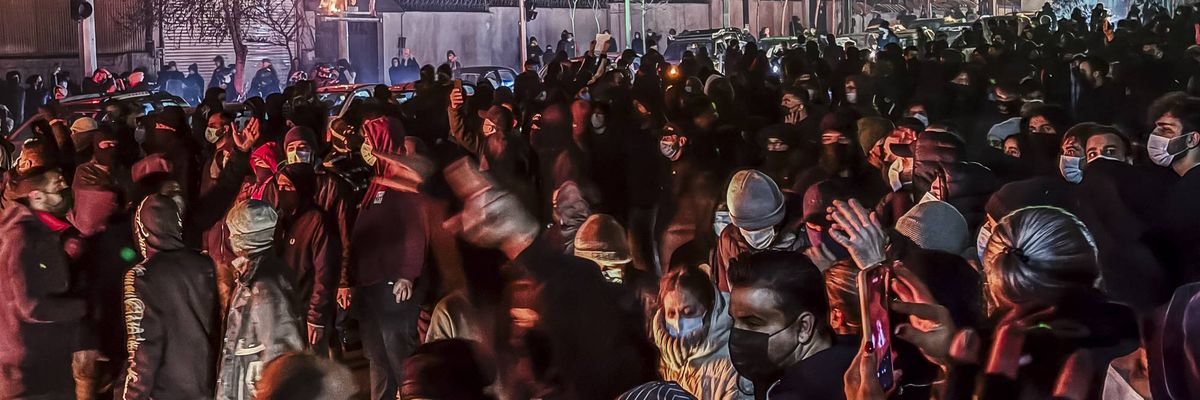
Iranians gather while blocking a street during a protest in Tehran, Iran on January 9, 2026.
It’s virtually impossible to predict what lies ahead for Iran and its people. But if President Donald Trump decides to take military action against Iran’s current regime, nothing good will come out of it.
Iran’s Islamic regime is under incredible pressure as the protests that begun in late December over the collapse of the currency have morphed into a mass popular uprising that has spread across the entire country and shows no sign of slowing despite a brutal crackdown that has resulted so far in the killing of thousands of protesters.
Make no mistake about it. Iran’s current leadership is murdering its own citizens in order to remain in power and thus block the growing support for secularism, freedom, and democracy. It’s as simple as that. This is a regime that has been facing unprecedented hostility by the United States and some of its closest allies since coming to power in 1979 but has been far more interested in exporting the Islamic revolution than looking after the well-being of its own citizens. It is a reactionary regime that has suppressed the fundamental rights of women, banned independent trade unions, and engaged in a systematic crackdown of communists and other leftists, all the while catering to powerful national capitalist interests.
Iranians have a long history of rebellion against authoritarianism and repression. Under the Shah, Iran had one of the world’s most brutal and repressive regimes, strongly supported by the United States. Indeed, while the Shah sought to modernize the country and even gave women the right to vote, and the Family Protection Law of 1968 granted women certain rights in divorce and custody, he and his generals ran the country with an iron first. Tens of thousands of Iranians were killed during the Shah’s reign, and Iran’s dreaded secret police, SAVAK, employed torture and execution to stifle political opposition.
Yet, Ayatollah Khomeini’s 1979 revolution, aided by Marxists, intellectuals, various secular groups, and the middle class, did not represent a transition from monarchy to democracy. Instead, it replaced a brutal, pro-Western monarchy with a theocratic regime that rolled back much of the social progress that had occurred up to that point. Repression came back, this time with an Islamic face, though the regime enjoyed at first considerable support among merchants, students, clerics, and the poor. Khomeini’s regime massacred and exiled all communists and embarked on a campaign of purification of policies. Women’s rights were drastically curtailed, and this included the removal of professional women from the public sector as well as the adoption of various means and methods aimed at discouraging women in general from entering the labor force.
The US is an imperialist power with a long history of undermining democracy throughout the world. The Iranian people will not accept US interference into their own political affairs.
Iranian women took to the streets by the thousands just a few weeks after the revolution to oppose Khomeini’s decree mandating the hijab. This decree was followed by a ban on alcohol, the separation of men and women in schools and beaches, and the criminalization of music. Iran was converted in no time from a Westernized society with a brutal political regime to an Islamic state sustained by an equally brutal political regime. Under the new social order, religion and state mixed as thoroughly as they did in Saudi Arabia. The only difference is that the two countries followed different branches of Islam--Iran’s political system is based on Shiism, while Saudi Arabia’s rests on Wahhabism.
More recently, in 2022, the death of the 22-year-old Kurdish-Iranian woman Jina Mahsa Amini while under morality police custody sparked the nationwide “Woman, Life, Freedom” protests, which people from all walks of life joined to call for an end to the four-decade rule of Iran by the religious fanatics. The Iranian authorities responded by detaining thousands of people while killing more than 560 protesters. It was reported that the average age of those arrested was 15.
The key reasons behind the current anti-government protests are economic hardships and political grievances. Iran’s economy has been under severe strains for a long time due to the international sanctions but also because of mismanagement, corruption, and a host of deep structural problems (chronic inflation, widespread poverty, and high youth unemployment, among others) which the regime has failed to address.
Protests broke out on December 28 after the Iranian currency, the rial, crumbled against the US dollar, leading to soaring food prices and to an even higher inflation rate, which had already risen to nearly 50%. It all started with demonstrations by shopkeepers in Tehran’s Grand Bazaar, but they quickly spread to numerous cities across the country, reflecting deep and widespread discontent among the general citizenry with the current regime. This means that the protests, which have been very large in size and joined by people from across Iranian society, are not simply driven by economic worries. They are political protests against a corrupt and oppressive regime.
According to some sources, more than 2,500 people have been killed by the Iranian authorities since the protests begun, but there are unverified reports, suggesting that the number of protesters killed could be at least 12,000 and possibly as high as 20,000. Leading Iranian officials have labeled protesters as “enemies of God,” a charge that is punishable by death under the laws of the Islamic Republic of Iran. They also insist that the protests are foreign driven.
Israel and the United States would like nothing more than to see regime change in Tehran and turn Iran into a US-Israeli vassal state. But the claim that the Iranian people are protesting against a dictatorship by being a pawn in the hands of foreign powers deserves nothing but scorn. Nonetheless, it speaks volumes of how alienated the regime’s rulers must feel from the nation’s citizenry. I suspect that deep down they are cognizant of the fact that their regime lacks political legitimacy in the eyes of the vast majority of the Iranian people.
The people of Iran have not forgotten the involvement of the CIA in the 1953 coup that ousted the democratically elected Prime Minister Muhammad Mossadegh. Their desire to get rid of Iran’s current regime is not an invitation for foreign interference. Indeed, who is to say that perhaps none of the courageous protesters would be paying with their lives for Iran to be free from an oppressive theocracy if the 1953 coup hadn’t happened?
It’s virtually impossible to predict what lies ahead for Iran and its people. But if President Donald Trump decides to take military action against Iran’s current regime, nothing good will come out of it. The US is an imperialist power with a long history of undermining democracy throughout the world. The Iranian people will not accept US interference into their own political affairs. In fact, such action may cause many Iranians to unite, at least temporarily, behind the regime. In sum, only the Iranian people themselves should be able decide their nation’s future.
Dear Common Dreams reader, It’s been nearly 30 years since I co-founded Common Dreams with my late wife, Lina Newhouser. We had the radical notion that journalism should serve the public good, not corporate profits. It was clear to us from the outset what it would take to build such a project. No paid advertisements. No corporate sponsors. No millionaire publisher telling us what to think or do. Many people said we wouldn't last a year, but we proved those doubters wrong. Together with a tremendous team of journalists and dedicated staff, we built an independent media outlet free from the constraints of profits and corporate control. Our mission has always been simple: To inform. To inspire. To ignite change for the common good. Building Common Dreams was not easy. Our survival was never guaranteed. When you take on the most powerful forces—Wall Street greed, fossil fuel industry destruction, Big Tech lobbyists, and uber-rich oligarchs who have spent billions upon billions rigging the economy and democracy in their favor—the only bulwark you have is supporters who believe in your work. But here’s the urgent message from me today. It's never been this bad out there. And it's never been this hard to keep us going. At the very moment Common Dreams is most needed, the threats we face are intensifying. We need your support now more than ever. We don't accept corporate advertising and never will. We don't have a paywall because we don't think people should be blocked from critical news based on their ability to pay. Everything we do is funded by the donations of readers like you. When everyone does the little they can afford, we are strong. But if that support retreats or dries up, so do we. Will you donate now to make sure Common Dreams not only survives but thrives? —Craig Brown, Co-founder |
Iran’s Islamic regime is under incredible pressure as the protests that begun in late December over the collapse of the currency have morphed into a mass popular uprising that has spread across the entire country and shows no sign of slowing despite a brutal crackdown that has resulted so far in the killing of thousands of protesters.
Make no mistake about it. Iran’s current leadership is murdering its own citizens in order to remain in power and thus block the growing support for secularism, freedom, and democracy. It’s as simple as that. This is a regime that has been facing unprecedented hostility by the United States and some of its closest allies since coming to power in 1979 but has been far more interested in exporting the Islamic revolution than looking after the well-being of its own citizens. It is a reactionary regime that has suppressed the fundamental rights of women, banned independent trade unions, and engaged in a systematic crackdown of communists and other leftists, all the while catering to powerful national capitalist interests.
Iranians have a long history of rebellion against authoritarianism and repression. Under the Shah, Iran had one of the world’s most brutal and repressive regimes, strongly supported by the United States. Indeed, while the Shah sought to modernize the country and even gave women the right to vote, and the Family Protection Law of 1968 granted women certain rights in divorce and custody, he and his generals ran the country with an iron first. Tens of thousands of Iranians were killed during the Shah’s reign, and Iran’s dreaded secret police, SAVAK, employed torture and execution to stifle political opposition.
Yet, Ayatollah Khomeini’s 1979 revolution, aided by Marxists, intellectuals, various secular groups, and the middle class, did not represent a transition from monarchy to democracy. Instead, it replaced a brutal, pro-Western monarchy with a theocratic regime that rolled back much of the social progress that had occurred up to that point. Repression came back, this time with an Islamic face, though the regime enjoyed at first considerable support among merchants, students, clerics, and the poor. Khomeini’s regime massacred and exiled all communists and embarked on a campaign of purification of policies. Women’s rights were drastically curtailed, and this included the removal of professional women from the public sector as well as the adoption of various means and methods aimed at discouraging women in general from entering the labor force.
The US is an imperialist power with a long history of undermining democracy throughout the world. The Iranian people will not accept US interference into their own political affairs.
Iranian women took to the streets by the thousands just a few weeks after the revolution to oppose Khomeini’s decree mandating the hijab. This decree was followed by a ban on alcohol, the separation of men and women in schools and beaches, and the criminalization of music. Iran was converted in no time from a Westernized society with a brutal political regime to an Islamic state sustained by an equally brutal political regime. Under the new social order, religion and state mixed as thoroughly as they did in Saudi Arabia. The only difference is that the two countries followed different branches of Islam--Iran’s political system is based on Shiism, while Saudi Arabia’s rests on Wahhabism.
More recently, in 2022, the death of the 22-year-old Kurdish-Iranian woman Jina Mahsa Amini while under morality police custody sparked the nationwide “Woman, Life, Freedom” protests, which people from all walks of life joined to call for an end to the four-decade rule of Iran by the religious fanatics. The Iranian authorities responded by detaining thousands of people while killing more than 560 protesters. It was reported that the average age of those arrested was 15.
The key reasons behind the current anti-government protests are economic hardships and political grievances. Iran’s economy has been under severe strains for a long time due to the international sanctions but also because of mismanagement, corruption, and a host of deep structural problems (chronic inflation, widespread poverty, and high youth unemployment, among others) which the regime has failed to address.
Protests broke out on December 28 after the Iranian currency, the rial, crumbled against the US dollar, leading to soaring food prices and to an even higher inflation rate, which had already risen to nearly 50%. It all started with demonstrations by shopkeepers in Tehran’s Grand Bazaar, but they quickly spread to numerous cities across the country, reflecting deep and widespread discontent among the general citizenry with the current regime. This means that the protests, which have been very large in size and joined by people from across Iranian society, are not simply driven by economic worries. They are political protests against a corrupt and oppressive regime.
According to some sources, more than 2,500 people have been killed by the Iranian authorities since the protests begun, but there are unverified reports, suggesting that the number of protesters killed could be at least 12,000 and possibly as high as 20,000. Leading Iranian officials have labeled protesters as “enemies of God,” a charge that is punishable by death under the laws of the Islamic Republic of Iran. They also insist that the protests are foreign driven.
Israel and the United States would like nothing more than to see regime change in Tehran and turn Iran into a US-Israeli vassal state. But the claim that the Iranian people are protesting against a dictatorship by being a pawn in the hands of foreign powers deserves nothing but scorn. Nonetheless, it speaks volumes of how alienated the regime’s rulers must feel from the nation’s citizenry. I suspect that deep down they are cognizant of the fact that their regime lacks political legitimacy in the eyes of the vast majority of the Iranian people.
The people of Iran have not forgotten the involvement of the CIA in the 1953 coup that ousted the democratically elected Prime Minister Muhammad Mossadegh. Their desire to get rid of Iran’s current regime is not an invitation for foreign interference. Indeed, who is to say that perhaps none of the courageous protesters would be paying with their lives for Iran to be free from an oppressive theocracy if the 1953 coup hadn’t happened?
It’s virtually impossible to predict what lies ahead for Iran and its people. But if President Donald Trump decides to take military action against Iran’s current regime, nothing good will come out of it. The US is an imperialist power with a long history of undermining democracy throughout the world. The Iranian people will not accept US interference into their own political affairs. In fact, such action may cause many Iranians to unite, at least temporarily, behind the regime. In sum, only the Iranian people themselves should be able decide their nation’s future.
Iran’s Islamic regime is under incredible pressure as the protests that begun in late December over the collapse of the currency have morphed into a mass popular uprising that has spread across the entire country and shows no sign of slowing despite a brutal crackdown that has resulted so far in the killing of thousands of protesters.
Make no mistake about it. Iran’s current leadership is murdering its own citizens in order to remain in power and thus block the growing support for secularism, freedom, and democracy. It’s as simple as that. This is a regime that has been facing unprecedented hostility by the United States and some of its closest allies since coming to power in 1979 but has been far more interested in exporting the Islamic revolution than looking after the well-being of its own citizens. It is a reactionary regime that has suppressed the fundamental rights of women, banned independent trade unions, and engaged in a systematic crackdown of communists and other leftists, all the while catering to powerful national capitalist interests.
Iranians have a long history of rebellion against authoritarianism and repression. Under the Shah, Iran had one of the world’s most brutal and repressive regimes, strongly supported by the United States. Indeed, while the Shah sought to modernize the country and even gave women the right to vote, and the Family Protection Law of 1968 granted women certain rights in divorce and custody, he and his generals ran the country with an iron first. Tens of thousands of Iranians were killed during the Shah’s reign, and Iran’s dreaded secret police, SAVAK, employed torture and execution to stifle political opposition.
Yet, Ayatollah Khomeini’s 1979 revolution, aided by Marxists, intellectuals, various secular groups, and the middle class, did not represent a transition from monarchy to democracy. Instead, it replaced a brutal, pro-Western monarchy with a theocratic regime that rolled back much of the social progress that had occurred up to that point. Repression came back, this time with an Islamic face, though the regime enjoyed at first considerable support among merchants, students, clerics, and the poor. Khomeini’s regime massacred and exiled all communists and embarked on a campaign of purification of policies. Women’s rights were drastically curtailed, and this included the removal of professional women from the public sector as well as the adoption of various means and methods aimed at discouraging women in general from entering the labor force.
The US is an imperialist power with a long history of undermining democracy throughout the world. The Iranian people will not accept US interference into their own political affairs.
Iranian women took to the streets by the thousands just a few weeks after the revolution to oppose Khomeini’s decree mandating the hijab. This decree was followed by a ban on alcohol, the separation of men and women in schools and beaches, and the criminalization of music. Iran was converted in no time from a Westernized society with a brutal political regime to an Islamic state sustained by an equally brutal political regime. Under the new social order, religion and state mixed as thoroughly as they did in Saudi Arabia. The only difference is that the two countries followed different branches of Islam--Iran’s political system is based on Shiism, while Saudi Arabia’s rests on Wahhabism.
More recently, in 2022, the death of the 22-year-old Kurdish-Iranian woman Jina Mahsa Amini while under morality police custody sparked the nationwide “Woman, Life, Freedom” protests, which people from all walks of life joined to call for an end to the four-decade rule of Iran by the religious fanatics. The Iranian authorities responded by detaining thousands of people while killing more than 560 protesters. It was reported that the average age of those arrested was 15.
The key reasons behind the current anti-government protests are economic hardships and political grievances. Iran’s economy has been under severe strains for a long time due to the international sanctions but also because of mismanagement, corruption, and a host of deep structural problems (chronic inflation, widespread poverty, and high youth unemployment, among others) which the regime has failed to address.
Protests broke out on December 28 after the Iranian currency, the rial, crumbled against the US dollar, leading to soaring food prices and to an even higher inflation rate, which had already risen to nearly 50%. It all started with demonstrations by shopkeepers in Tehran’s Grand Bazaar, but they quickly spread to numerous cities across the country, reflecting deep and widespread discontent among the general citizenry with the current regime. This means that the protests, which have been very large in size and joined by people from across Iranian society, are not simply driven by economic worries. They are political protests against a corrupt and oppressive regime.
According to some sources, more than 2,500 people have been killed by the Iranian authorities since the protests begun, but there are unverified reports, suggesting that the number of protesters killed could be at least 12,000 and possibly as high as 20,000. Leading Iranian officials have labeled protesters as “enemies of God,” a charge that is punishable by death under the laws of the Islamic Republic of Iran. They also insist that the protests are foreign driven.
Israel and the United States would like nothing more than to see regime change in Tehran and turn Iran into a US-Israeli vassal state. But the claim that the Iranian people are protesting against a dictatorship by being a pawn in the hands of foreign powers deserves nothing but scorn. Nonetheless, it speaks volumes of how alienated the regime’s rulers must feel from the nation’s citizenry. I suspect that deep down they are cognizant of the fact that their regime lacks political legitimacy in the eyes of the vast majority of the Iranian people.
The people of Iran have not forgotten the involvement of the CIA in the 1953 coup that ousted the democratically elected Prime Minister Muhammad Mossadegh. Their desire to get rid of Iran’s current regime is not an invitation for foreign interference. Indeed, who is to say that perhaps none of the courageous protesters would be paying with their lives for Iran to be free from an oppressive theocracy if the 1953 coup hadn’t happened?
It’s virtually impossible to predict what lies ahead for Iran and its people. But if President Donald Trump decides to take military action against Iran’s current regime, nothing good will come out of it. The US is an imperialist power with a long history of undermining democracy throughout the world. The Iranian people will not accept US interference into their own political affairs. In fact, such action may cause many Iranians to unite, at least temporarily, behind the regime. In sum, only the Iranian people themselves should be able decide their nation’s future.