
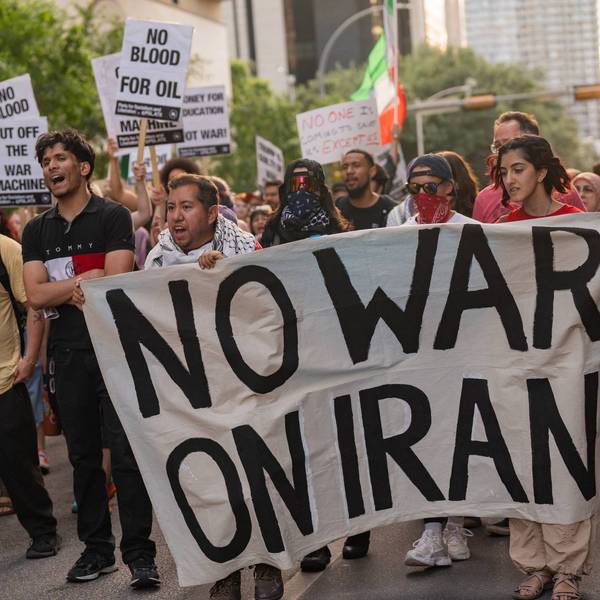
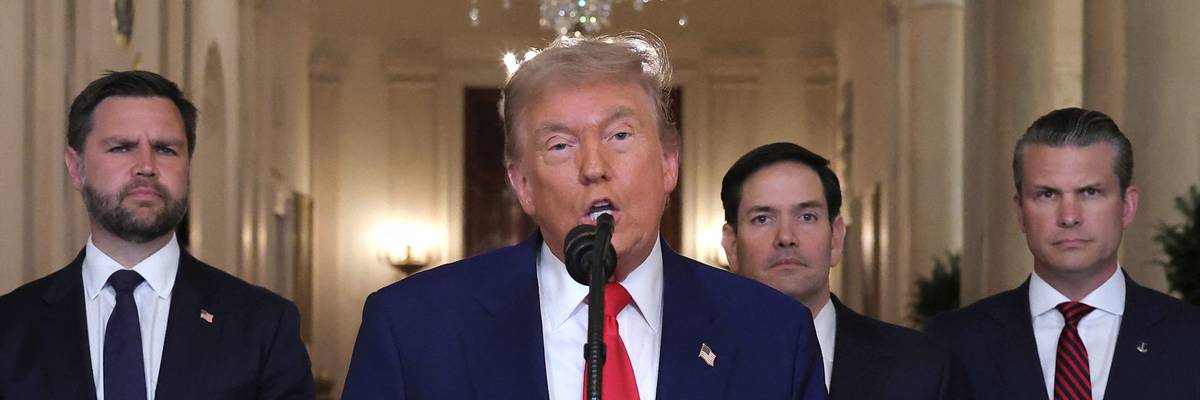
U.S. President Donald Trump addresses the nation, alongside U.S. Vice President JD Vance (L), U.S. Secretary of State Marco Rubio (2nd R), and U.S. Secretary of Defense Pete Hegseth (R), from the White House in Washington, D.C. on June 21, 2025.
President Trump’s War on Iran Was Illegal and Unconstitutional—Congress Must Act Like It
Without a change, we will only continue to see presidents launch more and larger wars whenever and wherever they want and for whatever reason they choose.
As a fragile cease-fire takes hold between Israel, Iran, and the United States, many questions remain.
With Iran’s nuclear program unquestionably damaged but likely not fully destroyed, will the Iranian government now race toward a bomb? Having repeatedly broken recent cease-fires in Lebanon and Gaza, will Prime Minister Netanyahu honor this one? And after having twice taken direct military action against Iran, will President Donald Trump pursue the peace he claims to seek or once again choose war?
Meanwhile, Congress is currently debating whether and how to rein in Trump's war making power, with votes possible by the end of this week. There are two competing House bills, one bipartisan War Powers Resolution (WPR) sponsored by Reps. Ro Khanna (D-Calif.) and Tom Massie (R-Ky.), and another by Reps. Gregory Meeks (D-N.Y.), Adam Smith (D-Wash.) and Jim Himes (D-Conn.). Sen. Tim Kaine (D-Va.) introduced a Senate version, and that one is likely to get a vote by Friday.
If one person alone decides when the nation goes to war, wars will inevitably be about one person’s grievances, politics, and personal interests.
Time will tell whether these measures will pass or have any effect on current events, but on one point, there is absolute certainty. President Trump’s war on Iran was illegal and unconstitutional.
When it comes to who has the legal authority to declare war, the Constitution is unequivocal. The power to declare war rests solely with Congress. Once authorized, the president is the commander-in-chief, but the title does not confer on him the authority to decide where, when, or against whom the country goes to war, simply to oversee the prosecution of wars once they have been authorized.
For the Constitution’s framers, these weren’t hypothetical arguments, and we don’t have to guess at their reasoning or intention. They lived in an age when wars were fought at the whims of monarchs, sometimes for lofty imperial goals but sometimes for petty personal grievances. Indeed their own revolution had been based, in part, over frustration with the massive taxation required to pay down King George’s war debts. Instead, they sought to create a system in which the people who would pay the war’s costs in blood and treasure would decide whether or not their nation goes to war.
To accomplish this, they put this awesome power in the branch of government most accountable to the people, Congress. They did so with the hope and intention that this would make going to war difficult. If one person alone decides when the nation goes to war, wars will inevitably be about one person’s grievances, politics, and personal interests. By requiring Congress to publicly come together and navigate their myriad differences, the hope was that consensus would be difficult to obtain and wars would thus only be launched when there was a clear, overwhelming, and genuine national interest in doing so.
And of course, if members of Congress failed to exercise their authority responsibly, they’d regularly face elections where they could be replaced.
It was and remains an inspiring decision to impose a massive check on the most awesome power of the state. Unfortunately, as Donald Trump’s decision to wage war on Iran reminds us, this system of war powers is deeply broken and prone to abuse.
For starters, Iran posed no imminent threat to the United States that required military action in self-defense. To the extent any such claims are being made, they are based on a hypothetical future threat that must be prevented, namely an Iranian nuclear weapon. Such claims, of course, are a disturbing echo of the Iraq War, and even then they amount to arguments for preventative wars, not genuine preemption of an imminent threat. While this may seem like a small distinction, it is in fact a massive one.
In a letter to Congress justifying his war-making, President Trump makes no claim that the Iranian government was preparing an attack against the United States that he needed to preempt. Instead, he argues he was simply acting to “protect United States citizens at home and abroad” as well as stating repeatedly he is acting to “advance vital United States national interests.” Nowhere in this justification or his public remarks does the president make any claim that he is acting to defend against an imminent attack. Rather, he is simply claiming the unilateral right to both decide what is in the national interest and then to use military force in pursuit of that interest. Even if one agrees with his definition of interests and belief that military force will achieve them (something of which this author and others are deeply skeptical), it does not negate the need for constitutionally required authorization before resorting to war.
Similarly, the president’s claim in the letter that he was acting “in collective self-defense of our ally, Israel” is not an invocation of any actual legal authority to wage war. What Trump is attempting here is a sleight of hand in which the president’s right to use military force in self-defense of the United States is, without any legal authority, bestowed upon another country. Sadly, Trump may have learned this trick from Joe Biden who absurdly also made this claim to justify his use of military force in Somalia. To be clear, international law does allow for using military force in collective self-defense, but international law is not a replacement for the Constitution’s requirements of congressional authority to go to war. For the U.S. president to send the U.S. military into war, they ultimately need authority under U.S. law, and U.S. law simply does not provide existing authority for using military force in defense of Israel.
Of course, Trump isn’t the first president to try to unilaterally expand his authority to wage war. After the disastrous U.S. experience in Vietnam in which the mission grew from a small advisory effort in support of the French and then South Vietnamese forces to hundreds of thousands of U.S. troops fighting a deadly and ultimately unsuccessful major war, Congress attempted to get ahead of this growing problem and place limits on presidents in the 1973 War Powers Act. While perhaps no law in history has been more misunderstood or misinterpreted, WPR reaffirmed Congress’ sole constitutional right to declare war and created a framework to force presidents to remove the military from situations in which they may become engaged in wars Congress had not authorized.
The goal was simple: If it seemed like the U.S. might end up in war, the WPR required the president to remove forces to prevent that from happening. It also gave Congress fast-track procedures to consider legislation to force the president to comply. Indeed, in the coming days Congress may consider this with the various versions offered in both the House and Senate. This is exactly what happened in 2020 following Trump’s assassination of Iranian Gen. Qassam Soleimani, when Congress passed a resolution blocking further military action against Iran.
The fate of that resolution, however, also revealed the fundamental flaws in the current system. Trump ultimately vetoed that 2020 WPR legislation, and no doubt will do so again if Congress passes such legislation in the coming days. Thus, without a two-thirds supermajority, the system creates the conditions for presidential impunity when violating the Constitution’s separation of powers. This is, of course, exactly the opposite of what the framers intended. Their goal was that a majority of both houses of Congress would be required to go to war, not that a super majority of Congress would be required to prevent a president from going to war. The current system is thus an absurd perversion of the plain text and obvious intention of the Constitution.
Thankfully, some in Congress are trying to repair this dangerous situation. Bipartisan groups in both the House and Senate have recently introduced legislation to return the balance of power to Congress, and by extension to the American public, preventing the kind of unilateral war-making President Trump has repeatedly engaged in. This legislation likely faces long odds, but such reforms are deeply necessary in the long run. Without a change, we will only continue to see presidents launch more and larger wars whenever and wherever they want and for whatever reason they choose.
While the worst-case scenarios of a spiraling, escalating war may (or may not) have been avoided in this case, there is no guarantee that future presidential war-making will be so limited. Thankfully, the Constitution was drafted to prevent just such disasters. The only question left is if we’ll continue to allow presidents to violate it and act like kings.
We are at a crossroads
This country and this world are at a monumental crossroads. In a few short weeks, US voters will have an opportunity to beat back the forces of fascism and confront the billionaires who are rigging the economy, our media system, and our democracy, making it increasingly impossible for ordinary people to get by. We’re not just talking about the election. We’re talking about what must be done once these fascist elements are vanquished from power. We need a bolder set of solutions than what either major party has so far been willing to offer and a working-class movement ready to fight like hell for it. Trump didn't emerge from nowhere. The conditions that fueled MAGA authoritarianism were created by decades of radical neoliberal economic policies and a corrupt political system dominated by corporate interests. They slashed taxes on the super-rich, promising that the benefits would trickle down. They said giveaways to the corporate titans would make life more affordable for the rest of us. It was all bullshit. And when a bitter, betrayed populace searches for someone to blame, right-wing demagogues have little trouble finding scapegoats. People know when they're being lied to, but you won't hear any of this from the corporate media. Only independent journalism—powered and funded by people who believe in building a better world—can deliver truly trustworthy daily news. Our Fall Campaign is underway, and we need your help. To power our newsroom through the rest of the year, we need to raise $125,000 by midnight on October 31. So if you share our vision, please contribute whatever you can to sustain our work. |
As a fragile cease-fire takes hold between Israel, Iran, and the United States, many questions remain.
With Iran’s nuclear program unquestionably damaged but likely not fully destroyed, will the Iranian government now race toward a bomb? Having repeatedly broken recent cease-fires in Lebanon and Gaza, will Prime Minister Netanyahu honor this one? And after having twice taken direct military action against Iran, will President Donald Trump pursue the peace he claims to seek or once again choose war?
Meanwhile, Congress is currently debating whether and how to rein in Trump's war making power, with votes possible by the end of this week. There are two competing House bills, one bipartisan War Powers Resolution (WPR) sponsored by Reps. Ro Khanna (D-Calif.) and Tom Massie (R-Ky.), and another by Reps. Gregory Meeks (D-N.Y.), Adam Smith (D-Wash.) and Jim Himes (D-Conn.). Sen. Tim Kaine (D-Va.) introduced a Senate version, and that one is likely to get a vote by Friday.
If one person alone decides when the nation goes to war, wars will inevitably be about one person’s grievances, politics, and personal interests.
Time will tell whether these measures will pass or have any effect on current events, but on one point, there is absolute certainty. President Trump’s war on Iran was illegal and unconstitutional.
When it comes to who has the legal authority to declare war, the Constitution is unequivocal. The power to declare war rests solely with Congress. Once authorized, the president is the commander-in-chief, but the title does not confer on him the authority to decide where, when, or against whom the country goes to war, simply to oversee the prosecution of wars once they have been authorized.
For the Constitution’s framers, these weren’t hypothetical arguments, and we don’t have to guess at their reasoning or intention. They lived in an age when wars were fought at the whims of monarchs, sometimes for lofty imperial goals but sometimes for petty personal grievances. Indeed their own revolution had been based, in part, over frustration with the massive taxation required to pay down King George’s war debts. Instead, they sought to create a system in which the people who would pay the war’s costs in blood and treasure would decide whether or not their nation goes to war.
To accomplish this, they put this awesome power in the branch of government most accountable to the people, Congress. They did so with the hope and intention that this would make going to war difficult. If one person alone decides when the nation goes to war, wars will inevitably be about one person’s grievances, politics, and personal interests. By requiring Congress to publicly come together and navigate their myriad differences, the hope was that consensus would be difficult to obtain and wars would thus only be launched when there was a clear, overwhelming, and genuine national interest in doing so.
And of course, if members of Congress failed to exercise their authority responsibly, they’d regularly face elections where they could be replaced.
It was and remains an inspiring decision to impose a massive check on the most awesome power of the state. Unfortunately, as Donald Trump’s decision to wage war on Iran reminds us, this system of war powers is deeply broken and prone to abuse.
For starters, Iran posed no imminent threat to the United States that required military action in self-defense. To the extent any such claims are being made, they are based on a hypothetical future threat that must be prevented, namely an Iranian nuclear weapon. Such claims, of course, are a disturbing echo of the Iraq War, and even then they amount to arguments for preventative wars, not genuine preemption of an imminent threat. While this may seem like a small distinction, it is in fact a massive one.
In a letter to Congress justifying his war-making, President Trump makes no claim that the Iranian government was preparing an attack against the United States that he needed to preempt. Instead, he argues he was simply acting to “protect United States citizens at home and abroad” as well as stating repeatedly he is acting to “advance vital United States national interests.” Nowhere in this justification or his public remarks does the president make any claim that he is acting to defend against an imminent attack. Rather, he is simply claiming the unilateral right to both decide what is in the national interest and then to use military force in pursuit of that interest. Even if one agrees with his definition of interests and belief that military force will achieve them (something of which this author and others are deeply skeptical), it does not negate the need for constitutionally required authorization before resorting to war.
Similarly, the president’s claim in the letter that he was acting “in collective self-defense of our ally, Israel” is not an invocation of any actual legal authority to wage war. What Trump is attempting here is a sleight of hand in which the president’s right to use military force in self-defense of the United States is, without any legal authority, bestowed upon another country. Sadly, Trump may have learned this trick from Joe Biden who absurdly also made this claim to justify his use of military force in Somalia. To be clear, international law does allow for using military force in collective self-defense, but international law is not a replacement for the Constitution’s requirements of congressional authority to go to war. For the U.S. president to send the U.S. military into war, they ultimately need authority under U.S. law, and U.S. law simply does not provide existing authority for using military force in defense of Israel.
Of course, Trump isn’t the first president to try to unilaterally expand his authority to wage war. After the disastrous U.S. experience in Vietnam in which the mission grew from a small advisory effort in support of the French and then South Vietnamese forces to hundreds of thousands of U.S. troops fighting a deadly and ultimately unsuccessful major war, Congress attempted to get ahead of this growing problem and place limits on presidents in the 1973 War Powers Act. While perhaps no law in history has been more misunderstood or misinterpreted, WPR reaffirmed Congress’ sole constitutional right to declare war and created a framework to force presidents to remove the military from situations in which they may become engaged in wars Congress had not authorized.
The goal was simple: If it seemed like the U.S. might end up in war, the WPR required the president to remove forces to prevent that from happening. It also gave Congress fast-track procedures to consider legislation to force the president to comply. Indeed, in the coming days Congress may consider this with the various versions offered in both the House and Senate. This is exactly what happened in 2020 following Trump’s assassination of Iranian Gen. Qassam Soleimani, when Congress passed a resolution blocking further military action against Iran.
The fate of that resolution, however, also revealed the fundamental flaws in the current system. Trump ultimately vetoed that 2020 WPR legislation, and no doubt will do so again if Congress passes such legislation in the coming days. Thus, without a two-thirds supermajority, the system creates the conditions for presidential impunity when violating the Constitution’s separation of powers. This is, of course, exactly the opposite of what the framers intended. Their goal was that a majority of both houses of Congress would be required to go to war, not that a super majority of Congress would be required to prevent a president from going to war. The current system is thus an absurd perversion of the plain text and obvious intention of the Constitution.
Thankfully, some in Congress are trying to repair this dangerous situation. Bipartisan groups in both the House and Senate have recently introduced legislation to return the balance of power to Congress, and by extension to the American public, preventing the kind of unilateral war-making President Trump has repeatedly engaged in. This legislation likely faces long odds, but such reforms are deeply necessary in the long run. Without a change, we will only continue to see presidents launch more and larger wars whenever and wherever they want and for whatever reason they choose.
While the worst-case scenarios of a spiraling, escalating war may (or may not) have been avoided in this case, there is no guarantee that future presidential war-making will be so limited. Thankfully, the Constitution was drafted to prevent just such disasters. The only question left is if we’ll continue to allow presidents to violate it and act like kings.
- Tim Kaine Moves to Force War Powers Vote to Prevent Trump From Attacking Iran ›
- US Progressives Say Stop Supporting 'Rogue Genocidal Regime' After Israel's Unprovoked Attack on Iran ›
- Bernie Sanders Condemns Trump for Putting US on Path to 'Another Disastrous War in the Middle East' ›
- Don’t Let Tyrant Trump Plunge Us Into War With Iran ›
- Americans Don't Want Trump's Illegal War on Iran ›
- Anti-War Advocates Demand Trump 'Return to Diplomatic Path' After Illegal Strikes on Iran ›
- Top Dem Says Video of Military 'Attacking Shipwrecked Sailors' Among 'Most Troubling Things' He Has Ever Seen | Common Dreams ›
- Opinion | Venezuela, Executive Defiance, and the Last Chance to Restore Congressional War Powers | Common Dreams ›
- 'Absolute Dereliction of Duty': House Republicans Kill Venezuela War Powers Resolutions | Common Dreams ›
- Opinion | Trump Declares War on Everyone | Common Dreams ›
- Opinion | Why the US Must Absolutely Not Force Regime Change in Iran | Common Dreams ›
- Opinion | There Is No Good Reason for the US to Attack Iran | Common Dreams ›
- 'I Guess I Can Say I Am': Trump Confirms He's Considering Unprovoked Attack on Iran | Common Dreams ›
- Amid Alarm That Trump Has No Plan for Iran, Critic Contends None 'Could Possibly Justify This' | Common Dreams ›
- Opinion | The Duty to Grieve: On Dehumanization, War, and the Cost of Witnessing | Common Dreams ›