SUBSCRIBE TO OUR FREE NEWSLETTER
Daily news & progressive opinion—funded by the people, not the corporations—delivered straight to your inbox.
5
#000000
#FFFFFF
To donate by check, phone, or other method, see our More Ways to Give page.
Daily news & progressive opinion—funded by the people, not the corporations—delivered straight to your inbox.
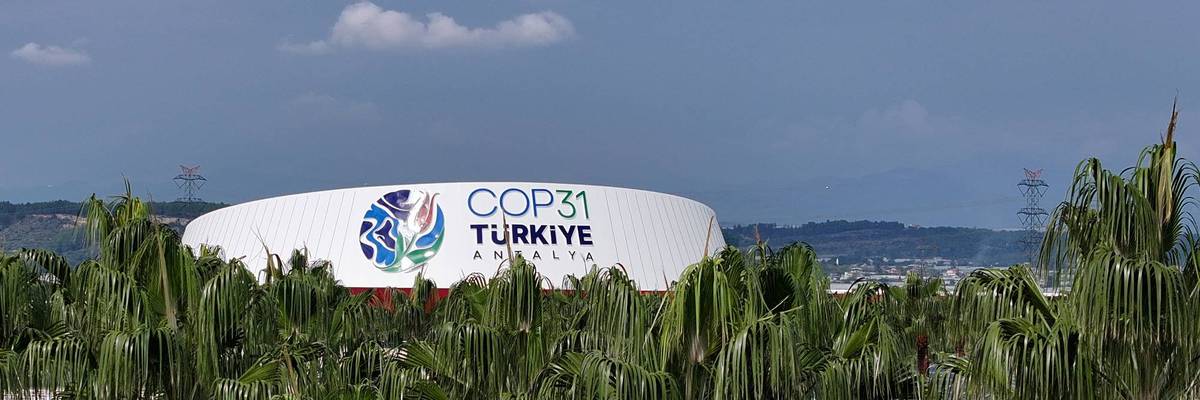
An aerial view shows the venue prepared for the 31st Conference of the Parties (COP31) to the United Nations Framework Convention on Climate Change (UNFCCC) in Antalya, Turkiye, on November 2, 2026.
The task for states gathering at COP31 now is to ensure that international cooperation delivers on international obligations: preventing further harm, addressing the consequences of climate change, and providing reparation to those in need.
Governments will gather November 9-20 in Antalya, Türkiye, for the COP31 climate talks, amid mounting pressure on nearly every front, and the picture could hardly be starker.
Climate impacts are accelerating, bringing devastating losses to countries and communities that have contributed the least to the crisis and intensifying demands for adequate finance and remedy. Conflict, economic instability, and price spikes are exposing the risks of continued dependence on fossil fuels, strengthening the case for the transition. Yet, windfall war profits for oil and gas companies and growing demand from artificial intelligence and data centers are driving fossil fuel expansion. And as global temperatures approach the 1.5°C temperature limit, speculative technological interventions are increasingly being promoted as ways to manage continued warming rather than prevent it.
The consequences are no longer projections. In August, a devastating glacial flood tore through Nepal, killing more than 1,400 people and leaving billions of dollars in recovery needs in a country responsible for only a tiny fraction of historic global emissions.
Consensus is not the aim. Action is.
The international institutions meant to help governments respond collectively are themselves under strain and struggle to overcome obstruction, corporate influence, and weak accountability. Deadlock at the Intergovernmental Panel on Climate Change (IPCC), escalating attacks on multilateralism and the international rule of law, continued fossil fuel influence, and shrinking civic space all raise a fundamental question for COP31: Can international cooperation deliver the action the climate crisis requires?
Since last year‘s climate summit, states have taken important steps outside and alongside the United Nations climate process toward collective implementation of legal obligations to prevent and repair climate harm. The first Conference on Transitioning Away from Fossil Fuels in Santa Marta, Colombia brought governments together to begin developing practical pathways for implementing the transition. The UN General Assembly resolution on how to operationalize the International Court of Justice’s (ICJ) climate Advisory Opinion showed that the world recognizes the rule of law must guide climate action.
COP31 must build on that momentum while closing the gap between commitment and conduct. The world does not need another inventory of climate promises from COP31 in Antalya. It needs evidence that international cooperation can still deliver when the science is urgent, the law is clear, and political and economic pressures are pushing governments toward delay.
COP31 is the first since the breakdown in Belém, Brazil spotlighted the structural flaws of the climate talks’ consensus-based process, fueling calls for reform.
After 30 years of climate talks, it is abundantly clear that the international climate regime is not delivering the collective response the crisis demands. The UN Framework Convention on Climate Change (UNFCCC) and the Paris Agreement remain essential to international cooperation, but progress on an equitable phaseout of fossil fuels and delivering the necessary climate finance is far too slow. And not for lack of clarity on what the science and law require.
The UNFCCC’s reliance on consensus is a barrier. Without agreed-upon rules for voting when consensus fails, a small number of governments can continue to block progress on the issues central to climate action. What should be an avenue for alignment has become a tool for veto. Of course, consensus itself is not the sole cause of inadequate climate action. Governments have had ample opportunities to act more ambitiously, and fossil fuel interests and some states have repeatedly shaped what is politically possible.
The COP31 slogan, “From consensus to action,” must serve as a reminder of the bottom line: Consensus is not the aim. Action is. When consensus impedes action, voting should be possible, and outvoted countries must nonetheless fulfill their obligations under international law.
A decision is one thing, but action is another. Assessing whether the process is delivering also means looking at how decisions are implemented. Reform must therefore also strengthen accountability. Governments’ commitments mean little without transparent monitoring, public scrutiny, and independent processes to assess implementation and address backsliding, with the participation of rights-holders. Progress must be measured by action: Are fossil fuel production and use declining? Are climate finance and remedies for climate harm reaching the countries and communities that need them?
The climate summit itself must be protected from conflicts of interest and corporate capture. Fossil fuel interests have enjoyed disproportionate influence in climate negotiations, while climate-vulnerable communities, Indigenous peoples, and civil society struggle to even have a seat at the table. At COP31, atates should adopt a clear definition of conflict of interest and safeguards to prevent those profiting from climate-destructive activities from undermining climate action. Protecting civic space and ensuring meaningful public participation are essential to a credible process.
Initiatives such as the Transition Away from Fossil Fuels process with the forthcoming Tuvalu-Ireland conference complement the UNFCCC by building momentum and developing practical pathways for a managed transition and strengthening cooperation among willing states. Such initiatives demonstrate that effective multilateralism can and must extend and change to deliver the action the climate crisis demands.
The critical 1.5°C temperature limit must remain an essential legal and moral benchmark for climate action and accountability. It is not a threshold beyond which all is lost, nor does approaching or exceeding it make further emissions cuts any less important; on the contrary. Warming below 1.5°C has already caused devastating harm, and each additional increment of warming increases the risks and impacts faced by communities and ecosystems worldwide.
Yet as climate action remains inadequate, carbon dioxide removal (CDR) and geoengineering technologies are increasingly presented as ways to “manage” warming exceeding 1.5°C, while carbon capture and storage (CCS) continues to be touted as a way to manage ongoing fossil fuel pollution. So-called “climate stabilization scenarios” often assume temperatures can later be brought back down “returning to 1.5°C”, relying on overly optimistic assumptions about feasibility, scale, resources, and risks—and on future technologies that do not even exist.
Decisions must close loopholes that enable continued fossil fuel use and prioritize a rapid and equitable phaseout of fossil fuels.
This approach risks normalizing the idea that the consequences of breaching the 1.5°C limit can be managed through future interventions rather than limited through immediate and deep emissions reductions. The obligation is to prevent climate harm now, not simply to respond to it later. The prospect of exceeding 1.5°C must never become a justification for treating harmful, speculative technological interventions as inevitable or necessary, or worse, delaying action today, entrenching fossil fuel dependence, and locking in devastation tomorrow.
Pathways that overshoot 1.5°C and rely heavily on CDR risk worsening climate impacts and triggering planetary tipping points. COP31 must not entrench speculative technologies in fossil fuel transition road maps or electrification targets. Decisions must close loopholes that enable continued fossil fuel use and prioritize a rapid and equitable phaseout of fossil fuels.
The focus on the ocean at COP31 must also not become an entry point for dangerous marine geoengineering technologies promoted as “ocean climate solutions.” The most important ocean-based solutions involve eliminating ocean-based threats, like offshore oil and gas. The priority must be to prevent further warming and harm, including to the ocean, at their source: Reduce emissions rapidly by curbing fossil fuel production and use; protect and restore ecosystems; and provide the finance needed for a just transition away from fossil fuels.
Climate action cannot be separated from human rights and the protection of those challenging powerful interests to defend people and the planet, who continue to face threats, intimidation, and restrictions on their participation in decisions that shape their futures.
As Türkiye hosts COP31, protecting civic space and the rights to freedom of expression, association, and peaceful assembly must be a top priority of all governments gathering for the COP31. The latest crackdown on LGBTI+ groups, activists, and human rights defenders in Türkiye is yet another stark reminder of the increasingly difficult environment in which civil society is operating.
Against this backdrop, it is particularly concerning that the COP31 Host Country Agreement reintroduces a provision requiring participants not to "interfere in the internal affairs" of the host country, a provision that was absent from the COP30 agreement. At a climate conference, civil society participation necessarily includes being present, speaking out, scrutinizing governments’ decisions and climate policies, and advocating for communities most vulnerable to climate change. Participants should never have to fear that legitimate human rights advocacy, peaceful protest, or criticism could be construed as interference in the host country’s internal affairs.
The COP31 joint Presidencies of Türkiye and Australia, the UNFCCC Secretariat, and all states share responsibility for ensuring safe and open civic space before, during, and after the negotiations. They must protect freedom of expression and peaceful assembly; prevent intimidation, harassment, violence, and reprisals; and guarantee meaningful and non-discriminatory access for civil society, Indigenous peoples, human rights defenders, and all rights-holders.
The same structures of fossil fuel dependence, resource extraction, and unequal power that drive climate breakdown are also deeply connected to the growing militarization of our world. From Gaza to Ukraine, from Iran to Sudan, armed conflicts continue to grow in number, duration, and complexity, with devastating impacts on people, human rights, and the environment while diverting resources from urgent climate needs and compounding suffering. As states gather in Antalya, it is critical that governments confront the crises of war and warming hand in hand.
The test in Antalya is not whether governments can produce another carefully negotiated declaration. It is whether they can tackle what matters in a world of crisis and conflict.
Can governments at COP31 accelerate a just and equitable transition away from fossil fuels while war and economic insecurity are being used to justify new fossil fuel investment? Can they protect 1.5°C as a benchmark for ambition and accountability without turning projected exceedance of the temperature limit into a rationale for speculative technological fixes? Can they deliver finance and remedy to countries and communities suffering losses they did little to cause? Can they reform climate institutions to overcome obstruction, rather than reward it? And can they defend human rights and civic space at a time when both are increasingly under attack?
If the ICJ confirmed that states’ climate obligations are grounded in international law, COP31 must confirm that their climate action is too. The task for states gathering at COP31 now is to ensure that international cooperation delivers on those international obligations: preventing further harm, addressing the consequences of climate change, and providing reparation to those in need.
The science leaves no room for ambiguity. Neither does the law. What remains is the political choice.
This country and this world are at a monumental crossroads. US voters have an opportunity to beat back the forces of fascism and confront the billionaires who are rigging the economy, our media system, and our democracy, making it increasingly impossible for ordinary people to get by. We’re not just talking about the election. We’re talking about what must be done once these fascist elements are vanquished from power. We need a bolder set of solutions than what either major party has so far been willing to offer and a working-class movement ready to fight like hell for it. Trump didn't emerge from nowhere. The conditions that fueled MAGA authoritarianism were created by decades of radical neoliberal economic policies and a corrupt political system dominated by corporate interests. They slashed taxes on the super-rich, promising that the benefits would trickle down. They said giveaways to the corporate titans would make life more affordable for the rest of us. It was all bullshit. And when a bitter, betrayed populace searches for someone to blame, right-wing demagogues have little trouble finding scapegoats. People know when they're being lied to, but you won't hear any of this from the corporate media. Only independent journalism—powered and funded by people who believe in building a better world—can deliver truly trustworthy daily news. If you share our vision, please contribute whatever you can to sustain our work. |
Governments will gather November 9-20 in Antalya, Türkiye, for the COP31 climate talks, amid mounting pressure on nearly every front, and the picture could hardly be starker.
Climate impacts are accelerating, bringing devastating losses to countries and communities that have contributed the least to the crisis and intensifying demands for adequate finance and remedy. Conflict, economic instability, and price spikes are exposing the risks of continued dependence on fossil fuels, strengthening the case for the transition. Yet, windfall war profits for oil and gas companies and growing demand from artificial intelligence and data centers are driving fossil fuel expansion. And as global temperatures approach the 1.5°C temperature limit, speculative technological interventions are increasingly being promoted as ways to manage continued warming rather than prevent it.
The consequences are no longer projections. In August, a devastating glacial flood tore through Nepal, killing more than 1,400 people and leaving billions of dollars in recovery needs in a country responsible for only a tiny fraction of historic global emissions.
Consensus is not the aim. Action is.
The international institutions meant to help governments respond collectively are themselves under strain and struggle to overcome obstruction, corporate influence, and weak accountability. Deadlock at the Intergovernmental Panel on Climate Change (IPCC), escalating attacks on multilateralism and the international rule of law, continued fossil fuel influence, and shrinking civic space all raise a fundamental question for COP31: Can international cooperation deliver the action the climate crisis requires?
Since last year‘s climate summit, states have taken important steps outside and alongside the United Nations climate process toward collective implementation of legal obligations to prevent and repair climate harm. The first Conference on Transitioning Away from Fossil Fuels in Santa Marta, Colombia brought governments together to begin developing practical pathways for implementing the transition. The UN General Assembly resolution on how to operationalize the International Court of Justice’s (ICJ) climate Advisory Opinion showed that the world recognizes the rule of law must guide climate action.
COP31 must build on that momentum while closing the gap between commitment and conduct. The world does not need another inventory of climate promises from COP31 in Antalya. It needs evidence that international cooperation can still deliver when the science is urgent, the law is clear, and political and economic pressures are pushing governments toward delay.
COP31 is the first since the breakdown in Belém, Brazil spotlighted the structural flaws of the climate talks’ consensus-based process, fueling calls for reform.
After 30 years of climate talks, it is abundantly clear that the international climate regime is not delivering the collective response the crisis demands. The UN Framework Convention on Climate Change (UNFCCC) and the Paris Agreement remain essential to international cooperation, but progress on an equitable phaseout of fossil fuels and delivering the necessary climate finance is far too slow. And not for lack of clarity on what the science and law require.
The UNFCCC’s reliance on consensus is a barrier. Without agreed-upon rules for voting when consensus fails, a small number of governments can continue to block progress on the issues central to climate action. What should be an avenue for alignment has become a tool for veto. Of course, consensus itself is not the sole cause of inadequate climate action. Governments have had ample opportunities to act more ambitiously, and fossil fuel interests and some states have repeatedly shaped what is politically possible.
The COP31 slogan, “From consensus to action,” must serve as a reminder of the bottom line: Consensus is not the aim. Action is. When consensus impedes action, voting should be possible, and outvoted countries must nonetheless fulfill their obligations under international law.
A decision is one thing, but action is another. Assessing whether the process is delivering also means looking at how decisions are implemented. Reform must therefore also strengthen accountability. Governments’ commitments mean little without transparent monitoring, public scrutiny, and independent processes to assess implementation and address backsliding, with the participation of rights-holders. Progress must be measured by action: Are fossil fuel production and use declining? Are climate finance and remedies for climate harm reaching the countries and communities that need them?
The climate summit itself must be protected from conflicts of interest and corporate capture. Fossil fuel interests have enjoyed disproportionate influence in climate negotiations, while climate-vulnerable communities, Indigenous peoples, and civil society struggle to even have a seat at the table. At COP31, atates should adopt a clear definition of conflict of interest and safeguards to prevent those profiting from climate-destructive activities from undermining climate action. Protecting civic space and ensuring meaningful public participation are essential to a credible process.
Initiatives such as the Transition Away from Fossil Fuels process with the forthcoming Tuvalu-Ireland conference complement the UNFCCC by building momentum and developing practical pathways for a managed transition and strengthening cooperation among willing states. Such initiatives demonstrate that effective multilateralism can and must extend and change to deliver the action the climate crisis demands.
The critical 1.5°C temperature limit must remain an essential legal and moral benchmark for climate action and accountability. It is not a threshold beyond which all is lost, nor does approaching or exceeding it make further emissions cuts any less important; on the contrary. Warming below 1.5°C has already caused devastating harm, and each additional increment of warming increases the risks and impacts faced by communities and ecosystems worldwide.
Yet as climate action remains inadequate, carbon dioxide removal (CDR) and geoengineering technologies are increasingly presented as ways to “manage” warming exceeding 1.5°C, while carbon capture and storage (CCS) continues to be touted as a way to manage ongoing fossil fuel pollution. So-called “climate stabilization scenarios” often assume temperatures can later be brought back down “returning to 1.5°C”, relying on overly optimistic assumptions about feasibility, scale, resources, and risks—and on future technologies that do not even exist.
Decisions must close loopholes that enable continued fossil fuel use and prioritize a rapid and equitable phaseout of fossil fuels.
This approach risks normalizing the idea that the consequences of breaching the 1.5°C limit can be managed through future interventions rather than limited through immediate and deep emissions reductions. The obligation is to prevent climate harm now, not simply to respond to it later. The prospect of exceeding 1.5°C must never become a justification for treating harmful, speculative technological interventions as inevitable or necessary, or worse, delaying action today, entrenching fossil fuel dependence, and locking in devastation tomorrow.
Pathways that overshoot 1.5°C and rely heavily on CDR risk worsening climate impacts and triggering planetary tipping points. COP31 must not entrench speculative technologies in fossil fuel transition road maps or electrification targets. Decisions must close loopholes that enable continued fossil fuel use and prioritize a rapid and equitable phaseout of fossil fuels.
The focus on the ocean at COP31 must also not become an entry point for dangerous marine geoengineering technologies promoted as “ocean climate solutions.” The most important ocean-based solutions involve eliminating ocean-based threats, like offshore oil and gas. The priority must be to prevent further warming and harm, including to the ocean, at their source: Reduce emissions rapidly by curbing fossil fuel production and use; protect and restore ecosystems; and provide the finance needed for a just transition away from fossil fuels.
Climate action cannot be separated from human rights and the protection of those challenging powerful interests to defend people and the planet, who continue to face threats, intimidation, and restrictions on their participation in decisions that shape their futures.
As Türkiye hosts COP31, protecting civic space and the rights to freedom of expression, association, and peaceful assembly must be a top priority of all governments gathering for the COP31. The latest crackdown on LGBTI+ groups, activists, and human rights defenders in Türkiye is yet another stark reminder of the increasingly difficult environment in which civil society is operating.
Against this backdrop, it is particularly concerning that the COP31 Host Country Agreement reintroduces a provision requiring participants not to "interfere in the internal affairs" of the host country, a provision that was absent from the COP30 agreement. At a climate conference, civil society participation necessarily includes being present, speaking out, scrutinizing governments’ decisions and climate policies, and advocating for communities most vulnerable to climate change. Participants should never have to fear that legitimate human rights advocacy, peaceful protest, or criticism could be construed as interference in the host country’s internal affairs.
The COP31 joint Presidencies of Türkiye and Australia, the UNFCCC Secretariat, and all states share responsibility for ensuring safe and open civic space before, during, and after the negotiations. They must protect freedom of expression and peaceful assembly; prevent intimidation, harassment, violence, and reprisals; and guarantee meaningful and non-discriminatory access for civil society, Indigenous peoples, human rights defenders, and all rights-holders.
The same structures of fossil fuel dependence, resource extraction, and unequal power that drive climate breakdown are also deeply connected to the growing militarization of our world. From Gaza to Ukraine, from Iran to Sudan, armed conflicts continue to grow in number, duration, and complexity, with devastating impacts on people, human rights, and the environment while diverting resources from urgent climate needs and compounding suffering. As states gather in Antalya, it is critical that governments confront the crises of war and warming hand in hand.
The test in Antalya is not whether governments can produce another carefully negotiated declaration. It is whether they can tackle what matters in a world of crisis and conflict.
Can governments at COP31 accelerate a just and equitable transition away from fossil fuels while war and economic insecurity are being used to justify new fossil fuel investment? Can they protect 1.5°C as a benchmark for ambition and accountability without turning projected exceedance of the temperature limit into a rationale for speculative technological fixes? Can they deliver finance and remedy to countries and communities suffering losses they did little to cause? Can they reform climate institutions to overcome obstruction, rather than reward it? And can they defend human rights and civic space at a time when both are increasingly under attack?
If the ICJ confirmed that states’ climate obligations are grounded in international law, COP31 must confirm that their climate action is too. The task for states gathering at COP31 now is to ensure that international cooperation delivers on those international obligations: preventing further harm, addressing the consequences of climate change, and providing reparation to those in need.
The science leaves no room for ambiguity. Neither does the law. What remains is the political choice.