5
#000000
#FFFFFF
To donate by check, phone, or other method, see our More Ways to Give page.
Daily news & progressive opinion—funded by the people, not the corporations—delivered straight to your inbox.
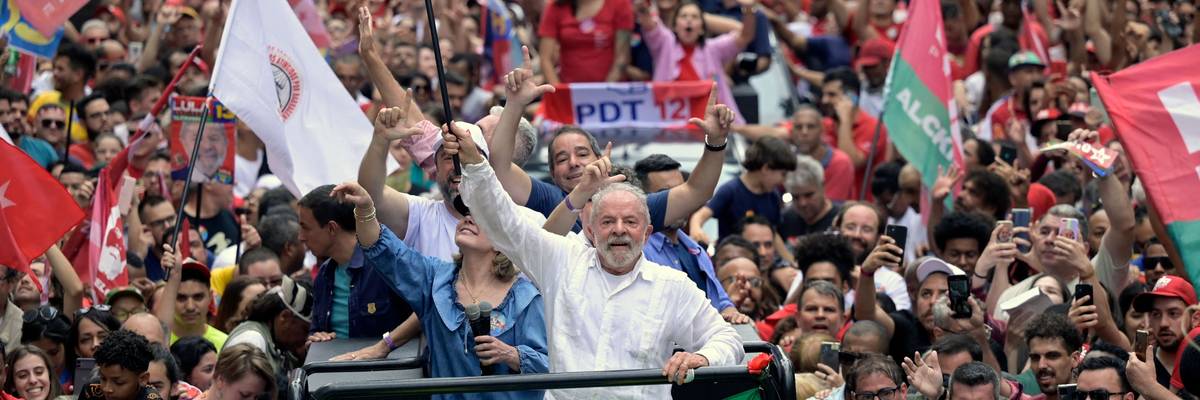
Brazil's former President (2003-2010) and then-presidential candidate for the leftist Workers Party (PT) Luiz Inacio Lula da Silva waves a national flag during a campaign rally in Belo Horizonte, Minas Gerais state, Brazil on October 9, 2022.
There are still three weeks until the next round, and Lula could still win, but it's gonna take a massive fight. Part of that fight is changing how the international media covers things.
With the Brazilian presidential election headed to a runoff, Luiz Inácio Lula da Silva is down 47% to 45% and faces a massive fight ahead. I wanted to give a quick analysis of what happened and where things are going next.
Lula lost by only 2%, and several third-party candidates, who took a combined 8% of the vote, have publicly indicated they would not endorse Flávio Bolsonaro in the second round.
Likewise, 29 million Brazilians did not vote in this round of the runoff and may be persuaded to vote for Lula in the second round if they fear Bolsonaro.
While Brasil defeated Jair Bolsonaro narrowly in 2022, it swung right again, much like the United States. Voters are upset, and they are taking it out on the party in power.
On Tuesday, the Brazilian Senate is scheduled to vote on a measure that would shorten the Brazilian workweek from six days to five days. Bolsonaro has opposed this measure, and Lula could use the vote to mobilize workers' support against the Bolsonaro team.
It's a tough road ahead for Lula, but not impossible.
Three primary factors hurt Lula in the first round. First, Lula’s age and the fact that the Workers' Party (PT) has held the presidency in Brazil for 18 of the last 24 years.
The second is that the Brazilian corporate media constantly manufactured scandals against Lula.
Finally, the role that US President Donald Trump played in training and validating the right-wing in Brasil, while not decisive, provided critical support. Here's what went wrong for Lula.
Like former US President Joe Biden, one problem Lula faces right now is that he is 80 years old. He doesn’t look as sharp as he used to, while Flávio Bolsonaro is nearly half his age—45 years younger.
Additionally, Lula’s party, the Workers’ Party (PT), has held the presidency for 18 of the last 24 years. Lula and Dilma, both members of the Workers' Party (PT), held the presidency from 2002 to 2016. Lula was reelected in 2022 for his record third term. No Brazilian has ever won a third term.
Although the PT has rarely controlled Congress, it is seen as the ruling party because it has held the presidency for 18 of the last 24 years. Voters are likely to associate any problems in the country with the PT, which has held the presidency for so long.
While Brasil defeated Jair Bolsonaro narrowly in 2022, it swung right again, much like the United States. Voters are upset, and they are taking it out on the party in power.
Even worse, Lula failed to recruit young candidates, who may have excited voters to turn out in tight races. In what should have been a competitive Senate election in Rio de Janeiro, the PT recruited 84-year-old Bendedita da Silva, who lost in a landslide to Bolsonaro allies.
Last week, Lula skipped the presidential debate; so did Bolsonaro and its unclear how much this decision might have hurt him.
Lacking excitement, nearly 29 million Brazilians did not vote despite it being obligatory in Brasil.
The Brazilian media market is extremely consolidated, and the heads of major networks like Globo have been going after Lula hard. They have been accused of manufacturing scandals against Lula.
Last November, the financial institution Banco Master collapsed amid allegations of massive fraud. The bank was being run like a Ponzi scheme, resulting in the largest financial collapse in Brazilian history, with nearly $8 billion in investors’ funds lost.
Despite Banco Master CEO Daniel Vorcaro being a very vocal Bolsonaro supporter, the Brazilian media has repeatedly tried to link the scandal to Lula’s Workers’ Party, as Vorcaro cultivated political ties on both sides of the aisle.
Every attack on Lula by the Trump administration generated headlines in Brasil and validated the wild claims made by Bolsonaro allies of a flawed Brazilian justice system.
Lula’s son, businessman Fábio Luís da Silva, commonly known as “Lulinha,” was scrutinized over large bank accounts worth millions of dollars. For months, Lulinha has offered to open his books and has claimed that he received no special favors from Banco Master. Still, the media repeatedly raised questions about Lulinha’s alleged impropriety.
At one point, media giant TV Globo made a giant infographic web with arrows, showing a complex network linked to Lula. Other reporters widely ridiculed the conspiracy theory map, and TV Globo eventually had to apologize publicly on air.
Then, in May, The Intercept Brasil released a WhatsApp message from Flávio Bolsonaro to Vorcaro, asking him for more than $26 million to fund a strange English-language biopic named Dark Horse, about his father. In the film, Jair Bolsonaro is portrayed by right-wing American actor Jim Caviezel, who played Jesus in the controversial 2004 film The Passion of the Christ.
Polling throughout the spring and summer showed Lula leading as the scandal remained fresh in people’s minds. Then, the Brazilian corporate media went into high gear to attack Lula. They went after Supreme Court Justice Alexandre de Moraes, who led the prosecution that jailed Bolsonaro.
Moraes has accused Brazilian Supreme Court Justice André Mendonca, a Bolsonaro appointee, of failing to follow proper procedure in his handling of the Banco Master scandal, leaking information to the press on Lula’s political allies while hiding information on Bolsonaro’s allies.
Moraes asked the Brazilian Federal police to investigate Mendonça's violation of federal investigation procedures and for selectively leaking information to the press that would make Lula allies look bad while suppressing information on Bolsonaro allies.
Moraes accused Mendonça of attempting to “steer the production of evidence toward falsely accusing Supreme Court justices of crimes, expressly naming Justices Gilmar Mendes, Dias Toffoli, Luiz Fux, Alexandre de Moraes, and Nunes Marques, as well as the prosecutor general and the director-general of the Federal Police.”
While I don’t want to underestimate the strength of fascists within Brasil, it’s important to note that Trump and his operatives did help the Bolsonaro family pull off an impressive comeback.
In March 2025, Eduardo Bolsonaro fled to the United States rather than face prosecution in Brasil for his role in trying to orchestrate a coup, and he was granted permanent residency status in July. While in the United States, Eduardo Bolsonaro has worked closely with Trump officials, including Special Presidential Envoy for Special Missions Richard Grenell, to oust Lula from power.
“It was a privilege to speak with Ambassador Richard Grenell at President Trump’s residence at Mar-a-Lago,” Eduardo Bolsonaro wrote on Instagram following a meeting with Grenel in 2025. “The conservative movement is global—and we are just getting started.”
Eduardo Bolsonaro worked closely with top Trump aides like Brad Parscale, Trump’s director of digital strategy, to learn the social media strategy that led Trump to win reelection.
As president, Trump worked hard to attack Lula. He placed punitive tariffs on Brazil for convicting Jair Bolsonaro, Eduardo’s father, for attempting to assassinate Lula and overthrow his government in 2022. These tariffs hurt Brasil’s economy.
More importantly, Trump’s constant denunciation of the jailing of Bolsonaro validated conspiracy theories of right-wingers that the justice process was flawed. When Alexandre de Moraes, who led Bolsonaro's conviction, was implicated in the Banco Master scandal, it only reinforced these conspiracy theories.
Ahead of the Brazilian presidential election, the Trump administration has labeled Brasil as a major distributor of cocaine and attempted to paint Lula as weak on taking on drug gangs.
In June, the Trump administration labeled two gangs as “terrorist organizations," something which the Lula administration has repeatedly resisted because of fears of how the Trump administration could intervene in law enforcement and military matters in Brasil.
Still, every attack on Lula by the Trump administration generated headlines in Brasil and validated the wild claims made by Bolsonaro allies of a flawed Brazilian justice system.
On Friday, the Trump administration closed its embassy in Brasil and all of its consulates in a move that many saw as a scare tactic designed to interfere once again in the Brazilian presidential election.
The same day, the Brazilian federal police and intelligence service ABIN were warning of a possible US coup attempt. It was already known that Trump operatives were training operatives in Brasil, and the Brazilian federal police report described in depth how much Trump's intervention had shifted things in Brasil.
Finally, the international media completely ignored the Brazilian presidential election, allowing corporate media within Brasil to dominate the conversation without any accountability from the international media.
There are still three weeks until the next round, and Lula could still win, but it's gonna take a massive fight. Part of that fight is changing how the international media covers things.
Payday Report can help play a small role in getting the US press more involved. The Washington Post once cited Payday Report in a front-page story for changing the way the pandemic strike wave was discussed, and maybe we can play a small role in getting American reporters to pay attention.
Donate to help Payday Report cover the fight ahead.
Dear Common Dreams reader, It’s been nearly 30 years since I co-founded Common Dreams with my late wife, Lina Newhouser. We had the radical notion that journalism should serve the public good, not corporate profits. It was clear to us from the outset what it would take to build such a project. No paid advertisements. No corporate sponsors. No millionaire publisher telling us what to think or do. Many people said we wouldn't last a year, but we proved those doubters wrong. Together with a tremendous team of journalists and dedicated staff, we built an independent media outlet free from the constraints of profits and corporate control. Our mission has always been simple: To inform. To inspire. To ignite change for the common good. Building Common Dreams was not easy. Our survival was never guaranteed. When you take on the most powerful forces—Wall Street greed, fossil fuel industry destruction, Big Tech lobbyists, and uber-rich oligarchs who have spent billions upon billions rigging the economy and democracy in their favor—the only bulwark you have is supporters who believe in your work. But here’s the urgent message from me today. It's never been this bad out there. And it's never been this hard to keep us going. At the very moment Common Dreams is most needed, the threats we face are intensifying. We need your support now more than ever. We don't accept corporate advertising and never will. We don't have a paywall because we don't think people should be blocked from critical news based on their ability to pay. Everything we do is funded by the donations of readers like you. When everyone does the little they can afford, we are strong. But if that support retreats or dries up, so do we. Will you donate now to make sure Common Dreams not only survives but thrives? —Craig Brown, Co-founder |
With the Brazilian presidential election headed to a runoff, Luiz Inácio Lula da Silva is down 47% to 45% and faces a massive fight ahead. I wanted to give a quick analysis of what happened and where things are going next.
Lula lost by only 2%, and several third-party candidates, who took a combined 8% of the vote, have publicly indicated they would not endorse Flávio Bolsonaro in the second round.
Likewise, 29 million Brazilians did not vote in this round of the runoff and may be persuaded to vote for Lula in the second round if they fear Bolsonaro.
While Brasil defeated Jair Bolsonaro narrowly in 2022, it swung right again, much like the United States. Voters are upset, and they are taking it out on the party in power.
On Tuesday, the Brazilian Senate is scheduled to vote on a measure that would shorten the Brazilian workweek from six days to five days. Bolsonaro has opposed this measure, and Lula could use the vote to mobilize workers' support against the Bolsonaro team.
It's a tough road ahead for Lula, but not impossible.
Three primary factors hurt Lula in the first round. First, Lula’s age and the fact that the Workers' Party (PT) has held the presidency in Brazil for 18 of the last 24 years.
The second is that the Brazilian corporate media constantly manufactured scandals against Lula.
Finally, the role that US President Donald Trump played in training and validating the right-wing in Brasil, while not decisive, provided critical support. Here's what went wrong for Lula.
Like former US President Joe Biden, one problem Lula faces right now is that he is 80 years old. He doesn’t look as sharp as he used to, while Flávio Bolsonaro is nearly half his age—45 years younger.
Additionally, Lula’s party, the Workers’ Party (PT), has held the presidency for 18 of the last 24 years. Lula and Dilma, both members of the Workers' Party (PT), held the presidency from 2002 to 2016. Lula was reelected in 2022 for his record third term. No Brazilian has ever won a third term.
Although the PT has rarely controlled Congress, it is seen as the ruling party because it has held the presidency for 18 of the last 24 years. Voters are likely to associate any problems in the country with the PT, which has held the presidency for so long.
While Brasil defeated Jair Bolsonaro narrowly in 2022, it swung right again, much like the United States. Voters are upset, and they are taking it out on the party in power.
Even worse, Lula failed to recruit young candidates, who may have excited voters to turn out in tight races. In what should have been a competitive Senate election in Rio de Janeiro, the PT recruited 84-year-old Bendedita da Silva, who lost in a landslide to Bolsonaro allies.
Last week, Lula skipped the presidential debate; so did Bolsonaro and its unclear how much this decision might have hurt him.
Lacking excitement, nearly 29 million Brazilians did not vote despite it being obligatory in Brasil.
The Brazilian media market is extremely consolidated, and the heads of major networks like Globo have been going after Lula hard. They have been accused of manufacturing scandals against Lula.
Last November, the financial institution Banco Master collapsed amid allegations of massive fraud. The bank was being run like a Ponzi scheme, resulting in the largest financial collapse in Brazilian history, with nearly $8 billion in investors’ funds lost.
Despite Banco Master CEO Daniel Vorcaro being a very vocal Bolsonaro supporter, the Brazilian media has repeatedly tried to link the scandal to Lula’s Workers’ Party, as Vorcaro cultivated political ties on both sides of the aisle.
Every attack on Lula by the Trump administration generated headlines in Brasil and validated the wild claims made by Bolsonaro allies of a flawed Brazilian justice system.
Lula’s son, businessman Fábio Luís da Silva, commonly known as “Lulinha,” was scrutinized over large bank accounts worth millions of dollars. For months, Lulinha has offered to open his books and has claimed that he received no special favors from Banco Master. Still, the media repeatedly raised questions about Lulinha’s alleged impropriety.
At one point, media giant TV Globo made a giant infographic web with arrows, showing a complex network linked to Lula. Other reporters widely ridiculed the conspiracy theory map, and TV Globo eventually had to apologize publicly on air.
Then, in May, The Intercept Brasil released a WhatsApp message from Flávio Bolsonaro to Vorcaro, asking him for more than $26 million to fund a strange English-language biopic named Dark Horse, about his father. In the film, Jair Bolsonaro is portrayed by right-wing American actor Jim Caviezel, who played Jesus in the controversial 2004 film The Passion of the Christ.
Polling throughout the spring and summer showed Lula leading as the scandal remained fresh in people’s minds. Then, the Brazilian corporate media went into high gear to attack Lula. They went after Supreme Court Justice Alexandre de Moraes, who led the prosecution that jailed Bolsonaro.
Moraes has accused Brazilian Supreme Court Justice André Mendonca, a Bolsonaro appointee, of failing to follow proper procedure in his handling of the Banco Master scandal, leaking information to the press on Lula’s political allies while hiding information on Bolsonaro’s allies.
Moraes asked the Brazilian Federal police to investigate Mendonça's violation of federal investigation procedures and for selectively leaking information to the press that would make Lula allies look bad while suppressing information on Bolsonaro allies.
Moraes accused Mendonça of attempting to “steer the production of evidence toward falsely accusing Supreme Court justices of crimes, expressly naming Justices Gilmar Mendes, Dias Toffoli, Luiz Fux, Alexandre de Moraes, and Nunes Marques, as well as the prosecutor general and the director-general of the Federal Police.”
While I don’t want to underestimate the strength of fascists within Brasil, it’s important to note that Trump and his operatives did help the Bolsonaro family pull off an impressive comeback.
In March 2025, Eduardo Bolsonaro fled to the United States rather than face prosecution in Brasil for his role in trying to orchestrate a coup, and he was granted permanent residency status in July. While in the United States, Eduardo Bolsonaro has worked closely with Trump officials, including Special Presidential Envoy for Special Missions Richard Grenell, to oust Lula from power.
“It was a privilege to speak with Ambassador Richard Grenell at President Trump’s residence at Mar-a-Lago,” Eduardo Bolsonaro wrote on Instagram following a meeting with Grenel in 2025. “The conservative movement is global—and we are just getting started.”
Eduardo Bolsonaro worked closely with top Trump aides like Brad Parscale, Trump’s director of digital strategy, to learn the social media strategy that led Trump to win reelection.
As president, Trump worked hard to attack Lula. He placed punitive tariffs on Brazil for convicting Jair Bolsonaro, Eduardo’s father, for attempting to assassinate Lula and overthrow his government in 2022. These tariffs hurt Brasil’s economy.
More importantly, Trump’s constant denunciation of the jailing of Bolsonaro validated conspiracy theories of right-wingers that the justice process was flawed. When Alexandre de Moraes, who led Bolsonaro's conviction, was implicated in the Banco Master scandal, it only reinforced these conspiracy theories.
Ahead of the Brazilian presidential election, the Trump administration has labeled Brasil as a major distributor of cocaine and attempted to paint Lula as weak on taking on drug gangs.
In June, the Trump administration labeled two gangs as “terrorist organizations," something which the Lula administration has repeatedly resisted because of fears of how the Trump administration could intervene in law enforcement and military matters in Brasil.
Still, every attack on Lula by the Trump administration generated headlines in Brasil and validated the wild claims made by Bolsonaro allies of a flawed Brazilian justice system.
On Friday, the Trump administration closed its embassy in Brasil and all of its consulates in a move that many saw as a scare tactic designed to interfere once again in the Brazilian presidential election.
The same day, the Brazilian federal police and intelligence service ABIN were warning of a possible US coup attempt. It was already known that Trump operatives were training operatives in Brasil, and the Brazilian federal police report described in depth how much Trump's intervention had shifted things in Brasil.
Finally, the international media completely ignored the Brazilian presidential election, allowing corporate media within Brasil to dominate the conversation without any accountability from the international media.
There are still three weeks until the next round, and Lula could still win, but it's gonna take a massive fight. Part of that fight is changing how the international media covers things.
Payday Report can help play a small role in getting the US press more involved. The Washington Post once cited Payday Report in a front-page story for changing the way the pandemic strike wave was discussed, and maybe we can play a small role in getting American reporters to pay attention.
Donate to help Payday Report cover the fight ahead.
With the Brazilian presidential election headed to a runoff, Luiz Inácio Lula da Silva is down 47% to 45% and faces a massive fight ahead. I wanted to give a quick analysis of what happened and where things are going next.
Lula lost by only 2%, and several third-party candidates, who took a combined 8% of the vote, have publicly indicated they would not endorse Flávio Bolsonaro in the second round.
Likewise, 29 million Brazilians did not vote in this round of the runoff and may be persuaded to vote for Lula in the second round if they fear Bolsonaro.
While Brasil defeated Jair Bolsonaro narrowly in 2022, it swung right again, much like the United States. Voters are upset, and they are taking it out on the party in power.
On Tuesday, the Brazilian Senate is scheduled to vote on a measure that would shorten the Brazilian workweek from six days to five days. Bolsonaro has opposed this measure, and Lula could use the vote to mobilize workers' support against the Bolsonaro team.
It's a tough road ahead for Lula, but not impossible.
Three primary factors hurt Lula in the first round. First, Lula’s age and the fact that the Workers' Party (PT) has held the presidency in Brazil for 18 of the last 24 years.
The second is that the Brazilian corporate media constantly manufactured scandals against Lula.
Finally, the role that US President Donald Trump played in training and validating the right-wing in Brasil, while not decisive, provided critical support. Here's what went wrong for Lula.
Like former US President Joe Biden, one problem Lula faces right now is that he is 80 years old. He doesn’t look as sharp as he used to, while Flávio Bolsonaro is nearly half his age—45 years younger.
Additionally, Lula’s party, the Workers’ Party (PT), has held the presidency for 18 of the last 24 years. Lula and Dilma, both members of the Workers' Party (PT), held the presidency from 2002 to 2016. Lula was reelected in 2022 for his record third term. No Brazilian has ever won a third term.
Although the PT has rarely controlled Congress, it is seen as the ruling party because it has held the presidency for 18 of the last 24 years. Voters are likely to associate any problems in the country with the PT, which has held the presidency for so long.
While Brasil defeated Jair Bolsonaro narrowly in 2022, it swung right again, much like the United States. Voters are upset, and they are taking it out on the party in power.
Even worse, Lula failed to recruit young candidates, who may have excited voters to turn out in tight races. In what should have been a competitive Senate election in Rio de Janeiro, the PT recruited 84-year-old Bendedita da Silva, who lost in a landslide to Bolsonaro allies.
Last week, Lula skipped the presidential debate; so did Bolsonaro and its unclear how much this decision might have hurt him.
Lacking excitement, nearly 29 million Brazilians did not vote despite it being obligatory in Brasil.
The Brazilian media market is extremely consolidated, and the heads of major networks like Globo have been going after Lula hard. They have been accused of manufacturing scandals against Lula.
Last November, the financial institution Banco Master collapsed amid allegations of massive fraud. The bank was being run like a Ponzi scheme, resulting in the largest financial collapse in Brazilian history, with nearly $8 billion in investors’ funds lost.
Despite Banco Master CEO Daniel Vorcaro being a very vocal Bolsonaro supporter, the Brazilian media has repeatedly tried to link the scandal to Lula’s Workers’ Party, as Vorcaro cultivated political ties on both sides of the aisle.
Every attack on Lula by the Trump administration generated headlines in Brasil and validated the wild claims made by Bolsonaro allies of a flawed Brazilian justice system.
Lula’s son, businessman Fábio Luís da Silva, commonly known as “Lulinha,” was scrutinized over large bank accounts worth millions of dollars. For months, Lulinha has offered to open his books and has claimed that he received no special favors from Banco Master. Still, the media repeatedly raised questions about Lulinha’s alleged impropriety.
At one point, media giant TV Globo made a giant infographic web with arrows, showing a complex network linked to Lula. Other reporters widely ridiculed the conspiracy theory map, and TV Globo eventually had to apologize publicly on air.
Then, in May, The Intercept Brasil released a WhatsApp message from Flávio Bolsonaro to Vorcaro, asking him for more than $26 million to fund a strange English-language biopic named Dark Horse, about his father. In the film, Jair Bolsonaro is portrayed by right-wing American actor Jim Caviezel, who played Jesus in the controversial 2004 film The Passion of the Christ.
Polling throughout the spring and summer showed Lula leading as the scandal remained fresh in people’s minds. Then, the Brazilian corporate media went into high gear to attack Lula. They went after Supreme Court Justice Alexandre de Moraes, who led the prosecution that jailed Bolsonaro.
Moraes has accused Brazilian Supreme Court Justice André Mendonca, a Bolsonaro appointee, of failing to follow proper procedure in his handling of the Banco Master scandal, leaking information to the press on Lula’s political allies while hiding information on Bolsonaro’s allies.
Moraes asked the Brazilian Federal police to investigate Mendonça's violation of federal investigation procedures and for selectively leaking information to the press that would make Lula allies look bad while suppressing information on Bolsonaro allies.
Moraes accused Mendonça of attempting to “steer the production of evidence toward falsely accusing Supreme Court justices of crimes, expressly naming Justices Gilmar Mendes, Dias Toffoli, Luiz Fux, Alexandre de Moraes, and Nunes Marques, as well as the prosecutor general and the director-general of the Federal Police.”
While I don’t want to underestimate the strength of fascists within Brasil, it’s important to note that Trump and his operatives did help the Bolsonaro family pull off an impressive comeback.
In March 2025, Eduardo Bolsonaro fled to the United States rather than face prosecution in Brasil for his role in trying to orchestrate a coup, and he was granted permanent residency status in July. While in the United States, Eduardo Bolsonaro has worked closely with Trump officials, including Special Presidential Envoy for Special Missions Richard Grenell, to oust Lula from power.
“It was a privilege to speak with Ambassador Richard Grenell at President Trump’s residence at Mar-a-Lago,” Eduardo Bolsonaro wrote on Instagram following a meeting with Grenel in 2025. “The conservative movement is global—and we are just getting started.”
Eduardo Bolsonaro worked closely with top Trump aides like Brad Parscale, Trump’s director of digital strategy, to learn the social media strategy that led Trump to win reelection.
As president, Trump worked hard to attack Lula. He placed punitive tariffs on Brazil for convicting Jair Bolsonaro, Eduardo’s father, for attempting to assassinate Lula and overthrow his government in 2022. These tariffs hurt Brasil’s economy.
More importantly, Trump’s constant denunciation of the jailing of Bolsonaro validated conspiracy theories of right-wingers that the justice process was flawed. When Alexandre de Moraes, who led Bolsonaro's conviction, was implicated in the Banco Master scandal, it only reinforced these conspiracy theories.
Ahead of the Brazilian presidential election, the Trump administration has labeled Brasil as a major distributor of cocaine and attempted to paint Lula as weak on taking on drug gangs.
In June, the Trump administration labeled two gangs as “terrorist organizations," something which the Lula administration has repeatedly resisted because of fears of how the Trump administration could intervene in law enforcement and military matters in Brasil.
Still, every attack on Lula by the Trump administration generated headlines in Brasil and validated the wild claims made by Bolsonaro allies of a flawed Brazilian justice system.
On Friday, the Trump administration closed its embassy in Brasil and all of its consulates in a move that many saw as a scare tactic designed to interfere once again in the Brazilian presidential election.
The same day, the Brazilian federal police and intelligence service ABIN were warning of a possible US coup attempt. It was already known that Trump operatives were training operatives in Brasil, and the Brazilian federal police report described in depth how much Trump's intervention had shifted things in Brasil.
Finally, the international media completely ignored the Brazilian presidential election, allowing corporate media within Brasil to dominate the conversation without any accountability from the international media.
There are still three weeks until the next round, and Lula could still win, but it's gonna take a massive fight. Part of that fight is changing how the international media covers things.
Payday Report can help play a small role in getting the US press more involved. The Washington Post once cited Payday Report in a front-page story for changing the way the pandemic strike wave was discussed, and maybe we can play a small role in getting American reporters to pay attention.
Donate to help Payday Report cover the fight ahead.