SUBSCRIBE TO OUR FREE NEWSLETTER
Daily news & progressive opinion—funded by the people, not the corporations—delivered straight to your inbox.
5
#000000
#FFFFFF
To donate by check, phone, or other method, see our More Ways to Give page.
Daily news & progressive opinion—funded by the people, not the corporations—delivered straight to your inbox.
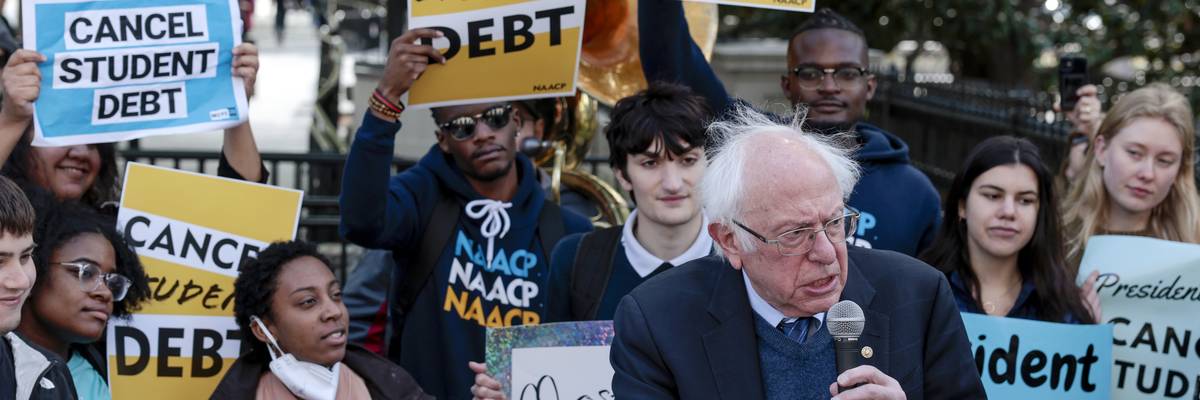
Sen. Bernie Sanders (I-VT) speaks at a Student Loan Forgiveness rally on Pennsylvania Avenue and 17th street near the White House on April 27, 2022 in Washington, DC.
The largest bill increase any single person may get this year is a student loan bill, so why have Dems left it out of their messaging?
With just 100 days left until the midterms, Minority Leader Hakeem Jeffries appeared on CNN to deliver Democrats’ closing message. “Life in this country is far too expensive,” said Jeffries, rolling out a new "Fighting for an Affordable America" tagline. Americans do not have “enough food on the table, not enough gas in the tank,” and they’re “unable to actually regularly and consistently afford to pay the rent or pay the mortgage.” Jeffries blamed President Donald Trump’s costly war of choice in Iran, tariffs that have cost everyday Americans thousands of dollars per year, and the largest cut to Medicaid in American history.
Later that afternoon, in a steel workers union hall in Bethlehem, Pennsylvania, Jeffries joined Gov. Josh Shapiro at a joint campaign event for Bob Brooks, a LeHigh Valley firefighter running for Congress in Pennsylvania’s seventh Congressional District. Together, the three Democrats pointed to both the corruption plaguing our national politics and the high financial cost Americans have been forced to bear since Trump took office as causes of the affordability crisis. They implored voters in the “swingiest swing state in the country” to shift the tides of Washington, DC by voting against Republicans’ cost-raising policies and for Democrats’ cost-lowering solutions in November.
Democrats are right to highlight the impacts of giant cuts to Medicaid and the Supplemental Nutrition Assistance Program, along with the rising cost of gas and utilities fueled by wars abroad and billionaire-backed corruption schemes at home. Uniting a broad electorate around an “affordability” agenda, akin to the messaging and policy success of New York City Mayor Zohran Mamdani, will bode well for Democrats around the nation going into an intense midterm election where the winds of Immigration and Customs Enforcement’s terror, mobilization against AI data centers, and widespread opposition to war is at the left’s back.
But mysteriously missing from Democrats' messaging about costs that have gone up as a result of Trump's One Big Beautiful Bill Act is a key expense that 40 million Americans are battling in the shadows—student loans. For many student debtors, the increase in their monthly student loan bill will be their largest bill increase of the year by a significant margin. This leaves a massive hole in Democrats’ messaging cadence that must be filled immediately. A successful affordability message requires engaging with the true reality of Americans’ purses, and holds a mirror to the specific financial burdens that working people lose sleep over each night.
A willingness to ignore such a massive systemic cost increase reveals that Democrats, at least in this moment, are not taking their own "affordability" messaging seriously—posing grave electoral problems.
Take a typical student debtor in a family of four who earns a median US household income of $81,000. Under former President Joe Biden’s SAVE plan, their monthly student debt payment was $36. Under Trump’s Repayment Assistance Plan (RAP) plan, that payment would increase to $440—well over 1,000% more than under SAVE. In an internal Debt Collective survey of more than 1,500 student debtors on the SAVE plan, 50% of student debtors reported an average expected payment increase of $500 a month—just a few bucks shy of the average monthly payment for a newly used car. Yet despite this grave expense, of which Trump and his Republican allies are solely to blame, student loan bill increases have seldom made it to Democrats’ November stump speeches. Except for a few sparing moments of attention—Sen. Bernie Sanders (I-Vt.) has used his platform to showcase the absurdity of rising student debt for seniors—student loan bills have largely fallen off the radar for congressional Democrats. But for the millions on the receiving end of the Department of Education’s confusing and frightening emails, student loans dominate workers’ ability to make financial decisions.
Massive errors have rendered the student debt system dysfunctional at an unprecedented level. Millions of debtors have payments gone uncounted by their servicer, inaccurate balances, are awaiting cancellation for relief programs they’ve been eligible for, or are in limbo to simply enroll in a repayment plan that works for them. Weeks ago, Secretary Linda McMahon’s Department of Education admitted to a massive glitch in which thousands of student debtors were wrongfully told their monthly payment would be $50 a month, only to find out weeks later that the plan they’re now stuck in requires a monthly payment hundreds of dollars more. In recent days, debtors serviced by MOHELA were wrongfully sent delinquency notices asserting that they owed back-payments for the months in which courts have legally paused their payments. Separate ongoing litigation moving its way through a DC district court has called out a “shadow repeal” of the REPAYE plan, asserting that the Trump administration's refusal to allow student debtors to enroll in a repayment plan that may be their best option is illegal. Today, no member of Congress has called on the Trump administration to reopen the plan.
Worse than remaining quiet on student debt, some Democrats have seemingly regressed on the issue. In July, a dangerous student debt bill that would exempt—yes, exempt—state-based lenders from transparency laws passed in the Senate Health, Education, Labor, and Pensions Committee. If the vote advances further, the new law of the land could give schools a financial incentive to push predatory loan products onto desperate students seeking to use private loans to pay for school. Nine out of 11 Democrats sided with Republicans on this measure, ensuring bipartisan support for deepening the student debt crisis and worsening the lending system.
Democrats' silence on the rising costs of student debt will fall flat with voters in November, many of whom are already dejected from the Biden administration’s botched attempt to cancel student debt broadly and the Supreme Court’s decision to side against debtors. A willingness to ignore such a massive systemic cost increase reveals that Democrats, at least in this moment, are not taking their own "affordability" messaging seriously—posing grave electoral problems.
The Debt Collective—the nation’s first union of debtors whom I organize with—is calling on Congressional Democrats to step up to the plate. At this moment, Democrats could call for an immediate pause on student debt payments—which Trump was the first to administer through executive authority in 2020—amid significant administrative errors, a costly rise in payments amid a worsening economy, and ongoing litigation. Without mentioning the one monthly bill that, for millions of Americans, rivals their mortgage, the blue wave Democrats will need to take back the House may resemble something more like a small splash.
Dear Common Dreams reader, It’s been nearly 30 years since I co-founded Common Dreams with my late wife, Lina Newhouser. We had the radical notion that journalism should serve the public good, not corporate profits. It was clear to us from the outset what it would take to build such a project. No paid advertisements. No corporate sponsors. No millionaire publisher telling us what to think or do. Many people said we wouldn't last a year, but we proved those doubters wrong. Together with a tremendous team of journalists and dedicated staff, we built an independent media outlet free from the constraints of profits and corporate control. Our mission has always been simple: To inform. To inspire. To ignite change for the common good. Building Common Dreams was not easy. Our survival was never guaranteed. When you take on the most powerful forces—Wall Street greed, fossil fuel industry destruction, Big Tech lobbyists, and uber-rich oligarchs who have spent billions upon billions rigging the economy and democracy in their favor—the only bulwark you have is supporters who believe in your work. But here’s the urgent message from me today. It's never been this bad out there. And it's never been this hard to keep us going. At the very moment Common Dreams is most needed, the threats we face are intensifying. We need your support now more than ever. We don't accept corporate advertising and never will. We don't have a paywall because we don't think people should be blocked from critical news based on their ability to pay. Everything we do is funded by the donations of readers like you. When everyone does the little they can afford, we are strong. But if that support retreats or dries up, so do we. Will you donate now to make sure Common Dreams not only survives but thrives? —Craig Brown, Co-founder |
With just 100 days left until the midterms, Minority Leader Hakeem Jeffries appeared on CNN to deliver Democrats’ closing message. “Life in this country is far too expensive,” said Jeffries, rolling out a new "Fighting for an Affordable America" tagline. Americans do not have “enough food on the table, not enough gas in the tank,” and they’re “unable to actually regularly and consistently afford to pay the rent or pay the mortgage.” Jeffries blamed President Donald Trump’s costly war of choice in Iran, tariffs that have cost everyday Americans thousands of dollars per year, and the largest cut to Medicaid in American history.
Later that afternoon, in a steel workers union hall in Bethlehem, Pennsylvania, Jeffries joined Gov. Josh Shapiro at a joint campaign event for Bob Brooks, a LeHigh Valley firefighter running for Congress in Pennsylvania’s seventh Congressional District. Together, the three Democrats pointed to both the corruption plaguing our national politics and the high financial cost Americans have been forced to bear since Trump took office as causes of the affordability crisis. They implored voters in the “swingiest swing state in the country” to shift the tides of Washington, DC by voting against Republicans’ cost-raising policies and for Democrats’ cost-lowering solutions in November.
Democrats are right to highlight the impacts of giant cuts to Medicaid and the Supplemental Nutrition Assistance Program, along with the rising cost of gas and utilities fueled by wars abroad and billionaire-backed corruption schemes at home. Uniting a broad electorate around an “affordability” agenda, akin to the messaging and policy success of New York City Mayor Zohran Mamdani, will bode well for Democrats around the nation going into an intense midterm election where the winds of Immigration and Customs Enforcement’s terror, mobilization against AI data centers, and widespread opposition to war is at the left’s back.
But mysteriously missing from Democrats' messaging about costs that have gone up as a result of Trump's One Big Beautiful Bill Act is a key expense that 40 million Americans are battling in the shadows—student loans. For many student debtors, the increase in their monthly student loan bill will be their largest bill increase of the year by a significant margin. This leaves a massive hole in Democrats’ messaging cadence that must be filled immediately. A successful affordability message requires engaging with the true reality of Americans’ purses, and holds a mirror to the specific financial burdens that working people lose sleep over each night.
A willingness to ignore such a massive systemic cost increase reveals that Democrats, at least in this moment, are not taking their own "affordability" messaging seriously—posing grave electoral problems.
Take a typical student debtor in a family of four who earns a median US household income of $81,000. Under former President Joe Biden’s SAVE plan, their monthly student debt payment was $36. Under Trump’s Repayment Assistance Plan (RAP) plan, that payment would increase to $440—well over 1,000% more than under SAVE. In an internal Debt Collective survey of more than 1,500 student debtors on the SAVE plan, 50% of student debtors reported an average expected payment increase of $500 a month—just a few bucks shy of the average monthly payment for a newly used car. Yet despite this grave expense, of which Trump and his Republican allies are solely to blame, student loan bill increases have seldom made it to Democrats’ November stump speeches. Except for a few sparing moments of attention—Sen. Bernie Sanders (I-Vt.) has used his platform to showcase the absurdity of rising student debt for seniors—student loan bills have largely fallen off the radar for congressional Democrats. But for the millions on the receiving end of the Department of Education’s confusing and frightening emails, student loans dominate workers’ ability to make financial decisions.
Massive errors have rendered the student debt system dysfunctional at an unprecedented level. Millions of debtors have payments gone uncounted by their servicer, inaccurate balances, are awaiting cancellation for relief programs they’ve been eligible for, or are in limbo to simply enroll in a repayment plan that works for them. Weeks ago, Secretary Linda McMahon’s Department of Education admitted to a massive glitch in which thousands of student debtors were wrongfully told their monthly payment would be $50 a month, only to find out weeks later that the plan they’re now stuck in requires a monthly payment hundreds of dollars more. In recent days, debtors serviced by MOHELA were wrongfully sent delinquency notices asserting that they owed back-payments for the months in which courts have legally paused their payments. Separate ongoing litigation moving its way through a DC district court has called out a “shadow repeal” of the REPAYE plan, asserting that the Trump administration's refusal to allow student debtors to enroll in a repayment plan that may be their best option is illegal. Today, no member of Congress has called on the Trump administration to reopen the plan.
Worse than remaining quiet on student debt, some Democrats have seemingly regressed on the issue. In July, a dangerous student debt bill that would exempt—yes, exempt—state-based lenders from transparency laws passed in the Senate Health, Education, Labor, and Pensions Committee. If the vote advances further, the new law of the land could give schools a financial incentive to push predatory loan products onto desperate students seeking to use private loans to pay for school. Nine out of 11 Democrats sided with Republicans on this measure, ensuring bipartisan support for deepening the student debt crisis and worsening the lending system.
Democrats' silence on the rising costs of student debt will fall flat with voters in November, many of whom are already dejected from the Biden administration’s botched attempt to cancel student debt broadly and the Supreme Court’s decision to side against debtors. A willingness to ignore such a massive systemic cost increase reveals that Democrats, at least in this moment, are not taking their own "affordability" messaging seriously—posing grave electoral problems.
The Debt Collective—the nation’s first union of debtors whom I organize with—is calling on Congressional Democrats to step up to the plate. At this moment, Democrats could call for an immediate pause on student debt payments—which Trump was the first to administer through executive authority in 2020—amid significant administrative errors, a costly rise in payments amid a worsening economy, and ongoing litigation. Without mentioning the one monthly bill that, for millions of Americans, rivals their mortgage, the blue wave Democrats will need to take back the House may resemble something more like a small splash.
With just 100 days left until the midterms, Minority Leader Hakeem Jeffries appeared on CNN to deliver Democrats’ closing message. “Life in this country is far too expensive,” said Jeffries, rolling out a new "Fighting for an Affordable America" tagline. Americans do not have “enough food on the table, not enough gas in the tank,” and they’re “unable to actually regularly and consistently afford to pay the rent or pay the mortgage.” Jeffries blamed President Donald Trump’s costly war of choice in Iran, tariffs that have cost everyday Americans thousands of dollars per year, and the largest cut to Medicaid in American history.
Later that afternoon, in a steel workers union hall in Bethlehem, Pennsylvania, Jeffries joined Gov. Josh Shapiro at a joint campaign event for Bob Brooks, a LeHigh Valley firefighter running for Congress in Pennsylvania’s seventh Congressional District. Together, the three Democrats pointed to both the corruption plaguing our national politics and the high financial cost Americans have been forced to bear since Trump took office as causes of the affordability crisis. They implored voters in the “swingiest swing state in the country” to shift the tides of Washington, DC by voting against Republicans’ cost-raising policies and for Democrats’ cost-lowering solutions in November.
Democrats are right to highlight the impacts of giant cuts to Medicaid and the Supplemental Nutrition Assistance Program, along with the rising cost of gas and utilities fueled by wars abroad and billionaire-backed corruption schemes at home. Uniting a broad electorate around an “affordability” agenda, akin to the messaging and policy success of New York City Mayor Zohran Mamdani, will bode well for Democrats around the nation going into an intense midterm election where the winds of Immigration and Customs Enforcement’s terror, mobilization against AI data centers, and widespread opposition to war is at the left’s back.
But mysteriously missing from Democrats' messaging about costs that have gone up as a result of Trump's One Big Beautiful Bill Act is a key expense that 40 million Americans are battling in the shadows—student loans. For many student debtors, the increase in their monthly student loan bill will be their largest bill increase of the year by a significant margin. This leaves a massive hole in Democrats’ messaging cadence that must be filled immediately. A successful affordability message requires engaging with the true reality of Americans’ purses, and holds a mirror to the specific financial burdens that working people lose sleep over each night.
A willingness to ignore such a massive systemic cost increase reveals that Democrats, at least in this moment, are not taking their own "affordability" messaging seriously—posing grave electoral problems.
Take a typical student debtor in a family of four who earns a median US household income of $81,000. Under former President Joe Biden’s SAVE plan, their monthly student debt payment was $36. Under Trump’s Repayment Assistance Plan (RAP) plan, that payment would increase to $440—well over 1,000% more than under SAVE. In an internal Debt Collective survey of more than 1,500 student debtors on the SAVE plan, 50% of student debtors reported an average expected payment increase of $500 a month—just a few bucks shy of the average monthly payment for a newly used car. Yet despite this grave expense, of which Trump and his Republican allies are solely to blame, student loan bill increases have seldom made it to Democrats’ November stump speeches. Except for a few sparing moments of attention—Sen. Bernie Sanders (I-Vt.) has used his platform to showcase the absurdity of rising student debt for seniors—student loan bills have largely fallen off the radar for congressional Democrats. But for the millions on the receiving end of the Department of Education’s confusing and frightening emails, student loans dominate workers’ ability to make financial decisions.
Massive errors have rendered the student debt system dysfunctional at an unprecedented level. Millions of debtors have payments gone uncounted by their servicer, inaccurate balances, are awaiting cancellation for relief programs they’ve been eligible for, or are in limbo to simply enroll in a repayment plan that works for them. Weeks ago, Secretary Linda McMahon’s Department of Education admitted to a massive glitch in which thousands of student debtors were wrongfully told their monthly payment would be $50 a month, only to find out weeks later that the plan they’re now stuck in requires a monthly payment hundreds of dollars more. In recent days, debtors serviced by MOHELA were wrongfully sent delinquency notices asserting that they owed back-payments for the months in which courts have legally paused their payments. Separate ongoing litigation moving its way through a DC district court has called out a “shadow repeal” of the REPAYE plan, asserting that the Trump administration's refusal to allow student debtors to enroll in a repayment plan that may be their best option is illegal. Today, no member of Congress has called on the Trump administration to reopen the plan.
Worse than remaining quiet on student debt, some Democrats have seemingly regressed on the issue. In July, a dangerous student debt bill that would exempt—yes, exempt—state-based lenders from transparency laws passed in the Senate Health, Education, Labor, and Pensions Committee. If the vote advances further, the new law of the land could give schools a financial incentive to push predatory loan products onto desperate students seeking to use private loans to pay for school. Nine out of 11 Democrats sided with Republicans on this measure, ensuring bipartisan support for deepening the student debt crisis and worsening the lending system.
Democrats' silence on the rising costs of student debt will fall flat with voters in November, many of whom are already dejected from the Biden administration’s botched attempt to cancel student debt broadly and the Supreme Court’s decision to side against debtors. A willingness to ignore such a massive systemic cost increase reveals that Democrats, at least in this moment, are not taking their own "affordability" messaging seriously—posing grave electoral problems.
The Debt Collective—the nation’s first union of debtors whom I organize with—is calling on Congressional Democrats to step up to the plate. At this moment, Democrats could call for an immediate pause on student debt payments—which Trump was the first to administer through executive authority in 2020—amid significant administrative errors, a costly rise in payments amid a worsening economy, and ongoing litigation. Without mentioning the one monthly bill that, for millions of Americans, rivals their mortgage, the blue wave Democrats will need to take back the House may resemble something more like a small splash.