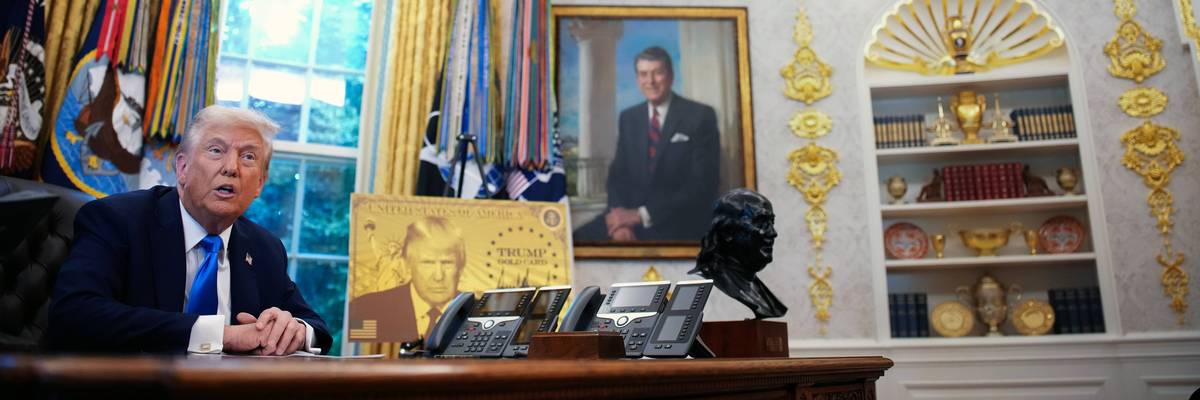
President Donald Trump delivers remarks alongside a poster of the "Trump Gold Card" before signing an executive order in the Oval Office at the White House on September 19, 2025 in Washington, DC.
Progressives Say 'Affordability' and Trump's Corruption Are Key, Symbiotic Issues for Democrats in 2026
"Trump and his regime have made corruption impossible to ignore, so Democrats should connect the administration’s self-dealing and abuses of power to the economic pressures voters are feeling."
Two leading progressive organizers on Tuesday argued that Democratic candidates don't need to choose between campaigning on affordability issues or against President Donald Trump's unprecedented corruption.
Ezra Levin and Leah Greenberg, co-executive directors of Indivisible, wrote in an op-ed published by The Guardian that a recent survey conducted with Lake Research Partners finds that the issues of affordability and government corruption are deeply intertwined.
"Affordability is essential," wrote Levin and Greenberg, "but our polling shows that the case for lowering costs becomes more compelling when paired with a clear commitment to take on corruption and special interests."
The reason for this, the organizers said, is that majorities of Americans are concerned about politicians rigging the political system to benefit themselves and about corruption costing taxpayers money.
Additionally, wrote Levin and Greenberg, vows to lower costs are more credible with voters when they come with concrete plans to take on corrupt corporate interests that are blamed for gouging consumers.
On top of that, they argued, "Trump and his regime have made corruption impossible to ignore, so Democrats should connect the administration’s self-dealing and abuses of power to the economic pressures voters are feeling."
In sum, the organizers emphasized that combining messages about affordability and corruption is "more persuasive than either message alone."
The Indivisible leaders' arguments echo those made by Dustin Guastella, director of operations for Teamsters Local 623 in Philadelphia, and Erica Etelson, president of the Rural Urban Bridge Initiative, who advocated for what they described as "kitchen-table populism" in an op-ed published in The Guardian last month.
Like Indivisible, Guastella and Etelson's organizations commissioned a poll conducted by Verasight testing progressive messages for the 2026 midterms, and came away with similar conclusions.
"The top-performing messages we tested have a simple formula," they wrote. "They promise to bring costs down, make the biggest corporations pay their fair share, and crack down on the people who game the system. Ultimately, they tell a simple story: Hard work should pay off."
With midterm elections less than two months away, there are signs of wide dissatisfaction with the state of the US economy.
Elections analyst Charlie Cook told The New Republic in an interview published Tuesday that he's seeing data indicating that worries about the economy are giving Democrats openings in places that would have once been solidly Republican.
The biggest driver of this economic anxiety, said Cook, appears to be Trump's illegal war with Iran, both because it broke a key 2024 campaign promise about no new wars in the Middle East, and because it has raised the price of countless consumer goods, including diesel fuel and fertilizer, which are both vitally important for US farmers.
“I mean, you take Iran—after promising no more wars and all that—but fuel, fertilizer, no more wars, you take tariffs,” Cook said, “and all this goes to the heart of his base, of, you know, small-town, rural, farm, all of that.”
“To have the people that are generally the most enthusiastic for you uniquely hurt,” Cook added, “now, that’s new territory.”
We are at a crossroads
This country and this world are at a monumental crossroads. In a few short weeks, US voters will have an opportunity to beat back the forces of fascism and confront the billionaires who are rigging the economy, our media system, and our democracy, making it increasingly impossible for ordinary people to get by. We’re not just talking about the election. We’re talking about what must be done once these fascist elements are vanquished from power. We need a bolder set of solutions than what either major party has so far been willing to offer and a working-class movement ready to fight like hell for it. Trump didn't emerge from nowhere. The conditions that fueled MAGA authoritarianism were created by decades of radical neoliberal economic policies and a corrupt political system dominated by corporate interests. They slashed taxes on the super-rich, promising that the benefits would trickle down. They said giveaways to the corporate titans would make life more affordable for the rest of us. It was all bullshit. And when a bitter, betrayed populace searches for someone to blame, right-wing demagogues have little trouble finding scapegoats. People know when they're being lied to, but you won't hear any of this from the corporate media. Only independent journalism—powered and funded by people who believe in building a better world—can deliver truly trustworthy daily news. Our Fall Campaign is underway, and we need your help. To power our newsroom through the rest of the year, we need to raise $125,000 by midnight on October 31. So if you share our vision, please contribute whatever you can to sustain our work. |
Two leading progressive organizers on Tuesday argued that Democratic candidates don't need to choose between campaigning on affordability issues or against President Donald Trump's unprecedented corruption.
Ezra Levin and Leah Greenberg, co-executive directors of Indivisible, wrote in an op-ed published by The Guardian that a recent survey conducted with Lake Research Partners finds that the issues of affordability and government corruption are deeply intertwined.
"Affordability is essential," wrote Levin and Greenberg, "but our polling shows that the case for lowering costs becomes more compelling when paired with a clear commitment to take on corruption and special interests."
The reason for this, the organizers said, is that majorities of Americans are concerned about politicians rigging the political system to benefit themselves and about corruption costing taxpayers money.
Additionally, wrote Levin and Greenberg, vows to lower costs are more credible with voters when they come with concrete plans to take on corrupt corporate interests that are blamed for gouging consumers.
On top of that, they argued, "Trump and his regime have made corruption impossible to ignore, so Democrats should connect the administration’s self-dealing and abuses of power to the economic pressures voters are feeling."
In sum, the organizers emphasized that combining messages about affordability and corruption is "more persuasive than either message alone."
The Indivisible leaders' arguments echo those made by Dustin Guastella, director of operations for Teamsters Local 623 in Philadelphia, and Erica Etelson, president of the Rural Urban Bridge Initiative, who advocated for what they described as "kitchen-table populism" in an op-ed published in The Guardian last month.
Like Indivisible, Guastella and Etelson's organizations commissioned a poll conducted by Verasight testing progressive messages for the 2026 midterms, and came away with similar conclusions.
"The top-performing messages we tested have a simple formula," they wrote. "They promise to bring costs down, make the biggest corporations pay their fair share, and crack down on the people who game the system. Ultimately, they tell a simple story: Hard work should pay off."
With midterm elections less than two months away, there are signs of wide dissatisfaction with the state of the US economy.
Elections analyst Charlie Cook told The New Republic in an interview published Tuesday that he's seeing data indicating that worries about the economy are giving Democrats openings in places that would have once been solidly Republican.
The biggest driver of this economic anxiety, said Cook, appears to be Trump's illegal war with Iran, both because it broke a key 2024 campaign promise about no new wars in the Middle East, and because it has raised the price of countless consumer goods, including diesel fuel and fertilizer, which are both vitally important for US farmers.
“I mean, you take Iran—after promising no more wars and all that—but fuel, fertilizer, no more wars, you take tariffs,” Cook said, “and all this goes to the heart of his base, of, you know, small-town, rural, farm, all of that.”
“To have the people that are generally the most enthusiastic for you uniquely hurt,” Cook added, “now, that’s new territory.”
- House Progressives Launch New Effort to Rally Working Class for Electoral Wins in 2026 ›
- Democrats’ Affordability Message Misses a Key Expense—Student Debt ›
- Over 80% of All US Voters Support Ending Dark Money’s Grip on Democracy ›
- Opinion | The One Issue the Midterm Victors Must Solve? Corruption | Common Dreams ›
Two leading progressive organizers on Tuesday argued that Democratic candidates don't need to choose between campaigning on affordability issues or against President Donald Trump's unprecedented corruption.
Ezra Levin and Leah Greenberg, co-executive directors of Indivisible, wrote in an op-ed published by The Guardian that a recent survey conducted with Lake Research Partners finds that the issues of affordability and government corruption are deeply intertwined.
"Affordability is essential," wrote Levin and Greenberg, "but our polling shows that the case for lowering costs becomes more compelling when paired with a clear commitment to take on corruption and special interests."
The reason for this, the organizers said, is that majorities of Americans are concerned about politicians rigging the political system to benefit themselves and about corruption costing taxpayers money.
Additionally, wrote Levin and Greenberg, vows to lower costs are more credible with voters when they come with concrete plans to take on corrupt corporate interests that are blamed for gouging consumers.
On top of that, they argued, "Trump and his regime have made corruption impossible to ignore, so Democrats should connect the administration’s self-dealing and abuses of power to the economic pressures voters are feeling."
In sum, the organizers emphasized that combining messages about affordability and corruption is "more persuasive than either message alone."
The Indivisible leaders' arguments echo those made by Dustin Guastella, director of operations for Teamsters Local 623 in Philadelphia, and Erica Etelson, president of the Rural Urban Bridge Initiative, who advocated for what they described as "kitchen-table populism" in an op-ed published in The Guardian last month.
Like Indivisible, Guastella and Etelson's organizations commissioned a poll conducted by Verasight testing progressive messages for the 2026 midterms, and came away with similar conclusions.
"The top-performing messages we tested have a simple formula," they wrote. "They promise to bring costs down, make the biggest corporations pay their fair share, and crack down on the people who game the system. Ultimately, they tell a simple story: Hard work should pay off."
With midterm elections less than two months away, there are signs of wide dissatisfaction with the state of the US economy.
Elections analyst Charlie Cook told The New Republic in an interview published Tuesday that he's seeing data indicating that worries about the economy are giving Democrats openings in places that would have once been solidly Republican.
The biggest driver of this economic anxiety, said Cook, appears to be Trump's illegal war with Iran, both because it broke a key 2024 campaign promise about no new wars in the Middle East, and because it has raised the price of countless consumer goods, including diesel fuel and fertilizer, which are both vitally important for US farmers.
“I mean, you take Iran—after promising no more wars and all that—but fuel, fertilizer, no more wars, you take tariffs,” Cook said, “and all this goes to the heart of his base, of, you know, small-town, rural, farm, all of that.”
“To have the people that are generally the most enthusiastic for you uniquely hurt,” Cook added, “now, that’s new territory.”
- House Progressives Launch New Effort to Rally Working Class for Electoral Wins in 2026 ›
- Democrats’ Affordability Message Misses a Key Expense—Student Debt ›
- Over 80% of All US Voters Support Ending Dark Money’s Grip on Democracy ›
- Opinion | The One Issue the Midterm Victors Must Solve? Corruption | Common Dreams ›