SUBSCRIBE TO OUR FREE NEWSLETTER
Daily news & progressive opinion—funded by the people, not the corporations—delivered straight to your inbox.
5
#000000
#FFFFFF
To donate by check, phone, or other method, see our More Ways to Give page.
Daily news & progressive opinion—funded by the people, not the corporations—delivered straight to your inbox.
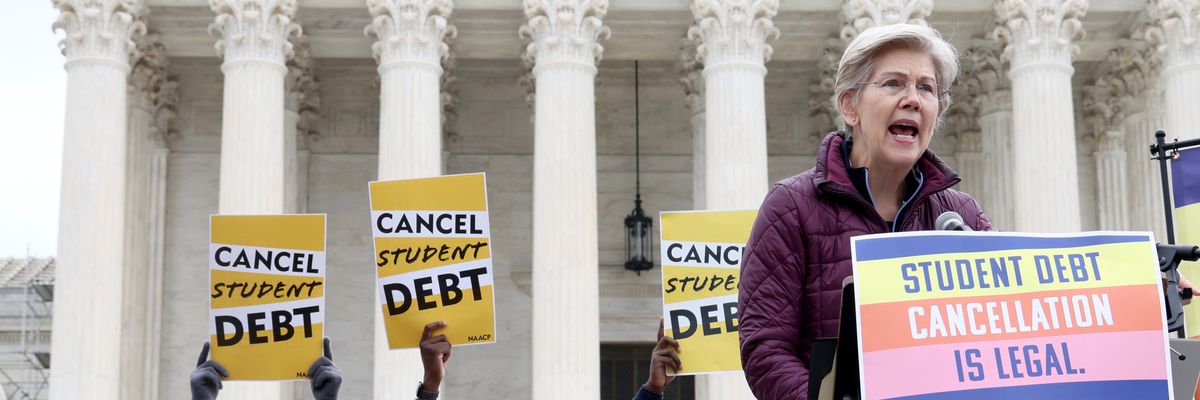
U.S. Sen. Elizabeth Warren (D-Mass.) speaks as student loan borrowers and advocates gather for a rally on February 28, 2023 in Washington, D.C.
"We are concerned that the latest draft of the rule would fall far short of providing the full scale of debt relief that low- and middle-income Americans urgently need."
Seven members of Congress on Monday sounded the alarm about the Biden administration's evolving student debt cancellation plan and called on U.S. Secretary of Education Miguel Cardona to use his authority to provide broad relief.
After the right-wing U.S. Supreme Court in June struck down President Joe Biden's initial debt relief plan—designed to cancel up to $20,000 per federal borrower—the administration launched a negotiated rulemaking process to establish an alternative plan under the Higher Education Act (HEA) of 1965.
The committee responsible for crafting the rule "has met several times already, but its final round of talks began on Monday and will continue through Tuesday," reported USA Today. "Frustrations arose almost immediately. Committee members expressed disappointment in the department's latest forgiveness proposal, released last week, which many said doesn't go far enough in its current form to address the issues they've spent months debating."
U.S. Senate Majority Leader Chuck Schumer (D-N.Y.), Sens. Alex Padilla (D-Calif.), Bernie Sanders (I-Vt.), and Elizabeth Warren (D-Mass.), and Reps. Ilhan Omar (D-Minn.), Ayanna Pressley (D-Mass.), and Frederica Wilson (D-Fla.) are also unsatisfied with the draft, as they made clear Monday in a letter to Cardona.
"This regulation has the potential to improve the financial security of tens of millions of hard-working Americans who are currently trapped by crushing student debt," the lawmakers noted. "However, we are concerned that the latest draft of the rule would fall far short of providing the full scale of debt relief that low- and middle-income Americans urgently need."
The letter explains that under the draft, only four groups would be eligible for relief: "(1) borrowers with outstanding federal student loan balances that exceed their original principal balance, due to interest; (2) borrowers with loans that have been in repayment for over 20 or 25 years; (3) borrowers who are eligible for forgiveness under an enumerated repayment plan or loan program but have not enrolled; and (4) certain borrowers who took on loans to attend programs that provide insufficient financial value, lost Title IV eligibility, or were found to have committed misconduct."
The U.S. Education Department (ED) "has also released an issue paper indicating the potential need for the rule to address a fifth category: 'those experiencing hardship that is not otherwise addressed by the existing student loan system,'" the letter notes.
The HEA empowers Cardona to "enforce, pay, compromise, waive, or release" federal student loans. The lawmakers pressured him "to leverage this authority to its fullest extent, maximizing relief for the greatest number of borrowers facing financial hardship," highlighting that 43.6 million borrowers "collectively owe an astronomical $1.65 trillion."
"As we lend our support to your diligent efforts to provide debt relief through regulatory procedures, we urge you to consider several recommendations to strengthen the department's debt relief rule," the lawmakers wrote, detailing six proposals:
"We are encouraged by the department's critical efforts to provide student debt relief through negotiated rulemaking. However, we believe more must be done to improve the draft regulatory text," the letter concludes. "The Biden administration should take every
opportunity to use the authority Congress has already given it to deliver on the promises made to student loan borrowers."
Acknowledging the letter on the Senate floor Monday, Schumer declared that "following the Supreme Court's cruel, abrupt blocking of student debt relief, too many borrowers—too many—remain saddled with massive—in many cases, unbearable—amounts of debt. We can and we must do more to help these borrowers."
After being paused throughout the Covid-19 pandemic and the legal battle over Biden's first debt relief proposal, student loan repayments resumed in October. Since the high court's ruling, federal borrowers across the country have pushed the president to continue pursuing sweeping debt cancellation.
"An Education Department spokesperson said the agency had received the letter, is reviewing it, and welcomes the input from lawmakers," according to Politico.
"The Biden-Harris administration is proud of our record of providing relief to borrowers as we work to fix the broken student loan system," the spokesperson said in a statement. "This rulemaking process is about standing up for borrowers who've been failed by the country's broken student loan system and creating new regulations that will reduce the burden of student debt in this country."
Dear Common Dreams reader, It’s been nearly 30 years since I co-founded Common Dreams with my late wife, Lina Newhouser. We had the radical notion that journalism should serve the public good, not corporate profits. It was clear to us from the outset what it would take to build such a project. No paid advertisements. No corporate sponsors. No millionaire publisher telling us what to think or do. Many people said we wouldn't last a year, but we proved those doubters wrong. Together with a tremendous team of journalists and dedicated staff, we built an independent media outlet free from the constraints of profits and corporate control. Our mission has always been simple: To inform. To inspire. To ignite change for the common good. Building Common Dreams was not easy. Our survival was never guaranteed. When you take on the most powerful forces—Wall Street greed, fossil fuel industry destruction, Big Tech lobbyists, and uber-rich oligarchs who have spent billions upon billions rigging the economy and democracy in their favor—the only bulwark you have is supporters who believe in your work. But here’s the urgent message from me today. It's never been this bad out there. And it's never been this hard to keep us going. At the very moment Common Dreams is most needed, the threats we face are intensifying. We need your support now more than ever. We don't accept corporate advertising and never will. We don't have a paywall because we don't think people should be blocked from critical news based on their ability to pay. Everything we do is funded by the donations of readers like you. When everyone does the little they can afford, we are strong. But if that support retreats or dries up, so do we. Will you donate now to make sure Common Dreams not only survives but thrives? —Craig Brown, Co-founder |
Seven members of Congress on Monday sounded the alarm about the Biden administration's evolving student debt cancellation plan and called on U.S. Secretary of Education Miguel Cardona to use his authority to provide broad relief.
After the right-wing U.S. Supreme Court in June struck down President Joe Biden's initial debt relief plan—designed to cancel up to $20,000 per federal borrower—the administration launched a negotiated rulemaking process to establish an alternative plan under the Higher Education Act (HEA) of 1965.
The committee responsible for crafting the rule "has met several times already, but its final round of talks began on Monday and will continue through Tuesday," reported USA Today. "Frustrations arose almost immediately. Committee members expressed disappointment in the department's latest forgiveness proposal, released last week, which many said doesn't go far enough in its current form to address the issues they've spent months debating."
U.S. Senate Majority Leader Chuck Schumer (D-N.Y.), Sens. Alex Padilla (D-Calif.), Bernie Sanders (I-Vt.), and Elizabeth Warren (D-Mass.), and Reps. Ilhan Omar (D-Minn.), Ayanna Pressley (D-Mass.), and Frederica Wilson (D-Fla.) are also unsatisfied with the draft, as they made clear Monday in a letter to Cardona.
"This regulation has the potential to improve the financial security of tens of millions of hard-working Americans who are currently trapped by crushing student debt," the lawmakers noted. "However, we are concerned that the latest draft of the rule would fall far short of providing the full scale of debt relief that low- and middle-income Americans urgently need."
The letter explains that under the draft, only four groups would be eligible for relief: "(1) borrowers with outstanding federal student loan balances that exceed their original principal balance, due to interest; (2) borrowers with loans that have been in repayment for over 20 or 25 years; (3) borrowers who are eligible for forgiveness under an enumerated repayment plan or loan program but have not enrolled; and (4) certain borrowers who took on loans to attend programs that provide insufficient financial value, lost Title IV eligibility, or were found to have committed misconduct."
The U.S. Education Department (ED) "has also released an issue paper indicating the potential need for the rule to address a fifth category: 'those experiencing hardship that is not otherwise addressed by the existing student loan system,'" the letter notes.
The HEA empowers Cardona to "enforce, pay, compromise, waive, or release" federal student loans. The lawmakers pressured him "to leverage this authority to its fullest extent, maximizing relief for the greatest number of borrowers facing financial hardship," highlighting that 43.6 million borrowers "collectively owe an astronomical $1.65 trillion."
"As we lend our support to your diligent efforts to provide debt relief through regulatory procedures, we urge you to consider several recommendations to strengthen the department's debt relief rule," the lawmakers wrote, detailing six proposals:
"We are encouraged by the department's critical efforts to provide student debt relief through negotiated rulemaking. However, we believe more must be done to improve the draft regulatory text," the letter concludes. "The Biden administration should take every
opportunity to use the authority Congress has already given it to deliver on the promises made to student loan borrowers."
Acknowledging the letter on the Senate floor Monday, Schumer declared that "following the Supreme Court's cruel, abrupt blocking of student debt relief, too many borrowers—too many—remain saddled with massive—in many cases, unbearable—amounts of debt. We can and we must do more to help these borrowers."
After being paused throughout the Covid-19 pandemic and the legal battle over Biden's first debt relief proposal, student loan repayments resumed in October. Since the high court's ruling, federal borrowers across the country have pushed the president to continue pursuing sweeping debt cancellation.
"An Education Department spokesperson said the agency had received the letter, is reviewing it, and welcomes the input from lawmakers," according to Politico.
"The Biden-Harris administration is proud of our record of providing relief to borrowers as we work to fix the broken student loan system," the spokesperson said in a statement. "This rulemaking process is about standing up for borrowers who've been failed by the country's broken student loan system and creating new regulations that will reduce the burden of student debt in this country."
Seven members of Congress on Monday sounded the alarm about the Biden administration's evolving student debt cancellation plan and called on U.S. Secretary of Education Miguel Cardona to use his authority to provide broad relief.
After the right-wing U.S. Supreme Court in June struck down President Joe Biden's initial debt relief plan—designed to cancel up to $20,000 per federal borrower—the administration launched a negotiated rulemaking process to establish an alternative plan under the Higher Education Act (HEA) of 1965.
The committee responsible for crafting the rule "has met several times already, but its final round of talks began on Monday and will continue through Tuesday," reported USA Today. "Frustrations arose almost immediately. Committee members expressed disappointment in the department's latest forgiveness proposal, released last week, which many said doesn't go far enough in its current form to address the issues they've spent months debating."
U.S. Senate Majority Leader Chuck Schumer (D-N.Y.), Sens. Alex Padilla (D-Calif.), Bernie Sanders (I-Vt.), and Elizabeth Warren (D-Mass.), and Reps. Ilhan Omar (D-Minn.), Ayanna Pressley (D-Mass.), and Frederica Wilson (D-Fla.) are also unsatisfied with the draft, as they made clear Monday in a letter to Cardona.
"This regulation has the potential to improve the financial security of tens of millions of hard-working Americans who are currently trapped by crushing student debt," the lawmakers noted. "However, we are concerned that the latest draft of the rule would fall far short of providing the full scale of debt relief that low- and middle-income Americans urgently need."
The letter explains that under the draft, only four groups would be eligible for relief: "(1) borrowers with outstanding federal student loan balances that exceed their original principal balance, due to interest; (2) borrowers with loans that have been in repayment for over 20 or 25 years; (3) borrowers who are eligible for forgiveness under an enumerated repayment plan or loan program but have not enrolled; and (4) certain borrowers who took on loans to attend programs that provide insufficient financial value, lost Title IV eligibility, or were found to have committed misconduct."
The U.S. Education Department (ED) "has also released an issue paper indicating the potential need for the rule to address a fifth category: 'those experiencing hardship that is not otherwise addressed by the existing student loan system,'" the letter notes.
The HEA empowers Cardona to "enforce, pay, compromise, waive, or release" federal student loans. The lawmakers pressured him "to leverage this authority to its fullest extent, maximizing relief for the greatest number of borrowers facing financial hardship," highlighting that 43.6 million borrowers "collectively owe an astronomical $1.65 trillion."
"As we lend our support to your diligent efforts to provide debt relief through regulatory procedures, we urge you to consider several recommendations to strengthen the department's debt relief rule," the lawmakers wrote, detailing six proposals:
"We are encouraged by the department's critical efforts to provide student debt relief through negotiated rulemaking. However, we believe more must be done to improve the draft regulatory text," the letter concludes. "The Biden administration should take every
opportunity to use the authority Congress has already given it to deliver on the promises made to student loan borrowers."
Acknowledging the letter on the Senate floor Monday, Schumer declared that "following the Supreme Court's cruel, abrupt blocking of student debt relief, too many borrowers—too many—remain saddled with massive—in many cases, unbearable—amounts of debt. We can and we must do more to help these borrowers."
After being paused throughout the Covid-19 pandemic and the legal battle over Biden's first debt relief proposal, student loan repayments resumed in October. Since the high court's ruling, federal borrowers across the country have pushed the president to continue pursuing sweeping debt cancellation.
"An Education Department spokesperson said the agency had received the letter, is reviewing it, and welcomes the input from lawmakers," according to Politico.
"The Biden-Harris administration is proud of our record of providing relief to borrowers as we work to fix the broken student loan system," the spokesperson said in a statement. "This rulemaking process is about standing up for borrowers who've been failed by the country's broken student loan system and creating new regulations that will reduce the burden of student debt in this country."