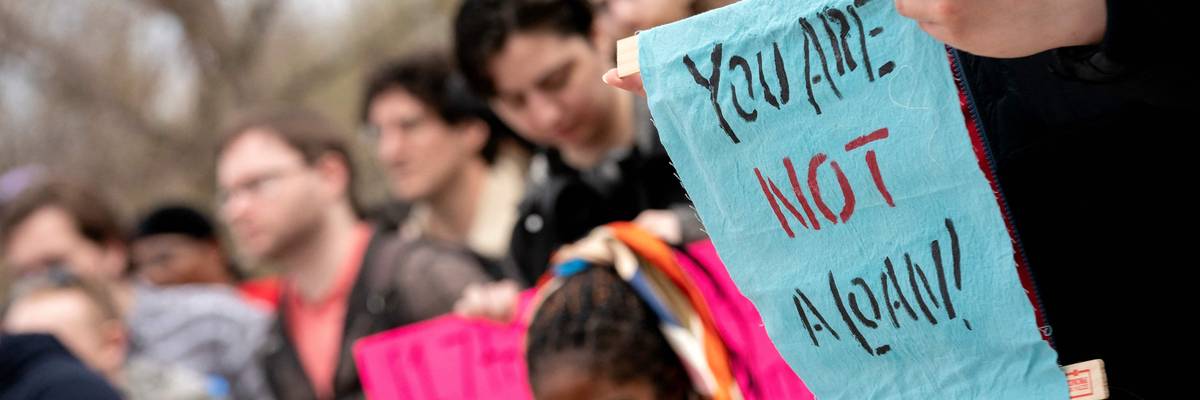
People hold signs during a Cancel Student Debt rally outside the U.S. Department of Education in Washington, DC, on April 4, 2022.
Advocates Warn GOP Just Unveiled 'Most Dangerous Higher Ed Bill in US History'
"This is the boldest attempt we've seen in recent history to segregate higher education along racial and class lines," said the Debt Collective.
At a markup session held by a U.S. House committee on the Republican Party's recently unveiled higher education reform bill Tuesday, one Democratic lawmaker had a succinct description for the legislation.
"This bill is a dream-killer," said Rep. Suzanne Bonamici (D-Ore.) of the so-called Student Success and Taxpayer Savings Plan, which was introduced by Education and Workforce Committee Chairman Tim Walberg (R-Mich.) as part of an effort to find $330 billion in education programs to offset President Donald Trump's tax plan.
Tasked with helping to make $4.5 trillion in tax cuts for the wealthiest Americans possible, Walberg on Monday proposed changes to the Pell Grant program, which has provided financial aid to more than 80 million low-income students since it began in 1972. The bill would allocate more funding to the program but would also reduce the number of students who are eligible for the grants, changing the definition of a "full-time" student to one enrolled in at least 30 semester hours each academic year—up from 12 hours. Students would be cut off from the financial assistance entirely if they are enrolled less than six hours per semester.
David Baime, senior vice president for government relations for the American Association of Community Colleges, suggested the legislation doesn't account for the realities faced by many students who benefit from Pell Grants.
"These students are almost always working a substantial number of hours each week and often have family responsibilities. Pell Grants help them meet the cost of tuition and required fees," Baime told Inside Higher Ed. "We commend the committee for identifying substantial additional resources to help finance Pell, but it should not come at the cost of undermining the ability of low-income working students to enroll at a community college."
The draft bill would also end subsidized loans, which don't accrue interest when a student is still in college and gives borrowers a six-month grace period after graduation, starting in July 2026. More than 30 million borrowers currently have subsidized loans.
The proposal would also reduce the number of student loan repayment options from those offered by the Biden administration to just two, with borrowers given the option for a fixed monthly amount paid over a certain period of time or an income-based plan.
At the markup session on Tuesday, Bonamici pointed to her own experience of paying for college and law school "through a combination of grants and loans and work study and food stamps," and noted that her Republican colleagues on the committee also "graduated from college."
"And more than half of them have gone on to earn advanced degrees," said the congresswoman. "And yet those same individuals who benefited so much from accessing higher education are supporting a bill that will prevent others from doing so."
“In a time when higher ed is being attacked, this bill is another assault,” @RepBonamici calls out committee leaders for wanting to gut financial aid.
“With this bill, they will be taking that opportunity [of higher ed] away from others. This bill is a dream killer.” pic.twitter.com/UjTYvnOEKv
— Student Borrower Protection Center (@theSBPC) April 29, 2025
Democrats on the committee also spoke out against provisions that would cap loans a student can take out for graduate programs at $100,000; the Grad PLUS program has allowed students to borrow up to the cost of attendance.
The Parent PLUS program, which has been found to provide crucial help to Black families accessing higher education, would also be restricted.
"Black students, brown students, first-generation college students, first-generation Americans, will not have access to college," said Rep. Summer Lee (D-Pa.).
“We cannot take away access to loans, and not replace it with anything else, not make the system better. We know the outcome here—Black, brown, and poor students will not figure it out. Instead, only elite students from the 1% will continue to access education.”@RepSummerLee🙇 pic.twitter.com/oGbRH154Ed
— Student Borrower Protection Center (@theSBPC) April 29, 2025
As the Student Borrower Protection Center (SBPC) warned last week, eliminating the Grad PLUS program without also lowering the cost of graduate programs would "subject millions of future borrowers to an unregulated and predatory private student loan market, while doing little to reduce overall student debt and the need to borrow."
Aissa Canchola Bañez, policy director for SBPC, told The Hill that the draft bill is "an attack on students and working families with student loan debt."
"We've seen an array of really problematic proposals that are on the table for congressional Republicans," Canchola Bañez said. "Many of these would cause massive spikes for families with monthly student loan payments."
With the proposal, which Republicans hope to pass through reconciliation with a simple majority, the party would be "restructuring higher education for the worse," said the Debt Collective.
"It's the most dangerous higher ed bill in U.S. history," said the student loan borrowers union. "It strips the Department of Education of virtually every authority to cancel student debt. Eliminates every repayment program. Abolishes subsidized loans."
"This is the boldest attempt we've seen in recent history to segregate higher education along racial and class lines," the group added. "We have to push back."
We are at a crossroads
This country and this world are at a monumental crossroads. In a few short weeks, US voters will have an opportunity to beat back the forces of fascism and confront the billionaires who are rigging the economy, our media system, and our democracy, making it increasingly impossible for ordinary people to get by. We’re not just talking about the election. We’re talking about what must be done once these fascist elements are vanquished from power. We need a bolder set of solutions than what either major party has so far been willing to offer and a working-class movement ready to fight like hell for it. Trump didn't emerge from nowhere. The conditions that fueled MAGA authoritarianism were created by decades of radical neoliberal economic policies and a corrupt political system dominated by corporate interests. They slashed taxes on the super-rich, promising that the benefits would trickle down. They said giveaways to the corporate titans would make life more affordable for the rest of us. It was all bullshit. And when a bitter, betrayed populace searches for someone to blame, right-wing demagogues have little trouble finding scapegoats. People know when they're being lied to, but you won't hear any of this from the corporate media. Only independent journalism—powered and funded by people who believe in building a better world—can deliver truly trustworthy daily news. Our Fall Campaign is underway, and we need your help. To power our newsroom through the rest of the year, we need to raise $125,000 by midnight on October 31. So if you share our vision, please contribute whatever you can to sustain our work. |
At a markup session held by a U.S. House committee on the Republican Party's recently unveiled higher education reform bill Tuesday, one Democratic lawmaker had a succinct description for the legislation.
"This bill is a dream-killer," said Rep. Suzanne Bonamici (D-Ore.) of the so-called Student Success and Taxpayer Savings Plan, which was introduced by Education and Workforce Committee Chairman Tim Walberg (R-Mich.) as part of an effort to find $330 billion in education programs to offset President Donald Trump's tax plan.
Tasked with helping to make $4.5 trillion in tax cuts for the wealthiest Americans possible, Walberg on Monday proposed changes to the Pell Grant program, which has provided financial aid to more than 80 million low-income students since it began in 1972. The bill would allocate more funding to the program but would also reduce the number of students who are eligible for the grants, changing the definition of a "full-time" student to one enrolled in at least 30 semester hours each academic year—up from 12 hours. Students would be cut off from the financial assistance entirely if they are enrolled less than six hours per semester.
David Baime, senior vice president for government relations for the American Association of Community Colleges, suggested the legislation doesn't account for the realities faced by many students who benefit from Pell Grants.
"These students are almost always working a substantial number of hours each week and often have family responsibilities. Pell Grants help them meet the cost of tuition and required fees," Baime told Inside Higher Ed. "We commend the committee for identifying substantial additional resources to help finance Pell, but it should not come at the cost of undermining the ability of low-income working students to enroll at a community college."
The draft bill would also end subsidized loans, which don't accrue interest when a student is still in college and gives borrowers a six-month grace period after graduation, starting in July 2026. More than 30 million borrowers currently have subsidized loans.
The proposal would also reduce the number of student loan repayment options from those offered by the Biden administration to just two, with borrowers given the option for a fixed monthly amount paid over a certain period of time or an income-based plan.
At the markup session on Tuesday, Bonamici pointed to her own experience of paying for college and law school "through a combination of grants and loans and work study and food stamps," and noted that her Republican colleagues on the committee also "graduated from college."
"And more than half of them have gone on to earn advanced degrees," said the congresswoman. "And yet those same individuals who benefited so much from accessing higher education are supporting a bill that will prevent others from doing so."
“In a time when higher ed is being attacked, this bill is another assault,” @RepBonamici calls out committee leaders for wanting to gut financial aid.
“With this bill, they will be taking that opportunity [of higher ed] away from others. This bill is a dream killer.” pic.twitter.com/UjTYvnOEKv
— Student Borrower Protection Center (@theSBPC) April 29, 2025
Democrats on the committee also spoke out against provisions that would cap loans a student can take out for graduate programs at $100,000; the Grad PLUS program has allowed students to borrow up to the cost of attendance.
The Parent PLUS program, which has been found to provide crucial help to Black families accessing higher education, would also be restricted.
"Black students, brown students, first-generation college students, first-generation Americans, will not have access to college," said Rep. Summer Lee (D-Pa.).
“We cannot take away access to loans, and not replace it with anything else, not make the system better. We know the outcome here—Black, brown, and poor students will not figure it out. Instead, only elite students from the 1% will continue to access education.”@RepSummerLee🙇 pic.twitter.com/oGbRH154Ed
— Student Borrower Protection Center (@theSBPC) April 29, 2025
As the Student Borrower Protection Center (SBPC) warned last week, eliminating the Grad PLUS program without also lowering the cost of graduate programs would "subject millions of future borrowers to an unregulated and predatory private student loan market, while doing little to reduce overall student debt and the need to borrow."
Aissa Canchola Bañez, policy director for SBPC, told The Hill that the draft bill is "an attack on students and working families with student loan debt."
"We've seen an array of really problematic proposals that are on the table for congressional Republicans," Canchola Bañez said. "Many of these would cause massive spikes for families with monthly student loan payments."
With the proposal, which Republicans hope to pass through reconciliation with a simple majority, the party would be "restructuring higher education for the worse," said the Debt Collective.
"It's the most dangerous higher ed bill in U.S. history," said the student loan borrowers union. "It strips the Department of Education of virtually every authority to cancel student debt. Eliminates every repayment program. Abolishes subsidized loans."
"This is the boldest attempt we've seen in recent history to segregate higher education along racial and class lines," the group added. "We have to push back."
- 'Crystal Clear' Polling Shows Voters Oppose Trump's Tax Cuts for Rich ›
- Opinion | Democrats’ Affordability Message Misses a Key Expense—Student Debt | Common Dreams ›
At a markup session held by a U.S. House committee on the Republican Party's recently unveiled higher education reform bill Tuesday, one Democratic lawmaker had a succinct description for the legislation.
"This bill is a dream-killer," said Rep. Suzanne Bonamici (D-Ore.) of the so-called Student Success and Taxpayer Savings Plan, which was introduced by Education and Workforce Committee Chairman Tim Walberg (R-Mich.) as part of an effort to find $330 billion in education programs to offset President Donald Trump's tax plan.
Tasked with helping to make $4.5 trillion in tax cuts for the wealthiest Americans possible, Walberg on Monday proposed changes to the Pell Grant program, which has provided financial aid to more than 80 million low-income students since it began in 1972. The bill would allocate more funding to the program but would also reduce the number of students who are eligible for the grants, changing the definition of a "full-time" student to one enrolled in at least 30 semester hours each academic year—up from 12 hours. Students would be cut off from the financial assistance entirely if they are enrolled less than six hours per semester.
David Baime, senior vice president for government relations for the American Association of Community Colleges, suggested the legislation doesn't account for the realities faced by many students who benefit from Pell Grants.
"These students are almost always working a substantial number of hours each week and often have family responsibilities. Pell Grants help them meet the cost of tuition and required fees," Baime told Inside Higher Ed. "We commend the committee for identifying substantial additional resources to help finance Pell, but it should not come at the cost of undermining the ability of low-income working students to enroll at a community college."
The draft bill would also end subsidized loans, which don't accrue interest when a student is still in college and gives borrowers a six-month grace period after graduation, starting in July 2026. More than 30 million borrowers currently have subsidized loans.
The proposal would also reduce the number of student loan repayment options from those offered by the Biden administration to just two, with borrowers given the option for a fixed monthly amount paid over a certain period of time or an income-based plan.
At the markup session on Tuesday, Bonamici pointed to her own experience of paying for college and law school "through a combination of grants and loans and work study and food stamps," and noted that her Republican colleagues on the committee also "graduated from college."
"And more than half of them have gone on to earn advanced degrees," said the congresswoman. "And yet those same individuals who benefited so much from accessing higher education are supporting a bill that will prevent others from doing so."
“In a time when higher ed is being attacked, this bill is another assault,” @RepBonamici calls out committee leaders for wanting to gut financial aid.
“With this bill, they will be taking that opportunity [of higher ed] away from others. This bill is a dream killer.” pic.twitter.com/UjTYvnOEKv
— Student Borrower Protection Center (@theSBPC) April 29, 2025
Democrats on the committee also spoke out against provisions that would cap loans a student can take out for graduate programs at $100,000; the Grad PLUS program has allowed students to borrow up to the cost of attendance.
The Parent PLUS program, which has been found to provide crucial help to Black families accessing higher education, would also be restricted.
"Black students, brown students, first-generation college students, first-generation Americans, will not have access to college," said Rep. Summer Lee (D-Pa.).
“We cannot take away access to loans, and not replace it with anything else, not make the system better. We know the outcome here—Black, brown, and poor students will not figure it out. Instead, only elite students from the 1% will continue to access education.”@RepSummerLee🙇 pic.twitter.com/oGbRH154Ed
— Student Borrower Protection Center (@theSBPC) April 29, 2025
As the Student Borrower Protection Center (SBPC) warned last week, eliminating the Grad PLUS program without also lowering the cost of graduate programs would "subject millions of future borrowers to an unregulated and predatory private student loan market, while doing little to reduce overall student debt and the need to borrow."
Aissa Canchola Bañez, policy director for SBPC, told The Hill that the draft bill is "an attack on students and working families with student loan debt."
"We've seen an array of really problematic proposals that are on the table for congressional Republicans," Canchola Bañez said. "Many of these would cause massive spikes for families with monthly student loan payments."
With the proposal, which Republicans hope to pass through reconciliation with a simple majority, the party would be "restructuring higher education for the worse," said the Debt Collective.
"It's the most dangerous higher ed bill in U.S. history," said the student loan borrowers union. "It strips the Department of Education of virtually every authority to cancel student debt. Eliminates every repayment program. Abolishes subsidized loans."
"This is the boldest attempt we've seen in recent history to segregate higher education along racial and class lines," the group added. "We have to push back."
- 'Crystal Clear' Polling Shows Voters Oppose Trump's Tax Cuts for Rich ›
- Opinion | Democrats’ Affordability Message Misses a Key Expense—Student Debt | Common Dreams ›