

SUBSCRIBE TO OUR FREE NEWSLETTER
Daily news & progressive opinion—funded by the people, not the corporations—delivered straight to your inbox.
5
#000000
#FFFFFF
To donate by check, phone, or other method, see our More Ways to Give page.
Daily news & progressive opinion—funded by the people, not the corporations—delivered straight to your inbox.

Today, As You Sow released its second edition of Pesticides in the Pantry: Transparency & Risk in Food Supply Chains, a report examining the growing risk to food manufacturers posed by the use of synthetic pesticides in agricultural supply chains. The report reviews the risks of farm systems dependent on high levels of toxic pesticides, provides benchmarks for improved management practices and transparency, and ranks food manufacturers on their actions to reduce the growing risk of pesticide use.
Today, As You Sow released its second edition of Pesticides in the Pantry: Transparency & Risk in Food Supply Chains, a report examining the growing risk to food manufacturers posed by the use of synthetic pesticides in agricultural supply chains. The report reviews the risks of farm systems dependent on high levels of toxic pesticides, provides benchmarks for improved management practices and transparency, and ranks food manufacturers on their actions to reduce the growing risk of pesticide use.
The report scores 17 major U.S. food manufacturers on their performance on 28 indicators designed to measure how effectively companies are reducing pesticide risk and improving agricultural resiliency.
Several companies made new commitments to reduce pesticide risk, representing improvement compared to 2019. Out of a total possible score of 27 points: General Mills (16 points), Lamb Weston (15), Del Monte (14), and PepsiCo (14) scored the highest. Post and B&G Foods scored the lowest (0 points each) followed by J.M. Smucker (1 point).
Across the board, many more companies are now committed to advancing regenerative agriculture practices compared with 2019. Companies are increasingly considering broad climate and biodiversity impacts of agriculture and establishing commitments to reduce these harms across agricultural supply chains. Yet, problematically, companies continue to avoid addressing and accounting for pesticide use as a meaningful component of promoting agricultural resiliency.
"We are seeing some interesting new initiatives that aim to transition land to regenerative farming practices that are better for the environment, farmers, and consumers," said Christy Spees, environmental health program manager at As You Sow and the report's lead author. "At the same time, there is evidence that these efforts could be thwarted by continued use of pesticides as companies, for the most part, continue to ignore this important component of risk and resiliency."
Regenerative agriculture has become a new ESG buzzword for food companies, and it is critical for investors to be able to differentiate between corporate greenwashing and meaningful commitments to transform the ailing food production system.
Pesticides are the lynchpin of the industrial agriculture system, which is becoming increasingly fragile after decades of applying toxins to fields and crops. In the face of climate change, the system's impairments are even more pronounced. In order to truly transform food supply chains, manufacturers' investments in resilient agriculture must include mechanisms for reducing reliance on pesticides.
A growing body of scientific research connects pesticide exposures to harmful human health effects ranging from cancer, cardiovascular disease, birth and developmental defects, to liver and kidney disease, and obesity, among others. The harms of pesticide-based agriculture are also accruing across the environment -- from loss of critical pollinator species to toxic waterways. Studies demonstrate connections between pesticides in the environment and reduced biodiversity and harm to endangered species.
"Investors expect companies to be planning for the future and preparing for the effects of climate change," said Danielle Fugere, As You Sow's president and a contributor to the report. "For food companies, climate resilience requires investing in agricultural systems that restore ecosystems and soil health and dramatically reduce the use of toxic chemicals."
The report identifies alternative solutions to support farmers in transitioning away from chemical-dependent farming systems. Certified organic farming, integrated pest management, and regenerative agriculture can be successful approaches to the problems associated with pesticide-dependent farming methods. Importantly, the report also outlines necessary reporting components of such strategies to delineate between empty commitments and meaningful progress.
As You Sow is the nation's non-profit leader in shareholder advocacy. Founded in 1992, we harness shareholder power to create lasting change that benefits people, planet, and profit. Our mission is to promote environmental and social corporate responsibility through shareholder advocacy, coalition building, and innovative legal strategies.

"Trump has turned Venezuela into an effective US colony," said one critic.
Some critics of the Trump administration are reacting with horror to revelations that US Secretary of State Marco Rubio has been serving as the de facto ruler of Venezuela.
According to a Saturday report in The New York Times, Rubio for the last several months has been acting informally as the "viceroy" of Venezuela ever since its recognized president, Nicolás Maduro, was abducted by the American military in January and brought to the US to face charges related to "narco-terrorism."
The Times' sources revealed that Rubio "effectively controls Venezuela’s finances, the distribution of its natural resources, and its government" and "is deeply involved in the country’s day-to-day operations," while maintaining regular contact with acting Venezuelan President Delcy Rodríguez.
Under current arrangements, the US Treasury Department takes in revenue from Venezuela's exports, including its petroleum, and then disperses the money back to the country through its private banks with strict conditions set by Rubio over what it can be spent on.
In explaining the system, the Times likened it to "parents handing out allowances to children," adding that it gives Rubio "immense leverage over... Rodríguez, who depends on the money to pay workers and prop up the national currency."
Elizabeth Saunders, professor of political science at Columbia University, described Rubio's power over Venezuela as "insane," as well as "derelict, unconscionable, and impeachable."
"The secretary of state's time is scarce, valuable, and not outsourcable," Saunders emphasized.
Orlando J. Pérez, professor of Political Science at the University of North Texas at Dallas, said the Times report made a mockery of Rubio's professed claims to want to bring democracy back to Venezuela.
"It appears Rubio has transformed from democracy promotion warrior," Pérez commented, "to transactional realpolitik operative!"
Kenneth Roth, former executive director at Human Rights Watch, wrote that US control over Venezuela appeared similar to the kind of imperial power wielded by European nations in the 19th Century.
"Trump has turned Venezuela into an effective US colony," said Roth, "with Marco Rubio as the viceroy and Washington controlling the country’s oil revenue and dictating major foreign and domestic policies. Democracy has been relegated to the distant future."
Bradley Simpson, historian at the University of Connecticut, also saw the current US arrangement with Venezuela as a return to overt imperialism.
"We are literally back in the Dollar Diplomacy days of the 1910s," Simpson wrote, "when the United States invaded countries and took over their financial systems and ran them as effective colonies. Flagrantly illegal, enormously corrupt. Where is the organization of American states or UN in denouncing this?"
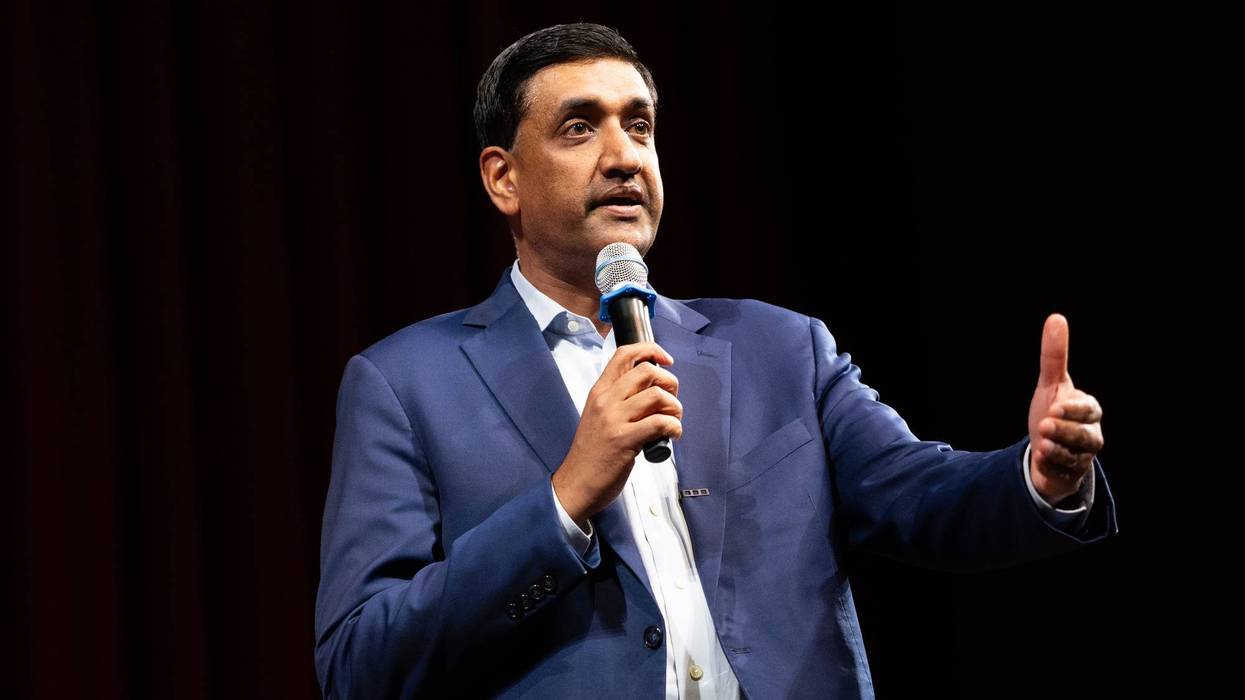
"These hoodlums come in with machine guns—M4, an American-made machine gun—and they detain us. They block off the road."
Rep. Ro Khanna this week was detained by a group of Israeli settlers whom he described as "hoodlums... with machine guns" while making a visit to a Palestinian village in the occupied West Bank.
In an interview with Reuters published on Saturday, Khanna (D-Calif.) said he and his tour group were surrounded by armed settlers as they were traveling through the West Bank on Wednesday.
"We were at a village that Israeli settlers had destroyed, they had destroyed the school, they had destroyed that village, and we were just looking at it," said Khanna. "And these hoodlums come in with machine guns—M4, an American-made machine gun—and they detain us. They block off the road."
The California Democrat said that the settlers called in members of the Israel Defense Forces (IDF) to help them deal with him and his group.
"The IDF is on their side," Khanna remarked, "not on the side of the Americans."
Cameron Kasky, an aide to Khanna, told Reuters that the group was held for over an hour before officials whom he believed to be police intervened and secured their release.
The IDF told Reuters that both military troops and police officers dispersed the settlers who had set up a roadblock near the small Palestinian village of Khirbet Zanuta.
Khanna wasn't the only American to have a run-in with Israeli settlers this week, as CNN reported that four settlers attacked groups of journalists, including CNN reporters and crew, who were traveling through an area north of the Palestinian city of Ramallah on Saturday.
As the journalists were driving, four settlers blocked off the road with their cars and began attacking the reporters' vehicles with wooden clubs and metal rods.
"The settlers then began to jump on the vehicle behind CNN's—carrying another group of journalists—and smashed the windshield of that vehicle," the network reported. "Another group of settlers tried to block a separate exit route before chasing the journalists towards the town of Sinjil."
Israeli police arrived on the scene and arrested four settlers who were allegedly responsible for the attacks, CNN reported.
"The Israel Police and the IDF view any manifestation of violence or causing damage to property very seriously," the Israeli officers said after the arrests, "especially when it concerns media personnel performing their work."
Israeli settlers for years have carried out violent attacks on Palestinians living in the West Bank, and witnesses have regularly described IDF soldiers at the scene either standing by as the attacks occur or even actively helping the attackers.
In an interview with CNN on Tuesday, Israeli Prime Minister Benjamin Netanyahu said that claims about settler violence have been "blown up beyond belief," describing attacks as being carried out by a small number of "juvenile delinquents."
"This brazen act should be seen as nothing more than an attempt to prevent the public from knowing what is happening in their country by intimidating journalists from doing their jobs."
The Trump administration on Friday escalated its war with the press by subpoenaing several reporters at The New York Times days after the paper published a story on Wednesday that detailed security concerns about the luxury jet the Qatari government gave to President Donald Trump.
According to the Times, the subpoenas are attempting to force reporters to testify before a federal grand jury in Manhattan on Wednesday next week, a move that the paper describes as an "extraordinary escalation in President Trump’s efforts to threaten and intimidate independent news organizations."
The issued subpoenas do not specifically name the Times' reporting on the Qatari jet as the reason for the grand jury probe, although they were given to all four journalists—Tyler Pager, Julian Barnes, Eric Schmitt, and Eric Lipton—who reported the story.
Additionally, the Times noted, a senior official at the FBI had asked the paper to hold off publishing its story on the jet before it came out on Wednesday, citing unspecified national security concerns about its content.
David McCraw, the top attorney representing the Times' newsroom, denounced the subpoenas as an attack on the freedom of the press.
"The appearance of federal law enforcement agents on the doorstep of news reporters should shock the conscience of any American who believes in the Constitution and the press freedom it protects," said McGraw. “This brazen act should be seen as nothing more than an attempt to prevent the public from knowing what is happening in their country by intimidating journalists from doing their jobs."
It is highly uncommon for government investigators to subpoena journalists when they are probing national security leaks, as such actions are generally seen as having a chilling effect on reporters’ ability to gather information.
Rick Stengel, former under secretary of state for President Barack Obama, said that the Times' reporting on the Qatari jet, whose security upgrades are being financed with US tax dollars, is completely within the scope of constitutional protections for press freedom.
"The reporting that the Times journalists have been subpoenaed for is exactly the kind of journalism the First Amendment is designed to protect: matters involving national security and taxpayer dollars," wrote Stengel in a Saturday social media post. "Reporting that embarrasses a president is protected speech."
Fox News chief national security correspondent Jennifer Griffin also denounced the Trump administration for trying to drag reporters into a grand jury investigation.
"This action by the US government to subpoena reporters for reporting legitimate news on security concerns about Air Force One should alarm every American," Griffin wrote.
Seth Stern, chief of advocacy for the Freedom of the Press Foundation, accused the Trump administration of abusing government power not to defend national security, but to protect the president from personal humiliation.
"We've long said that when the government claims it needs to investigate journalists to protect national security, it really means its own reputational security," said Stern. "This is as clear an example as you can get. The administration's embarrassment that it reportedly charged taxpayers hundreds of millions of dollars to retrofit a flying bribe that still isn't secure enough for hostile times does not supersede the need for a free and independent press."
This is the second time in recent weeks that the Trump administration has tried to subpoena reporters to compel their testimony in grand jury investigations.
In June, the US Department of Justice issued subpoenas for national security reporters at The Washington Post and The Wall Street Journal related to national security leaks.
Subpoenas against both news organizations were withdrawn after they issued legal challenges in sealed filings.