SUBSCRIBE TO OUR FREE NEWSLETTER
Daily news & progressive opinion—funded by the people, not the corporations—delivered straight to your inbox.
5
#000000
#FFFFFF
To donate by check, phone, or other method, see our More Ways to Give page.

George Kimbrell, Center for Food Safety, (571) 527-8618, gkimbrell@centerforfoodsafety.org
Tierra Curry, Center for Biological Diversity, (928) 522-3681, tcurry@biologicaldiversity.org
The yearly count of Monarch butterflies overwintering in Mexico, released today (see table below), continues to show a dramatic decline of the imperiled species. Today's count of 2.10 hectares (5.2 acres) of occupied winter habitat is down 26% from last year's count. The minimum population threshold needed to be out of the danger zone of extinction is six hectares.
Overall, eastern monarchs have declined by more than 80% over the past two decades.
"Monarchs are the face of the wildlife extinction crisis where even once common species could now disappear. They need us because if we don't act now to save them, monarch migrations will collapse and that would be morally unforgivable," said Tierra Curry, a senior scientist at the Center for Biological Diversity.
The eastern Monarch population is made up the butterflies east of the Rocky Mountains and accounts for roughly 99% of all North American Monarchs. They migrate each winter to oyamel fir forests on high elevation mountaintops in central Mexico. Scientists estimate the population size by measuring the area of trees turned orange by the clustering butterflies. That population has been dangerously low since 2008.
The U.S. Fish and Wildlife Service in December put Monarchs on the waiting list for Endangered Species Act listing, which confers no actual protection to them or their habitat. The Service itself has estimated up to an 80% probability of population collapse for eastern Monarchs within 50 years and a 96-100% probability for the western population.
"Last December even the Trump administration, the most anti-environment administration on record, could not deny that Monarchs deserve the important protection that endangered species listing provides. They just put it off for an unconscionable four more years," said George Kimbrell, legal director at the Center for Food Safety."Now the 2021 count shows monarch numbers declining considerably further because of Monsanto's toxic Roundup. So we are calling on the Biden administration to do what is right and what the science and law demands--list Monarchs now."
Monarchs are threatened by pesticides, global climate change, sprawl, and illegal logging of the forests where they migrate for the winter. They are also threatened by mortality during their migrations from roadkill and habitat fragmentation.
Scientists led by the Center for Biological Diversity and Center for Food Safety petitioned the U.S. Fish and Wildlife Service to protect the butterfly under the Endangered Species Act in 2014.
Monarchs have lost an estimated 165 million acres of breeding habitat in the United States to herbicide spraying and development in recent decades. The caterpillars only eat milkweed, but the plant has been devastated by increased herbicide spraying in conjunction with corn and soybean crops that have been genetically engineered to tolerate direct spraying. The butterflies are also threatened by neonicotinoid insecticides, fungicides, and other chemicals that are toxic to young caterpillars.
Monarch butterflies west of the Rocky Mountains overwinter on the central coast of California. Their numbers have plummeted by 99% and fewer than 2,000 total butterflies were counted this winter. The western migration has collapsed in part due to warmer winters and to people planting invasive tropical milkweed which is unhealthy for the butterflies.
In Canada Monarchs are slated for listing as endangered under the Species At Risk Act. In Mexico they are considered a species of special concern.

Center for Food Safety's mission is to empower people, support farmers, and protect the earth from the harmful impacts of industrial agriculture. Through groundbreaking legal, scientific, and grassroots action, we protect and promote your right to safe food and the environment. CFS's successful legal cases collectively represent a landmark body of case law on food and agricultural issues.
(202) 547-9359



Ovadia, a father of five children, has lived in New York's Rockland County since coming to the United States on a religious worker visa in 2022. He is a member of the Satmar Hasidic sect, an ultra-Orthodox movement that opposes Zionism on religious grounds, holding that Jews should not establish a sovereign state in the land of Israel before the coming of the Messiah.
Some members of Satmar have vocally protested against US support for Israel's genocidal military assault in Gaza since it began in 2023.
“We demonstrated for Gaza, for the liberation of Gaza, for the rights of the Palestinians and to show to the world that the Jews, real Judaism, want to have peace,” Ovadia told the Times from detention.
As the death toll in Gaza has mounted, Ovadia has continued to attend anti-Israel marches across New York and New Jersey. Earlier this year, the government revoked his legal status after he appeared at one of these protests.
In November 2023, Ovadia joined a group of anti-Zionist Hasidic Jews to protest the display of a large Israeli flag at the Ramapo Town Hall. Some attendees were recorded cutting the flag down with scissors. Ovadia and another man were charged with hate crimes over the incident—charges that were later dropped.
Ovadia later pleaded guilty to a misdemeanor offense of disorderly conduct, for which he paid a $200 fine plus an additional $125 charge. He says he was not one of the men who took down the flag and that he did not know about the other attendees' plans to do so.
The formal reason for Ovadia's deportation, according to the Department of Homeland Security (DHS), was that he “overstayed his welcome and refused to depart” the US after losing his status. But the reason he lost that status is more revealing.
Though it acknowledged that Ovadia was eligible to maintain his religious worker status, the US Citizenship and Immigration Services (USCIS) ultimately revoked it “as a matter of discretion." It cited what it said were “adverse factors” stemming from the 2023 Israeli flag protest.
DHS stated even more explicitly that the content of Ovadia's speech was the real issue.
"The Trump administration acted well within its statutory and constitutional authority, as it does with any alien who advocates for violence, glorifies and supports terrorists, harasses Jews, and steals property," DHS said.
At the beginning of his second term, President Donald Trump issued an executive order directing DHS to target noncitizens who have participated in pro-Palestinian protests, which it has deemed antisemitic.
The order has led to nonviolent political organizers, like the Columbia University graduate student Mahmoud Khalil and many others, having their legal immigration statuses abruptly revoked and being whisked into ICE detention without warning. Federal courts have struck down this policy on First Amendment grounds.
Ovadia's attorneys have filed a lawsuit in federal court alleging that DHS had unlawfully retaliated against Ovadia for his protected speech. They argue that by targeting Ovadia over activism that stems from his religious beliefs, the government has taken “an official position” favoring “one religious position within Judaism” while penalizing "an adherent of another.”
Many Jewish protesters have been arrested during demonstrations in solidarity with Palestinians, including dozens who were arrested at a Jewish Voice for Peace event last week to protest Israeli Prime Minister Benjamin Netanyahu's speech at the United Nations General Assembly. But Ovadia's attorneys believe he may be the first Jewish protester to have his immigration status stripped.
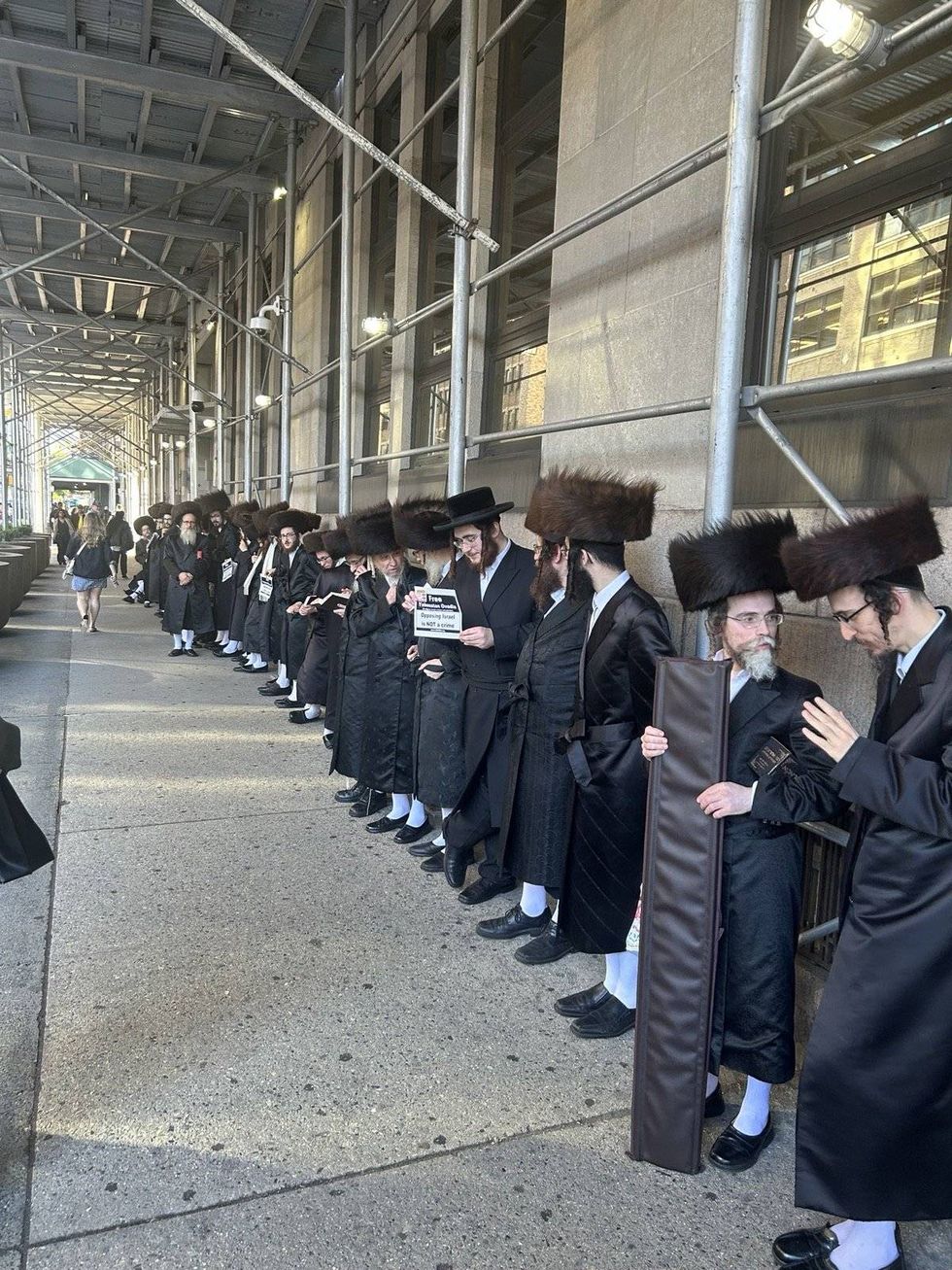 Supporters of Yehonatan Ovadia gather outside his immigration court hearing in Manhattan on September 30, 2026. (Photo from Eric Lee/X)
Eric Lee, one of Ovadia's attorneys, has emphasized the case as an example of why "equating anti-Zionism with antisemitism produces absurd results."
"Trump's DHS says ICE detention of Yehonatan Ovadia is justified because he was 'harassing Jews,'" Lee wrote in a post on social media. "A rabbi detained for participating in a Hasidic demonstration against Israel three years ago was harassing... himself? What a joke!"
Ovadia, whom a judge has denied bond, appeared in immigration court on Wednesday, while dozens of supporters, many in traditional Hasidic dress, assembled outside.
And from detention, the man DHS has accused of "harassing Jews" continued to describe his activism not as hostility toward his own people, but as an expression of Jewish solidarity with Palestinians.
"From the Jewish people to our Palestinian brothers and sisters in Gaza and the West Bank and all over occupied Palestine: We didn't forget you!" Ovadia said in a statement shared by Lee. "We are following you, and we know that you are facing genocide! Please be strong and continue to believe! Because your struggle is our struggle and your liberation is our liberation!"
"We will SHOUT and DEMONSTRATE for you," he continued, "from New York, Washington, Canada, London, and from every place that we can in the free world."
"Your liberation is near," Ovadia concluded, "and it will bring peace and liberation to all of us."