SUBSCRIBE TO OUR FREE NEWSLETTER
Daily news & progressive opinion—funded by the people, not the corporations—delivered straight to your inbox.
5
#000000
#FFFFFF
To donate by check, phone, or other method, see our More Ways to Give page.


Daily news & progressive opinion—funded by the people, not the corporations—delivered straight to your inbox.
Nikki Skuce, Senior Energy Campaigner,
250-877-7762 or 778-210-0117
Environmental groups are praising Michael Ignatieff and the Liberal
Party of Canada for their commitment today to formalize the oil tanker
ban in British Columbia. Such a ban would prevent crude oil tankers from
traveling through BC's Central and North Coast.
"Michael
Ignatieff's announcement to formalize the ban on oil tankers is
precisely the kind of leadership we need on this issue. We thank him for
making the commitment to ensure that the marine life, people, and
economy of coastal BC is protected from catastrophic oil spills," says
Jennifer Lash, Executive Director of the Living Oceans Society.
Last
month, Enbridge filed its application for the Northern Gateway
Pipeline, which would carry tar sands oil to a supertanker port at
Kitimat and bring 225 oil tankers per year to B.C.'s North Coast.
Environmental groups, including Dogwood Initiative, Forest Ethics,
Living Oceans Society, and West Coast Environmental Law have been
calling for a permanent, legislated ban on crude oil tankers to protect
the coast from oil spills.
"The only way we can ensure that the
ban on tankers is strong enough to withstand pressure from oil companies
is to formalize it through permanent legislation," says Josh Paterson,
Staff Lawyer at West Coast Environmental Law. "With today's
announcement, we believe there is enough support among all opposition
parties in the House of Commons to make this happen soon. As Liberal
leader, Mr. Ignatieff can play a pivotal role in passing legislation
to ban tankers."
Support for a ban on oil tankers has risen since
the Gulf of Mexico oil spill. A poll conducted in May 2010 by the
Mustel Group showed that 80 percent of British Columbians support a ban
on crude oil tankers.
"The images of oil drenching the shorelines
from the BP spill have reminded British Columbians how fortunate we are
to have an oil-free coast," stated Nikki Skuce Senior Energy Campaigner
at ForestEthics. "With today's announcement by the Liberal Party of
Canada, we are one step closer to giving the people of B.C. what they
have wanted for a long time: a legislated ban on oil tankers."
Coastal
First Nations have already declared a ban under their traditional laws
on oil tankers in their territorial waters. Federal legislation would
demonstrate Parliament's shared commitment to safeguarding the Pacific.
There are currently no crude oil tankers travelling the inside waters of
B.C.'s north and central coast.
"In light of the Liberal
announcement today, Enbridge should formally withdraw their proposal to
build a pipeline to Kitimat," added Eric Swanson, Corporate Campaigner
at the Dogwood Initiative. "It is a waste of time and taxpayers' money
to conduct a review of this project if the will of Parliament is to
enact a permanent tanker ban."
Founded in 2000, ForestEthics is a nonprofit environmental organization with staff in Canada, the United States and Chile. Our mission is to protect Endangered Forests and wild places, wildlife, and human wellbeing--one of our focus areas is climate change, which compromises all of our efforts if left unchecked. We catalyze environmental leadership among industry, governments and communities by running hard-hitting and highly effective campaigns that leverage public dialogue and pressure to achieve our goals.
Governments gathering for International Monetary Fund and World Bank meetings "have a clear responsibility," said a 350.org leader. "End this illegal war, stop the flow of destruction, and make the profiteers pay."
As the Spring Meetings of the International Monetary Fund and World Bank Group were held in Washington, DC during a two-week ceasefire between the United States, Israel, and Iran, over 130 civil society groups this week urged global governments to "secure a permanent end to the wars in South West Asia and break the chains of fossil fuel dependence."
The joint statement was coordinated by Fight Inequality Alliance and 350.org, which has been advocating for a windfall profits tax on oil and gas giants since the US and Israel launched their illegal war on Iran in late February, and the Iranian government responded by restricting traffic through the Strait of Hormuz, which sent fossil fuel prices soaring worldwide.
"While people struggle to afford food, fuel, and basic necessities, fossil fuel companies are profiting massively from the chaos. The IMF itself has warned of the risk of a global recession," said 350.org managing director Savio Carvalho in a statement.
"Governments gathering in Washington have a clear responsibility: End this illegal war, stop the flow of destruction, and make the profiteers pay," Carvalho argued. "Taxing windfall oil and gas profits could provide immediate relief to families and invest in the clean, affordable energy systems we urgently need. They profit, we pay. It's time to fix it now: no bombs, no barrels."
A permanent end to the war—which has killed people across the region—is the first demand of the open letter. The second is a windfall profits tax on fossil fuel giants, with the revenue being used "to guarantee public services, and provide immediate support to families and precarious workers hit hardest by soaring food and fuel prices."
Martha Tukahirwa, Fight Inequality Alliance's Africa coordinator, explained that "while thousands are killed in the war in Iran, millions of people across Africa are being crushed by soaring fuel prices that have made even the simplest meal unaffordable. In Nigeria, diesel has surged over 60%. In Malawi, the poorest households are forced to choose between cooking and eating."
"In Zimbabwe, the cost of public transport has soared, making it impossible for working people to earn a living," Tukahirwa continued. "This is no accident—fossil fuel companies and commodity traders are reaping massive profits from this crisis while our governments stand idle. Tax these obscene profits and redirect the money to shield our people from hunger and hardship. The time for half measures is over, the time for bold action is now."
The letter's third demand is to "make food and energy secure for all." The war has impacted the availability of not only fuel but also fertilizer. The coalition called on governments to "invest public money in sustainable local farming and homegrown renewable energy, and stop harmful handouts to weapons, fossil fuels, and fossil fertilizer."
The groups—which also include ActionAid International, Corporate Europe Observatory, Council of Canadians, Friends of the Earth International, GreenFaith, Greenpeace Japan, Make Polluters Pay, Oxfam in the Pacific, War on Want, and more—called for urgently rolling out "renewable energy solutions for farms, homes, schools, and clinics to protect them from this and future energy crises."
Rev. Fletcher Harper, executive director of GreenFaith, said that "our faiths call us to make peace with people and the planet alike, and to hold the powerful to account. Letting fossil fuel giants pocket windfalls while families struggle is a moral failure. Taxing windfall profits to provide energy relief is not radical. It is basic justice."
The fourth and final demand is to cancel debt payments for Global South countries, and agree to fairer debt rules. The coalition stressed that "after paying interest to Wall Street lenders, bankers, and rich governments, many Global South countries have no money left over to protect their people from this crisis."
As part of the debt demand, the coalition also urged governments to "support informal workers, farm laborers, women, and older people, and guarantee universal access to healthcare, education, and public transport."
David Archer, head of programs and Influencing at ActionAid, pointed to civil society's push for a United Nations treaty for restructuring sovereign debt.
"Billions of people across the Global South are living in countries already facing a debt crisis. This war will make their lives even harder, leading to rising prices and rising interest rates," Archer said. "We need urgent action to cancel debt and to take the power over debt away from the IMF and rich countries—through developing a UN Framework Convention on Sovereign Debt."
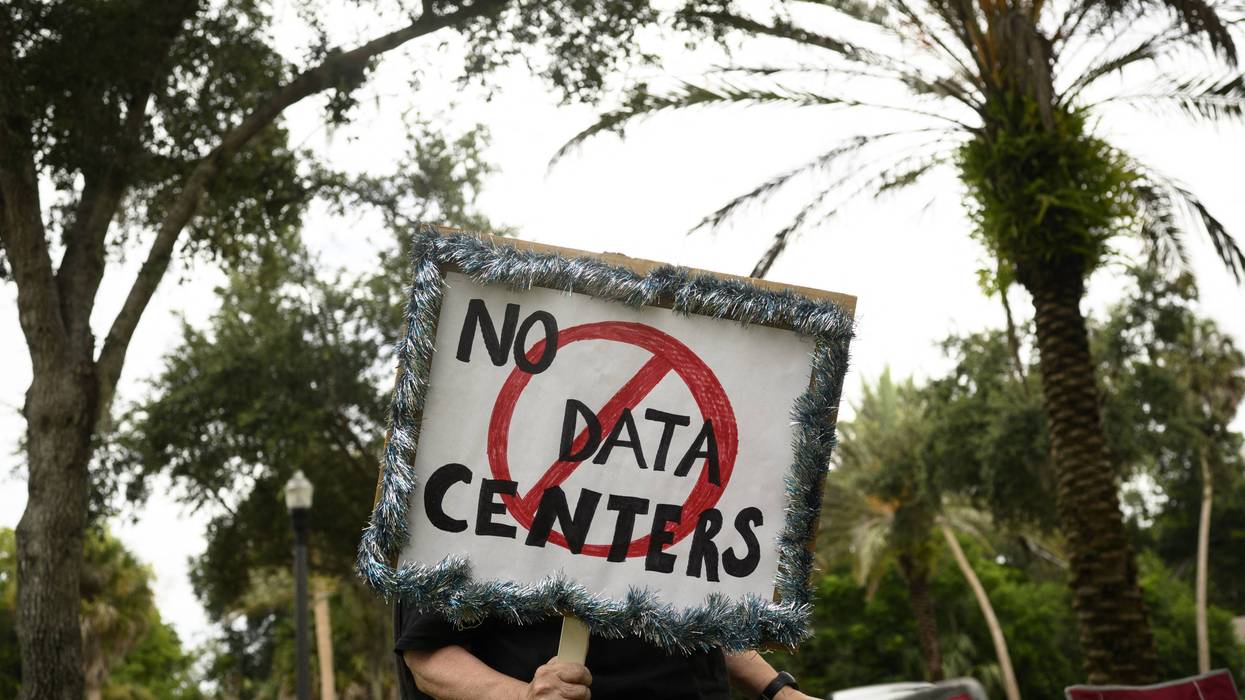
"Great credit to the people and state legislators of Maine for being at the forefront of a large and swelling national movement to put a halt to the reckless, unchecked explosive growth of hyperscale AI data centers."
Democratic Maine Gov. Janet Mills is facing pressure to sign what would be the nation's first statewide moratorium on artificial intelligence data centers after state legislators passed the bill on Tuesday.
The Maine House of Representatives approved the bill 79-62, and then the state Senate sent it to Mills' desk with a 21-13 vote.
"The bill, LD 307, would create a limitation on data centers with electric loads of at least 20 megawatts by preventing the state, local governments, and quasi-governmental agencies from issuing permits or other approvals until November 2027," according to the Portland Press Herald. "In the meantime, a new Data Center Coordination Council—also created in the bill—would get time to study the centers' potential impact in Maine and issue policy recommendations."
In addition to calling for a national moratorium on constructing new AI data centers, the advocacy group Food & Water Watch (FWW) has fought for related proposals in not only Maine but also California, Michigan, New Jersey, New York, Ohio, and Pennsylvania.
"Great credit to the people and state legislators of Maine for being at the forefront of a large and swelling national movement to put a halt to the reckless, unchecked explosive growth of hyperscale AI data centers," Mitch Jones, FWW's managing director of policy and litigation, said in a Tuesday statement.
"These massive facilities suck up unimaginable amounts of water and electricity, and wreak havoc on the everyday Americans in nearby communities that are forced to foot the bills for this irresponsible, profit-hungry industry," Jones stressed. "Gov. Mills should listen to the people and legislators of Maine, and sign this smart, nation-leading bill into law immediately."
However, as Maine Public detailed on Monday:
Mills has said the measure needs to have an exemption for a proposed $550 million project at the former Androscoggin paper mill in Jay to get her support.
"The people of Jay need those jobs, with appropriate guardrails on preserving water resources, electricity resources, local generation and all those things," Mills told reporters during an event in Bangor last week.
Mills' office did not respond to an email Monday asking if the governor intends to veto the bill.
After the votes on Tuesday, The Washington Post similarly noted that legislators had rejected an amendment for the exception sought by Mills, and a spokesperson for the governor "did not immediately respond to a query about whether she plans to approve the legislation."
Mills is locked in an intense US Senate primary race with combat veteran and oyster farmer Graham Platner, who has been leading her in various polls. While the governor has released attack advertisements targeting her opponent, Platner has largely focused on his platform—which prioritizes the needs of the working class—and Sen. Susan Collins, the Republican trying to keep her seat in November.
Millions of Italians have taken to the streets in support of Palestinians and around 3 in 4 say Israel committed a genocide in Gaza.
The Italian government has suspended a military cooperation agreement with Israel in response to its attacks against Lebanon in recent weeks, which have killed hundreds of people.
Italy's right-wing prime minister, Giorgia Meloni, announced on Tuesday that it was suspending an agreement with Israel that dates back to 2003 and involved cooperation between the two countries, which traded military equipment and shared technical data.
“In view of the current situation, the government has decided to suspend the automatic renewal of the defense agreement with Israel,” Meloni said on Tuesday.
It marks a dramatic shift in policy for Italy's government, which has until recently been one of Israel's closest allies in Europe. Amid the genocide in Gaza, Meloni has faced pressure both from opposition parties and from the public to cut ties with Israel for more than a year.
The relationship appears to have finally frayed with the events of the past several weeks, when Israel launched an invasion of Lebanon that has involved the displacement of more than 1 million people, the razing of entire villages, and the aggressive bombing of civilian areas.
Tension between the two countries hit a boiling point over the past week, when the Italian government accused Israeli forces of firing warning shots at Italian UN peacekeepers, which caused damage to a vehicle but resulted in no injuries.
Italy was also among several European countries that called for Lebanon's inclusion in last week's ceasefire agreement between the US and Iran. Meloni accused Israel of "disrespecting" the two-week truce when it launched the most devastating attack yet on Lebanon the day after the ceasefire was reached, which killed and wounded more than 1,400 people, including many civilians.
Though Meloni has been an ideological ally of US President Donald Trump, she has grown increasingly critical of the American president. On Monday, she condemned what she called "unacceptable" insults from Trump against Pope Leo XIV, who criticized the war in Iran.
Trump responded with his own shots at Meloni: “I thought she had courage. I was wrong," he said.
Meloni is also facing mounting pressure from her own people over Italy's relationship with Israel, which could loom large as she faces reelection in 2027.
Nearly 3 out of 4 Italians said in a September survey that they believe Israel's actions in Gaza constitute a genocide, and 59% said they wanted Italy to cut ties with Israel. During the fall, millions of Italians took to the streets to rally in solidarity with Palestinians and support the Global Sumud Flotilla as it carried humanitarian aid to besieged Gaza.
This anger has been seized on by the opposition. Last week, during a heated exchange, the Parliament erupted in applause after opposition lawmaker Angelo Bonelli took Meloni to task for "failing" to condemn or distance herself from Trump or Israeli Prime Minister Benjamin Netanyahu.
"You are stubbornly short-sighted and fail to grasp where the world is heading," Bonelli said. "A world where the logic of war is dictated by two criminals."
Responding to Israel's attacks on Lebanon on Wednesday, Bonelli asked the prime minister: "200 people were killed as if it were nothing. What is your response? What are you doing? Do you have the courage to take action?"
Riccardo Magi, a member of the center-left opposition party More Europe, wrote on social media that by suspending Italy's defense agreement with Israel, Meloni had "finally realized that something is happening in the Middle East."
"After years of massacres by Israel against Palestinian civilians, in which our government simply decided to look the other way, today Meloni has suddenly decided to suspend the memorandum between Italy and Israel, as the opposition has been demanding for a long time," he said.
However, he cautioned that the decision was "not about a renewed humanitarian spirit on the part of our government," but rather "pure electoral convenience."
"It is not enough for us, and we believe sanctions are necessary against Netanyahu and his ministers, including a ban on entry into the territory of the union," he said. "The illegal occupation of Gaza, together with the wars provoked in the area without any consideration for the lives of civilians, is now a point of no return. Israel must stop."