

SUBSCRIBE TO OUR FREE NEWSLETTER
Daily news & progressive opinion—funded by the people, not the corporations—delivered straight to your inbox.
5
#000000
#FFFFFF
To donate by check, phone, or other method, see our More Ways to Give page.
Daily news & progressive opinion—funded by the people, not the corporations—delivered straight to your inbox.
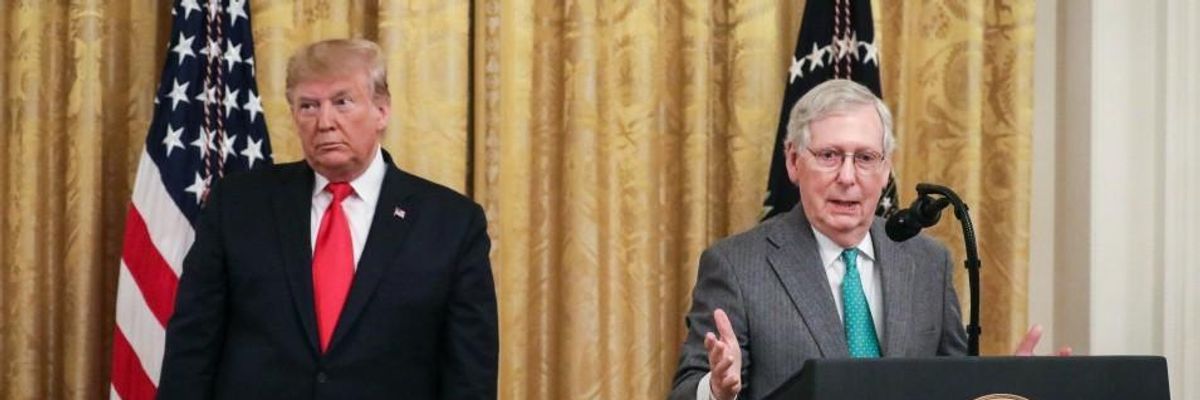
President Donald Trump looks on as Senate Majority Leader Mitch McConnell (R-Ky) speaks during an event about judicial confirmations in the East Room of the White House on November 6, 2019 in Washington, D.C. (Photo: Drew Angerer/Getty Images)
President Donald Trump on Monday came right out and admitted his Republican Party would soon be defunct if voting in the United States was easier in a way that allowed more citizens to vote in elections, telling a national television audience it was a good thing that Democratic proposals for increased voting protections and ballot access were left out of last week's coronavirus relief package.
The comment came during an interview with Fox & Friends, the president's go-to show for positive coverage.
"The things they had in there were crazy," Trump said of the voter protection and expansion proposals in the bill. "They had things--levels of voting that, if you ever agreed to it, you'd never have a Republican elected in this country again."
Watch:
The remark--as many were quick to point out--is what's called "saying the quiet part loud."
"This morning on live television, the president of the United States admitted he is opposed to laws that would make it easier for Americans to vote because that would hurt Republicans," said Ellen Kurz, founder and board president of iVote, which seeks to expand voting rights for Americans.
As the Washignton Post's Aaron Blake noted:
Trump didn't expand on the thought. But he clearly linked high turnout to Republicans losing elections. The most generous reading of his comment is that he was referring to large-scale voter fraud resulting from the easier vote-by-mail options; Trump has in the past baselessly speculated about millions of fraudulent votes helping Democrats in the 2016 election. The more nefarious reading would be that allowing more people to participate in the process legally would hurt his party because there are more Democratic-leaning voters in the country.
That's apparently true, but you typically don't see Republicans expressing the sentiment so directly. Generally, they'll connect tighter voting rules such as Voter ID to protecting the integrity of the process.
After progressive proposals to enhance voter protections and increased access were scrapped from the compromise bill that emerged from U.S. Senate--legislation that was ultimately signed by Trump on Friday--Michael Waldman, president of the Brennan Center for Justice at NYU Law, called the shortcomings a major failing of the legislation.
"The coronavirus pandemic is a health and economic crisis," Waldman said. "The $2 trillion dollar stimulus will help soften its effects on the American people. However, Congress failed to include sufficient, urgently needed funds in the stimulus to help states run elections in a time of pandemic. This could wreak havoc in November."
"States simply will not have the resources so people can vote safely," he warned. "Congress must do better when it composes the next stimulus package."
While state election officials from both parties have made it clear they will need federal assistance in order to "hold a safe, fair, and secure November election under pandemic conditions," Waldman said failure to provide that support could prove disastrous.
"By our estimate, state and local officials need at least $2 billion to prepare, an amount that would cover the equipment, supplies, staffing, training, and the other costs of adapting our voting processes to withstand the coronavirus," he said. "That funding is not partisan and it is not a luxury. Time remains of the essence."
Dear Common Dreams reader, It’s been nearly 30 years since I co-founded Common Dreams with my late wife, Lina Newhouser. We had the radical notion that journalism should serve the public good, not corporate profits. It was clear to us from the outset what it would take to build such a project. No paid advertisements. No corporate sponsors. No millionaire publisher telling us what to think or do. Many people said we wouldn't last a year, but we proved those doubters wrong. Together with a tremendous team of journalists and dedicated staff, we built an independent media outlet free from the constraints of profits and corporate control. Our mission has always been simple: To inform. To inspire. To ignite change for the common good. Building Common Dreams was not easy. Our survival was never guaranteed. When you take on the most powerful forces—Wall Street greed, fossil fuel industry destruction, Big Tech lobbyists, and uber-rich oligarchs who have spent billions upon billions rigging the economy and democracy in their favor—the only bulwark you have is supporters who believe in your work. But here’s the urgent message from me today. It's never been this bad out there. And it's never been this hard to keep us going. At the very moment Common Dreams is most needed, the threats we face are intensifying. We need your support now more than ever. We don't accept corporate advertising and never will. We don't have a paywall because we don't think people should be blocked from critical news based on their ability to pay. Everything we do is funded by the donations of readers like you. When everyone does the little they can afford, we are strong. But if that support retreats or dries up, so do we. Will you donate now to make sure Common Dreams not only survives but thrives? —Craig Brown, Co-founder |
President Donald Trump on Monday came right out and admitted his Republican Party would soon be defunct if voting in the United States was easier in a way that allowed more citizens to vote in elections, telling a national television audience it was a good thing that Democratic proposals for increased voting protections and ballot access were left out of last week's coronavirus relief package.
The comment came during an interview with Fox & Friends, the president's go-to show for positive coverage.
"The things they had in there were crazy," Trump said of the voter protection and expansion proposals in the bill. "They had things--levels of voting that, if you ever agreed to it, you'd never have a Republican elected in this country again."
Watch:
The remark--as many were quick to point out--is what's called "saying the quiet part loud."
"This morning on live television, the president of the United States admitted he is opposed to laws that would make it easier for Americans to vote because that would hurt Republicans," said Ellen Kurz, founder and board president of iVote, which seeks to expand voting rights for Americans.
As the Washignton Post's Aaron Blake noted:
Trump didn't expand on the thought. But he clearly linked high turnout to Republicans losing elections. The most generous reading of his comment is that he was referring to large-scale voter fraud resulting from the easier vote-by-mail options; Trump has in the past baselessly speculated about millions of fraudulent votes helping Democrats in the 2016 election. The more nefarious reading would be that allowing more people to participate in the process legally would hurt his party because there are more Democratic-leaning voters in the country.
That's apparently true, but you typically don't see Republicans expressing the sentiment so directly. Generally, they'll connect tighter voting rules such as Voter ID to protecting the integrity of the process.
After progressive proposals to enhance voter protections and increased access were scrapped from the compromise bill that emerged from U.S. Senate--legislation that was ultimately signed by Trump on Friday--Michael Waldman, president of the Brennan Center for Justice at NYU Law, called the shortcomings a major failing of the legislation.
"The coronavirus pandemic is a health and economic crisis," Waldman said. "The $2 trillion dollar stimulus will help soften its effects on the American people. However, Congress failed to include sufficient, urgently needed funds in the stimulus to help states run elections in a time of pandemic. This could wreak havoc in November."
"States simply will not have the resources so people can vote safely," he warned. "Congress must do better when it composes the next stimulus package."
While state election officials from both parties have made it clear they will need federal assistance in order to "hold a safe, fair, and secure November election under pandemic conditions," Waldman said failure to provide that support could prove disastrous.
"By our estimate, state and local officials need at least $2 billion to prepare, an amount that would cover the equipment, supplies, staffing, training, and the other costs of adapting our voting processes to withstand the coronavirus," he said. "That funding is not partisan and it is not a luxury. Time remains of the essence."
President Donald Trump on Monday came right out and admitted his Republican Party would soon be defunct if voting in the United States was easier in a way that allowed more citizens to vote in elections, telling a national television audience it was a good thing that Democratic proposals for increased voting protections and ballot access were left out of last week's coronavirus relief package.
The comment came during an interview with Fox & Friends, the president's go-to show for positive coverage.
"The things they had in there were crazy," Trump said of the voter protection and expansion proposals in the bill. "They had things--levels of voting that, if you ever agreed to it, you'd never have a Republican elected in this country again."
Watch:
The remark--as many were quick to point out--is what's called "saying the quiet part loud."
"This morning on live television, the president of the United States admitted he is opposed to laws that would make it easier for Americans to vote because that would hurt Republicans," said Ellen Kurz, founder and board president of iVote, which seeks to expand voting rights for Americans.
As the Washignton Post's Aaron Blake noted:
Trump didn't expand on the thought. But he clearly linked high turnout to Republicans losing elections. The most generous reading of his comment is that he was referring to large-scale voter fraud resulting from the easier vote-by-mail options; Trump has in the past baselessly speculated about millions of fraudulent votes helping Democrats in the 2016 election. The more nefarious reading would be that allowing more people to participate in the process legally would hurt his party because there are more Democratic-leaning voters in the country.
That's apparently true, but you typically don't see Republicans expressing the sentiment so directly. Generally, they'll connect tighter voting rules such as Voter ID to protecting the integrity of the process.
After progressive proposals to enhance voter protections and increased access were scrapped from the compromise bill that emerged from U.S. Senate--legislation that was ultimately signed by Trump on Friday--Michael Waldman, president of the Brennan Center for Justice at NYU Law, called the shortcomings a major failing of the legislation.
"The coronavirus pandemic is a health and economic crisis," Waldman said. "The $2 trillion dollar stimulus will help soften its effects on the American people. However, Congress failed to include sufficient, urgently needed funds in the stimulus to help states run elections in a time of pandemic. This could wreak havoc in November."
"States simply will not have the resources so people can vote safely," he warned. "Congress must do better when it composes the next stimulus package."
While state election officials from both parties have made it clear they will need federal assistance in order to "hold a safe, fair, and secure November election under pandemic conditions," Waldman said failure to provide that support could prove disastrous.
"By our estimate, state and local officials need at least $2 billion to prepare, an amount that would cover the equipment, supplies, staffing, training, and the other costs of adapting our voting processes to withstand the coronavirus," he said. "That funding is not partisan and it is not a luxury. Time remains of the essence."

