SUBSCRIBE TO OUR FREE NEWSLETTER
Daily news & progressive opinion—funded by the people, not the corporations—delivered straight to your inbox.
5
#000000
#FFFFFF
To donate by check, phone, or other method, see our More Ways to Give page.
Daily news & progressive opinion—funded by the people, not the corporations—delivered straight to your inbox.
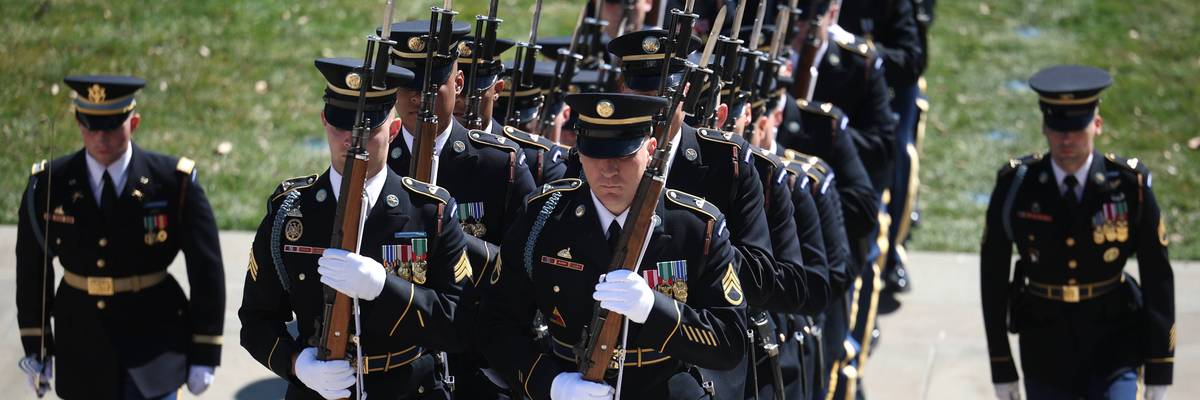
Members of an Army Honor Guard participate in a wreath laying ceremony with Prime Minister of Japan Sanae Takaichi at the Tomb of the Unknown Soldier at Arlington National Cemetery on March 20, 2026 in Arlington, Virginia.
"The US has lost control of this war," said foreign policy expert Trita Parsi.
As fears mount that he may soon launch a ground invasion of Iran, President Donald Trump is sending thousands more Marines and sailors to the Middle East.
According to a Friday report from Reuters, three US officials said that an expeditionary unit of about 2,500 Marines, among roughly 4,000 total service members, departed from San Diego aboard three ships on Wednesday—the amphibious assault ship USS Boxer and two amphibious transport dock ships, the USS Portland and the USS Comstock.
They will join around 50,000 US troops already in the Middle East, including another unit of around 2,500 Marines who were reported to be headed to the region last week, just before Trump launched an assault that struck military installations on Kharg Island, a critical hub for Iran’s oil exports.
Officials said it was not known for what purpose the additional troops were being deployed.
Trump was coy this week when asked by reporters if he planned to send ground troops into Iran.
“No, I’m not putting troops anywhere,” Trump said in the Oval Office on Thursday. “If I were, I certainly wouldn’t tell you, but I’m not putting troops.”
He previously emphasized that he would not be afraid to put "boots on the ground" in Iran if he deems it necessary.
“I don’t have the yips with respect to boots on the ground—like every president says, ‘There will be no boots on the ground.’ I don’t say it,” the president told The New York Post at the beginning of March.
With US gas prices nearing $4 per gallon and expected to climb further due to Iran's closure of the Strait of Hormuz, Axios reported on Friday that Trump is weighing plans to have US troops occupy Kharg Island, through which about 90% of Iran's oil exports move, in a bid to pressure Tehran into reopening the critical waterway.
Foreign policy experts have warned that a full-scale occupation of Kharg Island would be likely to fail and put more troops in harm's way while further embroiling the US in a quagmire.
"Even a blockade of Kharg Island would not force Iran to reopen the Strait of Hormuz," said Danny Citrinowicz, a senior fellow at Israel's Institute for National Security Studies. "For Tehran, control over the Strait is not just economic leverage—it is a core component of regime survival and deterrence."
"Reopening the Strait would likely require one of two extreme options: either regime change, or a large-scale military campaign to seize and secure the waterway. Such an operation would take months and still wouldn’t prevent Iran from disrupting traffic through asymmetric means."
Dominic Waghorn, the international affairs editor of Sky News, explained that "opening up a waterway that can be blocked again by cheap, easily deployable drones will be hugely challenging" and will likely only demonstrate to Tehran that the United States is "desperate."
The idea of sending ground troops into Iran is also deathly unpopular with the American public. In a Data For Progress poll published Thursday, 68% of voters surveyed said they would oppose putting boots on the ground, compared to just 26% who'd support it.
Even Republicans, who've generally backed Trump's military interventions to the hilt even though the president campaigned on "no new wars," are split on the idea, with 48% saying they'd oppose it and 48% in support.
Nevertheless, one official told Axios that in addition to the Marine units already heading to the Middle East, the Pentagon was considering sending even more troops soon.
"He wants Hormuz open," the official said, referring to Trump. "If he has to take Kharg Island to make it happen, that's going to happen. If he decides to have a coastal invasion, that's going to happen. But that decision hasn't been made."
Karim Sadjadpour, a senior fellow at the Carnegie Endowment for International Peace, noted earlier this week that the Strait of Hormuz would never have become an issue in the first place were it not for Trump's decision to launch a "war of choice" against Iran.
"I don't think President Trump, in his own words frankly, understood what he was getting into," Sadjadpour told NPR. "What began as a war of choice, in my view, has actually morphed into a war of necessity. I don't think that President Trump is going to simply be able to end the war and claim victory."
The war is costing American taxpayers $1-2 billion per day, according to lawmakers familiar with the Pentagon budget who spoke with The Intercept earlier this week, which estimated that it could cost trillions in the decades to come if prolonged.
"The US has lost control of this war," said Trita Parsi, the executive vice president of the Quincy Institute for Responsible Statecraft. He said that even if Trump pulled out now and declared victory, Iran would be determined to inflict maximum costs.
"Iran has leverage for the first time in years and will seek to trade it in," he said. "It has publicly demanded a closing of US bases, reparations, and sanctions relief in order to stop shooting at Israel and open the straits."
If the president's base of supporters begins to sour on the war, Parsi said, "it will become increasingly clear—if it hasn't already—to Trump that all his escalatory options only deepen the lose-lose situation he has put himself in."
Dear Common Dreams reader, It’s been nearly 30 years since I co-founded Common Dreams with my late wife, Lina Newhouser. We had the radical notion that journalism should serve the public good, not corporate profits. It was clear to us from the outset what it would take to build such a project. No paid advertisements. No corporate sponsors. No millionaire publisher telling us what to think or do. Many people said we wouldn't last a year, but we proved those doubters wrong. Together with a tremendous team of journalists and dedicated staff, we built an independent media outlet free from the constraints of profits and corporate control. Our mission has always been simple: To inform. To inspire. To ignite change for the common good. Building Common Dreams was not easy. Our survival was never guaranteed. When you take on the most powerful forces—Wall Street greed, fossil fuel industry destruction, Big Tech lobbyists, and uber-rich oligarchs who have spent billions upon billions rigging the economy and democracy in their favor—the only bulwark you have is supporters who believe in your work. But here’s the urgent message from me today. It's never been this bad out there. And it's never been this hard to keep us going. At the very moment Common Dreams is most needed, the threats we face are intensifying. We need your support now more than ever. We don't accept corporate advertising and never will. We don't have a paywall because we don't think people should be blocked from critical news based on their ability to pay. Everything we do is funded by the donations of readers like you. When everyone does the little they can afford, we are strong. But if that support retreats or dries up, so do we. Will you donate now to make sure Common Dreams not only survives but thrives? —Craig Brown, Co-founder |
As fears mount that he may soon launch a ground invasion of Iran, President Donald Trump is sending thousands more Marines and sailors to the Middle East.
According to a Friday report from Reuters, three US officials said that an expeditionary unit of about 2,500 Marines, among roughly 4,000 total service members, departed from San Diego aboard three ships on Wednesday—the amphibious assault ship USS Boxer and two amphibious transport dock ships, the USS Portland and the USS Comstock.
They will join around 50,000 US troops already in the Middle East, including another unit of around 2,500 Marines who were reported to be headed to the region last week, just before Trump launched an assault that struck military installations on Kharg Island, a critical hub for Iran’s oil exports.
Officials said it was not known for what purpose the additional troops were being deployed.
Trump was coy this week when asked by reporters if he planned to send ground troops into Iran.
“No, I’m not putting troops anywhere,” Trump said in the Oval Office on Thursday. “If I were, I certainly wouldn’t tell you, but I’m not putting troops.”
He previously emphasized that he would not be afraid to put "boots on the ground" in Iran if he deems it necessary.
“I don’t have the yips with respect to boots on the ground—like every president says, ‘There will be no boots on the ground.’ I don’t say it,” the president told The New York Post at the beginning of March.
With US gas prices nearing $4 per gallon and expected to climb further due to Iran's closure of the Strait of Hormuz, Axios reported on Friday that Trump is weighing plans to have US troops occupy Kharg Island, through which about 90% of Iran's oil exports move, in a bid to pressure Tehran into reopening the critical waterway.
Foreign policy experts have warned that a full-scale occupation of Kharg Island would be likely to fail and put more troops in harm's way while further embroiling the US in a quagmire.
"Even a blockade of Kharg Island would not force Iran to reopen the Strait of Hormuz," said Danny Citrinowicz, a senior fellow at Israel's Institute for National Security Studies. "For Tehran, control over the Strait is not just economic leverage—it is a core component of regime survival and deterrence."
"Reopening the Strait would likely require one of two extreme options: either regime change, or a large-scale military campaign to seize and secure the waterway. Such an operation would take months and still wouldn’t prevent Iran from disrupting traffic through asymmetric means."
Dominic Waghorn, the international affairs editor of Sky News, explained that "opening up a waterway that can be blocked again by cheap, easily deployable drones will be hugely challenging" and will likely only demonstrate to Tehran that the United States is "desperate."
The idea of sending ground troops into Iran is also deathly unpopular with the American public. In a Data For Progress poll published Thursday, 68% of voters surveyed said they would oppose putting boots on the ground, compared to just 26% who'd support it.
Even Republicans, who've generally backed Trump's military interventions to the hilt even though the president campaigned on "no new wars," are split on the idea, with 48% saying they'd oppose it and 48% in support.
Nevertheless, one official told Axios that in addition to the Marine units already heading to the Middle East, the Pentagon was considering sending even more troops soon.
"He wants Hormuz open," the official said, referring to Trump. "If he has to take Kharg Island to make it happen, that's going to happen. If he decides to have a coastal invasion, that's going to happen. But that decision hasn't been made."
Karim Sadjadpour, a senior fellow at the Carnegie Endowment for International Peace, noted earlier this week that the Strait of Hormuz would never have become an issue in the first place were it not for Trump's decision to launch a "war of choice" against Iran.
"I don't think President Trump, in his own words frankly, understood what he was getting into," Sadjadpour told NPR. "What began as a war of choice, in my view, has actually morphed into a war of necessity. I don't think that President Trump is going to simply be able to end the war and claim victory."
The war is costing American taxpayers $1-2 billion per day, according to lawmakers familiar with the Pentagon budget who spoke with The Intercept earlier this week, which estimated that it could cost trillions in the decades to come if prolonged.
"The US has lost control of this war," said Trita Parsi, the executive vice president of the Quincy Institute for Responsible Statecraft. He said that even if Trump pulled out now and declared victory, Iran would be determined to inflict maximum costs.
"Iran has leverage for the first time in years and will seek to trade it in," he said. "It has publicly demanded a closing of US bases, reparations, and sanctions relief in order to stop shooting at Israel and open the straits."
If the president's base of supporters begins to sour on the war, Parsi said, "it will become increasingly clear—if it hasn't already—to Trump that all his escalatory options only deepen the lose-lose situation he has put himself in."
As fears mount that he may soon launch a ground invasion of Iran, President Donald Trump is sending thousands more Marines and sailors to the Middle East.
According to a Friday report from Reuters, three US officials said that an expeditionary unit of about 2,500 Marines, among roughly 4,000 total service members, departed from San Diego aboard three ships on Wednesday—the amphibious assault ship USS Boxer and two amphibious transport dock ships, the USS Portland and the USS Comstock.
They will join around 50,000 US troops already in the Middle East, including another unit of around 2,500 Marines who were reported to be headed to the region last week, just before Trump launched an assault that struck military installations on Kharg Island, a critical hub for Iran’s oil exports.
Officials said it was not known for what purpose the additional troops were being deployed.
Trump was coy this week when asked by reporters if he planned to send ground troops into Iran.
“No, I’m not putting troops anywhere,” Trump said in the Oval Office on Thursday. “If I were, I certainly wouldn’t tell you, but I’m not putting troops.”
He previously emphasized that he would not be afraid to put "boots on the ground" in Iran if he deems it necessary.
“I don’t have the yips with respect to boots on the ground—like every president says, ‘There will be no boots on the ground.’ I don’t say it,” the president told The New York Post at the beginning of March.
With US gas prices nearing $4 per gallon and expected to climb further due to Iran's closure of the Strait of Hormuz, Axios reported on Friday that Trump is weighing plans to have US troops occupy Kharg Island, through which about 90% of Iran's oil exports move, in a bid to pressure Tehran into reopening the critical waterway.
Foreign policy experts have warned that a full-scale occupation of Kharg Island would be likely to fail and put more troops in harm's way while further embroiling the US in a quagmire.
"Even a blockade of Kharg Island would not force Iran to reopen the Strait of Hormuz," said Danny Citrinowicz, a senior fellow at Israel's Institute for National Security Studies. "For Tehran, control over the Strait is not just economic leverage—it is a core component of regime survival and deterrence."
"Reopening the Strait would likely require one of two extreme options: either regime change, or a large-scale military campaign to seize and secure the waterway. Such an operation would take months and still wouldn’t prevent Iran from disrupting traffic through asymmetric means."
Dominic Waghorn, the international affairs editor of Sky News, explained that "opening up a waterway that can be blocked again by cheap, easily deployable drones will be hugely challenging" and will likely only demonstrate to Tehran that the United States is "desperate."
The idea of sending ground troops into Iran is also deathly unpopular with the American public. In a Data For Progress poll published Thursday, 68% of voters surveyed said they would oppose putting boots on the ground, compared to just 26% who'd support it.
Even Republicans, who've generally backed Trump's military interventions to the hilt even though the president campaigned on "no new wars," are split on the idea, with 48% saying they'd oppose it and 48% in support.
Nevertheless, one official told Axios that in addition to the Marine units already heading to the Middle East, the Pentagon was considering sending even more troops soon.
"He wants Hormuz open," the official said, referring to Trump. "If he has to take Kharg Island to make it happen, that's going to happen. If he decides to have a coastal invasion, that's going to happen. But that decision hasn't been made."
Karim Sadjadpour, a senior fellow at the Carnegie Endowment for International Peace, noted earlier this week that the Strait of Hormuz would never have become an issue in the first place were it not for Trump's decision to launch a "war of choice" against Iran.
"I don't think President Trump, in his own words frankly, understood what he was getting into," Sadjadpour told NPR. "What began as a war of choice, in my view, has actually morphed into a war of necessity. I don't think that President Trump is going to simply be able to end the war and claim victory."
The war is costing American taxpayers $1-2 billion per day, according to lawmakers familiar with the Pentagon budget who spoke with The Intercept earlier this week, which estimated that it could cost trillions in the decades to come if prolonged.
"The US has lost control of this war," said Trita Parsi, the executive vice president of the Quincy Institute for Responsible Statecraft. He said that even if Trump pulled out now and declared victory, Iran would be determined to inflict maximum costs.
"Iran has leverage for the first time in years and will seek to trade it in," he said. "It has publicly demanded a closing of US bases, reparations, and sanctions relief in order to stop shooting at Israel and open the straits."
If the president's base of supporters begins to sour on the war, Parsi said, "it will become increasingly clear—if it hasn't already—to Trump that all his escalatory options only deepen the lose-lose situation he has put himself in."