SUBSCRIBE TO OUR FREE NEWSLETTER
Daily news & progressive opinion—funded by the people, not the corporations—delivered straight to your inbox.
5
#000000
#FFFFFF
To donate by check, phone, or other method, see our More Ways to Give page.
Daily news & progressive opinion—funded by the people, not the corporations—delivered straight to your inbox.
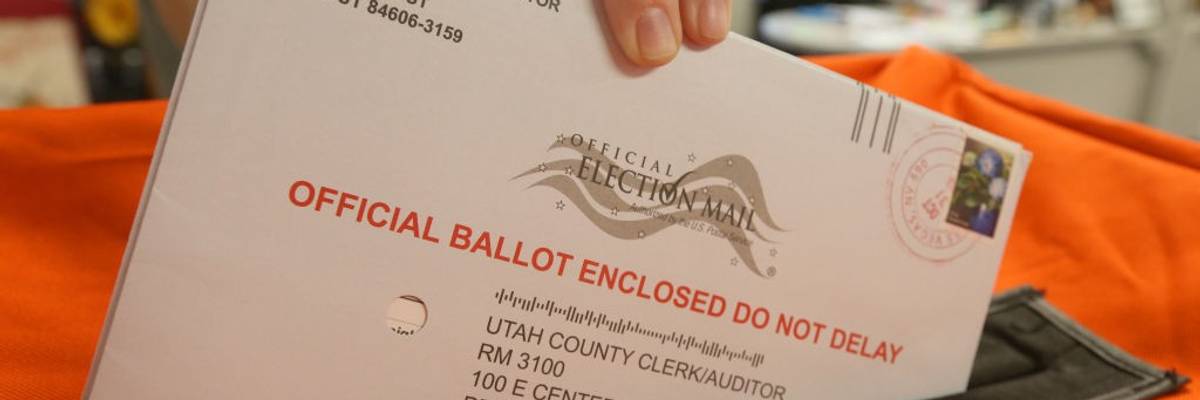
An employee at the Utah County Election Office puts mail-in ballots into a container to register the vote on November 6, 2018 in Provo, Utah.
Mail-in voting "is relied upon by nearly one million Americans serving in the military abroad and nearly 50 million Americans living in the US," noted one expert.
The US Supreme Court heard oral arguments Monday in a case in which Republicans are trying to ban states from accepting mail-in ballots after Election Day—a development that opponents warned could disenfranchise many of the roughly 50 million Americans who voted by mail in 2024.
Watson v. Republican National Committee challenges Mississippi's grace period for accepting mail-in ballots postmarked by Election Day. While most states require mailed ballots to arrive by that date, 14 states provide extra time ranging from days to weeks. Such grace periods allow the votes of people including US troops stationed overseas, Americans living abroad, disabled people, and others to be counted.
The case is partly driven by President Donald Trump's unfounded assertion that mail-in voting is riddled with fraud. Following Trump's 2020 election loss, the Cybersecurity and Infrastructure Security Agency—created by the president in 2018—called the contest “the most secure in American history.” Trump promptly fired the head of the agency before leaving office.
The U.S. Supreme Court will consider a GOP effort to dramatically restrict mail-in voting Monday, when it hears oral arguments in Watson v. Republican National Committee. www.democracydocket.com/news-alerts/...
[image or embed]
— Marc Elias (@marcelias.bsky.social) March 22, 2026 at 8:31 AM
Legal experts observing Monday's oral arguments said that some of the six Republican-appointed justices appeared sympathetic to arguments for restricting mail-in voting.
University of Michigan Law School professor Leah Litman said on Bluesky that Justices Neil Gorsuch, Brett Kavanaugh, and Clarence Thomas "sound like complete MAGA-pilled 'absentee voting/mail in voting is fraudulent' brains" who are "open to invalidating state laws allowing vote counting after Election Day—and perhaps more voting forms."
"They are doing what they often do in these cases with unhinged theories—invent far fetched hypos (could a state allow you to retract your vote, or say your vote is cast when you give your brother a ballot) to distract from what the case is about (is mail-in absentee voting going to be banned)," Litman added.
Slate senior writer Mark Joseph Stern said on Bluesky that Justice Samuel Alito "strongly implied that vote-by-mail, as practiced in most of the country today, is highly susceptible to fraud," adding that Gorsuch and Thomas "leaned in that direction as well," while Justices Amy Coney Barrett and John Roberts "are harder to read."
"SO many questions from the Republican-appointed justices so far having little or nothing to do with the law—they're venting their evident frustrations about modern election laws that broadly authorize mail voting and fretting that they're spoiling elections with distrust and fraud," Stern continued. "Really bad!"
"It's also pretty clear that the Republican-appointed justices do not understand a great deal about how elections are actually administered," he added. "Their questions (and especially hypotheticals) are built on weird, paranoid fantasies that do not align with reality."
Others warned of the high likelihood of voter disenfranchisement should the justices limit mailed ballots.
“Watson v. RNC is a brazen Republican effort to disenfranchise millions of Americans seeking to vote in the midterm elections," said Court Accountability co-founder Lisa Graves. "Mail-in voting has been part of the American election system since the Civil War, and this method of voting is relied upon by nearly one million Americans serving in the military abroad and nearly 50 million Americans living in the US."
“Of course, the hyper-partisan Roberts Court is considering using the power of the nation’s highest court–again–to put its thumb on the scale of justice in ways sought by the Republican Party," Graves continued. "Three Trump appointees on the Supreme Court are poised to join three other Republican appointees to side with the radical ruling of a trio of operatives Trump appointed to the Fifth Circuit."
Last November, the US Fifth Circuit Court of Appeals in New Orleans struck down a Mississippi law that allowed mailed ballots postmarked by Election Day to be counted as long as they arrive within five business days, setting up the Supreme Court showdown.
“Vote-by-mail is a secure and widely used way to participate in our elections," Stand Up America executive director Christina Harvey said Monday. "It’s a lifeline for military and overseas voters, voters with disabilities, elderly voters, and rural voters living far from their polling places. Nearly one-third of the votes cast in the 2024 election were cast by mail, proving just how essential this option has become."
“Watson v. RNC is part of a broader effort to dismantle voting options ahead of this year’s midterms," Harvey continued. "After pushing congressional Republicans to eliminate vote-by-mail and adopting [United States Postal Service] policy changes that could disqualify ballots sent on time, Donald Trump and his allies are asking the Supreme Court to finish the job."
"If the court rules in their favor, they’ll be making it easier for politicians to hold onto power without answering to voters," she added.
Critics allege that disenfranchisement is the point of policies like limiting mail-in voting or requiring voter ID. Republicans have implied—and even admitted outright—that these policies help Republicans win elections. During a 2020 interview, Trump said he opposed expanding mail-in voting, saying such a move would mean the country would "never have a Republican elected... again."
Last year, Trump signed the Orwellian-named “Preserving and Protecting the Integrity of American Elections” executive order, which critics argued would do just the opposite by making it more difficult for millions of voters to cast their ballots. Among other things, the decree pushes states to require proof of citizenship when voting—a policy that opponents warn disproportionately disenfranchises lower-income individuals, elderly, and adopted people without easy access to their birth certificates and those born at home in rural areas whose birth records were never officially filed.
Congressional Republicans are also pushing the SAVE Act and Make Elections Great Again (MEGA) Act, the latter of which was described by one analyst as the “most dangerous attack on voting rights ever" proposed in Congress. The SAVE Act—which would require anyone registering to vote in federal elections to provide documentary proof of US citizenship—passed in the House last month.
Dear Common Dreams reader, It’s been nearly 30 years since I co-founded Common Dreams with my late wife, Lina Newhouser. We had the radical notion that journalism should serve the public good, not corporate profits. It was clear to us from the outset what it would take to build such a project. No paid advertisements. No corporate sponsors. No millionaire publisher telling us what to think or do. Many people said we wouldn't last a year, but we proved those doubters wrong. Together with a tremendous team of journalists and dedicated staff, we built an independent media outlet free from the constraints of profits and corporate control. Our mission has always been simple: To inform. To inspire. To ignite change for the common good. Building Common Dreams was not easy. Our survival was never guaranteed. When you take on the most powerful forces—Wall Street greed, fossil fuel industry destruction, Big Tech lobbyists, and uber-rich oligarchs who have spent billions upon billions rigging the economy and democracy in their favor—the only bulwark you have is supporters who believe in your work. But here’s the urgent message from me today. It's never been this bad out there. And it's never been this hard to keep us going. At the very moment Common Dreams is most needed, the threats we face are intensifying. We need your support now more than ever. We don't accept corporate advertising and never will. We don't have a paywall because we don't think people should be blocked from critical news based on their ability to pay. Everything we do is funded by the donations of readers like you. When everyone does the little they can afford, we are strong. But if that support retreats or dries up, so do we. Will you donate now to make sure Common Dreams not only survives but thrives? —Craig Brown, Co-founder |
The US Supreme Court heard oral arguments Monday in a case in which Republicans are trying to ban states from accepting mail-in ballots after Election Day—a development that opponents warned could disenfranchise many of the roughly 50 million Americans who voted by mail in 2024.
Watson v. Republican National Committee challenges Mississippi's grace period for accepting mail-in ballots postmarked by Election Day. While most states require mailed ballots to arrive by that date, 14 states provide extra time ranging from days to weeks. Such grace periods allow the votes of people including US troops stationed overseas, Americans living abroad, disabled people, and others to be counted.
The case is partly driven by President Donald Trump's unfounded assertion that mail-in voting is riddled with fraud. Following Trump's 2020 election loss, the Cybersecurity and Infrastructure Security Agency—created by the president in 2018—called the contest “the most secure in American history.” Trump promptly fired the head of the agency before leaving office.
The U.S. Supreme Court will consider a GOP effort to dramatically restrict mail-in voting Monday, when it hears oral arguments in Watson v. Republican National Committee. www.democracydocket.com/news-alerts/...
[image or embed]
— Marc Elias (@marcelias.bsky.social) March 22, 2026 at 8:31 AM
Legal experts observing Monday's oral arguments said that some of the six Republican-appointed justices appeared sympathetic to arguments for restricting mail-in voting.
University of Michigan Law School professor Leah Litman said on Bluesky that Justices Neil Gorsuch, Brett Kavanaugh, and Clarence Thomas "sound like complete MAGA-pilled 'absentee voting/mail in voting is fraudulent' brains" who are "open to invalidating state laws allowing vote counting after Election Day—and perhaps more voting forms."
"They are doing what they often do in these cases with unhinged theories—invent far fetched hypos (could a state allow you to retract your vote, or say your vote is cast when you give your brother a ballot) to distract from what the case is about (is mail-in absentee voting going to be banned)," Litman added.
Slate senior writer Mark Joseph Stern said on Bluesky that Justice Samuel Alito "strongly implied that vote-by-mail, as practiced in most of the country today, is highly susceptible to fraud," adding that Gorsuch and Thomas "leaned in that direction as well," while Justices Amy Coney Barrett and John Roberts "are harder to read."
"SO many questions from the Republican-appointed justices so far having little or nothing to do with the law—they're venting their evident frustrations about modern election laws that broadly authorize mail voting and fretting that they're spoiling elections with distrust and fraud," Stern continued. "Really bad!"
"It's also pretty clear that the Republican-appointed justices do not understand a great deal about how elections are actually administered," he added. "Their questions (and especially hypotheticals) are built on weird, paranoid fantasies that do not align with reality."
Others warned of the high likelihood of voter disenfranchisement should the justices limit mailed ballots.
“Watson v. RNC is a brazen Republican effort to disenfranchise millions of Americans seeking to vote in the midterm elections," said Court Accountability co-founder Lisa Graves. "Mail-in voting has been part of the American election system since the Civil War, and this method of voting is relied upon by nearly one million Americans serving in the military abroad and nearly 50 million Americans living in the US."
“Of course, the hyper-partisan Roberts Court is considering using the power of the nation’s highest court–again–to put its thumb on the scale of justice in ways sought by the Republican Party," Graves continued. "Three Trump appointees on the Supreme Court are poised to join three other Republican appointees to side with the radical ruling of a trio of operatives Trump appointed to the Fifth Circuit."
Last November, the US Fifth Circuit Court of Appeals in New Orleans struck down a Mississippi law that allowed mailed ballots postmarked by Election Day to be counted as long as they arrive within five business days, setting up the Supreme Court showdown.
“Vote-by-mail is a secure and widely used way to participate in our elections," Stand Up America executive director Christina Harvey said Monday. "It’s a lifeline for military and overseas voters, voters with disabilities, elderly voters, and rural voters living far from their polling places. Nearly one-third of the votes cast in the 2024 election were cast by mail, proving just how essential this option has become."
“Watson v. RNC is part of a broader effort to dismantle voting options ahead of this year’s midterms," Harvey continued. "After pushing congressional Republicans to eliminate vote-by-mail and adopting [United States Postal Service] policy changes that could disqualify ballots sent on time, Donald Trump and his allies are asking the Supreme Court to finish the job."
"If the court rules in their favor, they’ll be making it easier for politicians to hold onto power without answering to voters," she added.
Critics allege that disenfranchisement is the point of policies like limiting mail-in voting or requiring voter ID. Republicans have implied—and even admitted outright—that these policies help Republicans win elections. During a 2020 interview, Trump said he opposed expanding mail-in voting, saying such a move would mean the country would "never have a Republican elected... again."
Last year, Trump signed the Orwellian-named “Preserving and Protecting the Integrity of American Elections” executive order, which critics argued would do just the opposite by making it more difficult for millions of voters to cast their ballots. Among other things, the decree pushes states to require proof of citizenship when voting—a policy that opponents warn disproportionately disenfranchises lower-income individuals, elderly, and adopted people without easy access to their birth certificates and those born at home in rural areas whose birth records were never officially filed.
Congressional Republicans are also pushing the SAVE Act and Make Elections Great Again (MEGA) Act, the latter of which was described by one analyst as the “most dangerous attack on voting rights ever" proposed in Congress. The SAVE Act—which would require anyone registering to vote in federal elections to provide documentary proof of US citizenship—passed in the House last month.
The US Supreme Court heard oral arguments Monday in a case in which Republicans are trying to ban states from accepting mail-in ballots after Election Day—a development that opponents warned could disenfranchise many of the roughly 50 million Americans who voted by mail in 2024.
Watson v. Republican National Committee challenges Mississippi's grace period for accepting mail-in ballots postmarked by Election Day. While most states require mailed ballots to arrive by that date, 14 states provide extra time ranging from days to weeks. Such grace periods allow the votes of people including US troops stationed overseas, Americans living abroad, disabled people, and others to be counted.
The case is partly driven by President Donald Trump's unfounded assertion that mail-in voting is riddled with fraud. Following Trump's 2020 election loss, the Cybersecurity and Infrastructure Security Agency—created by the president in 2018—called the contest “the most secure in American history.” Trump promptly fired the head of the agency before leaving office.
The U.S. Supreme Court will consider a GOP effort to dramatically restrict mail-in voting Monday, when it hears oral arguments in Watson v. Republican National Committee. www.democracydocket.com/news-alerts/...
[image or embed]
— Marc Elias (@marcelias.bsky.social) March 22, 2026 at 8:31 AM
Legal experts observing Monday's oral arguments said that some of the six Republican-appointed justices appeared sympathetic to arguments for restricting mail-in voting.
University of Michigan Law School professor Leah Litman said on Bluesky that Justices Neil Gorsuch, Brett Kavanaugh, and Clarence Thomas "sound like complete MAGA-pilled 'absentee voting/mail in voting is fraudulent' brains" who are "open to invalidating state laws allowing vote counting after Election Day—and perhaps more voting forms."
"They are doing what they often do in these cases with unhinged theories—invent far fetched hypos (could a state allow you to retract your vote, or say your vote is cast when you give your brother a ballot) to distract from what the case is about (is mail-in absentee voting going to be banned)," Litman added.
Slate senior writer Mark Joseph Stern said on Bluesky that Justice Samuel Alito "strongly implied that vote-by-mail, as practiced in most of the country today, is highly susceptible to fraud," adding that Gorsuch and Thomas "leaned in that direction as well," while Justices Amy Coney Barrett and John Roberts "are harder to read."
"SO many questions from the Republican-appointed justices so far having little or nothing to do with the law—they're venting their evident frustrations about modern election laws that broadly authorize mail voting and fretting that they're spoiling elections with distrust and fraud," Stern continued. "Really bad!"
"It's also pretty clear that the Republican-appointed justices do not understand a great deal about how elections are actually administered," he added. "Their questions (and especially hypotheticals) are built on weird, paranoid fantasies that do not align with reality."
Others warned of the high likelihood of voter disenfranchisement should the justices limit mailed ballots.
“Watson v. RNC is a brazen Republican effort to disenfranchise millions of Americans seeking to vote in the midterm elections," said Court Accountability co-founder Lisa Graves. "Mail-in voting has been part of the American election system since the Civil War, and this method of voting is relied upon by nearly one million Americans serving in the military abroad and nearly 50 million Americans living in the US."
“Of course, the hyper-partisan Roberts Court is considering using the power of the nation’s highest court–again–to put its thumb on the scale of justice in ways sought by the Republican Party," Graves continued. "Three Trump appointees on the Supreme Court are poised to join three other Republican appointees to side with the radical ruling of a trio of operatives Trump appointed to the Fifth Circuit."
Last November, the US Fifth Circuit Court of Appeals in New Orleans struck down a Mississippi law that allowed mailed ballots postmarked by Election Day to be counted as long as they arrive within five business days, setting up the Supreme Court showdown.
“Vote-by-mail is a secure and widely used way to participate in our elections," Stand Up America executive director Christina Harvey said Monday. "It’s a lifeline for military and overseas voters, voters with disabilities, elderly voters, and rural voters living far from their polling places. Nearly one-third of the votes cast in the 2024 election were cast by mail, proving just how essential this option has become."
“Watson v. RNC is part of a broader effort to dismantle voting options ahead of this year’s midterms," Harvey continued. "After pushing congressional Republicans to eliminate vote-by-mail and adopting [United States Postal Service] policy changes that could disqualify ballots sent on time, Donald Trump and his allies are asking the Supreme Court to finish the job."
"If the court rules in their favor, they’ll be making it easier for politicians to hold onto power without answering to voters," she added.
Critics allege that disenfranchisement is the point of policies like limiting mail-in voting or requiring voter ID. Republicans have implied—and even admitted outright—that these policies help Republicans win elections. During a 2020 interview, Trump said he opposed expanding mail-in voting, saying such a move would mean the country would "never have a Republican elected... again."
Last year, Trump signed the Orwellian-named “Preserving and Protecting the Integrity of American Elections” executive order, which critics argued would do just the opposite by making it more difficult for millions of voters to cast their ballots. Among other things, the decree pushes states to require proof of citizenship when voting—a policy that opponents warn disproportionately disenfranchises lower-income individuals, elderly, and adopted people without easy access to their birth certificates and those born at home in rural areas whose birth records were never officially filed.
Congressional Republicans are also pushing the SAVE Act and Make Elections Great Again (MEGA) Act, the latter of which was described by one analyst as the “most dangerous attack on voting rights ever" proposed in Congress. The SAVE Act—which would require anyone registering to vote in federal elections to provide documentary proof of US citizenship—passed in the House last month.