

SUBSCRIBE TO OUR FREE NEWSLETTER
Daily news & progressive opinion—funded by the people, not the corporations—delivered straight to your inbox.
5
#000000
#FFFFFF
To donate by check, phone, or other method, see our More Ways to Give page.
Daily news & progressive opinion—funded by the people, not the corporations—delivered straight to your inbox.
A proposed Ugandan law on HIV/AIDS promotes dangerous and discredited approaches to the AIDS epidemic and would violate human rights, a group of more than 50 Ugandan and international organizations and individuals said in a report released today. The HIV and AIDS Prevention and Control Bill could be taken up by Uganda's parliament shortly.
The report, a 10-page analysis of the bill, was released in Kampala, Uganda, and Geneva, Switzerland at a meeting on HIV treatment sponsored by the World Health Organization. The report criticizes repressive provisions in the legislation as contrary to the goal of universal access to HIV prevention, care, and treatment. The proposed law includes mandatory testing for HIV and forced disclosure of HIV status. It also criminalizes the willful transmission of HIV, the failure to "observe instructions on prevention and treatment," and misleading statements on preventing or controlling HIV.
"We know what works and what doesn't in fighting HIV," said Beatrice Were of the Uganda Network on Law, Ethics & HIV/AIDS. "This bill, unfortunately, is full of ineffective approaches that violate human rights and will set us back in our efforts to fight the AIDS epidemic and expand HIV programs nationwide."
The report cites Uganda's success during the 1990's in addressing HIV. Rather than adopt punitive approaches, the government engaged civil society in prevention efforts and worked to reduce the stigma of the disease. Citing international standards and "best practices," the report says that mandatory testing and criminal penalties can be counterproductive, driving people away from testing and treatment.
The report also highlighted how laws that criminalize HIV transmission can result in disproportionate prosecution of women because more women are tested as part of pre- or ante-natal medical care and therefore know their HIV status. Women's inability to safely negotiate condom use or disclosure to partners who might have been the source of their infection is not recognized in the bill as defenses against criminal penalties. Women who transmit HIV to their infants after birth via breast milk would also be subject to criminal prosecution, the report says.
"Women and girls have been disproportionately affected by HIV/AIDS," said Joseph Amon, health and human rights director at Human Rights Watch. "My fear is that mandatory testing and disclosure will lead to prosecution and violence instead of treatment and care."
The bill also criminalizes a wide and ill-defined range of conduct, such as discrimination against people living with HIV/AIDS and breach of confidentiality. According to the report, many of these acts are better dealt with through civil liability. Criminalizing such a wide range of actions opens the door for the government to prosecute people in selective or abusive ways while adding to the huge backlog in Uganda's courts.
The report highlights other areas in which the bill lacks specificity or appropriate guidance, including provisions that waive consent to testing when it is "unreasonably withheld." The report also found that the bill contains insufficient protections relating to the testing of children and their subsequent treatment, care, and support.
Further, the bill would mandate compulsory testing for drug users and sex workers, two already marginalized and criminalized groups. The report expresses concern that the proposed law, combined with other legislative efforts strengthening penalties related to homosexuality, is adding to a body of repressive criminal law in Uganda. These laws make it more difficult for civil society and non-governmental organizations to conduct effective programs with stigmatized communities.
"It's important to have a law that protects the rights of people with regard to the HIV/AIDS epidemic," Amon said. "But the bill as drafted would only make it harder to prevent and treat HIV and would put Uganda's HIV policies and response far outside of global norms."
In early November, a slightly updated version of the bill was made available for public comment. The most troubling aspects, including the lack of consent in testing, third party disclosure by medical practitioners, and criminalization of transmission have not changed. The modifications to the bill are in some instances harmful, in others beneficial.
The bill introduces additional, troubling provisions:
Some changes to the bill improve the potential for human rights protections, such as:
Endorsing Organizations and Individuals are:
1. ActionAid International Uganda
Uganda
2. African Services Committee
United States
3. AIDS and Rights Alliance for Southern Africa
Namibia
4. Andrey Rylkov Foundation for Health and Social Justice
Russia
5. ATHENA Network
Global
6. BAOBAB for Women's Human Rights
Nigeria
7. The Canadian HIV/AIDS Legal Network
Canada
8. Canadian Treatment Action Council
Canada
9. Caribbean Vulnerable Communities Coalition
Jamaica
10. Center for Health Policy and Innovation
South Africa
11. Center for Reproductive Rights
United States
12. Center for the Right to Health
Nigeria
13. Children's Hope Initiative
Kampala, Uganda
14. Community HIV/AIDS Mobilization Project
United States
15. Foundation for Integrative AIDS Research
United States
16. Fundacion para Estudio a Investigacion de la Mujer
[Foundation for Studies and Research on Women]
Argentina
17. Global AIDS Alliance
United States
18. The Global Forum on MSM & HIV
United States
19. Global Coalition of Women against AIDS in Uganda
Uganda
20. Health GAP
United States
21. International AIDS Women's Caucus
Global
22. International Community of Women Living with HIV and AIDS
Global
23. International Community of Women Living with HIV & AIDS-Eastern Africa Region
Uganda
24. Lembaga Bantuan Hukum Masyarakat [Community Legal Aid Institute]
Indonesia
25. Mama's Club
United States
26. National AIDS Housing Coalition - Facilitator of the International AIDS Housing Roundtable
United States
27. National Coalition of Women with AIDS in Uganda (NACOA)
Uganda
28. National Community of Women living with HIV/AIDS in Uganda (NACWOLA)
Uganda
29. National Empowerment Network of PLHAs in Kenya (NEPHAK)
Nairobi, Kenya
30. National Forum of People Living with HIV/AIDS Networks in Uganda
Uganda
31. National Guidance and Empowerment Network of People with HIV and AIDS
Uganda
32. Physicians for Human Rights
United States
33. Positive Malaysian Treatment Access & Advocacy Group
Malaysia
34. Positive Women Incorporated
New Zealand
35. Positive Women Leaders of Uganda (POWL)
Uganda
36. Prevenir es Cuidar [Prevention is Care]
Argentina
37. Rubaga Exchange on AIDS and Livelihood Support Group
Uganda
38. Sampada Grameen Mahila Sanstha (SANGRAM)
India
39. Social Justice Advocacy Initiative
Nigeria
40. Support on AIDS & Life thru Telephone Helpline (SALT)
Uganda
41. Tanzania Women Living with HIV/AIDS (Tawoliha)
Tanzania
42. Uganda Network of AIDS Service Organisation (UNASO)
Uganda
43. Uganda Young Positives
Uganda
44. United Belize Advocacy Movement
Belize
45. UGANET
Uganda
Individuals:
Assistant Professor, McGill University
Canada
47. Amanda Lugg
United States
48. Moses Mulumba, LLB
Health and Human Rights Advisor
Coalition for Health promotion and Social Development
Uganda
49. Maria Rakgowa
Botswana
50. Mindy Roseman
Lecturer on Law, Harvard Law School
United States
51. Meena Saraswathi Seshu
India
52. Busingye Kabumba
Lecturer, Faculty of Law
Makerere University
Uganda
Human Rights Watch is one of the world's leading independent organizations dedicated to defending and protecting human rights. By focusing international attention where human rights are violated, we give voice to the oppressed and hold oppressors accountable for their crimes. Our rigorous, objective investigations and strategic, targeted advocacy build intense pressure for action and raise the cost of human rights abuse. For 30 years, Human Rights Watch has worked tenaciously to lay the legal and moral groundwork for deep-rooted change and has fought to bring greater justice and security to people around the world.

Iran's first vice president called the attack a new "symbol of Trump's madness and ignorance."
A wave of US-Israeli airstrikes on Monday hit and extensively damaged Sharif University of Technology, a leading Iranian educational institution that is widely known as "the MIT of Iran" and seen as one of the world's top engineering schools.
The attack on the Tehran university—one of dozens of education sites bombed by the US and Israel since they launched their war on Iran in late February—sparked outrage inside Iran and around the world. Mohammad Reza Aref, an engineer currently serving as Iran's first vice president, said the attack on Sharif University "is a symbol of [US President Donald] Trump's madness and ignorance."
"He fails to understand that Iran's knowledge is not embedded in concrete to be destroyed by bombs; the true fortress is the will of our professors and elites," Aref wrote. "No barbarity in history has ever been able to strip science from the Iranian people. Science is rooted in our souls, and this fortress will not crumble."
The National Iranian American Council called the bombing "another outrageous, criminal act in an illegal war."
"This was a center of learning, not a military target," the group wrote on social media, highlighting video footage showing a building in ruins. "The increasing use of the Gaza playbook in Iran is deeply disturbing and will only deepen insecurity for the US and Israel. End this war."
US Rep. Yassamin Ansari (D-Ariz.), the lone Iranian American in Congress, noted that Sharif University has "produced a huge number of engineers who’ve gone on to Silicon Valley and founded some of the most successful American tech companies."
"Why are we bombing a university in a city of 10 million people?" Ansari asked.
Another outrageous, criminal act in an illegal war: U.S.-Israeli strikes have bombed one of the world’s most prestigious universities in Sharif University of Technology in Tehran. This was a center of learning, not a military target. The increasing use of the Gaza playbook in… pic.twitter.com/GE6J8WhgMC
— NIAC (@NIACouncil) April 6, 2026
Al Jazeera's Tohid Asadi reported from Tehran that the university was "severely hit, with extensive damage reported in the compound's mosque and laboratories."
Vira Ameli, an Iranian global health researcher and lecturer at the University of Oxford, decried the US-Israeli strike on Sharif University, where she spent time as a postdoctoral fellow.
"To wake to the news of this war crime, at a distance and unable to return, is difficult to articulate," Ameli wrote. "And yet history has made one thing clear: Iran is not a country undone by bombardment."
Iranian authorities say US-Israeli attacks have hit at least 30 of the nation's universities, including the Isfahan University of Technology and the Iran University of Science and Technology. The US and Israel have justified some of the attacks by claiming the universities were involved in military-related activities.
"Would American and Israeli leaders consider their own equivalent institutions fair game? Of course not," journalist Natasha Lennard wrote in a column for The Intercept last week. "By stated US and Israeli rationale, however, were Iran able to launch airstrikes on American soil, direct ties to the U.S. and Israeli military-industrial complex would make valid targets of at least the University of California, Berkeley; the Massachusetts Institute of Technology; and Johns Hopkins University, among dozens of other schools."
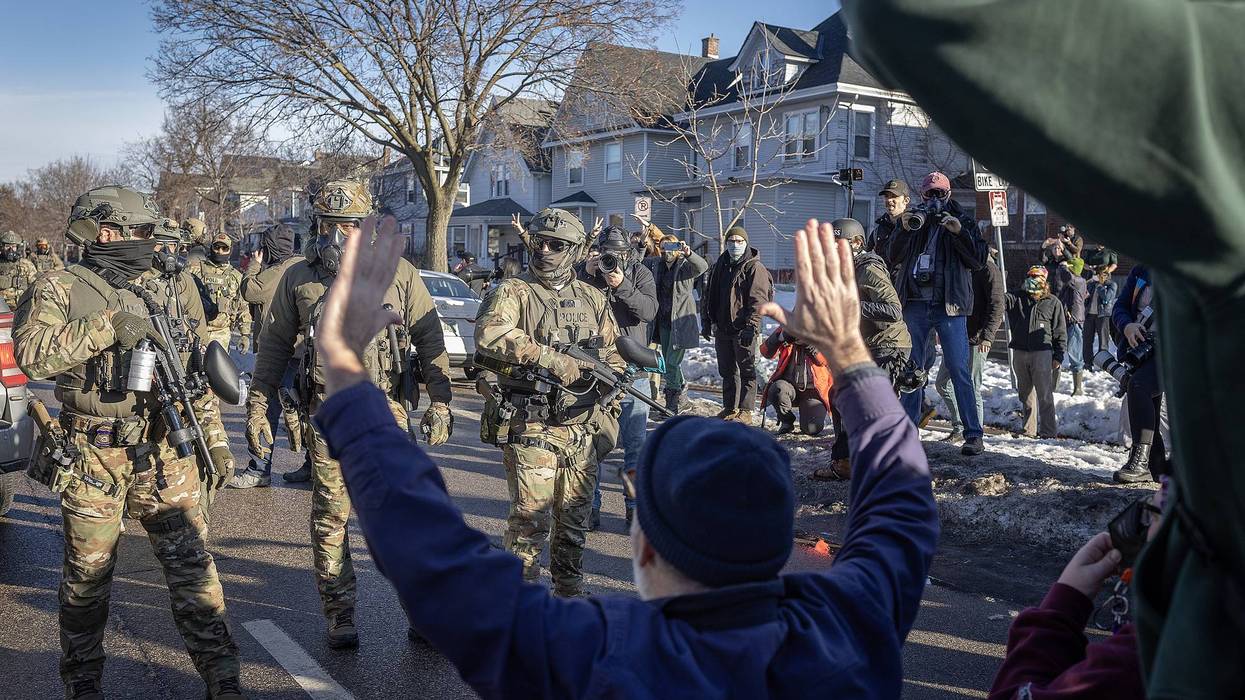
Minneapolis Mayor Jacob Frey said "bare due diligence" would have exposed ICE officers' falsehoods.
Video footage obtained by The New York Times has exposed lies told by two federal immigration enforcement agents about the circumstances leading up to a non-fatal shooting in Minneapolis that occurred on January 14.
According to a Monday report from the Times, the video directly contradicts claims made by US Immigration and Customs Enforcement (ICE) officials that they were attacked by assailants armed with a shovel and a broom for around three minutes before the agents opened fire and wounded one of the attackers.
"Instead, the confrontation depicted in the video lasts about 12 seconds and shows two men struggling with the agent," reported the Times. "It shows no sustained attack with a shovel."
Federal prosecutors had initially pursued assault charges against Venezuelan national Julio Cesar Sosa-Celis, who was shot in the leg by the ICE officers during the January confrontation, and fellow Venezuelan national Alfredo Aljorna.
However, the government abruptly dropped charges against the two men in February, and ICE Acting Director Todd Lyons acknowledged that two federal officers appear “to have made untruthful statements” about the incident.
The Times noted that the government had access to the video of the shooting hours after it took place.
However, one source told the paper that prosecutors didn't watch the video until three weeks after they filed charges against Sosa-Celis and Aljorna, and instead relied on "the ICE agent’s statement and an FBI agent’s affidavit describing the footage."
This revelation prompted a rebuke from Minneapolis Mayor Jacob Frey, who told the Times that "bare due diligence would have shown that the agents were lying."
Trump administration officials have come under fire in recent weeks for lying about shootings involving federal immigration officials, such as when former US Homeland Security Secretary Kristi Noem falsely claimed that slain Minneapolis intensive care nurse Alex Pretti was aiming “to inflict maximum damage on individuals and to kill law enforcement."
In reality, video footage showed Pretti never drew his handgun during his confrontation with federal immigration officers, while also clearly showing that officers disarmed him before they opened fire.
Noem also falsely claimed that slain ICE observer Renee Good had attempted "an act of domestic terrorism" by trying to run over a federal immigration officer with her car, even though footage clearly showed Good turning her vehicle away from the officer in an attempt to get away from the scene.

"This is an express public incitement for war crimes and crimes against humanity—and, I would say, for genocide," said a spokesperson for Iran's Foreign Ministry.
Iranian officials on Monday warned US President Donald Trump that his name will be "etched in history as a supreme war criminal" if he follows through with his threat to wage total war on Iran's civilian infrastructure, including bridges and power plants.
Kazem Gharibabadi, Iran's deputy foreign minister, wrote on social media following Trump's Easter-morning outburst that "threats to attack power plants and bridges (civilian infrastructure) constitute war crimes under Article 8(2)(b) of the Rome Statute of the International Criminal Court and Protocol I to the Geneva Conventions of 1977 (Article 52)."
"The president of the United States, in his capacity as the highest-ranking official of his country, has openly threatened to commit war crimes—an act that entails his individual criminal responsibility before the International Criminal Court and any competent national court," Gharibabadi added, vowing that Iran "will deliver a decisive, immediate, and regret-inducing response" to any attack.
Esmail Baghaei, a spokesperson for Iran's Foreign Ministry, said Trump's threats are "an indication of a criminal mindset."
"This is an express public incitement for war crimes and crimes against humanity—and, I would say, for genocide," Baghaei said in an interview on Sunday. "Threatening to attack a country's critical infrastructure, energy sector, it would mean that you want to put at risk the whole population."
Absolute bombshell. Iran's Spokesperson Esmail Baghaei accuses the Trump administration of a criminal mindset and public incitement for genocide. Threatening a nation's critical infrastructure puts the entire population at risk. The White House has completely abandoned morality. pic.twitter.com/HcBZGZho5p
— Furkan Gözükara (@FurkanGozukara) April 5, 2026
The US and Israel have already done significant damage to Iran's civilian infrastructure. The country's deputy health minister said Monday that more than 360 healthcare, education, and research centers have been hit by US-Israeli strikes, and dozens of medics have been killed since the bombing began on February 28.
But Trump on Sunday threatened an indiscriminate assault, telling Fox News that if the Iranians "don't make a deal and fast," he is "considering blowing everything up and taking the oil."
"You're going to see bridges and power plants dropping all over their country," the president said, setting a new deadline of 8 pm ET for the complete reopening of the Strait of Hormuz.
Trump's remarks came after he published a deranged post on his Truth Social platform demanding that Iran "open the Fuckin' Strait, you crazy bastards, or you'll be living in Hell."
Analysts and lawmakers in the US echoed Iranian officials' warnings that Trump's threatened attacks would constitute war crimes.
"Trump's advisers are telling him to hit civilian sites because it will cause unrest and potentially topple the regime. But just think about the insanity of this plan: kill tens of thousands of civilians in order to cause a national panic," US Sen. Chris Murphy (D-Conn.) wrote. "Bombing to induce political panic IS A WAR CRIME."
Dylan Williams, vice president for government affairs at the Center for International Policy, said that "any lawmaker who votes for supplemental funding for the war on Iran or against war powers resolutions to end it will be fully complicit in the war crimes threatened here, as well as those already committed by this unhinged and unfit Commander in Chief."
The US president's renewed threats came amid reports of a diplomatic effort, mediated in part by Pakistan, to enact a 45-day ceasefire to provide space for a lasting resolution to the war.
Axios reported that the talks are seen as "the only chance to prevent a dramatic escalation in the war that will include massive strikes on Iranian civilian infrastructure and a retaliation against energy and water facilities in the Gulf states."