SUBSCRIBE TO OUR FREE NEWSLETTER
Daily news & progressive opinion—funded by the people, not the corporations—delivered straight to your inbox.
5
#000000
#FFFFFF
To donate by check, phone, or other method, see our More Ways to Give page.
Daily news & progressive opinion—funded by the people, not the corporations—delivered straight to your inbox.
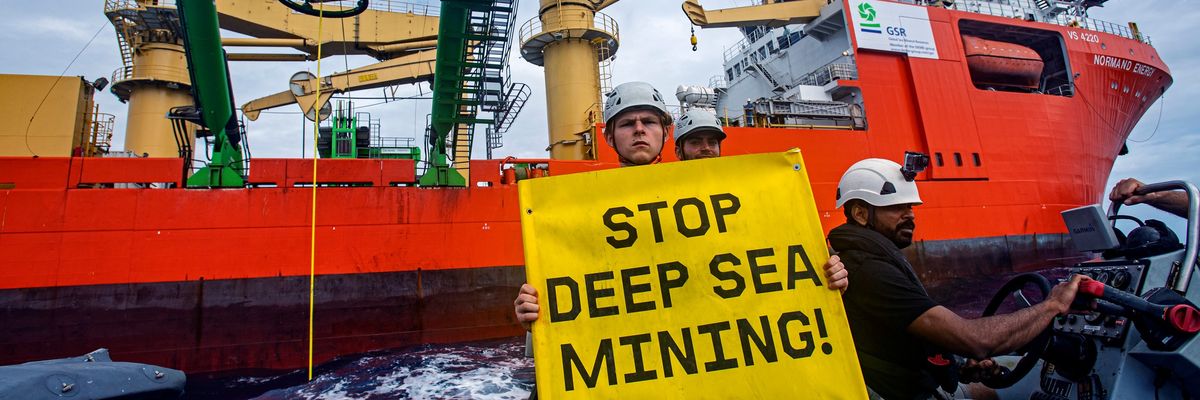
Greenpeace International activists attach a flag reading "Stop Deep Sea Mining'' to the cable holding the prototype robot, Patania II, to disturb a deep-sea mining impact test by the company Global Sea Mineral Resources.
As talks resume, supporters of a moratorium are also calling for the ouster of the International Seabed Authority's leader, who faces an election on July 29.
As talks to establish global policies on deep-sea mining resumed in Jamaica on Monday, Greenpeace International renewed its demand for a moratorium on the practice, the path also backed other civil society and Indigenous groups, at least hundreds of science and policy experts, and 27 countries.
"The science is clear—there can't be deep-sea mining without environmental cost and the only solution is a moratorium. The more we know about deep-sea mining, the harder it is to justify it," said Greenpeace campaigner Louisa Casson, who is attending the United Nations-affiliated International Seabed Authority's (ISA) 29th session in Kingston.
"Governments at the ISA must not dance to the tune of the industry and approve rushed regulations for the benefit of a few over the interests of Pacific communities and the opinion of scientists," Casson argued, as companies and countries see chances to cash in on the clean energy transition by extracting metals including cobalt, copper, and nickel.
"The deep ocean sustains crucial processes that make the entire planet habitable, from driving ocean currents that regulate our weather to storing carbon and buffering our planet against the impacts of climate change."
The Associated Press reported Monday that although the ISA has not allowed any extraction during debates, it "has granted 31 mining exploration contracts," and "much of the ongoing exploration is centered in the Clarion-Clipperton Fracture Zone, which covers 1.7 million square miles (4.5 million square kilometers) between Hawaii and Mexico."
The Mexican government last year endorsed a moratorium and Democratic Hawaii Gov. Josh Green last week signed a bill banning seabed mining in state waters, citing "environmental risks and constitutional rights to have a clean and healthy environment."
Ahead of the meeting in Jamaica, Deep Sea Conservation Coalition campaign lead Sofia Tsenikli highlighted that "gouging minerals from the seafloor poses an existential threat that goes far beyond the immediate destruction of deep-sea wildlife and habitats."
"The deep ocean sustains crucial processes that make the entire planet habitable, from driving ocean currents that regulate our weather to storing carbon and buffering our planet against the impacts of climate change," Tsenikli said. "States must now protect the ocean and not allow any more damage."
The ISA was established under the 1982 U.N. Convention on the Law of the Sea and a related 1994 agreement, and is responsible for waters not under the control of specific nations. As Common Dreams reported earlier this month, some diplomats have accused British lawyer Michael Lodge, its current secretary-general, of trying to speed up the start of mining.
"The rush to complete the mining code was triggered by the Pacific island state of Nauru, which is expected to submit a mining license application on behalf of Canada's the Metals Company (TMC) later this year, regardless of whether or not regulations are complete," Reuters noted Monday.
After ISA's 36-member Council negotiates the "Mining Code" over the next two weeks, its full Assembly is scheduled to meet on July 29 to vote on the next secretary-general, with Lodge facing a challenge from Brazil's Leticia Carvalho for the top post.
"It is time for change at the ISA," Casson of Greenpeace declared Monday. "A third term for Michael Lodge would not only put the oceans under threat but also risk further damaging public trust in the regulator. Mining companies are impatient to get started and mounting evidence indicates that Lodge is overstepping his supposedly-neutral role to align with commercial interests."
"The ISA must listen to millions of people and the growing number of governments calling for a halt to deep-sea mining," she added. "It is time to put conservation at the heart of the ISA's work."
In preparation for the talks in Kingston, Environment Oregon Research & Policy Center, U.S. Public Interest Research Group (PIRG) Education Fund, and Frontier Group last month released a report showing that not only would deep-sea mining destroy "a vibrant, biodiverse place, teeming with complex ecosystems and thousands, possibly millions of species," but also it isn't necessary.
"Disposable electronic devices are creating a toxic e-waste mess. Now, some mining companies are trying to convince policymakers that we need to wreak havoc on the ocean to source the materials to make more," said Charlie Fisher of the Oregon State PIRG Foundation. "This report shows that we don't need to ruin the deep sea to make the products we need. There is a more sustainable path: Make long-lasting, fixable electronics and recycle them when they no longer work."
Dear Common Dreams reader, It’s been nearly 30 years since I co-founded Common Dreams with my late wife, Lina Newhouser. We had the radical notion that journalism should serve the public good, not corporate profits. It was clear to us from the outset what it would take to build such a project. No paid advertisements. No corporate sponsors. No millionaire publisher telling us what to think or do. Many people said we wouldn't last a year, but we proved those doubters wrong. Together with a tremendous team of journalists and dedicated staff, we built an independent media outlet free from the constraints of profits and corporate control. Our mission has always been simple: To inform. To inspire. To ignite change for the common good. Building Common Dreams was not easy. Our survival was never guaranteed. When you take on the most powerful forces—Wall Street greed, fossil fuel industry destruction, Big Tech lobbyists, and uber-rich oligarchs who have spent billions upon billions rigging the economy and democracy in their favor—the only bulwark you have is supporters who believe in your work. But here’s the urgent message from me today. It's never been this bad out there. And it's never been this hard to keep us going. At the very moment Common Dreams is most needed, the threats we face are intensifying. We need your support now more than ever. We don't accept corporate advertising and never will. We don't have a paywall because we don't think people should be blocked from critical news based on their ability to pay. Everything we do is funded by the donations of readers like you. When everyone does the little they can afford, we are strong. But if that support retreats or dries up, so do we. Will you donate now to make sure Common Dreams not only survives but thrives? —Craig Brown, Co-founder |
As talks to establish global policies on deep-sea mining resumed in Jamaica on Monday, Greenpeace International renewed its demand for a moratorium on the practice, the path also backed other civil society and Indigenous groups, at least hundreds of science and policy experts, and 27 countries.
"The science is clear—there can't be deep-sea mining without environmental cost and the only solution is a moratorium. The more we know about deep-sea mining, the harder it is to justify it," said Greenpeace campaigner Louisa Casson, who is attending the United Nations-affiliated International Seabed Authority's (ISA) 29th session in Kingston.
"Governments at the ISA must not dance to the tune of the industry and approve rushed regulations for the benefit of a few over the interests of Pacific communities and the opinion of scientists," Casson argued, as companies and countries see chances to cash in on the clean energy transition by extracting metals including cobalt, copper, and nickel.
"The deep ocean sustains crucial processes that make the entire planet habitable, from driving ocean currents that regulate our weather to storing carbon and buffering our planet against the impacts of climate change."
The Associated Press reported Monday that although the ISA has not allowed any extraction during debates, it "has granted 31 mining exploration contracts," and "much of the ongoing exploration is centered in the Clarion-Clipperton Fracture Zone, which covers 1.7 million square miles (4.5 million square kilometers) between Hawaii and Mexico."
The Mexican government last year endorsed a moratorium and Democratic Hawaii Gov. Josh Green last week signed a bill banning seabed mining in state waters, citing "environmental risks and constitutional rights to have a clean and healthy environment."
Ahead of the meeting in Jamaica, Deep Sea Conservation Coalition campaign lead Sofia Tsenikli highlighted that "gouging minerals from the seafloor poses an existential threat that goes far beyond the immediate destruction of deep-sea wildlife and habitats."
"The deep ocean sustains crucial processes that make the entire planet habitable, from driving ocean currents that regulate our weather to storing carbon and buffering our planet against the impacts of climate change," Tsenikli said. "States must now protect the ocean and not allow any more damage."
The ISA was established under the 1982 U.N. Convention on the Law of the Sea and a related 1994 agreement, and is responsible for waters not under the control of specific nations. As Common Dreams reported earlier this month, some diplomats have accused British lawyer Michael Lodge, its current secretary-general, of trying to speed up the start of mining.
"The rush to complete the mining code was triggered by the Pacific island state of Nauru, which is expected to submit a mining license application on behalf of Canada's the Metals Company (TMC) later this year, regardless of whether or not regulations are complete," Reuters noted Monday.
After ISA's 36-member Council negotiates the "Mining Code" over the next two weeks, its full Assembly is scheduled to meet on July 29 to vote on the next secretary-general, with Lodge facing a challenge from Brazil's Leticia Carvalho for the top post.
"It is time for change at the ISA," Casson of Greenpeace declared Monday. "A third term for Michael Lodge would not only put the oceans under threat but also risk further damaging public trust in the regulator. Mining companies are impatient to get started and mounting evidence indicates that Lodge is overstepping his supposedly-neutral role to align with commercial interests."
"The ISA must listen to millions of people and the growing number of governments calling for a halt to deep-sea mining," she added. "It is time to put conservation at the heart of the ISA's work."
In preparation for the talks in Kingston, Environment Oregon Research & Policy Center, U.S. Public Interest Research Group (PIRG) Education Fund, and Frontier Group last month released a report showing that not only would deep-sea mining destroy "a vibrant, biodiverse place, teeming with complex ecosystems and thousands, possibly millions of species," but also it isn't necessary.
"Disposable electronic devices are creating a toxic e-waste mess. Now, some mining companies are trying to convince policymakers that we need to wreak havoc on the ocean to source the materials to make more," said Charlie Fisher of the Oregon State PIRG Foundation. "This report shows that we don't need to ruin the deep sea to make the products we need. There is a more sustainable path: Make long-lasting, fixable electronics and recycle them when they no longer work."
As talks to establish global policies on deep-sea mining resumed in Jamaica on Monday, Greenpeace International renewed its demand for a moratorium on the practice, the path also backed other civil society and Indigenous groups, at least hundreds of science and policy experts, and 27 countries.
"The science is clear—there can't be deep-sea mining without environmental cost and the only solution is a moratorium. The more we know about deep-sea mining, the harder it is to justify it," said Greenpeace campaigner Louisa Casson, who is attending the United Nations-affiliated International Seabed Authority's (ISA) 29th session in Kingston.
"Governments at the ISA must not dance to the tune of the industry and approve rushed regulations for the benefit of a few over the interests of Pacific communities and the opinion of scientists," Casson argued, as companies and countries see chances to cash in on the clean energy transition by extracting metals including cobalt, copper, and nickel.
"The deep ocean sustains crucial processes that make the entire planet habitable, from driving ocean currents that regulate our weather to storing carbon and buffering our planet against the impacts of climate change."
The Associated Press reported Monday that although the ISA has not allowed any extraction during debates, it "has granted 31 mining exploration contracts," and "much of the ongoing exploration is centered in the Clarion-Clipperton Fracture Zone, which covers 1.7 million square miles (4.5 million square kilometers) between Hawaii and Mexico."
The Mexican government last year endorsed a moratorium and Democratic Hawaii Gov. Josh Green last week signed a bill banning seabed mining in state waters, citing "environmental risks and constitutional rights to have a clean and healthy environment."
Ahead of the meeting in Jamaica, Deep Sea Conservation Coalition campaign lead Sofia Tsenikli highlighted that "gouging minerals from the seafloor poses an existential threat that goes far beyond the immediate destruction of deep-sea wildlife and habitats."
"The deep ocean sustains crucial processes that make the entire planet habitable, from driving ocean currents that regulate our weather to storing carbon and buffering our planet against the impacts of climate change," Tsenikli said. "States must now protect the ocean and not allow any more damage."
The ISA was established under the 1982 U.N. Convention on the Law of the Sea and a related 1994 agreement, and is responsible for waters not under the control of specific nations. As Common Dreams reported earlier this month, some diplomats have accused British lawyer Michael Lodge, its current secretary-general, of trying to speed up the start of mining.
"The rush to complete the mining code was triggered by the Pacific island state of Nauru, which is expected to submit a mining license application on behalf of Canada's the Metals Company (TMC) later this year, regardless of whether or not regulations are complete," Reuters noted Monday.
After ISA's 36-member Council negotiates the "Mining Code" over the next two weeks, its full Assembly is scheduled to meet on July 29 to vote on the next secretary-general, with Lodge facing a challenge from Brazil's Leticia Carvalho for the top post.
"It is time for change at the ISA," Casson of Greenpeace declared Monday. "A third term for Michael Lodge would not only put the oceans under threat but also risk further damaging public trust in the regulator. Mining companies are impatient to get started and mounting evidence indicates that Lodge is overstepping his supposedly-neutral role to align with commercial interests."
"The ISA must listen to millions of people and the growing number of governments calling for a halt to deep-sea mining," she added. "It is time to put conservation at the heart of the ISA's work."
In preparation for the talks in Kingston, Environment Oregon Research & Policy Center, U.S. Public Interest Research Group (PIRG) Education Fund, and Frontier Group last month released a report showing that not only would deep-sea mining destroy "a vibrant, biodiverse place, teeming with complex ecosystems and thousands, possibly millions of species," but also it isn't necessary.
"Disposable electronic devices are creating a toxic e-waste mess. Now, some mining companies are trying to convince policymakers that we need to wreak havoc on the ocean to source the materials to make more," said Charlie Fisher of the Oregon State PIRG Foundation. "This report shows that we don't need to ruin the deep sea to make the products we need. There is a more sustainable path: Make long-lasting, fixable electronics and recycle them when they no longer work."