

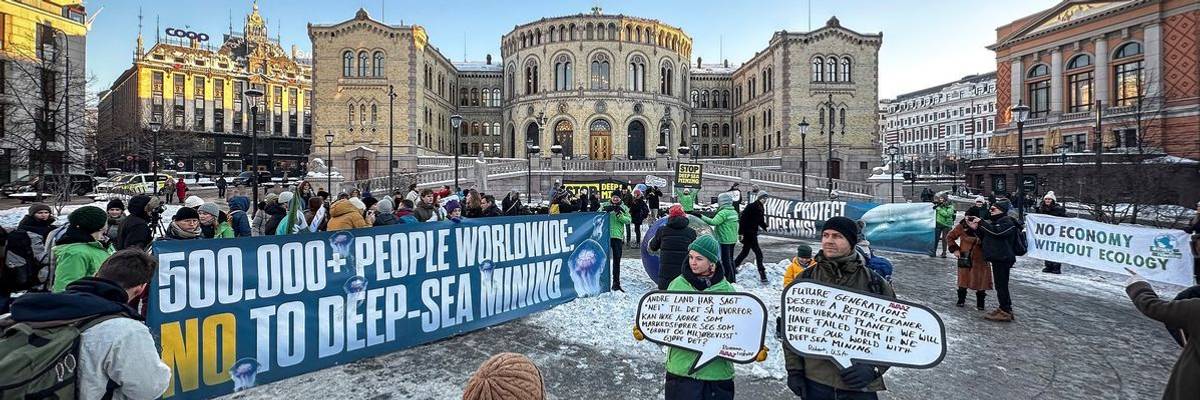
Activists gathered outside the Norwegian parliament in Oslo during a vote to approve deep-sea mining on January 9, 2024
In 'Historic Victory' for Oceans, Norway Pauses Controversial Deep-Sea Mining Plans
"We will not let this industry destroy the unique life in the deep sea, not in the Arctic, nor anywhere else," one campaigner said.
In a move celebrated by environmental advocates as a "massive win for nature," the Norwegian government on Wednesday delayed the issuing of deep-sea mining licenses in its Arctic waters for a second year in a row, this time until 2029.
In January 2024, Norway drew massive criticism from ocean campaigners and scientists when it became the first European country to open its waters to the controversial practice. Since then, however, smaller parties have twice succeeded in delaying the granting of licenses in return for passing the yearly budget.
“Deep-sea mining in Norway has once again been successfully stopped," Haldis Tjeldflaat Helle, the deep-sea mining campaigner at Greenpeace Nordic, said in a statement. "We will not let this industry destroy the unique life in the deep sea, not in the Arctic, nor anywhere else."
Wednesday's decision came as part of the new Labour government's budget negotiations, as the Reds, the Socialist Left Party, and the Green Party all opposed granting licenses. To pass its state budget, the government agreed "not to launch the first tenders for deep-sea mining during the current legislative term," which lasts four years, according to Agence France-Presse. The agreement comes a year after a similar intervention by the Socialist Left Party delayed the first round of licenses.
"Wherever this industry tries to start, it fails. We can protect the oceans from extraction."
The Norwegian government also said it would no longer direct public funds toward mapping for minerals, which Greenpeace called a "major shift in its stance on deep-sea mining."
The World Wildlife Fund (WWF) agreed, saying, "This decision represents a significant shift in Norway’s position and is a historic victory for nature, science, and public pressure."
A 2024 Greenpeace report warned that mining the Arctic seabed could cause "irreversible harm" to its unique ecosystems and even drive some as yet unstudied species extinct.
“This decision is a historic victory. Norwegian politicians decided to listen to scientific expertise and to the strong public demand to protect the vulnerable deep-sea environment, rather than being swayed by the mining lobby,” Karoline Andaur, CEO of WWF-Norway, said in a statement.
Louisa Casson, a Greenpeace International deep-sea mining campaigner, wrote on social media: "Deep-sea miners thought it would be easy to start mining the Arctic seafloor… But thanks to campaigning, Norway has just halted all deep-sea mining development! Wherever this industry tries to start, it fails. We can protect the oceans from extraction."
Deep-sea mining opponents like Greenpeace saw Norway's decision as "another blow" to an industry that has faced widespread popular opposition. It follows the decision by the Cook Islands last month to postpone a determination on deep-sea mining until 2032.
“There is no version of seabed mining that is sustainable or safe," Greenpeace Aotearoa campaigner Juressa Lee said in a statement at the time. "Alongside our allies who want to protect the ocean for future generations, we will continue to say a loud and bold no to miners who want to strip the seafloor for their profit.”
Following its pause on licenses, environmental advocates want Norway to bolster the growing momentum against deep-sea mining by joining the nations who have signed on in support of a global moratorium.
"Now Norway must step up and become a real ocean leader, join the call for a global moratorium against deep-sea mining, and bring forward a proposal of real protection for the Arctic deep sea," Helle said.
WWF's Andaur noted that "as cochair of the High-Level Panel for a Sustainable Ocean Economy, Norway now has a unique opportunity be consistent and stand alongside their cochair Palau and the 40 countries already supporting a global moratorium or pause on deep-seabed mining, turning this national pause into true global ocean leadership."
“Millions of people across the world are calling on governments to resist the dire threat of deep-sea mining to safeguard oceans worldwide," Greenpeace's Casson said. "This is yet another huge step forward to protect the Arctic, and now it is time for Norway to join over 40 countries calling for a moratorium and be a true ocean champion."
We are at a crossroads
This country and this world are at a monumental crossroads. In a few short weeks, US voters will have an opportunity to beat back the forces of fascism and confront the billionaires who are rigging the economy, our media system, and our democracy, making it increasingly impossible for ordinary people to get by. We’re not just talking about the election. We’re talking about what must be done once these fascist elements are vanquished from power. We need a bolder set of solutions than what either major party has so far been willing to offer and a working-class movement ready to fight like hell for it. Trump didn't emerge from nowhere. The conditions that fueled MAGA authoritarianism were created by decades of radical neoliberal economic policies and a corrupt political system dominated by corporate interests. They slashed taxes on the super-rich, promising that the benefits would trickle down. They said giveaways to the corporate titans would make life more affordable for the rest of us. It was all bullshit. And when a bitter, betrayed populace searches for someone to blame, right-wing demagogues have little trouble finding scapegoats. People know when they're being lied to, but you won't hear any of this from the corporate media. Only independent journalism—powered and funded by people who believe in building a better world—can deliver truly trustworthy daily news. Our Fall Campaign is underway, and we need your help. To power our newsroom through the rest of the year, we need to raise $125,000 by midnight on October 31. So if you share our vision, please contribute whatever you can to sustain our work. |
In a move celebrated by environmental advocates as a "massive win for nature," the Norwegian government on Wednesday delayed the issuing of deep-sea mining licenses in its Arctic waters for a second year in a row, this time until 2029.
In January 2024, Norway drew massive criticism from ocean campaigners and scientists when it became the first European country to open its waters to the controversial practice. Since then, however, smaller parties have twice succeeded in delaying the granting of licenses in return for passing the yearly budget.
“Deep-sea mining in Norway has once again been successfully stopped," Haldis Tjeldflaat Helle, the deep-sea mining campaigner at Greenpeace Nordic, said in a statement. "We will not let this industry destroy the unique life in the deep sea, not in the Arctic, nor anywhere else."
Wednesday's decision came as part of the new Labour government's budget negotiations, as the Reds, the Socialist Left Party, and the Green Party all opposed granting licenses. To pass its state budget, the government agreed "not to launch the first tenders for deep-sea mining during the current legislative term," which lasts four years, according to Agence France-Presse. The agreement comes a year after a similar intervention by the Socialist Left Party delayed the first round of licenses.
"Wherever this industry tries to start, it fails. We can protect the oceans from extraction."
The Norwegian government also said it would no longer direct public funds toward mapping for minerals, which Greenpeace called a "major shift in its stance on deep-sea mining."
The World Wildlife Fund (WWF) agreed, saying, "This decision represents a significant shift in Norway’s position and is a historic victory for nature, science, and public pressure."
A 2024 Greenpeace report warned that mining the Arctic seabed could cause "irreversible harm" to its unique ecosystems and even drive some as yet unstudied species extinct.
“This decision is a historic victory. Norwegian politicians decided to listen to scientific expertise and to the strong public demand to protect the vulnerable deep-sea environment, rather than being swayed by the mining lobby,” Karoline Andaur, CEO of WWF-Norway, said in a statement.
Louisa Casson, a Greenpeace International deep-sea mining campaigner, wrote on social media: "Deep-sea miners thought it would be easy to start mining the Arctic seafloor… But thanks to campaigning, Norway has just halted all deep-sea mining development! Wherever this industry tries to start, it fails. We can protect the oceans from extraction."
Deep-sea mining opponents like Greenpeace saw Norway's decision as "another blow" to an industry that has faced widespread popular opposition. It follows the decision by the Cook Islands last month to postpone a determination on deep-sea mining until 2032.
“There is no version of seabed mining that is sustainable or safe," Greenpeace Aotearoa campaigner Juressa Lee said in a statement at the time. "Alongside our allies who want to protect the ocean for future generations, we will continue to say a loud and bold no to miners who want to strip the seafloor for their profit.”
Following its pause on licenses, environmental advocates want Norway to bolster the growing momentum against deep-sea mining by joining the nations who have signed on in support of a global moratorium.
"Now Norway must step up and become a real ocean leader, join the call for a global moratorium against deep-sea mining, and bring forward a proposal of real protection for the Arctic deep sea," Helle said.
WWF's Andaur noted that "as cochair of the High-Level Panel for a Sustainable Ocean Economy, Norway now has a unique opportunity be consistent and stand alongside their cochair Palau and the 40 countries already supporting a global moratorium or pause on deep-seabed mining, turning this national pause into true global ocean leadership."
“Millions of people across the world are calling on governments to resist the dire threat of deep-sea mining to safeguard oceans worldwide," Greenpeace's Casson said. "This is yet another huge step forward to protect the Arctic, and now it is time for Norway to join over 40 countries calling for a moratorium and be a true ocean champion."
- Campaigners Demand Global Ban on Deep-Sea Mining ›
- Company's Deep-Sea Mining Plans Called 'Big Kick in the Teeth' for Ocean Protectors ›
- Greenpeace Says Ban Deep-Sea Mining, Not Our Right to Protest Against It ›
- Trump Signs Executive Order to Advance 'Deeply Dangerous' Deep-Sea Mining ›
- Norwegian Deep-Sea Mining Threatens Arctic Biodiversity With 'Irreversible Harm' ›
In a move celebrated by environmental advocates as a "massive win for nature," the Norwegian government on Wednesday delayed the issuing of deep-sea mining licenses in its Arctic waters for a second year in a row, this time until 2029.
In January 2024, Norway drew massive criticism from ocean campaigners and scientists when it became the first European country to open its waters to the controversial practice. Since then, however, smaller parties have twice succeeded in delaying the granting of licenses in return for passing the yearly budget.
“Deep-sea mining in Norway has once again been successfully stopped," Haldis Tjeldflaat Helle, the deep-sea mining campaigner at Greenpeace Nordic, said in a statement. "We will not let this industry destroy the unique life in the deep sea, not in the Arctic, nor anywhere else."
Wednesday's decision came as part of the new Labour government's budget negotiations, as the Reds, the Socialist Left Party, and the Green Party all opposed granting licenses. To pass its state budget, the government agreed "not to launch the first tenders for deep-sea mining during the current legislative term," which lasts four years, according to Agence France-Presse. The agreement comes a year after a similar intervention by the Socialist Left Party delayed the first round of licenses.
"Wherever this industry tries to start, it fails. We can protect the oceans from extraction."
The Norwegian government also said it would no longer direct public funds toward mapping for minerals, which Greenpeace called a "major shift in its stance on deep-sea mining."
The World Wildlife Fund (WWF) agreed, saying, "This decision represents a significant shift in Norway’s position and is a historic victory for nature, science, and public pressure."
A 2024 Greenpeace report warned that mining the Arctic seabed could cause "irreversible harm" to its unique ecosystems and even drive some as yet unstudied species extinct.
“This decision is a historic victory. Norwegian politicians decided to listen to scientific expertise and to the strong public demand to protect the vulnerable deep-sea environment, rather than being swayed by the mining lobby,” Karoline Andaur, CEO of WWF-Norway, said in a statement.
Louisa Casson, a Greenpeace International deep-sea mining campaigner, wrote on social media: "Deep-sea miners thought it would be easy to start mining the Arctic seafloor… But thanks to campaigning, Norway has just halted all deep-sea mining development! Wherever this industry tries to start, it fails. We can protect the oceans from extraction."
Deep-sea mining opponents like Greenpeace saw Norway's decision as "another blow" to an industry that has faced widespread popular opposition. It follows the decision by the Cook Islands last month to postpone a determination on deep-sea mining until 2032.
“There is no version of seabed mining that is sustainable or safe," Greenpeace Aotearoa campaigner Juressa Lee said in a statement at the time. "Alongside our allies who want to protect the ocean for future generations, we will continue to say a loud and bold no to miners who want to strip the seafloor for their profit.”
Following its pause on licenses, environmental advocates want Norway to bolster the growing momentum against deep-sea mining by joining the nations who have signed on in support of a global moratorium.
"Now Norway must step up and become a real ocean leader, join the call for a global moratorium against deep-sea mining, and bring forward a proposal of real protection for the Arctic deep sea," Helle said.
WWF's Andaur noted that "as cochair of the High-Level Panel for a Sustainable Ocean Economy, Norway now has a unique opportunity be consistent and stand alongside their cochair Palau and the 40 countries already supporting a global moratorium or pause on deep-seabed mining, turning this national pause into true global ocean leadership."
“Millions of people across the world are calling on governments to resist the dire threat of deep-sea mining to safeguard oceans worldwide," Greenpeace's Casson said. "This is yet another huge step forward to protect the Arctic, and now it is time for Norway to join over 40 countries calling for a moratorium and be a true ocean champion."
- Campaigners Demand Global Ban on Deep-Sea Mining ›
- Company's Deep-Sea Mining Plans Called 'Big Kick in the Teeth' for Ocean Protectors ›
- Greenpeace Says Ban Deep-Sea Mining, Not Our Right to Protest Against It ›
- Trump Signs Executive Order to Advance 'Deeply Dangerous' Deep-Sea Mining ›
- Norwegian Deep-Sea Mining Threatens Arctic Biodiversity With 'Irreversible Harm' ›