SUBSCRIBE TO OUR FREE NEWSLETTER
Daily news & progressive opinion—funded by the people, not the corporations—delivered straight to your inbox.
5
#000000
#FFFFFF
To donate by check, phone, or other method, see our More Ways to Give page.
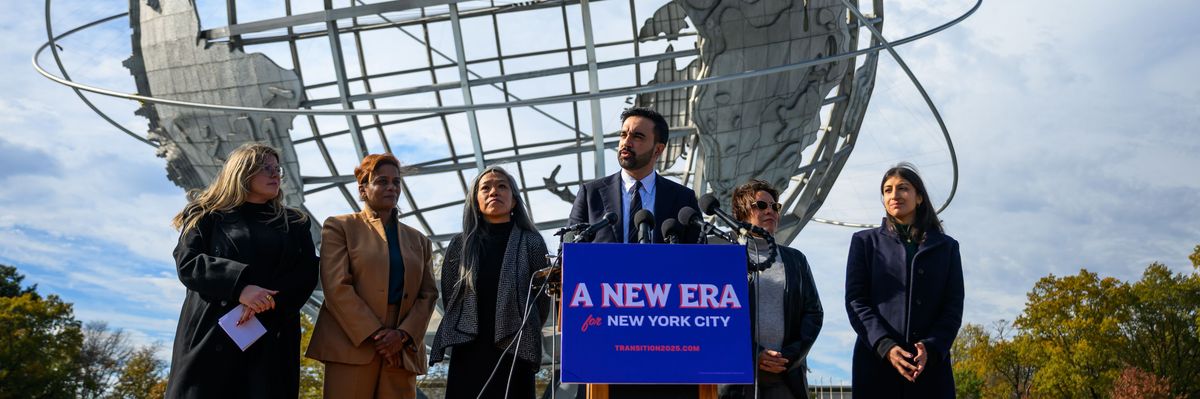
Amid calls for ousting Democratic congressional leadership because the party caved in the government shutdown fight over healthcare, a YouGov poll released Monday shows the nationwide popularity of New York City Mayor-elect Zohran Mamdani's economic agenda.
Mamdani beat former New York Gov. Andrew Cuomo in both the June Democratic primary and last week's general election by campaigning unapologetically as a democratic socialist dedicated to making the nation's largest city more affordable for working people.
Multiple polls have suggested that Mamdani's progressive platform offers Democrats across the United States a roadmap for candidates in next year's midterms and beyond. As NYC's next mayor began assembling his team and the movement that worked to elect him created a group to keep fighting for his ambitious agenda, YouGov surveyed 1,133 US adults after his victory.
While just 31% of those surveyed said they would have voted for Mamdani—more than any other candidate—and the same share said they would vote for a candidate who identified as a "democratic socialist," the policies he ran on garnered far more support.
YouGov found:
Data for Progress similarly surveyed 1,228 likely voters from across the United States about key pieces of Mamdani's platform before his win. The think tank found that large majorities of Americans support efforts to build more affordable housing, higher taxes for corporations as well as millionaires and billionaires, and free childcare, among other policies.
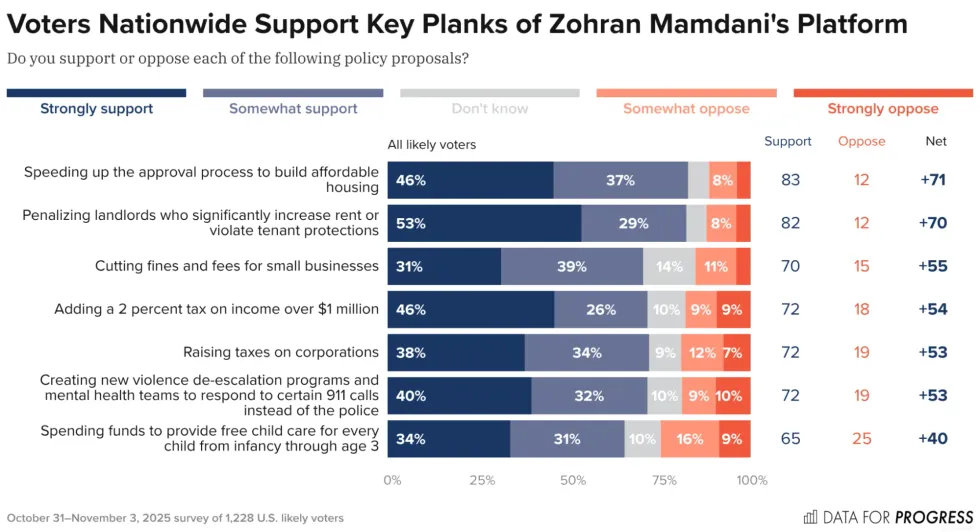
"There's a common refrain from some pundits to dismiss Mamdani's victory as a quirk of New York City politics rather than a sign of something bigger," Data for Progress executive director Ryan O'Donnell wrote last week. "But his campaign paired moral conviction with concrete plans to lower costs and expand access to services, making it unmistakable what he stood for and whom he was fighting for. The lesson isn't that every candidate should mimic his style—you can't fake authenticity—but that voters everywhere respond when a candidate connects economic populism to clear, actionable goals."
"Candidates closer to the center are running on an affordability message as well," he noted, pointing to Democrat Mikie Sherrill's gubernatorial victory in New Jersey. "When a center-left figure like Sherill is running on taking on corporate power, it underscores how central economic populism has become across the political spectrum. Her message may have been less fiery than Mamdani's, but she drew from a similar well of voter frustration over rising costs and corporate influence. In doing so, Sherrill demonstrated to voters that her administration would play an active role in lowering costs—something that voters nationwide overwhelmingly believe the government should be doing."
Amid calls for ousting Democratic congressional leadership because the party caved in the government shutdown fight over healthcare, a YouGov poll released Monday shows the nationwide popularity of New York City Mayor-elect Zohran Mamdani's economic agenda.
Mamdani beat former New York Gov. Andrew Cuomo in both the June Democratic primary and last week's general election by campaigning unapologetically as a democratic socialist dedicated to making the nation's largest city more affordable for working people.
Multiple polls have suggested that Mamdani's progressive platform offers Democrats across the United States a roadmap for candidates in next year's midterms and beyond. As NYC's next mayor began assembling his team and the movement that worked to elect him created a group to keep fighting for his ambitious agenda, YouGov surveyed 1,133 US adults after his victory.
While just 31% of those surveyed said they would have voted for Mamdani—more than any other candidate—and the same share said they would vote for a candidate who identified as a "democratic socialist," the policies he ran on garnered far more support.
YouGov found:
Data for Progress similarly surveyed 1,228 likely voters from across the United States about key pieces of Mamdani's platform before his win. The think tank found that large majorities of Americans support efforts to build more affordable housing, higher taxes for corporations as well as millionaires and billionaires, and free childcare, among other policies.
"There's a common refrain from some pundits to dismiss Mamdani's victory as a quirk of New York City politics rather than a sign of something bigger," Data for Progress executive director Ryan O'Donnell wrote last week. "But his campaign paired moral conviction with concrete plans to lower costs and expand access to services, making it unmistakable what he stood for and whom he was fighting for. The lesson isn't that every candidate should mimic his style—you can't fake authenticity—but that voters everywhere respond when a candidate connects economic populism to clear, actionable goals."
"Candidates closer to the center are running on an affordability message as well," he noted, pointing to Democrat Mikie Sherrill's gubernatorial victory in New Jersey. "When a center-left figure like Sherill is running on taking on corporate power, it underscores how central economic populism has become across the political spectrum. Her message may have been less fiery than Mamdani's, but she drew from a similar well of voter frustration over rising costs and corporate influence. In doing so, Sherrill demonstrated to voters that her administration would play an active role in lowering costs—something that voters nationwide overwhelmingly believe the government should be doing."
Amid calls for ousting Democratic congressional leadership because the party caved in the government shutdown fight over healthcare, a YouGov poll released Monday shows the nationwide popularity of New York City Mayor-elect Zohran Mamdani's economic agenda.
Mamdani beat former New York Gov. Andrew Cuomo in both the June Democratic primary and last week's general election by campaigning unapologetically as a democratic socialist dedicated to making the nation's largest city more affordable for working people.
Multiple polls have suggested that Mamdani's progressive platform offers Democrats across the United States a roadmap for candidates in next year's midterms and beyond. As NYC's next mayor began assembling his team and the movement that worked to elect him created a group to keep fighting for his ambitious agenda, YouGov surveyed 1,133 US adults after his victory.
While just 31% of those surveyed said they would have voted for Mamdani—more than any other candidate—and the same share said they would vote for a candidate who identified as a "democratic socialist," the policies he ran on garnered far more support.
YouGov found:
Data for Progress similarly surveyed 1,228 likely voters from across the United States about key pieces of Mamdani's platform before his win. The think tank found that large majorities of Americans support efforts to build more affordable housing, higher taxes for corporations as well as millionaires and billionaires, and free childcare, among other policies.
"There's a common refrain from some pundits to dismiss Mamdani's victory as a quirk of New York City politics rather than a sign of something bigger," Data for Progress executive director Ryan O'Donnell wrote last week. "But his campaign paired moral conviction with concrete plans to lower costs and expand access to services, making it unmistakable what he stood for and whom he was fighting for. The lesson isn't that every candidate should mimic his style—you can't fake authenticity—but that voters everywhere respond when a candidate connects economic populism to clear, actionable goals."
"Candidates closer to the center are running on an affordability message as well," he noted, pointing to Democrat Mikie Sherrill's gubernatorial victory in New Jersey. "When a center-left figure like Sherill is running on taking on corporate power, it underscores how central economic populism has become across the political spectrum. Her message may have been less fiery than Mamdani's, but she drew from a similar well of voter frustration over rising costs and corporate influence. In doing so, Sherrill demonstrated to voters that her administration would play an active role in lowering costs—something that voters nationwide overwhelmingly believe the government should be doing."