SUBSCRIBE TO OUR FREE NEWSLETTER
Daily news & progressive opinion—funded by the people, not the corporations—delivered straight to your inbox.
5
#000000
#FFFFFF
To donate by check, phone, or other method, see our More Ways to Give page.
Daily news & progressive opinion—funded by the people, not the corporations—delivered straight to your inbox.
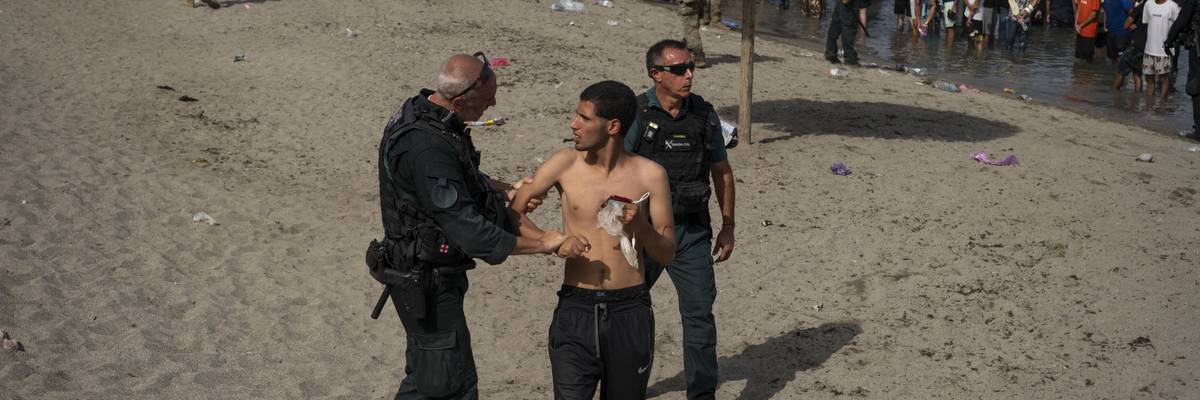
Police check migrants arriving on Tarajal Beach after crossing the border between Spain and Morocco on July 31, 2026 in Ceuta, Spain.
"Under international law, the principle of non-refoulement is absolute and collective expulsions are prohibited in all cases," said Esteban Beltrán of Amnesty International Spain.
The director of Amnesty International Spain on Friday said both Spanish and Moroccan officials must "put their human rights obligations at the center of their response" to an influx of about 60,000 migrants over 24 hours into the self-governing Spanish city of Ceuta, an exclave in North Africa that borders Morocco.
As the vast majority of people had reportedly returned to Morocco after facing aggression from Spanish police and armed forces who had been deployed to the territory, where a humanitarian crisis quickly unfolded following the migrants' arrival, the director of the group, Esteban Beltrán, issued a reminder of international law pertaining to migration.
"The large number of people arriving in Ceuta and the circumstances of crossings must not distract from the fact that under international law, the principle of non-refoulement is absolute and collective expulsions are prohibited in all cases," said Beltrán.
At least 57 people were killed while trying to cross into Ceuta, The Associated Press reported, with some drowning and others killed in a stampede as many of the migrants tried to cross a barrier near a border checkpoint.
"Spanish authorities must also ensure that adequate healthcare and social care resources are deployed to respond to the needs of the people, including to cater for the needs of children and others at increased risk of human rights violations," Beltrán said.
On Friday, even after about 48,000 people were reported to have crossed back over the border, reports still indicated that thousands of migrants were sleeping on the streets of Ceuta, with many reporting they had crossed into the territory in search of work.
“You ask why everyone came—because there’s no work in Morocco,” Ajoub el-Arrot, a 24-year-old Moroccan migrant, told The New York Times.
Abdulah Buji, 21, told the Times that he would "have to work 12-hour shifts for a meager wage."
“But I haven’t found any opportunities here either, so I have to go back," said Buji.
Italian and French authorities said they would tighten controls at their borders with Spain in light of the surge.
The arrival of the migrants drew the attention of the far right in Europe and the US, where conservatives have been critical of Spanish Prime Minister Pedro Sánchez's migration policy.
Earlier this year, contrasting with President Donald Trump's aggressive and violent crackdown on immigrants and mass deportation campaign in the US, Sánchez moved to grant up to 500,000 undocumented immigrants legal status in the country, with those who had arrived before January 2026 and had authorization to work made eligible.
Conservative Spanish politician Isabel Díaz Ayuso said Sánchez had allowed Spain "to be invaded through Ceuta,” while the US State Department said the sudden influx of migrants was "the direct result of the Spanish government’s deliberate efforts to enable and facilitate mass illegal migration into Europe.”
Sánchez's government countered that the situation in Ceuta had "nothing to do with the regularization of migrants," and the prime minister said human traffickers had misinterpreted a recent Spanish Supreme Court ruling which said that people who arrive in the country by sea could not be summarily deported.
Claims that people could easily cross from Morocco into Ceuta "spread like wildfire over the past few hours through the networks of human trafficking organizations,” Sánchez said.
Another Spanish self-governing city on the North African coast, Melilla, also saw migrants attempting to cross from Morocco on Friday. Many Moroccans consider both Ceuta and Melilla to be occupied Moroccan territory.
While many of the migrants said they had been hoping to find work, they also told reporters that Moroccan authorities had urged the massive group to attempt to cross into Ceuta, according to the Times.
“They just kept saying, ‘Go that way, go that way,’” Youssef Alaoui, 26, said of Moroccan police officers near the border.
Some analysts suggested Morocco could be trying to pressure Spain out of strengthening ties with Algeria, a rival nation. The Spanish foreign minister made a recent trip to Algeria and spoke about importing more gas from the country, and Sánchez also recently visited.
“It is impossible for nearly 50,000 people to cross the border between Morocco and Spain in a single day without Morocco having a hand in it,” Lorenzo Gabrielli, a senior researcher at Pompeu Fabra University in Barcelona, told the Times.
Meanwhile, Portuguese author and former Secretary of State for European Affairs Bruno Maçães pointed to calls made by pro-Israel think tanks in April for Israel to "help Morocco take over Ceuta in order to punish Spain" for its pro-Palestinian, anti-Israeli positions.
"Spain's refusal to allow the United States access to its Rota and Morón military bases during the Iran campaign, its consistent failure to meet NATO defense spending targets, and Prime Minister Pedro Sánchez's confrontational posture toward the Trump administration have collectively generated something rare in North African affairs: a genuine crack in Spain's strategic armor over Ceuta and Melilla," wrote Amine Ayoub, a fellow at the Middle East Forum in April. "Into that crack, Morocco's most consequential new partner, Israel, is uniquely positioned to press."
Ayoub continued:
Israel can advance Morocco's cause through three distinct channels. First, through direct diplomatic signaling. Israeli acknowledgment that Spain's continued occupation of African territory undermines the post-colonial credibility that normalization frameworks require would reframe Ceuta and Melilla as a regional governance issue, not merely a bilateral spat. Second, through Washington corridors where Israel's influence is considerable, Israeli officials can amplify the case that Morocco's strategic contribution, anchoring the western Mediterranean, controlling the southern approach to the Strait of Gibraltar, and serving as America's longest-standing treaty partner, warrants concrete American support on its most persistent territorial demand. Third, Israel can expose Spain's glaring hypocrisy. Madrid has been among the loudest European voices condemning Israeli territorial policies and settlements. Spain recognized a Palestinian state in 2024 while simultaneously maintaining European enclaves on African soil that predate modern Israel by four centuries.
Danny Danon, Israel's ambassador to the United Nations, said Thursday that Spain "never misses an opportunity to lecture Israel."
"Maybe before it continues lecturing us," he said, "it’s time it explained to the world why it still maintains colonial enclaves in Africa."
Maçães said it was unclear whether Israel had pushed to "advance Morocco's cause," as Ayoub wrote, but he added, "whether or not the US and Israel were involved before the fact, they were deeply involved and intensely active after the fact, especially trying to use [the crisis in Ceuta] against the current Spanish government."
Dear Common Dreams reader, It’s been nearly 30 years since I co-founded Common Dreams with my late wife, Lina Newhouser. We had the radical notion that journalism should serve the public good, not corporate profits. It was clear to us from the outset what it would take to build such a project. No paid advertisements. No corporate sponsors. No millionaire publisher telling us what to think or do. Many people said we wouldn't last a year, but we proved those doubters wrong. Together with a tremendous team of journalists and dedicated staff, we built an independent media outlet free from the constraints of profits and corporate control. Our mission has always been simple: To inform. To inspire. To ignite change for the common good. Building Common Dreams was not easy. Our survival was never guaranteed. When you take on the most powerful forces—Wall Street greed, fossil fuel industry destruction, Big Tech lobbyists, and uber-rich oligarchs who have spent billions upon billions rigging the economy and democracy in their favor—the only bulwark you have is supporters who believe in your work. But here’s the urgent message from me today. It's never been this bad out there. And it's never been this hard to keep us going. At the very moment Common Dreams is most needed, the threats we face are intensifying. We need your support now more than ever. We don't accept corporate advertising and never will. We don't have a paywall because we don't think people should be blocked from critical news based on their ability to pay. Everything we do is funded by the donations of readers like you. When everyone does the little they can afford, we are strong. But if that support retreats or dries up, so do we. Will you donate now to make sure Common Dreams not only survives but thrives? —Craig Brown, Co-founder |
The director of Amnesty International Spain on Friday said both Spanish and Moroccan officials must "put their human rights obligations at the center of their response" to an influx of about 60,000 migrants over 24 hours into the self-governing Spanish city of Ceuta, an exclave in North Africa that borders Morocco.
As the vast majority of people had reportedly returned to Morocco after facing aggression from Spanish police and armed forces who had been deployed to the territory, where a humanitarian crisis quickly unfolded following the migrants' arrival, the director of the group, Esteban Beltrán, issued a reminder of international law pertaining to migration.
"The large number of people arriving in Ceuta and the circumstances of crossings must not distract from the fact that under international law, the principle of non-refoulement is absolute and collective expulsions are prohibited in all cases," said Beltrán.
At least 57 people were killed while trying to cross into Ceuta, The Associated Press reported, with some drowning and others killed in a stampede as many of the migrants tried to cross a barrier near a border checkpoint.
"Spanish authorities must also ensure that adequate healthcare and social care resources are deployed to respond to the needs of the people, including to cater for the needs of children and others at increased risk of human rights violations," Beltrán said.
On Friday, even after about 48,000 people were reported to have crossed back over the border, reports still indicated that thousands of migrants were sleeping on the streets of Ceuta, with many reporting they had crossed into the territory in search of work.
“You ask why everyone came—because there’s no work in Morocco,” Ajoub el-Arrot, a 24-year-old Moroccan migrant, told The New York Times.
Abdulah Buji, 21, told the Times that he would "have to work 12-hour shifts for a meager wage."
“But I haven’t found any opportunities here either, so I have to go back," said Buji.
Italian and French authorities said they would tighten controls at their borders with Spain in light of the surge.
The arrival of the migrants drew the attention of the far right in Europe and the US, where conservatives have been critical of Spanish Prime Minister Pedro Sánchez's migration policy.
Earlier this year, contrasting with President Donald Trump's aggressive and violent crackdown on immigrants and mass deportation campaign in the US, Sánchez moved to grant up to 500,000 undocumented immigrants legal status in the country, with those who had arrived before January 2026 and had authorization to work made eligible.
Conservative Spanish politician Isabel Díaz Ayuso said Sánchez had allowed Spain "to be invaded through Ceuta,” while the US State Department said the sudden influx of migrants was "the direct result of the Spanish government’s deliberate efforts to enable and facilitate mass illegal migration into Europe.”
Sánchez's government countered that the situation in Ceuta had "nothing to do with the regularization of migrants," and the prime minister said human traffickers had misinterpreted a recent Spanish Supreme Court ruling which said that people who arrive in the country by sea could not be summarily deported.
Claims that people could easily cross from Morocco into Ceuta "spread like wildfire over the past few hours through the networks of human trafficking organizations,” Sánchez said.
Another Spanish self-governing city on the North African coast, Melilla, also saw migrants attempting to cross from Morocco on Friday. Many Moroccans consider both Ceuta and Melilla to be occupied Moroccan territory.
While many of the migrants said they had been hoping to find work, they also told reporters that Moroccan authorities had urged the massive group to attempt to cross into Ceuta, according to the Times.
“They just kept saying, ‘Go that way, go that way,’” Youssef Alaoui, 26, said of Moroccan police officers near the border.
Some analysts suggested Morocco could be trying to pressure Spain out of strengthening ties with Algeria, a rival nation. The Spanish foreign minister made a recent trip to Algeria and spoke about importing more gas from the country, and Sánchez also recently visited.
“It is impossible for nearly 50,000 people to cross the border between Morocco and Spain in a single day without Morocco having a hand in it,” Lorenzo Gabrielli, a senior researcher at Pompeu Fabra University in Barcelona, told the Times.
Meanwhile, Portuguese author and former Secretary of State for European Affairs Bruno Maçães pointed to calls made by pro-Israel think tanks in April for Israel to "help Morocco take over Ceuta in order to punish Spain" for its pro-Palestinian, anti-Israeli positions.
"Spain's refusal to allow the United States access to its Rota and Morón military bases during the Iran campaign, its consistent failure to meet NATO defense spending targets, and Prime Minister Pedro Sánchez's confrontational posture toward the Trump administration have collectively generated something rare in North African affairs: a genuine crack in Spain's strategic armor over Ceuta and Melilla," wrote Amine Ayoub, a fellow at the Middle East Forum in April. "Into that crack, Morocco's most consequential new partner, Israel, is uniquely positioned to press."
Ayoub continued:
Israel can advance Morocco's cause through three distinct channels. First, through direct diplomatic signaling. Israeli acknowledgment that Spain's continued occupation of African territory undermines the post-colonial credibility that normalization frameworks require would reframe Ceuta and Melilla as a regional governance issue, not merely a bilateral spat. Second, through Washington corridors where Israel's influence is considerable, Israeli officials can amplify the case that Morocco's strategic contribution, anchoring the western Mediterranean, controlling the southern approach to the Strait of Gibraltar, and serving as America's longest-standing treaty partner, warrants concrete American support on its most persistent territorial demand. Third, Israel can expose Spain's glaring hypocrisy. Madrid has been among the loudest European voices condemning Israeli territorial policies and settlements. Spain recognized a Palestinian state in 2024 while simultaneously maintaining European enclaves on African soil that predate modern Israel by four centuries.
Danny Danon, Israel's ambassador to the United Nations, said Thursday that Spain "never misses an opportunity to lecture Israel."
"Maybe before it continues lecturing us," he said, "it’s time it explained to the world why it still maintains colonial enclaves in Africa."
Maçães said it was unclear whether Israel had pushed to "advance Morocco's cause," as Ayoub wrote, but he added, "whether or not the US and Israel were involved before the fact, they were deeply involved and intensely active after the fact, especially trying to use [the crisis in Ceuta] against the current Spanish government."
The director of Amnesty International Spain on Friday said both Spanish and Moroccan officials must "put their human rights obligations at the center of their response" to an influx of about 60,000 migrants over 24 hours into the self-governing Spanish city of Ceuta, an exclave in North Africa that borders Morocco.
As the vast majority of people had reportedly returned to Morocco after facing aggression from Spanish police and armed forces who had been deployed to the territory, where a humanitarian crisis quickly unfolded following the migrants' arrival, the director of the group, Esteban Beltrán, issued a reminder of international law pertaining to migration.
"The large number of people arriving in Ceuta and the circumstances of crossings must not distract from the fact that under international law, the principle of non-refoulement is absolute and collective expulsions are prohibited in all cases," said Beltrán.
At least 57 people were killed while trying to cross into Ceuta, The Associated Press reported, with some drowning and others killed in a stampede as many of the migrants tried to cross a barrier near a border checkpoint.
"Spanish authorities must also ensure that adequate healthcare and social care resources are deployed to respond to the needs of the people, including to cater for the needs of children and others at increased risk of human rights violations," Beltrán said.
On Friday, even after about 48,000 people were reported to have crossed back over the border, reports still indicated that thousands of migrants were sleeping on the streets of Ceuta, with many reporting they had crossed into the territory in search of work.
“You ask why everyone came—because there’s no work in Morocco,” Ajoub el-Arrot, a 24-year-old Moroccan migrant, told The New York Times.
Abdulah Buji, 21, told the Times that he would "have to work 12-hour shifts for a meager wage."
“But I haven’t found any opportunities here either, so I have to go back," said Buji.
Italian and French authorities said they would tighten controls at their borders with Spain in light of the surge.
The arrival of the migrants drew the attention of the far right in Europe and the US, where conservatives have been critical of Spanish Prime Minister Pedro Sánchez's migration policy.
Earlier this year, contrasting with President Donald Trump's aggressive and violent crackdown on immigrants and mass deportation campaign in the US, Sánchez moved to grant up to 500,000 undocumented immigrants legal status in the country, with those who had arrived before January 2026 and had authorization to work made eligible.
Conservative Spanish politician Isabel Díaz Ayuso said Sánchez had allowed Spain "to be invaded through Ceuta,” while the US State Department said the sudden influx of migrants was "the direct result of the Spanish government’s deliberate efforts to enable and facilitate mass illegal migration into Europe.”
Sánchez's government countered that the situation in Ceuta had "nothing to do with the regularization of migrants," and the prime minister said human traffickers had misinterpreted a recent Spanish Supreme Court ruling which said that people who arrive in the country by sea could not be summarily deported.
Claims that people could easily cross from Morocco into Ceuta "spread like wildfire over the past few hours through the networks of human trafficking organizations,” Sánchez said.
Another Spanish self-governing city on the North African coast, Melilla, also saw migrants attempting to cross from Morocco on Friday. Many Moroccans consider both Ceuta and Melilla to be occupied Moroccan territory.
While many of the migrants said they had been hoping to find work, they also told reporters that Moroccan authorities had urged the massive group to attempt to cross into Ceuta, according to the Times.
“They just kept saying, ‘Go that way, go that way,’” Youssef Alaoui, 26, said of Moroccan police officers near the border.
Some analysts suggested Morocco could be trying to pressure Spain out of strengthening ties with Algeria, a rival nation. The Spanish foreign minister made a recent trip to Algeria and spoke about importing more gas from the country, and Sánchez also recently visited.
“It is impossible for nearly 50,000 people to cross the border between Morocco and Spain in a single day without Morocco having a hand in it,” Lorenzo Gabrielli, a senior researcher at Pompeu Fabra University in Barcelona, told the Times.
Meanwhile, Portuguese author and former Secretary of State for European Affairs Bruno Maçães pointed to calls made by pro-Israel think tanks in April for Israel to "help Morocco take over Ceuta in order to punish Spain" for its pro-Palestinian, anti-Israeli positions.
"Spain's refusal to allow the United States access to its Rota and Morón military bases during the Iran campaign, its consistent failure to meet NATO defense spending targets, and Prime Minister Pedro Sánchez's confrontational posture toward the Trump administration have collectively generated something rare in North African affairs: a genuine crack in Spain's strategic armor over Ceuta and Melilla," wrote Amine Ayoub, a fellow at the Middle East Forum in April. "Into that crack, Morocco's most consequential new partner, Israel, is uniquely positioned to press."
Ayoub continued:
Israel can advance Morocco's cause through three distinct channels. First, through direct diplomatic signaling. Israeli acknowledgment that Spain's continued occupation of African territory undermines the post-colonial credibility that normalization frameworks require would reframe Ceuta and Melilla as a regional governance issue, not merely a bilateral spat. Second, through Washington corridors where Israel's influence is considerable, Israeli officials can amplify the case that Morocco's strategic contribution, anchoring the western Mediterranean, controlling the southern approach to the Strait of Gibraltar, and serving as America's longest-standing treaty partner, warrants concrete American support on its most persistent territorial demand. Third, Israel can expose Spain's glaring hypocrisy. Madrid has been among the loudest European voices condemning Israeli territorial policies and settlements. Spain recognized a Palestinian state in 2024 while simultaneously maintaining European enclaves on African soil that predate modern Israel by four centuries.
Danny Danon, Israel's ambassador to the United Nations, said Thursday that Spain "never misses an opportunity to lecture Israel."
"Maybe before it continues lecturing us," he said, "it’s time it explained to the world why it still maintains colonial enclaves in Africa."
Maçães said it was unclear whether Israel had pushed to "advance Morocco's cause," as Ayoub wrote, but he added, "whether or not the US and Israel were involved before the fact, they were deeply involved and intensely active after the fact, especially trying to use [the crisis in Ceuta] against the current Spanish government."