SUBSCRIBE TO OUR FREE NEWSLETTER
Daily news & progressive opinion—funded by the people, not the corporations—delivered straight to your inbox.
5
#000000
#FFFFFF
To donate by check, phone, or other method, see our More Ways to Give page.
Daily news & progressive opinion—funded by the people, not the corporations—delivered straight to your inbox.
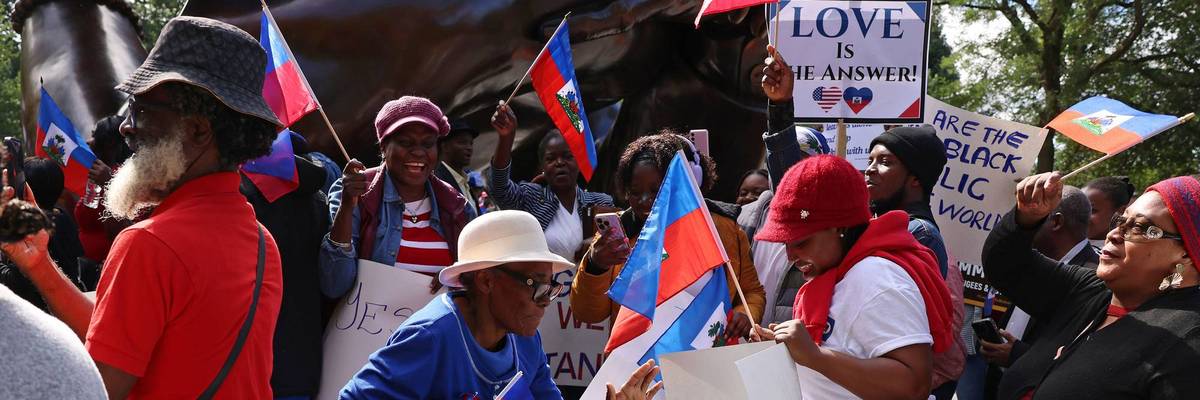
Members of the Haitian community and their allies marched and danced around The Embrace sculpture on the Boston Common after holding a rally to denounce the hateful rhetoric aimed towards Haitian migrants in Ohio and elsewhere in the United States.
"For Haitian TPS holders and their families, this decision provides immediate relief from the fear of family separation, job loss, and forced return to life-threatening conditions in Haiti."
Haitian refugees living in the United States with temporary protected status were given a reprieve Monday night when a federal judge blocked an order by the Trump administration to strip them of their TPS—an effort that many feared would lead to an immediate intensification of efforts to target such communities with the same heavy-handed tactics seen by federal agents in Minnesota, Maine, and elsewhere.
US District Judge Ana Reyes in Washington granted a request to pause the TPS termination for Haitians while a lawsuit challenging the order issued by Secretary of Homeland Security Kristi Noem in November proceeds.
The termination of TPS for Haitian nationals was set for Tuesday, but Reyes's 83-page order stated that it "shall be null, void, and of no legal effect."
Rose-Thamar Joseph, the operations director of the Haitian Support Center in Springfield, Ohio—which has a large Haitian community that has been the target of racist and xenophobic attacks from President Donald Trump, Vice President JD Vance, and their allies—said the judge's ruling means "we can breathe for a little bit."
The residents of Springfield and surrounding areas have been anxious that their community would be the next target for Trump's aggressive deportation tactics. The legal challenge to the termination of TPS for Haitians alleges that the secretary acted with "animus," as evidenced by repeated public remarks from Noem and other administration officials.
Reyes, in her ruling, determined that the suit stands a good chance of winning on the merits, writing: “The mismatch between what the secretary said in the termination and what the evidence shows confirms that the termination of Haiti’s TPS designation was not the product of reasoned decision-making, but of a preordained outcome justified by pretextual reasons."
Jerome Bazard, a member of the First Haitian Evangelical Church of Springfield, told NPR that life in Haiti remains too dangerous for many in his community to return.
"They can't go to Haiti because it's not safe," Bazard said. "Without the TPS, they can't work. And if they can't work, they can't eat, they can't pay bills. You're killing the people."
The sense of relief was felt beyond Ohio, as people from Haiti living with TPS status live in communities across the US.
Tessa Petit, executive director of the Florida Immigrant Coalition and a native of Haiti, said the ruling is a welcome development for the approximately 330,000-350,000 people living in the country with TPS, which allows them to work and pay taxes. In her ruling, Reyes noted that Haitians with TPS generate $5.2 billion annually in tax revenue.
"For Haitian TPS holders and their families, this decision provides immediate relief from the fear of family separation, job loss, and forced return to life-threatening conditions in Haiti," said Petit, "where political instability, gang violence, and humanitarian collapse remain acute. No one should be deported into crisis, and today’s ruling affirms that the law cannot be twisted to justify cruelty.”
“Today’s ruling is a victory for the roughly 350,000 Haitian TPS holders whose status was set to expire tomorrow,” said Sen. Ed Markey (D-Mass). “By providing a safe haven to those who cannot return home safely, TPS embodies the American promise as a land of freedom and refuge. Haitian TPS holders are deeply rooted in our Massachusetts communities—from Mattapan to Brockton. They are our friends, our family members, our neighbors, our colleagues. I will keep fighting to protect the Haitian community.”
Aaron Reichlin-Melnick, senior fellow at the American Immigration Council, said that even though Monday's ruling is sure to be appealed by the Trump administration, it arrives as a "huge" win.
With the order, he said, "350,000 people can breathe a sigh of relief and go to work or school tomorrow without suddenly having been rendered 'illegal' and forced to either go back into danger or risk being rounded up by ICE agents on the street."
Dear Common Dreams reader, It’s been nearly 30 years since I co-founded Common Dreams with my late wife, Lina Newhouser. We had the radical notion that journalism should serve the public good, not corporate profits. It was clear to us from the outset what it would take to build such a project. No paid advertisements. No corporate sponsors. No millionaire publisher telling us what to think or do. Many people said we wouldn't last a year, but we proved those doubters wrong. Together with a tremendous team of journalists and dedicated staff, we built an independent media outlet free from the constraints of profits and corporate control. Our mission has always been simple: To inform. To inspire. To ignite change for the common good. Building Common Dreams was not easy. Our survival was never guaranteed. When you take on the most powerful forces—Wall Street greed, fossil fuel industry destruction, Big Tech lobbyists, and uber-rich oligarchs who have spent billions upon billions rigging the economy and democracy in their favor—the only bulwark you have is supporters who believe in your work. But here’s the urgent message from me today. It's never been this bad out there. And it's never been this hard to keep us going. At the very moment Common Dreams is most needed, the threats we face are intensifying. We need your support now more than ever. We don't accept corporate advertising and never will. We don't have a paywall because we don't think people should be blocked from critical news based on their ability to pay. Everything we do is funded by the donations of readers like you. When everyone does the little they can afford, we are strong. But if that support retreats or dries up, so do we. Will you donate now to make sure Common Dreams not only survives but thrives? —Craig Brown, Co-founder |
Haitian refugees living in the United States with temporary protected status were given a reprieve Monday night when a federal judge blocked an order by the Trump administration to strip them of their TPS—an effort that many feared would lead to an immediate intensification of efforts to target such communities with the same heavy-handed tactics seen by federal agents in Minnesota, Maine, and elsewhere.
US District Judge Ana Reyes in Washington granted a request to pause the TPS termination for Haitians while a lawsuit challenging the order issued by Secretary of Homeland Security Kristi Noem in November proceeds.
The termination of TPS for Haitian nationals was set for Tuesday, but Reyes's 83-page order stated that it "shall be null, void, and of no legal effect."
Rose-Thamar Joseph, the operations director of the Haitian Support Center in Springfield, Ohio—which has a large Haitian community that has been the target of racist and xenophobic attacks from President Donald Trump, Vice President JD Vance, and their allies—said the judge's ruling means "we can breathe for a little bit."
The residents of Springfield and surrounding areas have been anxious that their community would be the next target for Trump's aggressive deportation tactics. The legal challenge to the termination of TPS for Haitians alleges that the secretary acted with "animus," as evidenced by repeated public remarks from Noem and other administration officials.
Reyes, in her ruling, determined that the suit stands a good chance of winning on the merits, writing: “The mismatch between what the secretary said in the termination and what the evidence shows confirms that the termination of Haiti’s TPS designation was not the product of reasoned decision-making, but of a preordained outcome justified by pretextual reasons."
Jerome Bazard, a member of the First Haitian Evangelical Church of Springfield, told NPR that life in Haiti remains too dangerous for many in his community to return.
"They can't go to Haiti because it's not safe," Bazard said. "Without the TPS, they can't work. And if they can't work, they can't eat, they can't pay bills. You're killing the people."
The sense of relief was felt beyond Ohio, as people from Haiti living with TPS status live in communities across the US.
Tessa Petit, executive director of the Florida Immigrant Coalition and a native of Haiti, said the ruling is a welcome development for the approximately 330,000-350,000 people living in the country with TPS, which allows them to work and pay taxes. In her ruling, Reyes noted that Haitians with TPS generate $5.2 billion annually in tax revenue.
"For Haitian TPS holders and their families, this decision provides immediate relief from the fear of family separation, job loss, and forced return to life-threatening conditions in Haiti," said Petit, "where political instability, gang violence, and humanitarian collapse remain acute. No one should be deported into crisis, and today’s ruling affirms that the law cannot be twisted to justify cruelty.”
“Today’s ruling is a victory for the roughly 350,000 Haitian TPS holders whose status was set to expire tomorrow,” said Sen. Ed Markey (D-Mass). “By providing a safe haven to those who cannot return home safely, TPS embodies the American promise as a land of freedom and refuge. Haitian TPS holders are deeply rooted in our Massachusetts communities—from Mattapan to Brockton. They are our friends, our family members, our neighbors, our colleagues. I will keep fighting to protect the Haitian community.”
Aaron Reichlin-Melnick, senior fellow at the American Immigration Council, said that even though Monday's ruling is sure to be appealed by the Trump administration, it arrives as a "huge" win.
With the order, he said, "350,000 people can breathe a sigh of relief and go to work or school tomorrow without suddenly having been rendered 'illegal' and forced to either go back into danger or risk being rounded up by ICE agents on the street."
Haitian refugees living in the United States with temporary protected status were given a reprieve Monday night when a federal judge blocked an order by the Trump administration to strip them of their TPS—an effort that many feared would lead to an immediate intensification of efforts to target such communities with the same heavy-handed tactics seen by federal agents in Minnesota, Maine, and elsewhere.
US District Judge Ana Reyes in Washington granted a request to pause the TPS termination for Haitians while a lawsuit challenging the order issued by Secretary of Homeland Security Kristi Noem in November proceeds.
The termination of TPS for Haitian nationals was set for Tuesday, but Reyes's 83-page order stated that it "shall be null, void, and of no legal effect."
Rose-Thamar Joseph, the operations director of the Haitian Support Center in Springfield, Ohio—which has a large Haitian community that has been the target of racist and xenophobic attacks from President Donald Trump, Vice President JD Vance, and their allies—said the judge's ruling means "we can breathe for a little bit."
The residents of Springfield and surrounding areas have been anxious that their community would be the next target for Trump's aggressive deportation tactics. The legal challenge to the termination of TPS for Haitians alleges that the secretary acted with "animus," as evidenced by repeated public remarks from Noem and other administration officials.
Reyes, in her ruling, determined that the suit stands a good chance of winning on the merits, writing: “The mismatch between what the secretary said in the termination and what the evidence shows confirms that the termination of Haiti’s TPS designation was not the product of reasoned decision-making, but of a preordained outcome justified by pretextual reasons."
Jerome Bazard, a member of the First Haitian Evangelical Church of Springfield, told NPR that life in Haiti remains too dangerous for many in his community to return.
"They can't go to Haiti because it's not safe," Bazard said. "Without the TPS, they can't work. And if they can't work, they can't eat, they can't pay bills. You're killing the people."
The sense of relief was felt beyond Ohio, as people from Haiti living with TPS status live in communities across the US.
Tessa Petit, executive director of the Florida Immigrant Coalition and a native of Haiti, said the ruling is a welcome development for the approximately 330,000-350,000 people living in the country with TPS, which allows them to work and pay taxes. In her ruling, Reyes noted that Haitians with TPS generate $5.2 billion annually in tax revenue.
"For Haitian TPS holders and their families, this decision provides immediate relief from the fear of family separation, job loss, and forced return to life-threatening conditions in Haiti," said Petit, "where political instability, gang violence, and humanitarian collapse remain acute. No one should be deported into crisis, and today’s ruling affirms that the law cannot be twisted to justify cruelty.”
“Today’s ruling is a victory for the roughly 350,000 Haitian TPS holders whose status was set to expire tomorrow,” said Sen. Ed Markey (D-Mass). “By providing a safe haven to those who cannot return home safely, TPS embodies the American promise as a land of freedom and refuge. Haitian TPS holders are deeply rooted in our Massachusetts communities—from Mattapan to Brockton. They are our friends, our family members, our neighbors, our colleagues. I will keep fighting to protect the Haitian community.”
Aaron Reichlin-Melnick, senior fellow at the American Immigration Council, said that even though Monday's ruling is sure to be appealed by the Trump administration, it arrives as a "huge" win.
With the order, he said, "350,000 people can breathe a sigh of relief and go to work or school tomorrow without suddenly having been rendered 'illegal' and forced to either go back into danger or risk being rounded up by ICE agents on the street."