SUBSCRIBE TO OUR FREE NEWSLETTER
Daily news & progressive opinion—funded by the people, not the corporations—delivered straight to your inbox.
5
#000000
#FFFFFF
To donate by check, phone, or other method, see our More Ways to Give page.
Daily news & progressive opinion—funded by the people, not the corporations—delivered straight to your inbox.
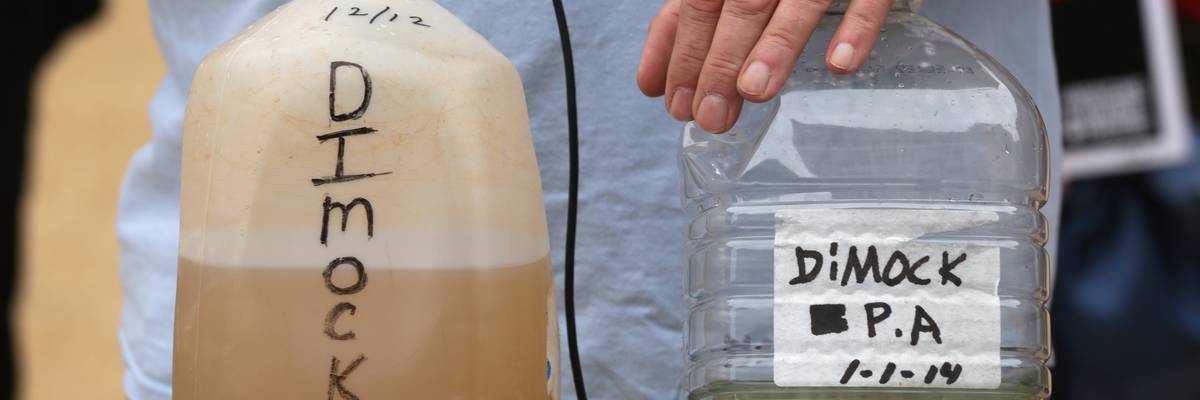
Ray Kemble of Dimock, Pennsylvania shows water samples collected from Dimock, Pennsylvania during a rally on fracking-related water investigations on October 10, 2014 outside the Environmental Protection Agency's Headquarters in Washington, DC.
The current system is set up to protect industry, capitalism, and the profits of a few, not the people and environment.
As a community organizer and environmental activist for over 15 years, I’ve often used the metaphor that “we are spinning on a hamster wheel.” That phrase gets mixed reactions. Some nod in agreement, and some get angry. The truth is not always easy to hear. I understand that from my own experiences.
In 2012, I learned that fracking for natural gas and oil was happening in my community. I started researching fracking, and found out about air pollution, toxic chemicals being injected underground, threats to water, farmland being bought up at an unprecedented pace, and tax incentives subsidizing all this. And in the end, the community wouldn’t even have lower energy costs.
The fracking boom was hitting communities all over Ohio, Pennsylvania, Texas, Colorado—anywhere the fossil fuel industry sniffed out profits—and people were angry. So my neighbors and I tried to use the tools we had been taught we have in our supposed democracy.
We went to local and state officials, regulatory agencies like the Environmental Protection Agency and Health Department, and environmental organizations. With help from the Community Environmental Legal Defense Fund (CELDF), we passed a citizen initiative to ban fracking. The people voted for it—but then two drilling companies sued to have our democratically enacted law overturned for violating their corporate “rights.” The court agreed with them and overturned our law.
Maybe we can work together in community to build grassroots power, take direct action, disrupt unjust systems, and resist corporate encroachment.
Afterwards, I convinced myself that it was our fault. I believed that if more communities took action like we had, positive change would come. So, I started organizing with other communities across Ohio and in other states that found themselves in the same position. But the same cycle of corporate power overriding the people was repeated over and over. The people in these communities had no legal authority to stop fracking.
Some communities, like New York, banned fracking. However, they didn’t ban the use of fracked gas, so my community and many others were sacrificed to make sure Times Square stayed lit up. No offense to New Yorkers, but that’s the hard truth. It is how the system is set up to work.
Other communities turned to regulations. People convinced themselves that if frackers had to have further setbacks from schools and homes, we’d be protected from toxic water injections, airborne chemicals from waste pits and hundreds of trucks, and water depletion due to the between 1.5 and 16 million gallons of water used for each frack well. Communities enacted stricter regulations, but the harm continued.
It became all too clear that we the people were indeed like hamsters spinning in a wheel. All the tools that we grew up believing would protect us and our communities didn’t work. They were just diversions to keep us occupied as the government and the fracking industry drilled well after well.
Now it’s 2026, and communities are up in arms again over an issue that causes many of the same harms as fracking: data centers. I get calls and emails every week from communities all over the country with people sharing concerns—farmland being purchased at unprecedented rates, massive water withdrawals, air pollution and toxification, astronomical energy usage, skyrocketing power rates, and tax subsidies for mega tech corporations. Sound familiar?
It reminds me of the Aerosmith song, "Same Old Song and Dance." The song is about how the “justice system” does not apply equally to all. The band wasn't singing about fracking or data centers, but it may as well have been. Whether we use metaphors like spinning in a hamster wheel or cliches like “same old song and dance,” this is how the system is set up to work: It protects industry, capitalism and the profits of a few, not the people and environment. Folks fighting mining, toxic waste, big agriculture, industrial energy of any kind, clear cutting of forests, plastic pollution, etc. are all trapped in the hamster wheel.
We must jump out. This will take facing hard truths, like the fact that holding up signs in front of public meetings, writing letters, and giving testimony to regulatory agencies won’t protect you and your community. Once we can begin reckoning with these truths, maybe we can turn toward each other and turn away from the existing system. Maybe we can free our imaginations and creativity to experiment with new ideas. Maybe we can work together in community to build grassroots power, take direct action, disrupt unjust systems, and resist corporate encroachment rather than jumping back into the hamster wheel. Maybe we can start being effective.
My colleagues and I at CELDF have some ideas and would love to talk with you to share our experience and to listen to yours. If nothing else, we can be here to soften your landing when you finally decide to jump off that hamster wheel.
Dear Common Dreams reader, It’s been nearly 30 years since I co-founded Common Dreams with my late wife, Lina Newhouser. We had the radical notion that journalism should serve the public good, not corporate profits. It was clear to us from the outset what it would take to build such a project. No paid advertisements. No corporate sponsors. No millionaire publisher telling us what to think or do. Many people said we wouldn't last a year, but we proved those doubters wrong. Together with a tremendous team of journalists and dedicated staff, we built an independent media outlet free from the constraints of profits and corporate control. Our mission has always been simple: To inform. To inspire. To ignite change for the common good. Building Common Dreams was not easy. Our survival was never guaranteed. When you take on the most powerful forces—Wall Street greed, fossil fuel industry destruction, Big Tech lobbyists, and uber-rich oligarchs who have spent billions upon billions rigging the economy and democracy in their favor—the only bulwark you have is supporters who believe in your work. But here’s the urgent message from me today. It's never been this bad out there. And it's never been this hard to keep us going. At the very moment Common Dreams is most needed, the threats we face are intensifying. We need your support now more than ever. We don't accept corporate advertising and never will. We don't have a paywall because we don't think people should be blocked from critical news based on their ability to pay. Everything we do is funded by the donations of readers like you. When everyone does the little they can afford, we are strong. But if that support retreats or dries up, so do we. Will you donate now to make sure Common Dreams not only survives but thrives? —Craig Brown, Co-founder |
As a community organizer and environmental activist for over 15 years, I’ve often used the metaphor that “we are spinning on a hamster wheel.” That phrase gets mixed reactions. Some nod in agreement, and some get angry. The truth is not always easy to hear. I understand that from my own experiences.
In 2012, I learned that fracking for natural gas and oil was happening in my community. I started researching fracking, and found out about air pollution, toxic chemicals being injected underground, threats to water, farmland being bought up at an unprecedented pace, and tax incentives subsidizing all this. And in the end, the community wouldn’t even have lower energy costs.
The fracking boom was hitting communities all over Ohio, Pennsylvania, Texas, Colorado—anywhere the fossil fuel industry sniffed out profits—and people were angry. So my neighbors and I tried to use the tools we had been taught we have in our supposed democracy.
We went to local and state officials, regulatory agencies like the Environmental Protection Agency and Health Department, and environmental organizations. With help from the Community Environmental Legal Defense Fund (CELDF), we passed a citizen initiative to ban fracking. The people voted for it—but then two drilling companies sued to have our democratically enacted law overturned for violating their corporate “rights.” The court agreed with them and overturned our law.
Maybe we can work together in community to build grassroots power, take direct action, disrupt unjust systems, and resist corporate encroachment.
Afterwards, I convinced myself that it was our fault. I believed that if more communities took action like we had, positive change would come. So, I started organizing with other communities across Ohio and in other states that found themselves in the same position. But the same cycle of corporate power overriding the people was repeated over and over. The people in these communities had no legal authority to stop fracking.
Some communities, like New York, banned fracking. However, they didn’t ban the use of fracked gas, so my community and many others were sacrificed to make sure Times Square stayed lit up. No offense to New Yorkers, but that’s the hard truth. It is how the system is set up to work.
Other communities turned to regulations. People convinced themselves that if frackers had to have further setbacks from schools and homes, we’d be protected from toxic water injections, airborne chemicals from waste pits and hundreds of trucks, and water depletion due to the between 1.5 and 16 million gallons of water used for each frack well. Communities enacted stricter regulations, but the harm continued.
It became all too clear that we the people were indeed like hamsters spinning in a wheel. All the tools that we grew up believing would protect us and our communities didn’t work. They were just diversions to keep us occupied as the government and the fracking industry drilled well after well.
Now it’s 2026, and communities are up in arms again over an issue that causes many of the same harms as fracking: data centers. I get calls and emails every week from communities all over the country with people sharing concerns—farmland being purchased at unprecedented rates, massive water withdrawals, air pollution and toxification, astronomical energy usage, skyrocketing power rates, and tax subsidies for mega tech corporations. Sound familiar?
It reminds me of the Aerosmith song, "Same Old Song and Dance." The song is about how the “justice system” does not apply equally to all. The band wasn't singing about fracking or data centers, but it may as well have been. Whether we use metaphors like spinning in a hamster wheel or cliches like “same old song and dance,” this is how the system is set up to work: It protects industry, capitalism and the profits of a few, not the people and environment. Folks fighting mining, toxic waste, big agriculture, industrial energy of any kind, clear cutting of forests, plastic pollution, etc. are all trapped in the hamster wheel.
We must jump out. This will take facing hard truths, like the fact that holding up signs in front of public meetings, writing letters, and giving testimony to regulatory agencies won’t protect you and your community. Once we can begin reckoning with these truths, maybe we can turn toward each other and turn away from the existing system. Maybe we can free our imaginations and creativity to experiment with new ideas. Maybe we can work together in community to build grassroots power, take direct action, disrupt unjust systems, and resist corporate encroachment rather than jumping back into the hamster wheel. Maybe we can start being effective.
My colleagues and I at CELDF have some ideas and would love to talk with you to share our experience and to listen to yours. If nothing else, we can be here to soften your landing when you finally decide to jump off that hamster wheel.
As a community organizer and environmental activist for over 15 years, I’ve often used the metaphor that “we are spinning on a hamster wheel.” That phrase gets mixed reactions. Some nod in agreement, and some get angry. The truth is not always easy to hear. I understand that from my own experiences.
In 2012, I learned that fracking for natural gas and oil was happening in my community. I started researching fracking, and found out about air pollution, toxic chemicals being injected underground, threats to water, farmland being bought up at an unprecedented pace, and tax incentives subsidizing all this. And in the end, the community wouldn’t even have lower energy costs.
The fracking boom was hitting communities all over Ohio, Pennsylvania, Texas, Colorado—anywhere the fossil fuel industry sniffed out profits—and people were angry. So my neighbors and I tried to use the tools we had been taught we have in our supposed democracy.
We went to local and state officials, regulatory agencies like the Environmental Protection Agency and Health Department, and environmental organizations. With help from the Community Environmental Legal Defense Fund (CELDF), we passed a citizen initiative to ban fracking. The people voted for it—but then two drilling companies sued to have our democratically enacted law overturned for violating their corporate “rights.” The court agreed with them and overturned our law.
Maybe we can work together in community to build grassroots power, take direct action, disrupt unjust systems, and resist corporate encroachment.
Afterwards, I convinced myself that it was our fault. I believed that if more communities took action like we had, positive change would come. So, I started organizing with other communities across Ohio and in other states that found themselves in the same position. But the same cycle of corporate power overriding the people was repeated over and over. The people in these communities had no legal authority to stop fracking.
Some communities, like New York, banned fracking. However, they didn’t ban the use of fracked gas, so my community and many others were sacrificed to make sure Times Square stayed lit up. No offense to New Yorkers, but that’s the hard truth. It is how the system is set up to work.
Other communities turned to regulations. People convinced themselves that if frackers had to have further setbacks from schools and homes, we’d be protected from toxic water injections, airborne chemicals from waste pits and hundreds of trucks, and water depletion due to the between 1.5 and 16 million gallons of water used for each frack well. Communities enacted stricter regulations, but the harm continued.
It became all too clear that we the people were indeed like hamsters spinning in a wheel. All the tools that we grew up believing would protect us and our communities didn’t work. They were just diversions to keep us occupied as the government and the fracking industry drilled well after well.
Now it’s 2026, and communities are up in arms again over an issue that causes many of the same harms as fracking: data centers. I get calls and emails every week from communities all over the country with people sharing concerns—farmland being purchased at unprecedented rates, massive water withdrawals, air pollution and toxification, astronomical energy usage, skyrocketing power rates, and tax subsidies for mega tech corporations. Sound familiar?
It reminds me of the Aerosmith song, "Same Old Song and Dance." The song is about how the “justice system” does not apply equally to all. The band wasn't singing about fracking or data centers, but it may as well have been. Whether we use metaphors like spinning in a hamster wheel or cliches like “same old song and dance,” this is how the system is set up to work: It protects industry, capitalism and the profits of a few, not the people and environment. Folks fighting mining, toxic waste, big agriculture, industrial energy of any kind, clear cutting of forests, plastic pollution, etc. are all trapped in the hamster wheel.
We must jump out. This will take facing hard truths, like the fact that holding up signs in front of public meetings, writing letters, and giving testimony to regulatory agencies won’t protect you and your community. Once we can begin reckoning with these truths, maybe we can turn toward each other and turn away from the existing system. Maybe we can free our imaginations and creativity to experiment with new ideas. Maybe we can work together in community to build grassroots power, take direct action, disrupt unjust systems, and resist corporate encroachment rather than jumping back into the hamster wheel. Maybe we can start being effective.
My colleagues and I at CELDF have some ideas and would love to talk with you to share our experience and to listen to yours. If nothing else, we can be here to soften your landing when you finally decide to jump off that hamster wheel.