SUBSCRIBE TO OUR FREE NEWSLETTER
Daily news & progressive opinion—funded by the people, not the corporations—delivered straight to your inbox.
5
#000000
#FFFFFF
To donate by check, phone, or other method, see our More Ways to Give page.
Daily news & progressive opinion—funded by the people, not the corporations—delivered straight to your inbox.
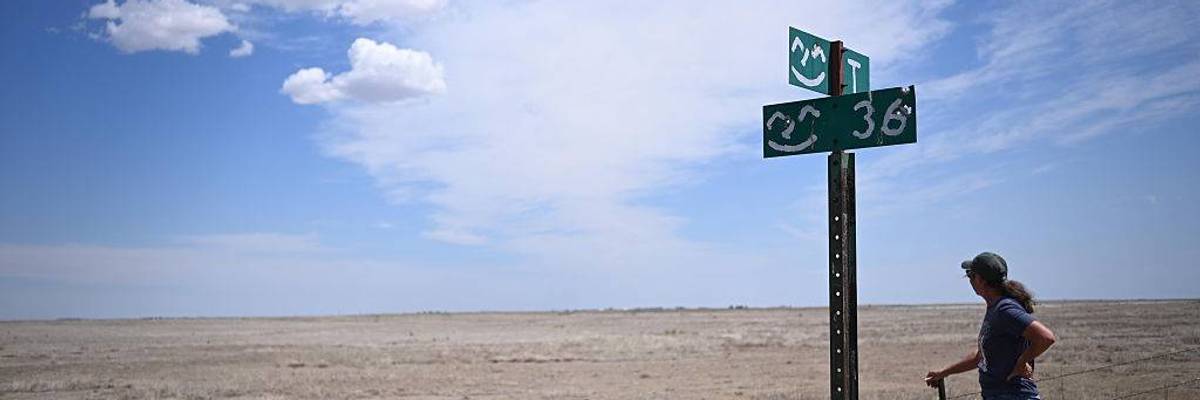
Becky Schroder surveys a severely arid field during the worst drought in Colorado history on May 9, 2026 in Campo, Colorado.
"If and when a hurricane unleashes widespread death and destruction... Democrats should make Trump and his Republican accomplices pay a steep political price for deliberately putting people in harm's way."
The World Meteorological Organization on Tuesday issued a warning about an El Niño event forming that is expected to "increase the risk of extreme weather over the coming months."
El Niño refers to a climate pattern that features warmer than average temperatures in the Pacific Ocean. WMO said its latest forecast estimates an 80% likelihood of an event occurring this summer, with most of its models suggesting “it will be at least moderate—and possibly strong.”
WMO Secretary-General Celeste Saulo warned that a strong El Niño this summer "will exacerbate drought and heavy rainfall and increase the risk of heatwaves both on land and in the ocean," and said WMO scientists will be "carefully monitoring conditions in the coming months to inform decision-making by governments, humanitarian agencies, and climate-sensitive sectors."
United Nations Secretary-General António Guterres said the latest WMO projections must spur global action to address the climate crisis.
"The world must treat it as the urgent climate warning it is," Guterres said. "El Niño conditions will pour fuel on the fire of a warming world. Impacts will hit even harder, travel even farther, and cross borders with devastating speed. The only effective response is climate action equal to the crisis—ending the addiction to fossil fuels, accelerating the shift to renewables, protecting the most vulnerable, and delivering early warning systems for all."
An El Niño event could pose particular problems in the United States, as critics are warning that President Donald Trump's attacks on climate research and federal disaster preparedness are leaving Americans particularly vulnerable to extreme weather.
Revolving Door Project senior researcher Kenny Stancil on Tuesday published an analysis breaking down the ways the Trump administration "has relentlessly undermined disaster readiness and response capacity" by taking a hatchet to key institutions such as the Federal Emergency Management Agency (FEMA), the National Oceanic and Atmospheric Administration (NOAA), and the National Weather Service (NWS).
Among other things, Stancil documented how the Trump administration has ousted "thousands of NOAA workers, including hundreds of NWS employees"; gutted FEMA's staff by "pushing out thousands of rank-and-file workers and dozens of veteran leaders"; and is "thwarting investments in disaster risk reduction, from slashing emissions to pursuing just and sustainable urban development."
Stancil added that while Homeland Security Secretary Markwayne Mullin has reversed some of the cuts made by former DHS chief Kristi Noem, these "last-minute reversals can't undo" the "severe damage" caused by the initial actions.
"If and when a hurricane unleashes widespread death and destruction (if not in 2026, it could be in 2027 or 2028)," Stancil wrote, "Democrats should make Trump and his Republican accomplices pay a steep political price for deliberately putting people in harm's way."
Stancil's concerns about US preparedness for extreme weather events were echoed by Shana Udvardy, senior climate resilience policy analyst at the Union of Concerned Scientists, who on Monday published an analysis outlining the current state of FEMA ahead of hurricane season.
Although Udvardy offered some qualified praise for Mullin for undoing some of Noem's worst policy decisions, she said FEMA still faces potentially catastrophic vacancies at key positions.
"Roughly half of FEMA’s leadership, 18 out of 38 of top-level positions, have yet to be filled as of today, at the start of the Atlantic hurricane season," she explained, adding that "it can take six months to a year to recruit and onboard a senior executive and a year to hire full-time staff."
The administration this week also announced plans to dismantle the Ocean Observatories Initiative, a deep-sea monitoring system that can provide crucial storm forecasting data while also tracking the health of coastal habitats.
Chris Robbins, associate director of scientific initiatives at Ocean Conservatory, said on Tuesday that the administration's effort to dismantle the system heading into a projected El Niño event "doesn't make any sense."
"Walking away from a $368 million investment in a state-of-the-art system, a feat of engineering already paid for by the American people, is absolutely myopic," Robbins said. "This system is a vital scientific asset that quietly protects American lives, communities, and the economy through unfettered access to world-class scientific data. Its loss would create an irreparable blind spot for our country in predicting earthquakes, fishery health, storm forecasting, coastal flooding, and more."
Dear Common Dreams reader, It’s been nearly 30 years since I co-founded Common Dreams with my late wife, Lina Newhouser. We had the radical notion that journalism should serve the public good, not corporate profits. It was clear to us from the outset what it would take to build such a project. No paid advertisements. No corporate sponsors. No millionaire publisher telling us what to think or do. Many people said we wouldn't last a year, but we proved those doubters wrong. Together with a tremendous team of journalists and dedicated staff, we built an independent media outlet free from the constraints of profits and corporate control. Our mission has always been simple: To inform. To inspire. To ignite change for the common good. Building Common Dreams was not easy. Our survival was never guaranteed. When you take on the most powerful forces—Wall Street greed, fossil fuel industry destruction, Big Tech lobbyists, and uber-rich oligarchs who have spent billions upon billions rigging the economy and democracy in their favor—the only bulwark you have is supporters who believe in your work. But here’s the urgent message from me today. It's never been this bad out there. And it's never been this hard to keep us going. At the very moment Common Dreams is most needed, the threats we face are intensifying. We need your support now more than ever. We don't accept corporate advertising and never will. We don't have a paywall because we don't think people should be blocked from critical news based on their ability to pay. Everything we do is funded by the donations of readers like you. When everyone does the little they can afford, we are strong. But if that support retreats or dries up, so do we. Will you donate now to make sure Common Dreams not only survives but thrives? —Craig Brown, Co-founder |
The World Meteorological Organization on Tuesday issued a warning about an El Niño event forming that is expected to "increase the risk of extreme weather over the coming months."
El Niño refers to a climate pattern that features warmer than average temperatures in the Pacific Ocean. WMO said its latest forecast estimates an 80% likelihood of an event occurring this summer, with most of its models suggesting “it will be at least moderate—and possibly strong.”
WMO Secretary-General Celeste Saulo warned that a strong El Niño this summer "will exacerbate drought and heavy rainfall and increase the risk of heatwaves both on land and in the ocean," and said WMO scientists will be "carefully monitoring conditions in the coming months to inform decision-making by governments, humanitarian agencies, and climate-sensitive sectors."
United Nations Secretary-General António Guterres said the latest WMO projections must spur global action to address the climate crisis.
"The world must treat it as the urgent climate warning it is," Guterres said. "El Niño conditions will pour fuel on the fire of a warming world. Impacts will hit even harder, travel even farther, and cross borders with devastating speed. The only effective response is climate action equal to the crisis—ending the addiction to fossil fuels, accelerating the shift to renewables, protecting the most vulnerable, and delivering early warning systems for all."
An El Niño event could pose particular problems in the United States, as critics are warning that President Donald Trump's attacks on climate research and federal disaster preparedness are leaving Americans particularly vulnerable to extreme weather.
Revolving Door Project senior researcher Kenny Stancil on Tuesday published an analysis breaking down the ways the Trump administration "has relentlessly undermined disaster readiness and response capacity" by taking a hatchet to key institutions such as the Federal Emergency Management Agency (FEMA), the National Oceanic and Atmospheric Administration (NOAA), and the National Weather Service (NWS).
Among other things, Stancil documented how the Trump administration has ousted "thousands of NOAA workers, including hundreds of NWS employees"; gutted FEMA's staff by "pushing out thousands of rank-and-file workers and dozens of veteran leaders"; and is "thwarting investments in disaster risk reduction, from slashing emissions to pursuing just and sustainable urban development."
Stancil added that while Homeland Security Secretary Markwayne Mullin has reversed some of the cuts made by former DHS chief Kristi Noem, these "last-minute reversals can't undo" the "severe damage" caused by the initial actions.
"If and when a hurricane unleashes widespread death and destruction (if not in 2026, it could be in 2027 or 2028)," Stancil wrote, "Democrats should make Trump and his Republican accomplices pay a steep political price for deliberately putting people in harm's way."
Stancil's concerns about US preparedness for extreme weather events were echoed by Shana Udvardy, senior climate resilience policy analyst at the Union of Concerned Scientists, who on Monday published an analysis outlining the current state of FEMA ahead of hurricane season.
Although Udvardy offered some qualified praise for Mullin for undoing some of Noem's worst policy decisions, she said FEMA still faces potentially catastrophic vacancies at key positions.
"Roughly half of FEMA’s leadership, 18 out of 38 of top-level positions, have yet to be filled as of today, at the start of the Atlantic hurricane season," she explained, adding that "it can take six months to a year to recruit and onboard a senior executive and a year to hire full-time staff."
The administration this week also announced plans to dismantle the Ocean Observatories Initiative, a deep-sea monitoring system that can provide crucial storm forecasting data while also tracking the health of coastal habitats.
Chris Robbins, associate director of scientific initiatives at Ocean Conservatory, said on Tuesday that the administration's effort to dismantle the system heading into a projected El Niño event "doesn't make any sense."
"Walking away from a $368 million investment in a state-of-the-art system, a feat of engineering already paid for by the American people, is absolutely myopic," Robbins said. "This system is a vital scientific asset that quietly protects American lives, communities, and the economy through unfettered access to world-class scientific data. Its loss would create an irreparable blind spot for our country in predicting earthquakes, fishery health, storm forecasting, coastal flooding, and more."
The World Meteorological Organization on Tuesday issued a warning about an El Niño event forming that is expected to "increase the risk of extreme weather over the coming months."
El Niño refers to a climate pattern that features warmer than average temperatures in the Pacific Ocean. WMO said its latest forecast estimates an 80% likelihood of an event occurring this summer, with most of its models suggesting “it will be at least moderate—and possibly strong.”
WMO Secretary-General Celeste Saulo warned that a strong El Niño this summer "will exacerbate drought and heavy rainfall and increase the risk of heatwaves both on land and in the ocean," and said WMO scientists will be "carefully monitoring conditions in the coming months to inform decision-making by governments, humanitarian agencies, and climate-sensitive sectors."
United Nations Secretary-General António Guterres said the latest WMO projections must spur global action to address the climate crisis.
"The world must treat it as the urgent climate warning it is," Guterres said. "El Niño conditions will pour fuel on the fire of a warming world. Impacts will hit even harder, travel even farther, and cross borders with devastating speed. The only effective response is climate action equal to the crisis—ending the addiction to fossil fuels, accelerating the shift to renewables, protecting the most vulnerable, and delivering early warning systems for all."
An El Niño event could pose particular problems in the United States, as critics are warning that President Donald Trump's attacks on climate research and federal disaster preparedness are leaving Americans particularly vulnerable to extreme weather.
Revolving Door Project senior researcher Kenny Stancil on Tuesday published an analysis breaking down the ways the Trump administration "has relentlessly undermined disaster readiness and response capacity" by taking a hatchet to key institutions such as the Federal Emergency Management Agency (FEMA), the National Oceanic and Atmospheric Administration (NOAA), and the National Weather Service (NWS).
Among other things, Stancil documented how the Trump administration has ousted "thousands of NOAA workers, including hundreds of NWS employees"; gutted FEMA's staff by "pushing out thousands of rank-and-file workers and dozens of veteran leaders"; and is "thwarting investments in disaster risk reduction, from slashing emissions to pursuing just and sustainable urban development."
Stancil added that while Homeland Security Secretary Markwayne Mullin has reversed some of the cuts made by former DHS chief Kristi Noem, these "last-minute reversals can't undo" the "severe damage" caused by the initial actions.
"If and when a hurricane unleashes widespread death and destruction (if not in 2026, it could be in 2027 or 2028)," Stancil wrote, "Democrats should make Trump and his Republican accomplices pay a steep political price for deliberately putting people in harm's way."
Stancil's concerns about US preparedness for extreme weather events were echoed by Shana Udvardy, senior climate resilience policy analyst at the Union of Concerned Scientists, who on Monday published an analysis outlining the current state of FEMA ahead of hurricane season.
Although Udvardy offered some qualified praise for Mullin for undoing some of Noem's worst policy decisions, she said FEMA still faces potentially catastrophic vacancies at key positions.
"Roughly half of FEMA’s leadership, 18 out of 38 of top-level positions, have yet to be filled as of today, at the start of the Atlantic hurricane season," she explained, adding that "it can take six months to a year to recruit and onboard a senior executive and a year to hire full-time staff."
The administration this week also announced plans to dismantle the Ocean Observatories Initiative, a deep-sea monitoring system that can provide crucial storm forecasting data while also tracking the health of coastal habitats.
Chris Robbins, associate director of scientific initiatives at Ocean Conservatory, said on Tuesday that the administration's effort to dismantle the system heading into a projected El Niño event "doesn't make any sense."
"Walking away from a $368 million investment in a state-of-the-art system, a feat of engineering already paid for by the American people, is absolutely myopic," Robbins said. "This system is a vital scientific asset that quietly protects American lives, communities, and the economy through unfettered access to world-class scientific data. Its loss would create an irreparable blind spot for our country in predicting earthquakes, fishery health, storm forecasting, coastal flooding, and more."