

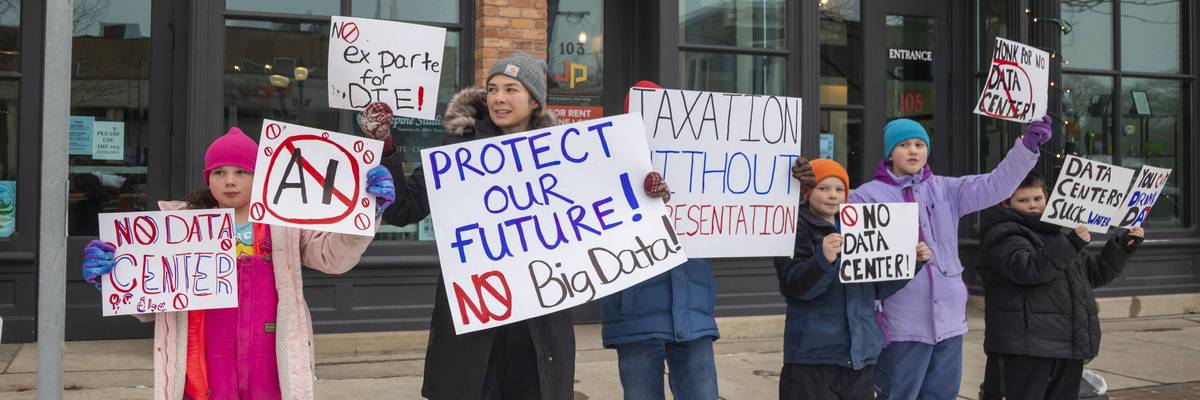
Rural Michigan residents rally against a planned $7 billion data center in Saline on December 1, 2025.
Scientists Say Clean Energy-Powered Data Centers Could Save Trillions in Climate, Health Costs
"In a future with immense data center growth, ratepayers shouldn't be forced to subsidize Big Tech's profits at the expense of their own health, climate, and pocketbooks," said a Union of Concerned Scientists analyst.
As ratepayers and environmentalists continue sounding the alarm over a push to rapidly build data centers to support artificial intelligence and cryptocurrency across the United States, scientists stressed Wednesday that powering such facilities with clean energy could save trillions of dollars in climate and health costs over the coming decades.
"US electricity demand could increase by 60% to 80% between 2025 and 2050, with data centers accounting for more than half of the increase by 2030," according to the new Union of Concerned Scientists (UCS) report, Data Center Power Play. "Estimates of the cumulative electricity costs attributable to data centers from 2026 to 2050 range from $886 billion to $978 billion."
"Without stronger clean energy policies, the additional fossil fuel generation used to power data centers results in an increase in annual US power plant emissions of carbon dioxide (CO2) of 19% to 29% (229 to 342 million metric tons—MMT) by 2035," the document warns. "Restoring federal clean energy tax credits would reduce total US power plant emissions of CO2 by 33% between 2026 and 2035, even if data center demand more than doubles."
Reviving those tax credits is just one of the "forward-looking policies" for which the report advocates. It also calls for "establishing binding emission reduction targets and carbon-free electricity standards, adopting strong power plant carbon standards, and providing incentives to increase transmission capacity."
💡It's the smartest, quickest way to meet growing electricity demand while protecting people’s health, wallets and the climate. 🏛️$248 billion in wholesale electricity costs could be avoided by 2050 by restoring federal clean energy tax credits slashed by the Trump administration.
— Union of Concerned Scientists (@ucs.org) January 21, 2026 at 10:47 AM
The report further pushes for making large electricity customers, including data centers, cover additional costs and requiring utilities to not only conduct long-term planning for data center load growth but also meet that growth with new low-carbon or zero-carbon generation.
"State and federal policymakers should require data center companies and utilities to negotiate power purchase agreements and grid interconnection terms in public proceedings rather than behind closed doors and nondisclosure agreements," the publication argues. "Policymakers should also require data center companies and utilities to publicly report power needs, onsite and induced emissions, water use, and other data—and to do so with enough advance notice for communities to make informed decisions."
In a statement, Mike Jacobs, senior energy analyst at UCS and author of a recent report about costs being pushed onto the public, highlighted that "data centers are already secretly increasing peoples' electricity bills."
"While some utility companies and data center developers are intentionally misdirecting scrutiny, others are willfully ignorant about their roles in passing costs onto consumers," he explained. "In a future with immense data center growth, ratepayers shouldn't be forced to subsidize Big Tech's profits at the expense of their own health, climate, and pocketbooks. State utility regulators have clear authority to assign costs to those that cause them—it's time they require data center developers to pay their fair share for energy needs that can dwarf that of entire cities."
The new report emphasizes that "additional policies to nearly decarbonize the power sector by 2050 would help limit future damages from extreme heat, drought, wildfires, flooding, and other climate impacts. These policies would also deeply cut harmful air pollutants that contribute to respiratory ailments, heart attacks, other illnesses, and mortalities."
Reducing US power sector CO2 emissions 70% by 2035 would result in...🌎 More than $1.6 trillion in avoided global climate damages🌱 Reduce air pollution from fossil fuels, resulting in $40 billion in avoided health costs nationally
— Union of Concerned Scientists (@ucs.org) January 21, 2026 at 10:47 AM
UCS found that "the cumulative global climate benefits from reducing US heat-trapping emissions total $1.3 trillion to $1.6 trillion between 2026 and 2035, growing to $8 trillion to $13 trillion by 2050. Cumulative health benefits from reducing local air pollution range from $120 billion to $220 billion by 2050."
The report's lead author, UCS director of energy research Steve Clemmer, said Wednesday that "the climate and health benefits and net cost savings of building clean energy to meet future electricity needs are obvious and enormous, but they will not materialize without political support and responsible management of data center load growth."
Julie McNamara, associate policy director for the Climate and Energy Program at UCS, took aim at Big Oil-backed President Donald Trump, whose administration "has repeatedly worked to derail clean energy deployment precisely when we need it most."
"With surging demand from data centers, the need for plentiful, affordable power has never been higher," she said. "Yet instead of clearing the path for the fastest, cheapest, cleanest resources to deploy, President Trump is sidelining renewables just to boost the interests of the fossil fuel industry. People will pay the price: in higher bills, in dirtier air, in lost local investments, and in worsened climate impacts."
We are at a crossroads
This country and this world are at a monumental crossroads. In a few short weeks, US voters will have an opportunity to beat back the forces of fascism and confront the billionaires who are rigging the economy, our media system, and our democracy, making it increasingly impossible for ordinary people to get by. We’re not just talking about the election. We’re talking about what must be done once these fascist elements are vanquished from power. We need a bolder set of solutions than what either major party has so far been willing to offer and a working-class movement ready to fight like hell for it. Trump didn't emerge from nowhere. The conditions that fueled MAGA authoritarianism were created by decades of radical neoliberal economic policies and a corrupt political system dominated by corporate interests. They slashed taxes on the super-rich, promising that the benefits would trickle down. They said giveaways to the corporate titans would make life more affordable for the rest of us. It was all bullshit. And when a bitter, betrayed populace searches for someone to blame, right-wing demagogues have little trouble finding scapegoats. People know when they're being lied to, but you won't hear any of this from the corporate media. Only independent journalism—powered and funded by people who believe in building a better world—can deliver truly trustworthy daily news. Our Fall Campaign is underway, and we need your help. To power our newsroom through the rest of the year, we need to raise $125,000 by midnight on October 31. So if you share our vision, please contribute whatever you can to sustain our work. |
As ratepayers and environmentalists continue sounding the alarm over a push to rapidly build data centers to support artificial intelligence and cryptocurrency across the United States, scientists stressed Wednesday that powering such facilities with clean energy could save trillions of dollars in climate and health costs over the coming decades.
"US electricity demand could increase by 60% to 80% between 2025 and 2050, with data centers accounting for more than half of the increase by 2030," according to the new Union of Concerned Scientists (UCS) report, Data Center Power Play. "Estimates of the cumulative electricity costs attributable to data centers from 2026 to 2050 range from $886 billion to $978 billion."
"Without stronger clean energy policies, the additional fossil fuel generation used to power data centers results in an increase in annual US power plant emissions of carbon dioxide (CO2) of 19% to 29% (229 to 342 million metric tons—MMT) by 2035," the document warns. "Restoring federal clean energy tax credits would reduce total US power plant emissions of CO2 by 33% between 2026 and 2035, even if data center demand more than doubles."
Reviving those tax credits is just one of the "forward-looking policies" for which the report advocates. It also calls for "establishing binding emission reduction targets and carbon-free electricity standards, adopting strong power plant carbon standards, and providing incentives to increase transmission capacity."
💡It's the smartest, quickest way to meet growing electricity demand while protecting people’s health, wallets and the climate. 🏛️$248 billion in wholesale electricity costs could be avoided by 2050 by restoring federal clean energy tax credits slashed by the Trump administration.
— Union of Concerned Scientists (@ucs.org) January 21, 2026 at 10:47 AM
The report further pushes for making large electricity customers, including data centers, cover additional costs and requiring utilities to not only conduct long-term planning for data center load growth but also meet that growth with new low-carbon or zero-carbon generation.
"State and federal policymakers should require data center companies and utilities to negotiate power purchase agreements and grid interconnection terms in public proceedings rather than behind closed doors and nondisclosure agreements," the publication argues. "Policymakers should also require data center companies and utilities to publicly report power needs, onsite and induced emissions, water use, and other data—and to do so with enough advance notice for communities to make informed decisions."
In a statement, Mike Jacobs, senior energy analyst at UCS and author of a recent report about costs being pushed onto the public, highlighted that "data centers are already secretly increasing peoples' electricity bills."
"While some utility companies and data center developers are intentionally misdirecting scrutiny, others are willfully ignorant about their roles in passing costs onto consumers," he explained. "In a future with immense data center growth, ratepayers shouldn't be forced to subsidize Big Tech's profits at the expense of their own health, climate, and pocketbooks. State utility regulators have clear authority to assign costs to those that cause them—it's time they require data center developers to pay their fair share for energy needs that can dwarf that of entire cities."
The new report emphasizes that "additional policies to nearly decarbonize the power sector by 2050 would help limit future damages from extreme heat, drought, wildfires, flooding, and other climate impacts. These policies would also deeply cut harmful air pollutants that contribute to respiratory ailments, heart attacks, other illnesses, and mortalities."
Reducing US power sector CO2 emissions 70% by 2035 would result in...🌎 More than $1.6 trillion in avoided global climate damages🌱 Reduce air pollution from fossil fuels, resulting in $40 billion in avoided health costs nationally
— Union of Concerned Scientists (@ucs.org) January 21, 2026 at 10:47 AM
UCS found that "the cumulative global climate benefits from reducing US heat-trapping emissions total $1.3 trillion to $1.6 trillion between 2026 and 2035, growing to $8 trillion to $13 trillion by 2050. Cumulative health benefits from reducing local air pollution range from $120 billion to $220 billion by 2050."
The report's lead author, UCS director of energy research Steve Clemmer, said Wednesday that "the climate and health benefits and net cost savings of building clean energy to meet future electricity needs are obvious and enormous, but they will not materialize without political support and responsible management of data center load growth."
Julie McNamara, associate policy director for the Climate and Energy Program at UCS, took aim at Big Oil-backed President Donald Trump, whose administration "has repeatedly worked to derail clean energy deployment precisely when we need it most."
"With surging demand from data centers, the need for plentiful, affordable power has never been higher," she said. "Yet instead of clearing the path for the fastest, cheapest, cleanest resources to deploy, President Trump is sidelining renewables just to boost the interests of the fossil fuel industry. People will pay the price: in higher bills, in dirtier air, in lost local investments, and in worsened climate impacts."
- Artificial Intelligence Is on a Collision Course With the Green Transition ›
- Nationwide Backlash Brewing Against Big Tech's Energy-Devouring AI Data Centers ›
- Critics Slam Amazon's Billion-Dollar 'Corporate Welfare' for Oregon Data Centers ›
- More Americans Fall Behind on Utility Bills as AI Data Centers, Trump Attacks on Renewables Raise Costs ›
- How to Make Sure People and the Planet Don’t Pay for the Data Center Buildout ›
- Opinion | The Harm Data Centers Cause Isn't Only Local | Common Dreams ›
- UN Chief: Tax Big Oil's Windfall Profits and Power AI Data Centers With Renewable Energy | Common Dreams ›
- Opinion | If Big Tech Needs a New Power Plant, It Should Pay for the Whole Damn Thing | Common Dreams ›
- Opinion | Data Centers Are Surging Energy Demand, But the UN Climate Conference Will Ignore Them | Common Dreams ›
As ratepayers and environmentalists continue sounding the alarm over a push to rapidly build data centers to support artificial intelligence and cryptocurrency across the United States, scientists stressed Wednesday that powering such facilities with clean energy could save trillions of dollars in climate and health costs over the coming decades.
"US electricity demand could increase by 60% to 80% between 2025 and 2050, with data centers accounting for more than half of the increase by 2030," according to the new Union of Concerned Scientists (UCS) report, Data Center Power Play. "Estimates of the cumulative electricity costs attributable to data centers from 2026 to 2050 range from $886 billion to $978 billion."
"Without stronger clean energy policies, the additional fossil fuel generation used to power data centers results in an increase in annual US power plant emissions of carbon dioxide (CO2) of 19% to 29% (229 to 342 million metric tons—MMT) by 2035," the document warns. "Restoring federal clean energy tax credits would reduce total US power plant emissions of CO2 by 33% between 2026 and 2035, even if data center demand more than doubles."
Reviving those tax credits is just one of the "forward-looking policies" for which the report advocates. It also calls for "establishing binding emission reduction targets and carbon-free electricity standards, adopting strong power plant carbon standards, and providing incentives to increase transmission capacity."
💡It's the smartest, quickest way to meet growing electricity demand while protecting people’s health, wallets and the climate. 🏛️$248 billion in wholesale electricity costs could be avoided by 2050 by restoring federal clean energy tax credits slashed by the Trump administration.
— Union of Concerned Scientists (@ucs.org) January 21, 2026 at 10:47 AM
The report further pushes for making large electricity customers, including data centers, cover additional costs and requiring utilities to not only conduct long-term planning for data center load growth but also meet that growth with new low-carbon or zero-carbon generation.
"State and federal policymakers should require data center companies and utilities to negotiate power purchase agreements and grid interconnection terms in public proceedings rather than behind closed doors and nondisclosure agreements," the publication argues. "Policymakers should also require data center companies and utilities to publicly report power needs, onsite and induced emissions, water use, and other data—and to do so with enough advance notice for communities to make informed decisions."
In a statement, Mike Jacobs, senior energy analyst at UCS and author of a recent report about costs being pushed onto the public, highlighted that "data centers are already secretly increasing peoples' electricity bills."
"While some utility companies and data center developers are intentionally misdirecting scrutiny, others are willfully ignorant about their roles in passing costs onto consumers," he explained. "In a future with immense data center growth, ratepayers shouldn't be forced to subsidize Big Tech's profits at the expense of their own health, climate, and pocketbooks. State utility regulators have clear authority to assign costs to those that cause them—it's time they require data center developers to pay their fair share for energy needs that can dwarf that of entire cities."
The new report emphasizes that "additional policies to nearly decarbonize the power sector by 2050 would help limit future damages from extreme heat, drought, wildfires, flooding, and other climate impacts. These policies would also deeply cut harmful air pollutants that contribute to respiratory ailments, heart attacks, other illnesses, and mortalities."
Reducing US power sector CO2 emissions 70% by 2035 would result in...🌎 More than $1.6 trillion in avoided global climate damages🌱 Reduce air pollution from fossil fuels, resulting in $40 billion in avoided health costs nationally
— Union of Concerned Scientists (@ucs.org) January 21, 2026 at 10:47 AM
UCS found that "the cumulative global climate benefits from reducing US heat-trapping emissions total $1.3 trillion to $1.6 trillion between 2026 and 2035, growing to $8 trillion to $13 trillion by 2050. Cumulative health benefits from reducing local air pollution range from $120 billion to $220 billion by 2050."
The report's lead author, UCS director of energy research Steve Clemmer, said Wednesday that "the climate and health benefits and net cost savings of building clean energy to meet future electricity needs are obvious and enormous, but they will not materialize without political support and responsible management of data center load growth."
Julie McNamara, associate policy director for the Climate and Energy Program at UCS, took aim at Big Oil-backed President Donald Trump, whose administration "has repeatedly worked to derail clean energy deployment precisely when we need it most."
"With surging demand from data centers, the need for plentiful, affordable power has never been higher," she said. "Yet instead of clearing the path for the fastest, cheapest, cleanest resources to deploy, President Trump is sidelining renewables just to boost the interests of the fossil fuel industry. People will pay the price: in higher bills, in dirtier air, in lost local investments, and in worsened climate impacts."
- Artificial Intelligence Is on a Collision Course With the Green Transition ›
- Nationwide Backlash Brewing Against Big Tech's Energy-Devouring AI Data Centers ›
- Critics Slam Amazon's Billion-Dollar 'Corporate Welfare' for Oregon Data Centers ›
- More Americans Fall Behind on Utility Bills as AI Data Centers, Trump Attacks on Renewables Raise Costs ›
- How to Make Sure People and the Planet Don’t Pay for the Data Center Buildout ›
- Opinion | The Harm Data Centers Cause Isn't Only Local | Common Dreams ›
- UN Chief: Tax Big Oil's Windfall Profits and Power AI Data Centers With Renewable Energy | Common Dreams ›
- Opinion | If Big Tech Needs a New Power Plant, It Should Pay for the Whole Damn Thing | Common Dreams ›
- Opinion | Data Centers Are Surging Energy Demand, But the UN Climate Conference Will Ignore Them | Common Dreams ›