SUBSCRIBE TO OUR FREE NEWSLETTER
Daily news & progressive opinion—funded by the people, not the corporations—delivered straight to your inbox.
5
#000000
#FFFFFF
To donate by check, phone, or other method, see our More Ways to Give page.
Daily news & progressive opinion—funded by the people, not the corporations—delivered straight to your inbox.
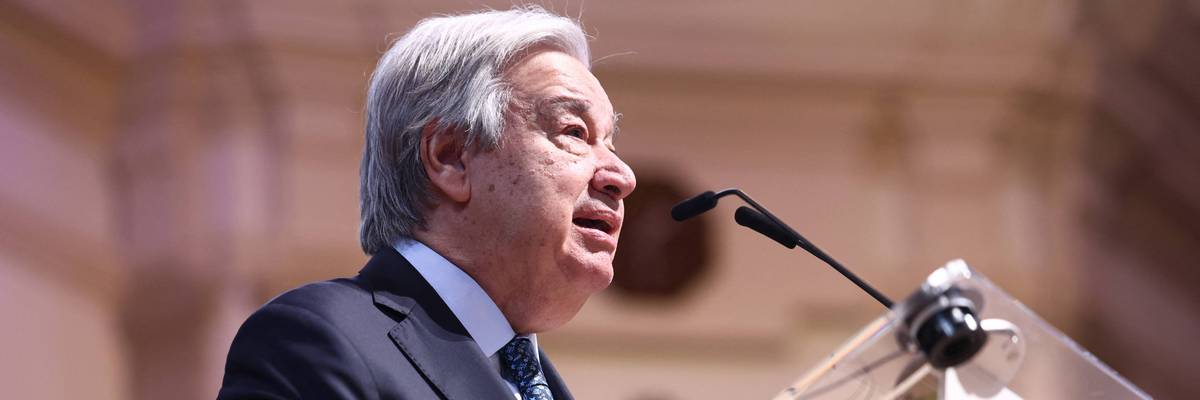
United Nations Secretary-General António Guterres speaks at the UNA-UK conference to mark the 80th anniversary of the founding of the UN in London on January 17, 2026
UN Secretary-General António Guterres called on leaders to work together to solve the growing problem of global inequality at the UN General Assembly.
High-level meetings at the United Nations General Assembly are set to begin next week, and they come at a time when the threats to humanity posed by the climate emergency and artificial intelligence have never been clearer.
Those crises demand that policymakers work together to prevent catastrophic, permanent planetary heating and the creation of "runaway" AI technology, suggested UN Secretary-General António Guterres on Wednesday, but he emphasized that another pernicious, destructive problem cannot be overlooked.
Guterres also named "the intolerable deepening of inequalities" as another "existential threat" that leaders must address at the upcoming meetings.
Earlier this year, the anti-poverty group Oxfam International released a report showing that combined billionaire wealth stood at $18.2 trillion in 2025, having risen from $3.6 trillion in 2009.
At the same time, the number of food-insecure people on Earth shot up to 2.2 billion in 2024, rising from 1.5 billion a decade earlier.
"Nearly half of the world lives in poverty while a select few continue to gain extreme wealth and power," said Oxfam at the time. "The amount of wealth owned by the poorest half of the world is less than the amount owned by just the 12 richest billionaires. This extreme concentration of wealth isn’t just making life less affordable for most of us, it’s creating harmful divisions. Billionaires, corporations, and politicians are taking away people’s basic ability to make choices about their futures and suppressing dissenting voices."
An analysis focused on wealth inequality in the US by the Center for American Progress (CAP) this week also showed that the gap between the ultrarich and the rest of the American public has gotten significantly wider in less than two years since President Donald Trump was reelected, with hundreds of billions of dollars in financial backing from billionaires including tech CEO Elon Musk.
"Since Trump took office, the ultrawealthy (top 0.1%) gained more than 8,000 times as much wealth per household as those in the bottom half of the wealth distribution," said CAP. "To provide an example of the extremity and exponential nature of wealth inequality in the United States, the 10 wealthiest Americans alone saw their real fortunes grow by a combined $259 billion over the same period, according to the Bloomberg Billionaires Index—about $26 billion per person, or 22 million times more than the bottom half’s $1,200 per household."
Economic experts have found that the growing inequality crisis is entirely solvable. As Common Dreams reported last year, research from the European Union Tax Observatory found that a global 2% minimum tax on billionaire wealth "would generate about $250 billion in tax revenue—from just 3,000 individuals," raising about $50 billion in Europe alone.
In 2024, finance ministers at a meeting of the Group of 20 in Rio de Janeiro agreed on the need to tax the richest people in the world at a higher rate to address persistent and worsening economic inequality.
As Common Dreams reported Tuesday, a study published in The Lancet found that the global inequality that's been worsened by Trump's foreign aid cuts could be addressed by a 3% wealth tax—raising a small amount of money compared to the total wealth of the world's richest people, but enough to save 29.5 million lives over the next four years.
Climate campaigners in Africa, who have demanded an end to French company Total Energies' East African Crude Oil Pipeline (EACOP), agreed with Guterres' point that "climate, inequality, and international cooperation are inseparable."
"People living along EACOP's path," said the group Stop EACOP, "are the first to bear the environmental and economic costs of decisions made far from their communities."
Dear Common Dreams reader, It’s been nearly 30 years since I co-founded Common Dreams with my late wife, Lina Newhouser. We had the radical notion that journalism should serve the public good, not corporate profits. It was clear to us from the outset what it would take to build such a project. No paid advertisements. No corporate sponsors. No millionaire publisher telling us what to think or do. Many people said we wouldn't last a year, but we proved those doubters wrong. Together with a tremendous team of journalists and dedicated staff, we built an independent media outlet free from the constraints of profits and corporate control. Our mission has always been simple: To inform. To inspire. To ignite change for the common good. Building Common Dreams was not easy. Our survival was never guaranteed. When you take on the most powerful forces—Wall Street greed, fossil fuel industry destruction, Big Tech lobbyists, and uber-rich oligarchs who have spent billions upon billions rigging the economy and democracy in their favor—the only bulwark you have is supporters who believe in your work. But here’s the urgent message from me today. It's never been this bad out there. And it's never been this hard to keep us going. At the very moment Common Dreams is most needed, the threats we face are intensifying. We need your support now more than ever. We don't accept corporate advertising and never will. We don't have a paywall because we don't think people should be blocked from critical news based on their ability to pay. Everything we do is funded by the donations of readers like you. When everyone does the little they can afford, we are strong. But if that support retreats or dries up, so do we. Will you donate now to make sure Common Dreams not only survives but thrives? —Craig Brown, Co-founder |
High-level meetings at the United Nations General Assembly are set to begin next week, and they come at a time when the threats to humanity posed by the climate emergency and artificial intelligence have never been clearer.
Those crises demand that policymakers work together to prevent catastrophic, permanent planetary heating and the creation of "runaway" AI technology, suggested UN Secretary-General António Guterres on Wednesday, but he emphasized that another pernicious, destructive problem cannot be overlooked.
Guterres also named "the intolerable deepening of inequalities" as another "existential threat" that leaders must address at the upcoming meetings.
Earlier this year, the anti-poverty group Oxfam International released a report showing that combined billionaire wealth stood at $18.2 trillion in 2025, having risen from $3.6 trillion in 2009.
At the same time, the number of food-insecure people on Earth shot up to 2.2 billion in 2024, rising from 1.5 billion a decade earlier.
"Nearly half of the world lives in poverty while a select few continue to gain extreme wealth and power," said Oxfam at the time. "The amount of wealth owned by the poorest half of the world is less than the amount owned by just the 12 richest billionaires. This extreme concentration of wealth isn’t just making life less affordable for most of us, it’s creating harmful divisions. Billionaires, corporations, and politicians are taking away people’s basic ability to make choices about their futures and suppressing dissenting voices."
An analysis focused on wealth inequality in the US by the Center for American Progress (CAP) this week also showed that the gap between the ultrarich and the rest of the American public has gotten significantly wider in less than two years since President Donald Trump was reelected, with hundreds of billions of dollars in financial backing from billionaires including tech CEO Elon Musk.
"Since Trump took office, the ultrawealthy (top 0.1%) gained more than 8,000 times as much wealth per household as those in the bottom half of the wealth distribution," said CAP. "To provide an example of the extremity and exponential nature of wealth inequality in the United States, the 10 wealthiest Americans alone saw their real fortunes grow by a combined $259 billion over the same period, according to the Bloomberg Billionaires Index—about $26 billion per person, or 22 million times more than the bottom half’s $1,200 per household."
Economic experts have found that the growing inequality crisis is entirely solvable. As Common Dreams reported last year, research from the European Union Tax Observatory found that a global 2% minimum tax on billionaire wealth "would generate about $250 billion in tax revenue—from just 3,000 individuals," raising about $50 billion in Europe alone.
In 2024, finance ministers at a meeting of the Group of 20 in Rio de Janeiro agreed on the need to tax the richest people in the world at a higher rate to address persistent and worsening economic inequality.
As Common Dreams reported Tuesday, a study published in The Lancet found that the global inequality that's been worsened by Trump's foreign aid cuts could be addressed by a 3% wealth tax—raising a small amount of money compared to the total wealth of the world's richest people, but enough to save 29.5 million lives over the next four years.
Climate campaigners in Africa, who have demanded an end to French company Total Energies' East African Crude Oil Pipeline (EACOP), agreed with Guterres' point that "climate, inequality, and international cooperation are inseparable."
"People living along EACOP's path," said the group Stop EACOP, "are the first to bear the environmental and economic costs of decisions made far from their communities."
High-level meetings at the United Nations General Assembly are set to begin next week, and they come at a time when the threats to humanity posed by the climate emergency and artificial intelligence have never been clearer.
Those crises demand that policymakers work together to prevent catastrophic, permanent planetary heating and the creation of "runaway" AI technology, suggested UN Secretary-General António Guterres on Wednesday, but he emphasized that another pernicious, destructive problem cannot be overlooked.
Guterres also named "the intolerable deepening of inequalities" as another "existential threat" that leaders must address at the upcoming meetings.
Earlier this year, the anti-poverty group Oxfam International released a report showing that combined billionaire wealth stood at $18.2 trillion in 2025, having risen from $3.6 trillion in 2009.
At the same time, the number of food-insecure people on Earth shot up to 2.2 billion in 2024, rising from 1.5 billion a decade earlier.
"Nearly half of the world lives in poverty while a select few continue to gain extreme wealth and power," said Oxfam at the time. "The amount of wealth owned by the poorest half of the world is less than the amount owned by just the 12 richest billionaires. This extreme concentration of wealth isn’t just making life less affordable for most of us, it’s creating harmful divisions. Billionaires, corporations, and politicians are taking away people’s basic ability to make choices about their futures and suppressing dissenting voices."
An analysis focused on wealth inequality in the US by the Center for American Progress (CAP) this week also showed that the gap between the ultrarich and the rest of the American public has gotten significantly wider in less than two years since President Donald Trump was reelected, with hundreds of billions of dollars in financial backing from billionaires including tech CEO Elon Musk.
"Since Trump took office, the ultrawealthy (top 0.1%) gained more than 8,000 times as much wealth per household as those in the bottom half of the wealth distribution," said CAP. "To provide an example of the extremity and exponential nature of wealth inequality in the United States, the 10 wealthiest Americans alone saw their real fortunes grow by a combined $259 billion over the same period, according to the Bloomberg Billionaires Index—about $26 billion per person, or 22 million times more than the bottom half’s $1,200 per household."
Economic experts have found that the growing inequality crisis is entirely solvable. As Common Dreams reported last year, research from the European Union Tax Observatory found that a global 2% minimum tax on billionaire wealth "would generate about $250 billion in tax revenue—from just 3,000 individuals," raising about $50 billion in Europe alone.
In 2024, finance ministers at a meeting of the Group of 20 in Rio de Janeiro agreed on the need to tax the richest people in the world at a higher rate to address persistent and worsening economic inequality.
As Common Dreams reported Tuesday, a study published in The Lancet found that the global inequality that's been worsened by Trump's foreign aid cuts could be addressed by a 3% wealth tax—raising a small amount of money compared to the total wealth of the world's richest people, but enough to save 29.5 million lives over the next four years.
Climate campaigners in Africa, who have demanded an end to French company Total Energies' East African Crude Oil Pipeline (EACOP), agreed with Guterres' point that "climate, inequality, and international cooperation are inseparable."
"People living along EACOP's path," said the group Stop EACOP, "are the first to bear the environmental and economic costs of decisions made far from their communities."