

SUBSCRIBE TO OUR FREE NEWSLETTER
Daily news & progressive opinion—funded by the people, not the corporations—delivered straight to your inbox.
5
#000000
#FFFFFF
To donate by check, phone, or other method, see our More Ways to Give page.
Daily news & progressive opinion—funded by the people, not the corporations—delivered straight to your inbox.
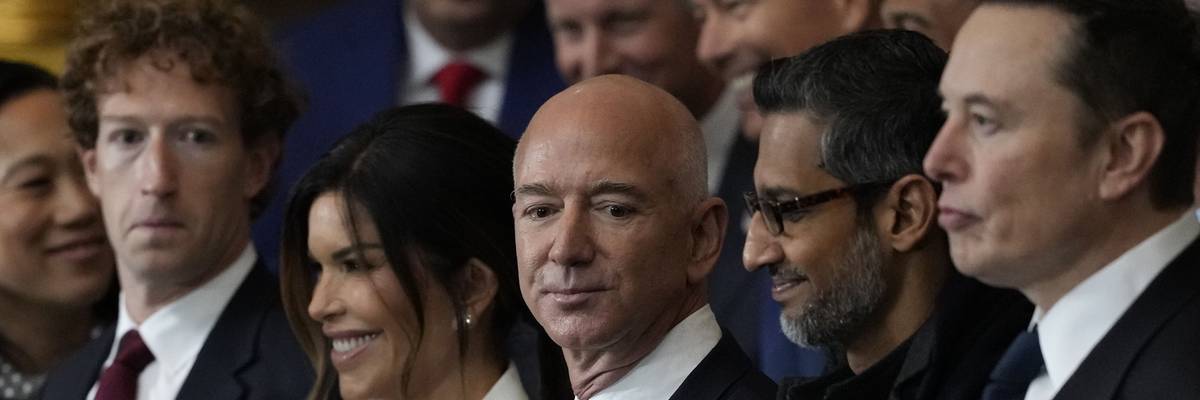
"With donor countries facing growing indebtedness and increasingly reallocating resources towards military spending, funding humanitarian assistance via the taxation of large fortunes was one of the most viable strategies."
With international aid programs facing an unprecedented cash crunch thanks in large part to foreign aid cuts ordered by US President Donald Trump, a recent study published The Lancet suggests that taxing the ultrarich would be the simplest way to plug funding gaps faced by crucial life-saving programs.
Specifically, the peer-reviewed study found that a hitting the world's billionaires with a 3% wealth tax would raise enough money to save up to 29.5 million lives in the world's most vulnerable populations over the next four years leading into 2030.
Lucio Exposito, senior economist of the study and researcher at the ICESI School of Economics and University of East Anglia School of Global Development, told Euronews that a global wealth tax was the most plausible way to undo the damage done by international aid cuts, many of which were caused by billionaire SpaceX CEO Elon Musk's dismantling of the United States Agency for International Development (USAID) in 2025 under the direct orders of Trump.
"With donor countries facing growing indebtedness and increasingly reallocating resources towards military spending," Exposito explained, "funding humanitarian assistance via the taxation of large fortunes was one of the most viable strategies."
The study's introduction notes that wealth inequality has reached unprecedented heights in recent years, growing especially acute in the wake of the Covid-19 pandemic.
"Today, the top 10% of the global population owns approximately 75% of global wealth, while the bottom 50% holds only 2%, with absolute income inequality steadily increasing over the past three decades," the study explains. "Moreover, the wealthiest 0.002% of the global population... controls an estimated $37.1 trillion in global wealth, surpassing the gross domestic product of the world's largest economy—the USA."
Even as the world's richest people have seen their wealth grow by bounds, official development assistance (ODA) to the Global South has been slashed significantly.
According to a study from the Organization for Economic Cooperation and Development (OECD) released earlier this year, ODA spending in 2025 fell by 23% compared to 2024, with the US responsible for 75% of the global decline.
A 2025 study published by The Lancet estimated that the elimination of USAID would lead to 14 million additional deaths worldwide by 2030.
Dear Common Dreams reader, It’s been nearly 30 years since I co-founded Common Dreams with my late wife, Lina Newhouser. We had the radical notion that journalism should serve the public good, not corporate profits. It was clear to us from the outset what it would take to build such a project. No paid advertisements. No corporate sponsors. No millionaire publisher telling us what to think or do. Many people said we wouldn't last a year, but we proved those doubters wrong. Together with a tremendous team of journalists and dedicated staff, we built an independent media outlet free from the constraints of profits and corporate control. Our mission has always been simple: To inform. To inspire. To ignite change for the common good. Building Common Dreams was not easy. Our survival was never guaranteed. When you take on the most powerful forces—Wall Street greed, fossil fuel industry destruction, Big Tech lobbyists, and uber-rich oligarchs who have spent billions upon billions rigging the economy and democracy in their favor—the only bulwark you have is supporters who believe in your work. But here’s the urgent message from me today. It's never been this bad out there. And it's never been this hard to keep us going. At the very moment Common Dreams is most needed, the threats we face are intensifying. We need your support now more than ever. We don't accept corporate advertising and never will. We don't have a paywall because we don't think people should be blocked from critical news based on their ability to pay. Everything we do is funded by the donations of readers like you. When everyone does the little they can afford, we are strong. But if that support retreats or dries up, so do we. Will you donate now to make sure Common Dreams not only survives but thrives? —Craig Brown, Co-founder |
With international aid programs facing an unprecedented cash crunch thanks in large part to foreign aid cuts ordered by US President Donald Trump, a recent study published The Lancet suggests that taxing the ultrarich would be the simplest way to plug funding gaps faced by crucial life-saving programs.
Specifically, the peer-reviewed study found that a hitting the world's billionaires with a 3% wealth tax would raise enough money to save up to 29.5 million lives in the world's most vulnerable populations over the next four years leading into 2030.
Lucio Exposito, senior economist of the study and researcher at the ICESI School of Economics and University of East Anglia School of Global Development, told Euronews that a global wealth tax was the most plausible way to undo the damage done by international aid cuts, many of which were caused by billionaire SpaceX CEO Elon Musk's dismantling of the United States Agency for International Development (USAID) in 2025 under the direct orders of Trump.
"With donor countries facing growing indebtedness and increasingly reallocating resources towards military spending," Exposito explained, "funding humanitarian assistance via the taxation of large fortunes was one of the most viable strategies."
The study's introduction notes that wealth inequality has reached unprecedented heights in recent years, growing especially acute in the wake of the Covid-19 pandemic.
"Today, the top 10% of the global population owns approximately 75% of global wealth, while the bottom 50% holds only 2%, with absolute income inequality steadily increasing over the past three decades," the study explains. "Moreover, the wealthiest 0.002% of the global population... controls an estimated $37.1 trillion in global wealth, surpassing the gross domestic product of the world's largest economy—the USA."
Even as the world's richest people have seen their wealth grow by bounds, official development assistance (ODA) to the Global South has been slashed significantly.
According to a study from the Organization for Economic Cooperation and Development (OECD) released earlier this year, ODA spending in 2025 fell by 23% compared to 2024, with the US responsible for 75% of the global decline.
A 2025 study published by The Lancet estimated that the elimination of USAID would lead to 14 million additional deaths worldwide by 2030.
With international aid programs facing an unprecedented cash crunch thanks in large part to foreign aid cuts ordered by US President Donald Trump, a recent study published The Lancet suggests that taxing the ultrarich would be the simplest way to plug funding gaps faced by crucial life-saving programs.
Specifically, the peer-reviewed study found that a hitting the world's billionaires with a 3% wealth tax would raise enough money to save up to 29.5 million lives in the world's most vulnerable populations over the next four years leading into 2030.
Lucio Exposito, senior economist of the study and researcher at the ICESI School of Economics and University of East Anglia School of Global Development, told Euronews that a global wealth tax was the most plausible way to undo the damage done by international aid cuts, many of which were caused by billionaire SpaceX CEO Elon Musk's dismantling of the United States Agency for International Development (USAID) in 2025 under the direct orders of Trump.
"With donor countries facing growing indebtedness and increasingly reallocating resources towards military spending," Exposito explained, "funding humanitarian assistance via the taxation of large fortunes was one of the most viable strategies."
The study's introduction notes that wealth inequality has reached unprecedented heights in recent years, growing especially acute in the wake of the Covid-19 pandemic.
"Today, the top 10% of the global population owns approximately 75% of global wealth, while the bottom 50% holds only 2%, with absolute income inequality steadily increasing over the past three decades," the study explains. "Moreover, the wealthiest 0.002% of the global population... controls an estimated $37.1 trillion in global wealth, surpassing the gross domestic product of the world's largest economy—the USA."
Even as the world's richest people have seen their wealth grow by bounds, official development assistance (ODA) to the Global South has been slashed significantly.
According to a study from the Organization for Economic Cooperation and Development (OECD) released earlier this year, ODA spending in 2025 fell by 23% compared to 2024, with the US responsible for 75% of the global decline.
A 2025 study published by The Lancet estimated that the elimination of USAID would lead to 14 million additional deaths worldwide by 2030.

