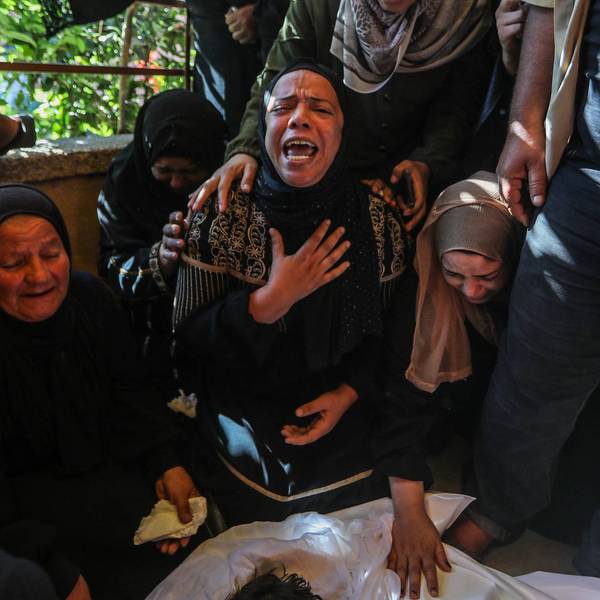
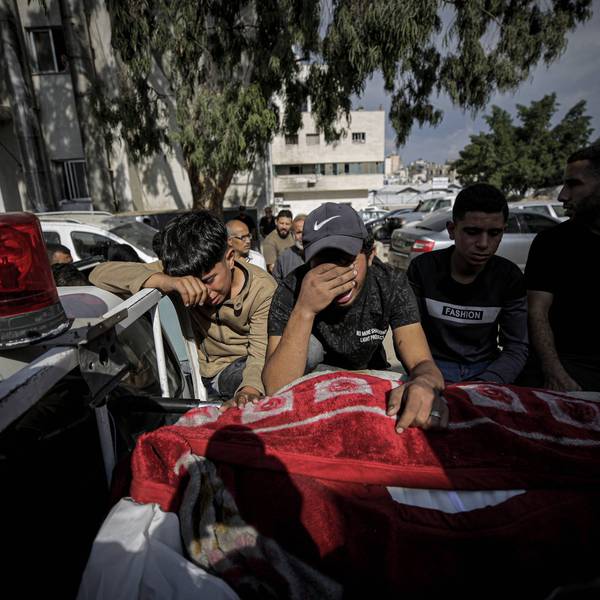
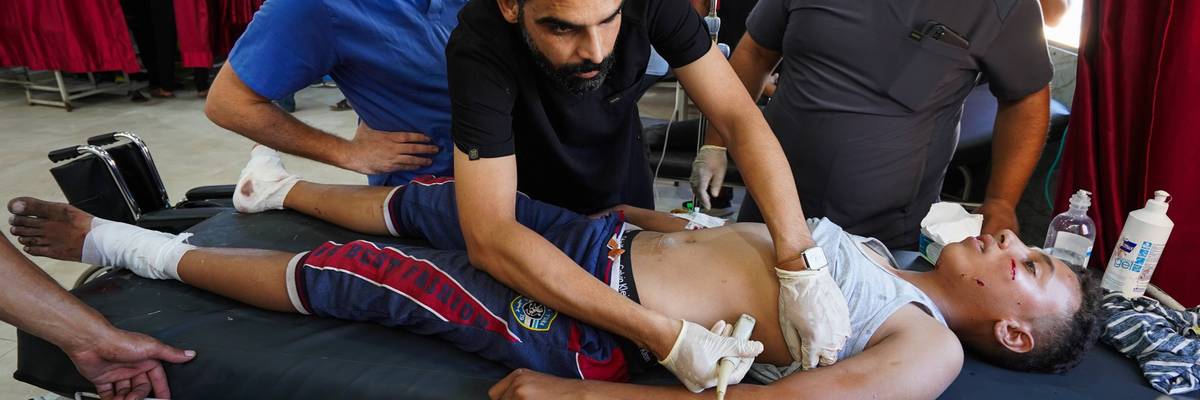
A Palestinian boy receives treatment after the Israeli forces attacked the Nuseirat refugee camp in the central Gaza Strip on July 28, 2026.
'This Is Not a Ceasefire,' Doctors Without Borders Says of Gaza, 'It Is a Continuation of the Genocide'
"A ceasefire should ensure that hostilities are paused, weapons are silenced, and that people are safe from strikes across the strip."
Nearly 10 months into a "ceasefire" in the Gaza Strip, as Israel on Tuesday killed at least one Palestinian man with an airstrike on the Nuseirat refugee camp, Doctors Without Borders declared that "the wounds of war are not only unhealed—they are still being inflicted."
"This is not a ceasefire," said the medical charity, also known as Médecins Sans Frontières (MSF), in a statement. "It is a continuation of the genocide, calibrated to be violent enough to keep Palestinians suffering every day, yet silent enough to avoid stirring international outrage."
Israeli forces have killed more than 73,300 Palestinians in Gaza and wounded over 174,009 since the Hamas-led October 7, 2023 attack on Israel—with global experts warning the true toll is likely far higher. Local authorities have documented at least 1,200 deaths and 3,900 injuries since the ceasefire was agreed to over nine months ago.
Experts with the United Nations and others around the world have denounced the Israeli assault and blockade as a genocide, and South Africa is leading a related case at the International Court of Justice. The International Criminal Court has also issued arrest warrants for Israeli Prime Minister Benjamin Netanyahu and his former defense minister, Yoav Gallant, over the mass slaughter.
Nearly all of Gaza's roughly 2 million survivors have been forcibly displaced, starved, or sickened. MSF said that "the destruction of homes has not stopped with the announcement of the ceasefire. Sudden and arbitrary orders for people to flee their homes and shelters continue to be used as a tool of psychological warfare by Israeli forces."
Rajaa Jendiya, who was widowed in the "flour massacres," is living in a tent at a school-turned-displacement camp with her children. She told Middle East Eye that she often takes them to the hospital because of illnesses.
"Inside and around the school, you often see sewage water overflowing, while rubbish accumulates, attracting flies and insects," Jendiya said. "These conditions become even worse with the heat, and many times my children have developed skin diseases."
In such makeshift shelters across Gaza, "scabies, respiratory infections, rat bites, and other diseases are rife," according to MSF.
Accessing healthcare has also become difficult in the coastal strip, as Israel has killed and detained Palestinian medical providers, and bombed civilian infrastructure such as hospitals, including in the months since the ceasefire deal was reached.
As MSF detailed Tuesday:
On July 16, an Israeli strike near an MSF clinic in Al-Mawasi sent four injured people to our teams. The following day, two apartment buildings housing our staff in Gaza City were struck without warning, trapping families inside as explosions shattered windows. In one building, rubble and bodies crashed into the lower-floor apartment of an MSF staff member.
The same day, MSF teams in Deir al-Balah, central Gaza, treated 12 people—seven of whom were children—who were injured after Israeli forces struck a funeral in Al-Nuseirat. In total, this strike killed eight people and injured 20. Among those killed was the 21-year-old son of an MSF staff member. Our colleague got the news while working in another emergency room.
"These were not isolated incidents," the organization stressed, "but merely a snapshot of 48 hours in Gaza."
Israel has also limited the flow of food and medicine into the war-torn territory. Calling out the country for using humanitarian assistance "as an instrument of oppression," MSF emphasized that "the Israeli state has an obligation under international law to ensure Palestinians in Gaza have access to aid, regardless of political negotiations, military agreements, or conduct of hostilities."
Since October, when the Israel Defense Forces controlled about half of Gaza, the "yellow line" indicating IDF occupation has kept shifting, to push Palestinians into "an ever-shrinking area," MSF explained. "Today, almost 2 million Palestinians are confined to approximately 30% of the strip."
After speaking with residents in Deir al-Balah, Khan Younis, Rafah, and Gaza City's Zeitoun, Tuffah, and Shejaia neighborhoods, Reuters reported Tuesday that "Israeli forces have advanced the yellow block markers during the past 10 days, triggering new waves of displacement in areas already devastated by months of conflict."
While loading bags and mattresses onto a truck in Zeitoun, Assem Dawla told the news agency: "The whole war is displacement, displacement. You can't stay anywhere without [Israel] telling you, 'Get out of here, we want to come in.'"
Staying near the yellow line comes with risks. MSF said that "just this week, one mother told our teams that her 14-year-old son, who has Down syndrome, was shot five times by Israeli snipers near the yellow line while he was playing near his home."
"A ceasefire should ensure that hostilities are paused, weapons are silenced, and that people are safe from strikes across the strip," the group asserted. "Using it as a weapon of war and reinforcing the confinement to a fraction of Gaza cannot be justified."
We are at a crossroads
This country and this world are at a monumental crossroads. In a few short weeks, US voters will have an opportunity to beat back the forces of fascism and confront the billionaires who are rigging the economy, our media system, and our democracy, making it increasingly impossible for ordinary people to get by. We’re not just talking about the election. We’re talking about what must be done once these fascist elements are vanquished from power. We need a bolder set of solutions than what either major party has so far been willing to offer and a working-class movement ready to fight like hell for it. Trump didn't emerge from nowhere. The conditions that fueled MAGA authoritarianism were created by decades of radical neoliberal economic policies and a corrupt political system dominated by corporate interests. They slashed taxes on the super-rich, promising that the benefits would trickle down. They said giveaways to the corporate titans would make life more affordable for the rest of us. It was all bullshit. And when a bitter, betrayed populace searches for someone to blame, right-wing demagogues have little trouble finding scapegoats. People know when they're being lied to, but you won't hear any of this from the corporate media. Only independent journalism—powered and funded by people who believe in building a better world—can deliver truly trustworthy daily news. Our Fall Campaign is underway, and we need your help. To power our newsroom through the rest of the year, we need to raise $125,000 by midnight on October 31. So if you share our vision, please contribute whatever you can to sustain our work. |
Nearly 10 months into a "ceasefire" in the Gaza Strip, as Israel on Tuesday killed at least one Palestinian man with an airstrike on the Nuseirat refugee camp, Doctors Without Borders declared that "the wounds of war are not only unhealed—they are still being inflicted."
"This is not a ceasefire," said the medical charity, also known as Médecins Sans Frontières (MSF), in a statement. "It is a continuation of the genocide, calibrated to be violent enough to keep Palestinians suffering every day, yet silent enough to avoid stirring international outrage."
Israeli forces have killed more than 73,300 Palestinians in Gaza and wounded over 174,009 since the Hamas-led October 7, 2023 attack on Israel—with global experts warning the true toll is likely far higher. Local authorities have documented at least 1,200 deaths and 3,900 injuries since the ceasefire was agreed to over nine months ago.
Experts with the United Nations and others around the world have denounced the Israeli assault and blockade as a genocide, and South Africa is leading a related case at the International Court of Justice. The International Criminal Court has also issued arrest warrants for Israeli Prime Minister Benjamin Netanyahu and his former defense minister, Yoav Gallant, over the mass slaughter.
Nearly all of Gaza's roughly 2 million survivors have been forcibly displaced, starved, or sickened. MSF said that "the destruction of homes has not stopped with the announcement of the ceasefire. Sudden and arbitrary orders for people to flee their homes and shelters continue to be used as a tool of psychological warfare by Israeli forces."
Rajaa Jendiya, who was widowed in the "flour massacres," is living in a tent at a school-turned-displacement camp with her children. She told Middle East Eye that she often takes them to the hospital because of illnesses.
"Inside and around the school, you often see sewage water overflowing, while rubbish accumulates, attracting flies and insects," Jendiya said. "These conditions become even worse with the heat, and many times my children have developed skin diseases."
In such makeshift shelters across Gaza, "scabies, respiratory infections, rat bites, and other diseases are rife," according to MSF.
Accessing healthcare has also become difficult in the coastal strip, as Israel has killed and detained Palestinian medical providers, and bombed civilian infrastructure such as hospitals, including in the months since the ceasefire deal was reached.
As MSF detailed Tuesday:
On July 16, an Israeli strike near an MSF clinic in Al-Mawasi sent four injured people to our teams. The following day, two apartment buildings housing our staff in Gaza City were struck without warning, trapping families inside as explosions shattered windows. In one building, rubble and bodies crashed into the lower-floor apartment of an MSF staff member.
The same day, MSF teams in Deir al-Balah, central Gaza, treated 12 people—seven of whom were children—who were injured after Israeli forces struck a funeral in Al-Nuseirat. In total, this strike killed eight people and injured 20. Among those killed was the 21-year-old son of an MSF staff member. Our colleague got the news while working in another emergency room.
"These were not isolated incidents," the organization stressed, "but merely a snapshot of 48 hours in Gaza."
Israel has also limited the flow of food and medicine into the war-torn territory. Calling out the country for using humanitarian assistance "as an instrument of oppression," MSF emphasized that "the Israeli state has an obligation under international law to ensure Palestinians in Gaza have access to aid, regardless of political negotiations, military agreements, or conduct of hostilities."
Since October, when the Israel Defense Forces controlled about half of Gaza, the "yellow line" indicating IDF occupation has kept shifting, to push Palestinians into "an ever-shrinking area," MSF explained. "Today, almost 2 million Palestinians are confined to approximately 30% of the strip."
After speaking with residents in Deir al-Balah, Khan Younis, Rafah, and Gaza City's Zeitoun, Tuffah, and Shejaia neighborhoods, Reuters reported Tuesday that "Israeli forces have advanced the yellow block markers during the past 10 days, triggering new waves of displacement in areas already devastated by months of conflict."
While loading bags and mattresses onto a truck in Zeitoun, Assem Dawla told the news agency: "The whole war is displacement, displacement. You can't stay anywhere without [Israel] telling you, 'Get out of here, we want to come in.'"
Staying near the yellow line comes with risks. MSF said that "just this week, one mother told our teams that her 14-year-old son, who has Down syndrome, was shot five times by Israeli snipers near the yellow line while he was playing near his home."
"A ceasefire should ensure that hostilities are paused, weapons are silenced, and that people are safe from strikes across the strip," the group asserted. "Using it as a weapon of war and reinforcing the confinement to a fraction of Gaza cannot be justified."
- 'Burning Entire Families to Death as They Slept' in Gaza, Israel Kill Count Nears 1,000 Since Ceasefire ›
- Nearly 2 Months Into 'Ceasefire,' IDF Kills 2 More Palestinian Children as Gaza Death Toll Passes 70,000 ›
- With Aid Blocked and 'At Least 2 Children a Day' Killed or Maimed, NGOs Say Trump's Gaza Ceasefire Is Failing ›
- World Famine Authorities Warn Most Gazans Still Suffering 'Crisis'-Level Hunger ›
- 'Ceasefire Is a Joke': Israeli Soldiers Recount Ongoing Indiscriminate Killings in Gaza ›
- Gaza Holds Mass Funeral for 112 Palestinians Slaughtered by Israel in 2023 | Common Dreams ›
- 94% of Palestinians in Gaza Need Shelter, Basic Aid to 'Live Safely and With Dignity' | Common Dreams ›
- Opinion | They Told the World the War Was Over—Gaza Knows Better | Common Dreams ›
- Pro-Israel Group Condemned for Demanding UK Ban on Doctors Without Borders | Common Dreams ›
- Israeli Election Panel OKs Ben-Gvir and Smotrich's Far-Right Parties After Voting to Ban Arab Ones | Common Dreams ›
Nearly 10 months into a "ceasefire" in the Gaza Strip, as Israel on Tuesday killed at least one Palestinian man with an airstrike on the Nuseirat refugee camp, Doctors Without Borders declared that "the wounds of war are not only unhealed—they are still being inflicted."
"This is not a ceasefire," said the medical charity, also known as Médecins Sans Frontières (MSF), in a statement. "It is a continuation of the genocide, calibrated to be violent enough to keep Palestinians suffering every day, yet silent enough to avoid stirring international outrage."
Israeli forces have killed more than 73,300 Palestinians in Gaza and wounded over 174,009 since the Hamas-led October 7, 2023 attack on Israel—with global experts warning the true toll is likely far higher. Local authorities have documented at least 1,200 deaths and 3,900 injuries since the ceasefire was agreed to over nine months ago.
Experts with the United Nations and others around the world have denounced the Israeli assault and blockade as a genocide, and South Africa is leading a related case at the International Court of Justice. The International Criminal Court has also issued arrest warrants for Israeli Prime Minister Benjamin Netanyahu and his former defense minister, Yoav Gallant, over the mass slaughter.
Nearly all of Gaza's roughly 2 million survivors have been forcibly displaced, starved, or sickened. MSF said that "the destruction of homes has not stopped with the announcement of the ceasefire. Sudden and arbitrary orders for people to flee their homes and shelters continue to be used as a tool of psychological warfare by Israeli forces."
Rajaa Jendiya, who was widowed in the "flour massacres," is living in a tent at a school-turned-displacement camp with her children. She told Middle East Eye that she often takes them to the hospital because of illnesses.
"Inside and around the school, you often see sewage water overflowing, while rubbish accumulates, attracting flies and insects," Jendiya said. "These conditions become even worse with the heat, and many times my children have developed skin diseases."
In such makeshift shelters across Gaza, "scabies, respiratory infections, rat bites, and other diseases are rife," according to MSF.
Accessing healthcare has also become difficult in the coastal strip, as Israel has killed and detained Palestinian medical providers, and bombed civilian infrastructure such as hospitals, including in the months since the ceasefire deal was reached.
As MSF detailed Tuesday:
On July 16, an Israeli strike near an MSF clinic in Al-Mawasi sent four injured people to our teams. The following day, two apartment buildings housing our staff in Gaza City were struck without warning, trapping families inside as explosions shattered windows. In one building, rubble and bodies crashed into the lower-floor apartment of an MSF staff member.
The same day, MSF teams in Deir al-Balah, central Gaza, treated 12 people—seven of whom were children—who were injured after Israeli forces struck a funeral in Al-Nuseirat. In total, this strike killed eight people and injured 20. Among those killed was the 21-year-old son of an MSF staff member. Our colleague got the news while working in another emergency room.
"These were not isolated incidents," the organization stressed, "but merely a snapshot of 48 hours in Gaza."
Israel has also limited the flow of food and medicine into the war-torn territory. Calling out the country for using humanitarian assistance "as an instrument of oppression," MSF emphasized that "the Israeli state has an obligation under international law to ensure Palestinians in Gaza have access to aid, regardless of political negotiations, military agreements, or conduct of hostilities."
Since October, when the Israel Defense Forces controlled about half of Gaza, the "yellow line" indicating IDF occupation has kept shifting, to push Palestinians into "an ever-shrinking area," MSF explained. "Today, almost 2 million Palestinians are confined to approximately 30% of the strip."
After speaking with residents in Deir al-Balah, Khan Younis, Rafah, and Gaza City's Zeitoun, Tuffah, and Shejaia neighborhoods, Reuters reported Tuesday that "Israeli forces have advanced the yellow block markers during the past 10 days, triggering new waves of displacement in areas already devastated by months of conflict."
While loading bags and mattresses onto a truck in Zeitoun, Assem Dawla told the news agency: "The whole war is displacement, displacement. You can't stay anywhere without [Israel] telling you, 'Get out of here, we want to come in.'"
Staying near the yellow line comes with risks. MSF said that "just this week, one mother told our teams that her 14-year-old son, who has Down syndrome, was shot five times by Israeli snipers near the yellow line while he was playing near his home."
"A ceasefire should ensure that hostilities are paused, weapons are silenced, and that people are safe from strikes across the strip," the group asserted. "Using it as a weapon of war and reinforcing the confinement to a fraction of Gaza cannot be justified."
- 'Burning Entire Families to Death as They Slept' in Gaza, Israel Kill Count Nears 1,000 Since Ceasefire ›
- Nearly 2 Months Into 'Ceasefire,' IDF Kills 2 More Palestinian Children as Gaza Death Toll Passes 70,000 ›
- With Aid Blocked and 'At Least 2 Children a Day' Killed or Maimed, NGOs Say Trump's Gaza Ceasefire Is Failing ›
- World Famine Authorities Warn Most Gazans Still Suffering 'Crisis'-Level Hunger ›
- 'Ceasefire Is a Joke': Israeli Soldiers Recount Ongoing Indiscriminate Killings in Gaza ›
- Gaza Holds Mass Funeral for 112 Palestinians Slaughtered by Israel in 2023 | Common Dreams ›
- 94% of Palestinians in Gaza Need Shelter, Basic Aid to 'Live Safely and With Dignity' | Common Dreams ›
- Opinion | They Told the World the War Was Over—Gaza Knows Better | Common Dreams ›
- Pro-Israel Group Condemned for Demanding UK Ban on Doctors Without Borders | Common Dreams ›
- Israeli Election Panel OKs Ben-Gvir and Smotrich's Far-Right Parties After Voting to Ban Arab Ones | Common Dreams ›