SUBSCRIBE TO OUR FREE NEWSLETTER
Daily news & progressive opinion—funded by the people, not the corporations—delivered straight to your inbox.
5
#000000
#FFFFFF
To donate by check, phone, or other method, see our More Ways to Give page.
Daily news & progressive opinion—funded by the people, not the corporations—delivered straight to your inbox.
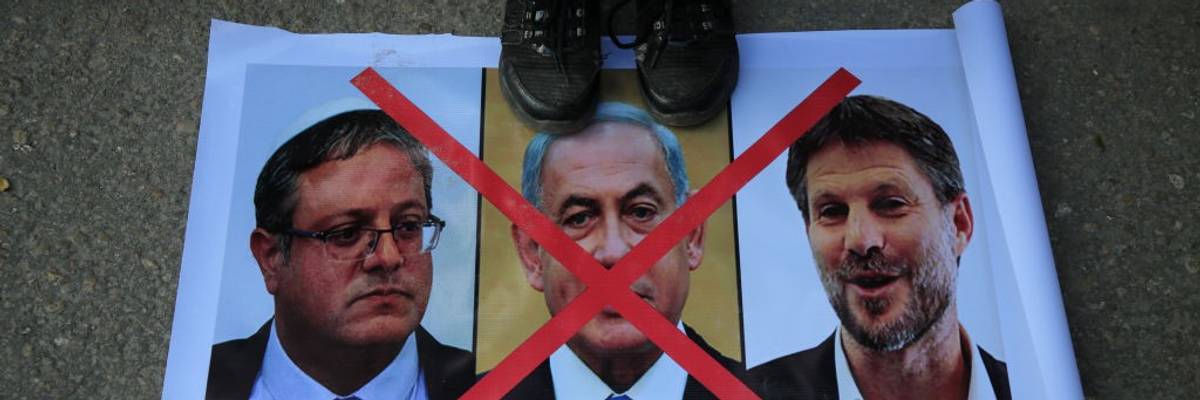
Palestinian protesters take part in a demonstration against Israeli National Security Minister Itamar Ben-Gvir, Prime Minister Benjamin Netanyahu, and Finance Minister Bezalel Smotrich, in front of the United Nations headquarters in Gaza City on January 12, 2023.
"Meanwhile, ministers and MKs threaten to nuke Gaza, starve the population, annex the West Bank, call to arrest journalists and enshrine Jewish law. This is who gets the all-clear," noted one Israeli writer.
On the heels of voting to disqualify all Arab-majority political parties and multiple candidates from Israel's October 27 Knesset election, the Israeli Central Elections Committee on Thursday declined to bar various far-right parties—a series of events that critics condemned as anti-democratic and racist.
The CEC—which is chaired by a Supreme Court justice but dominated by members of the Knesset's governing coalition—rejected petitions to ban National Security Minister Itamar Ben Gvir's Otzma Yehudit, Finance Minister Bezalel Smotrich's Religious Zionism, and Zehut, founded by Moshe Feiglin, a former member of Prime Minister Benjamin Netanyahu's Likud party.
"Under Israel's Basic Law on the Knesset, candidates and party slates can be barred from elections for rejecting Israel's existence as a Jewish and democratic state, inciting racism, or supporting armed struggle by an enemy state or terrorist organization against Israel," explained Haaretz.
In an unsuccessful bid to bar the Otzma Yehudit slate, Gilad Kariv, a member of the Knesset for the Democrats, declared that "Ben-Gvir is not a right-wing Zionist; he is a racist Kahanist who has been convicted of incitement to racism and supporting a terrorist organization."
While the panel ultimately refused to pass petitions on the right-wing parties, the previous day, it voted to disqualify the United Arab List—also known as Ra'am and led by Member of the Knesset Mansour Abbas—and the Joint List, an alliance made up of the parties Balad, Hadash, and Ta'al.
The committee disqualified the Joint List on grounds including its alleged rejection of Israel's existence as a Jewish and democratic state and support for armed struggle against it, and the United Arab List on those grounds, plus incitement to racism.
Sharply condemning the "political, racist, and anti-democratic decision," the Joint List said that "Netanyahu and Ben-Gvir know that the only way they can remain in power is by disqualifying Arab political representation and suppressing voter turnout in Arab society. This is how they seek to pave their way to another term."
"It is deeply regrettable to see that those who claim to seek to replace Netanyahu are once again falling into the racist trap set by Netanyahu and Ben-Gvir and lending their support to this political campaign," the coalition continued. "In doing so, they are contributing to the continued racist persecution of the entire Arab public, deepening racism, and perpetuating the rule of Netanyahu and his political partners."
"The Joint List is the only party that has placed at the forefront of its platform the struggle for democracy for all, genuine equality, justice and comprehensive peace. It is the only alternative to the racist policies of Netanyahu and Ben-Gvir," it added.
Dov Waxman, a professor of Israeli studies at the University of California, Los Angeles, similarly suggested on social media Wednesday that the CEC disqualified the Arab-majority parties "to delegitimize" them "in the minds of Israeli Jewish voters, and they want to do that in order to make it harder for the opposition to form a coalition government."
An opposition coalition including Ra'am "is the most likely way that an alternative, Eisenkot-led government could take power if the anti-Netanyahu bloc wins the election," Waxman added, referring to Yashar's Gadi Eisenkot.
The CEC on Wednesday also disqualified MK Ofer Cassif of the left-wing Arab-Jewish Hadash party and Balad's leader, Sami Abu Shehadeh. The Times of Israel noted that a representative for Attorney General Gali Baharav-Miara reaffirmed her "position that none of the petitions before the CEC had sufficient grounds except the one against Abu Shehadeh."
"All opposition parties—Gadi Eisenkot's Yashar, Naftali Bennett's B'Yachad, Yair Golan's Democrats, Avigdor Liberman's Yisrael Beytenu, and Benny Gantz's Blue and White—backed the petition" against the Balad leader, as did Supreme Court Justice Noam Sohlberg, the panel's chair, according to The Times of Israel.
"The backing of Sohlberg and Baharav-Miara raises the prospect that the Supreme Court may uphold the decision, despite its historically high threshold for disqualifying candidates and its repeated overturning of such decisions by the committee," the newspaper added, pointing to plans for the justices to consider the decisions next week.
Otzma Yehudit sought to disqualify Abu Shehadeh over an article in which he called the Hamas-led October 2023 attack on Israel—which led to the ongoing Israeli assault on the Gaza Strip widely denounced as genocide—as "an important historic event militarily, politically, and strategically."
As Haaretz detailed:
Abu Shehadeh said he regretted writing the article at the center of the request to disqualify him. "I wrote it on October 7, and I didn't know the scale of the atrocities. If I had known, I would not have written it this way," he said. "I agree with the justified criticism of the article. I should not have written it, and I should have clearly condemned [the attack]."
"My intention was for the military campaign to be halted and for the parties to move to a diplomatic track led by the Palestinian Authority and Arab states," he explained.
As for Cassif, whose ban was spearheaded by Likud, he said that "the disqualification requests are intended to achieve the complete delegitimization of Arab society and Israeli-Arab partnership, and to perpetuate totalitarian rule and majority tyranny," according to the newspaper.
"There is no contradiction between the absolute condemnation I have expressed of the Gaza massacre and the war crimes being committed by the Israeli government, and the absolute condemnation I have expressed of the October 7 massacre and Hamas' horrific crimes," he added.
After the Wednesday decisions, the Haifa-based rights group Adalah said in a statement that "the hearings, like the motions themselves, showed once again that this is an arbitrary, inciting, and racist process, devoid of any legal process. The CEC conducted an illegitimate political process aimed at persecuting ideas the majority does not accept, and it ended with the disqualification of all Palestinian representation in the Israeli Knesset."
"The CEC approved every disqualification motion except a separate motion against Balad/Tajammu' alone, which it rejected on procedural grounds," noted Adalah—which "represented all the political party lists and individual candidates before the CEC, and will represent them against these decisions before the Supreme Court."
Dear Common Dreams reader, It’s been nearly 30 years since I co-founded Common Dreams with my late wife, Lina Newhouser. We had the radical notion that journalism should serve the public good, not corporate profits. It was clear to us from the outset what it would take to build such a project. No paid advertisements. No corporate sponsors. No millionaire publisher telling us what to think or do. Many people said we wouldn't last a year, but we proved those doubters wrong. Together with a tremendous team of journalists and dedicated staff, we built an independent media outlet free from the constraints of profits and corporate control. Our mission has always been simple: To inform. To inspire. To ignite change for the common good. Building Common Dreams was not easy. Our survival was never guaranteed. When you take on the most powerful forces—Wall Street greed, fossil fuel industry destruction, Big Tech lobbyists, and uber-rich oligarchs who have spent billions upon billions rigging the economy and democracy in their favor—the only bulwark you have is supporters who believe in your work. But here’s the urgent message from me today. It's never been this bad out there. And it's never been this hard to keep us going. At the very moment Common Dreams is most needed, the threats we face are intensifying. We need your support now more than ever. We don't accept corporate advertising and never will. We don't have a paywall because we don't think people should be blocked from critical news based on their ability to pay. Everything we do is funded by the donations of readers like you. When everyone does the little they can afford, we are strong. But if that support retreats or dries up, so do we. Will you donate now to make sure Common Dreams not only survives but thrives? —Craig Brown, Co-founder |
On the heels of voting to disqualify all Arab-majority political parties and multiple candidates from Israel's October 27 Knesset election, the Israeli Central Elections Committee on Thursday declined to bar various far-right parties—a series of events that critics condemned as anti-democratic and racist.
The CEC—which is chaired by a Supreme Court justice but dominated by members of the Knesset's governing coalition—rejected petitions to ban National Security Minister Itamar Ben Gvir's Otzma Yehudit, Finance Minister Bezalel Smotrich's Religious Zionism, and Zehut, founded by Moshe Feiglin, a former member of Prime Minister Benjamin Netanyahu's Likud party.
"Under Israel's Basic Law on the Knesset, candidates and party slates can be barred from elections for rejecting Israel's existence as a Jewish and democratic state, inciting racism, or supporting armed struggle by an enemy state or terrorist organization against Israel," explained Haaretz.
In an unsuccessful bid to bar the Otzma Yehudit slate, Gilad Kariv, a member of the Knesset for the Democrats, declared that "Ben-Gvir is not a right-wing Zionist; he is a racist Kahanist who has been convicted of incitement to racism and supporting a terrorist organization."
While the panel ultimately refused to pass petitions on the right-wing parties, the previous day, it voted to disqualify the United Arab List—also known as Ra'am and led by Member of the Knesset Mansour Abbas—and the Joint List, an alliance made up of the parties Balad, Hadash, and Ta'al.
The committee disqualified the Joint List on grounds including its alleged rejection of Israel's existence as a Jewish and democratic state and support for armed struggle against it, and the United Arab List on those grounds, plus incitement to racism.
Sharply condemning the "political, racist, and anti-democratic decision," the Joint List said that "Netanyahu and Ben-Gvir know that the only way they can remain in power is by disqualifying Arab political representation and suppressing voter turnout in Arab society. This is how they seek to pave their way to another term."
"It is deeply regrettable to see that those who claim to seek to replace Netanyahu are once again falling into the racist trap set by Netanyahu and Ben-Gvir and lending their support to this political campaign," the coalition continued. "In doing so, they are contributing to the continued racist persecution of the entire Arab public, deepening racism, and perpetuating the rule of Netanyahu and his political partners."
"The Joint List is the only party that has placed at the forefront of its platform the struggle for democracy for all, genuine equality, justice and comprehensive peace. It is the only alternative to the racist policies of Netanyahu and Ben-Gvir," it added.
Dov Waxman, a professor of Israeli studies at the University of California, Los Angeles, similarly suggested on social media Wednesday that the CEC disqualified the Arab-majority parties "to delegitimize" them "in the minds of Israeli Jewish voters, and they want to do that in order to make it harder for the opposition to form a coalition government."
An opposition coalition including Ra'am "is the most likely way that an alternative, Eisenkot-led government could take power if the anti-Netanyahu bloc wins the election," Waxman added, referring to Yashar's Gadi Eisenkot.
The CEC on Wednesday also disqualified MK Ofer Cassif of the left-wing Arab-Jewish Hadash party and Balad's leader, Sami Abu Shehadeh. The Times of Israel noted that a representative for Attorney General Gali Baharav-Miara reaffirmed her "position that none of the petitions before the CEC had sufficient grounds except the one against Abu Shehadeh."
"All opposition parties—Gadi Eisenkot's Yashar, Naftali Bennett's B'Yachad, Yair Golan's Democrats, Avigdor Liberman's Yisrael Beytenu, and Benny Gantz's Blue and White—backed the petition" against the Balad leader, as did Supreme Court Justice Noam Sohlberg, the panel's chair, according to The Times of Israel.
"The backing of Sohlberg and Baharav-Miara raises the prospect that the Supreme Court may uphold the decision, despite its historically high threshold for disqualifying candidates and its repeated overturning of such decisions by the committee," the newspaper added, pointing to plans for the justices to consider the decisions next week.
Otzma Yehudit sought to disqualify Abu Shehadeh over an article in which he called the Hamas-led October 2023 attack on Israel—which led to the ongoing Israeli assault on the Gaza Strip widely denounced as genocide—as "an important historic event militarily, politically, and strategically."
As Haaretz detailed:
Abu Shehadeh said he regretted writing the article at the center of the request to disqualify him. "I wrote it on October 7, and I didn't know the scale of the atrocities. If I had known, I would not have written it this way," he said. "I agree with the justified criticism of the article. I should not have written it, and I should have clearly condemned [the attack]."
"My intention was for the military campaign to be halted and for the parties to move to a diplomatic track led by the Palestinian Authority and Arab states," he explained.
As for Cassif, whose ban was spearheaded by Likud, he said that "the disqualification requests are intended to achieve the complete delegitimization of Arab society and Israeli-Arab partnership, and to perpetuate totalitarian rule and majority tyranny," according to the newspaper.
"There is no contradiction between the absolute condemnation I have expressed of the Gaza massacre and the war crimes being committed by the Israeli government, and the absolute condemnation I have expressed of the October 7 massacre and Hamas' horrific crimes," he added.
After the Wednesday decisions, the Haifa-based rights group Adalah said in a statement that "the hearings, like the motions themselves, showed once again that this is an arbitrary, inciting, and racist process, devoid of any legal process. The CEC conducted an illegitimate political process aimed at persecuting ideas the majority does not accept, and it ended with the disqualification of all Palestinian representation in the Israeli Knesset."
"The CEC approved every disqualification motion except a separate motion against Balad/Tajammu' alone, which it rejected on procedural grounds," noted Adalah—which "represented all the political party lists and individual candidates before the CEC, and will represent them against these decisions before the Supreme Court."
On the heels of voting to disqualify all Arab-majority political parties and multiple candidates from Israel's October 27 Knesset election, the Israeli Central Elections Committee on Thursday declined to bar various far-right parties—a series of events that critics condemned as anti-democratic and racist.
The CEC—which is chaired by a Supreme Court justice but dominated by members of the Knesset's governing coalition—rejected petitions to ban National Security Minister Itamar Ben Gvir's Otzma Yehudit, Finance Minister Bezalel Smotrich's Religious Zionism, and Zehut, founded by Moshe Feiglin, a former member of Prime Minister Benjamin Netanyahu's Likud party.
"Under Israel's Basic Law on the Knesset, candidates and party slates can be barred from elections for rejecting Israel's existence as a Jewish and democratic state, inciting racism, or supporting armed struggle by an enemy state or terrorist organization against Israel," explained Haaretz.
In an unsuccessful bid to bar the Otzma Yehudit slate, Gilad Kariv, a member of the Knesset for the Democrats, declared that "Ben-Gvir is not a right-wing Zionist; he is a racist Kahanist who has been convicted of incitement to racism and supporting a terrorist organization."
While the panel ultimately refused to pass petitions on the right-wing parties, the previous day, it voted to disqualify the United Arab List—also known as Ra'am and led by Member of the Knesset Mansour Abbas—and the Joint List, an alliance made up of the parties Balad, Hadash, and Ta'al.
The committee disqualified the Joint List on grounds including its alleged rejection of Israel's existence as a Jewish and democratic state and support for armed struggle against it, and the United Arab List on those grounds, plus incitement to racism.
Sharply condemning the "political, racist, and anti-democratic decision," the Joint List said that "Netanyahu and Ben-Gvir know that the only way they can remain in power is by disqualifying Arab political representation and suppressing voter turnout in Arab society. This is how they seek to pave their way to another term."
"It is deeply regrettable to see that those who claim to seek to replace Netanyahu are once again falling into the racist trap set by Netanyahu and Ben-Gvir and lending their support to this political campaign," the coalition continued. "In doing so, they are contributing to the continued racist persecution of the entire Arab public, deepening racism, and perpetuating the rule of Netanyahu and his political partners."
"The Joint List is the only party that has placed at the forefront of its platform the struggle for democracy for all, genuine equality, justice and comprehensive peace. It is the only alternative to the racist policies of Netanyahu and Ben-Gvir," it added.
Dov Waxman, a professor of Israeli studies at the University of California, Los Angeles, similarly suggested on social media Wednesday that the CEC disqualified the Arab-majority parties "to delegitimize" them "in the minds of Israeli Jewish voters, and they want to do that in order to make it harder for the opposition to form a coalition government."
An opposition coalition including Ra'am "is the most likely way that an alternative, Eisenkot-led government could take power if the anti-Netanyahu bloc wins the election," Waxman added, referring to Yashar's Gadi Eisenkot.
The CEC on Wednesday also disqualified MK Ofer Cassif of the left-wing Arab-Jewish Hadash party and Balad's leader, Sami Abu Shehadeh. The Times of Israel noted that a representative for Attorney General Gali Baharav-Miara reaffirmed her "position that none of the petitions before the CEC had sufficient grounds except the one against Abu Shehadeh."
"All opposition parties—Gadi Eisenkot's Yashar, Naftali Bennett's B'Yachad, Yair Golan's Democrats, Avigdor Liberman's Yisrael Beytenu, and Benny Gantz's Blue and White—backed the petition" against the Balad leader, as did Supreme Court Justice Noam Sohlberg, the panel's chair, according to The Times of Israel.
"The backing of Sohlberg and Baharav-Miara raises the prospect that the Supreme Court may uphold the decision, despite its historically high threshold for disqualifying candidates and its repeated overturning of such decisions by the committee," the newspaper added, pointing to plans for the justices to consider the decisions next week.
Otzma Yehudit sought to disqualify Abu Shehadeh over an article in which he called the Hamas-led October 2023 attack on Israel—which led to the ongoing Israeli assault on the Gaza Strip widely denounced as genocide—as "an important historic event militarily, politically, and strategically."
As Haaretz detailed:
Abu Shehadeh said he regretted writing the article at the center of the request to disqualify him. "I wrote it on October 7, and I didn't know the scale of the atrocities. If I had known, I would not have written it this way," he said. "I agree with the justified criticism of the article. I should not have written it, and I should have clearly condemned [the attack]."
"My intention was for the military campaign to be halted and for the parties to move to a diplomatic track led by the Palestinian Authority and Arab states," he explained.
As for Cassif, whose ban was spearheaded by Likud, he said that "the disqualification requests are intended to achieve the complete delegitimization of Arab society and Israeli-Arab partnership, and to perpetuate totalitarian rule and majority tyranny," according to the newspaper.
"There is no contradiction between the absolute condemnation I have expressed of the Gaza massacre and the war crimes being committed by the Israeli government, and the absolute condemnation I have expressed of the October 7 massacre and Hamas' horrific crimes," he added.
After the Wednesday decisions, the Haifa-based rights group Adalah said in a statement that "the hearings, like the motions themselves, showed once again that this is an arbitrary, inciting, and racist process, devoid of any legal process. The CEC conducted an illegitimate political process aimed at persecuting ideas the majority does not accept, and it ended with the disqualification of all Palestinian representation in the Israeli Knesset."
"The CEC approved every disqualification motion except a separate motion against Balad/Tajammu' alone, which it rejected on procedural grounds," noted Adalah—which "represented all the political party lists and individual candidates before the CEC, and will represent them against these decisions before the Supreme Court."