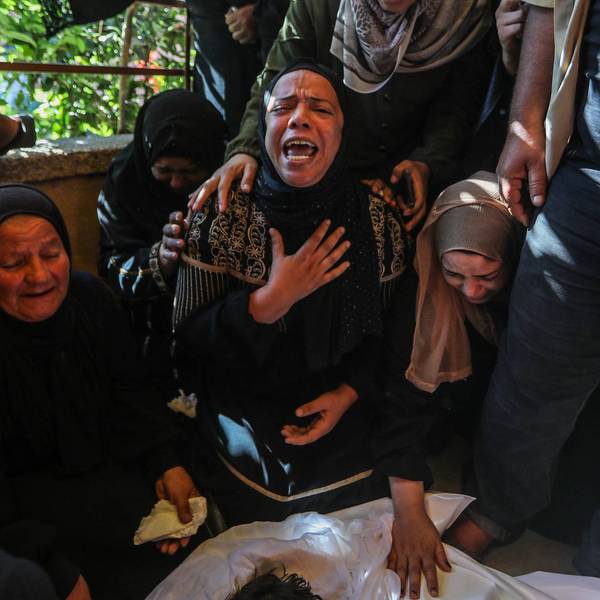
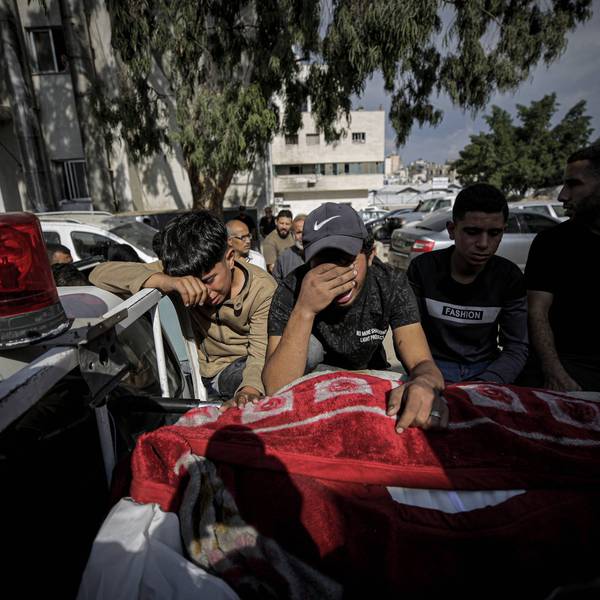
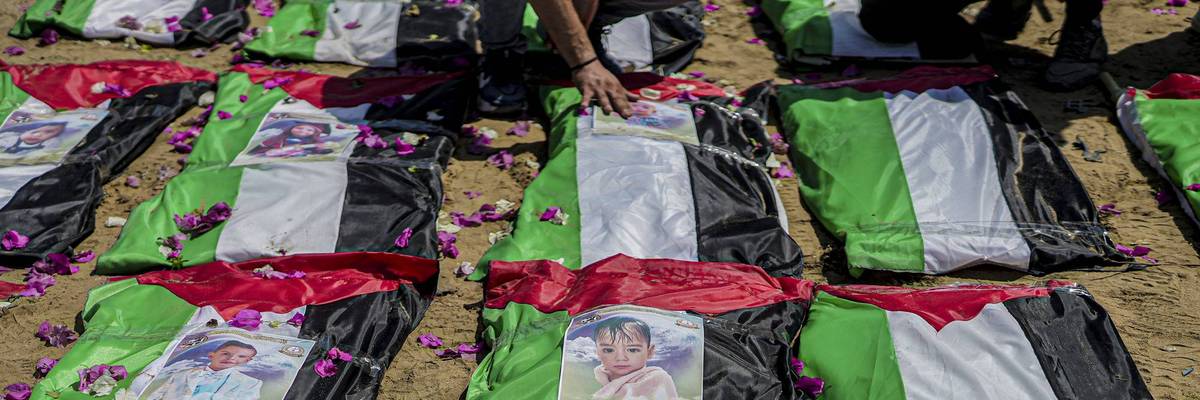
Photographs rest on bodies wrapped in Palestinian flags during a mass funeral in Gaza City, Gaza Strip, on August 4, 2026.
They Told the World the War Was Over—Gaza Knows Better
A ceasefire cannot mean peace when people are still being killed, buried under rubble, and denied the basic conditions for rebuilding their lives.
When US President Donald Trump declared in October 2025 that “the war is over,” the statement quickly became part of the international language surrounding Gaza. Headlines shifted. Political leaders began speaking about a post-war phase. The world was encouraged to look forward—to reconstruction, diplomacy, and what might come next.
But from inside Gaza, the distinction between “war” and “peace” has never been so simple. A ceasefire may reduce the intensity of bombardment. It may change the language used by politicians and diplomats. But for Palestinians who remain surrounded by destruction, displacement, deprivation, and the remains of those who were killed, the war does not simply disappear because leaders declare a new phase.
On August 4, Gaza witnessed a devastating reminder of this reality. The remains of 112 Palestinians were buried in a mass funeral in Gaza City, more than two and a half years after they were killed in an Israeli strike on the Sabra neighborhood. The victims included 37 children. Rescue workers spent weeks searching through the ruins for their remains, working with almost no equipment and identifying bodies through fragments, clothing, family testimony, and whatever personal belongings could be recovered.
For the families, the violence did not end when the bombs stopped falling on that neighborhood. It continued in the rubble. And the 112 bodies were not an isolated tragedy. Gaza's Civil Defence has estimated that around 8,000 bodies remain beneath the rubble across the strip. Recovery teams say that removing them will require heavy equipment that is still desperately lacking. Without that equipment, the dead may remain trapped for years.
A ceasefire should be the beginning of ending the violence—not an excuse to redefine its consequences as peace.
This is what it means to tell Palestinians that the war is over. For many people outside Gaza, war is measured by explosions: the number of airstrikes, the intensity of fighting, or the number of military operations reported each day. For those of us living here, war is also measured in what remains after the explosions.
It is measured in the family searching for the body of a missing relative. It is measured in children growing up among destroyed schools. It is measured in homes that no longer exist, universities reduced to ruins, hospitals struggling to function, and displaced families who cannot return to places that once defined their lives. It is measured in the enormous task of removing the dead from beneath the rubble before their families can bury them.
The language of a “post-war” Gaza therefore risks becoming another form of erasure. It suggests that the violence belongs to the past, while the consequences are treated as a humanitarian problem waiting to be solved.
But Gaza cannot simply be rebuilt like a damaged road. A society has been shattered. Families have been separated and destroyed. Communities have disappeared. Hundreds of thousands of people have lost homes. Children have lost years of education. The physical destruction is accompanied by grief that cannot be captured by reconstruction statistics. And yet, international attention has increasingly moved elsewhere.
This is perhaps the most painful part. People around the world demonstrated for Gaza. Students occupied campuses. Human rights organizations documented violations. Workers and trade unions called for solidarity. Millions of ordinary people refused to accept the destruction of an entire population as normal.
But public sympathy does not automatically produce political action. Western governments can express concern while continuing to treat Gaza as a diplomatic file rather than a human emergency. Leaders can call for peace while failing to ensure that Palestinians have the conditions necessary to live with dignity. Statements can be issued, condolences offered, and conferences held—while the consequences of the destruction remain largely the responsibility of Palestinians themselves.
This is why the words “the war is over” matter. Words shape political reality. When a government, president, or media institution describes Gaza as post-war, audiences far from the strip may assume that the emergency has passed. Attention moves elsewhere. Political pressure decreases. The suffering becomes background noise.
But the people of Gaza cannot move on simply because the world has decided to. The 112 people buried in August had already waited nearly three years for a grave. Thousands more remain beneath the rubble. Their families are still waiting. And millions of Palestinians are still trying to understand what “peace” is supposed to mean when they have nowhere safe to return to and so little ability to rebuild what was destroyed.
A ceasefire should be the beginning of ending the violence—not an excuse to redefine its consequences as peace. If the international community truly wants to speak about a post-war Gaza, it must first confront what the war has left behind. That means guaranteeing sustained humanitarian access; enabling the removal and identification of those buried beneath the rubble; supporting the rebuilding of homes, schools, hospitals, and universities; and establishing meaningful accountability for violations of international law.
Most importantly, Palestinians must not be treated merely as recipients of humanitarian assistance. They must be recognized as people with rights, agency, and a future that belongs to them. The world may want to turn the page on Gaza. We cannot. We are still living in the pages that came before.
For those of us here, the war is not an entry in a history book. It is the rubble outside our doors, the empty chair at the family table, the child who cannot return to school, and the grave that took years to become possible. So when the world is told that the war is over, listen to Gaza.
Look beneath the rubble.
Count the graves.
And ask whether peace can truly be declared while thousands of the dead are still waiting to be found.
We are at a crossroads
This country and this world are at a monumental crossroads. In a few short weeks, US voters will have an opportunity to beat back the forces of fascism and confront the billionaires who are rigging the economy, our media system, and our democracy, making it increasingly impossible for ordinary people to get by. We’re not just talking about the election. We’re talking about what must be done once these fascist elements are vanquished from power. We need a bolder set of solutions than what either major party has so far been willing to offer and a working-class movement ready to fight like hell for it. Trump didn't emerge from nowhere. The conditions that fueled MAGA authoritarianism were created by decades of radical neoliberal economic policies and a corrupt political system dominated by corporate interests. They slashed taxes on the super-rich, promising that the benefits would trickle down. They said giveaways to the corporate titans would make life more affordable for the rest of us. It was all bullshit. And when a bitter, betrayed populace searches for someone to blame, right-wing demagogues have little trouble finding scapegoats. People know when they're being lied to, but you won't hear any of this from the corporate media. Only independent journalism—powered and funded by people who believe in building a better world—can deliver truly trustworthy daily news. Our Fall Campaign is underway, and we need your help. To power our newsroom through the rest of the year, we need to raise $125,000 by midnight on October 31. So if you share our vision, please contribute whatever you can to sustain our work. |
When US President Donald Trump declared in October 2025 that “the war is over,” the statement quickly became part of the international language surrounding Gaza. Headlines shifted. Political leaders began speaking about a post-war phase. The world was encouraged to look forward—to reconstruction, diplomacy, and what might come next.
But from inside Gaza, the distinction between “war” and “peace” has never been so simple. A ceasefire may reduce the intensity of bombardment. It may change the language used by politicians and diplomats. But for Palestinians who remain surrounded by destruction, displacement, deprivation, and the remains of those who were killed, the war does not simply disappear because leaders declare a new phase.
On August 4, Gaza witnessed a devastating reminder of this reality. The remains of 112 Palestinians were buried in a mass funeral in Gaza City, more than two and a half years after they were killed in an Israeli strike on the Sabra neighborhood. The victims included 37 children. Rescue workers spent weeks searching through the ruins for their remains, working with almost no equipment and identifying bodies through fragments, clothing, family testimony, and whatever personal belongings could be recovered.
For the families, the violence did not end when the bombs stopped falling on that neighborhood. It continued in the rubble. And the 112 bodies were not an isolated tragedy. Gaza's Civil Defence has estimated that around 8,000 bodies remain beneath the rubble across the strip. Recovery teams say that removing them will require heavy equipment that is still desperately lacking. Without that equipment, the dead may remain trapped for years.
A ceasefire should be the beginning of ending the violence—not an excuse to redefine its consequences as peace.
This is what it means to tell Palestinians that the war is over. For many people outside Gaza, war is measured by explosions: the number of airstrikes, the intensity of fighting, or the number of military operations reported each day. For those of us living here, war is also measured in what remains after the explosions.
It is measured in the family searching for the body of a missing relative. It is measured in children growing up among destroyed schools. It is measured in homes that no longer exist, universities reduced to ruins, hospitals struggling to function, and displaced families who cannot return to places that once defined their lives. It is measured in the enormous task of removing the dead from beneath the rubble before their families can bury them.
The language of a “post-war” Gaza therefore risks becoming another form of erasure. It suggests that the violence belongs to the past, while the consequences are treated as a humanitarian problem waiting to be solved.
But Gaza cannot simply be rebuilt like a damaged road. A society has been shattered. Families have been separated and destroyed. Communities have disappeared. Hundreds of thousands of people have lost homes. Children have lost years of education. The physical destruction is accompanied by grief that cannot be captured by reconstruction statistics. And yet, international attention has increasingly moved elsewhere.
This is perhaps the most painful part. People around the world demonstrated for Gaza. Students occupied campuses. Human rights organizations documented violations. Workers and trade unions called for solidarity. Millions of ordinary people refused to accept the destruction of an entire population as normal.
But public sympathy does not automatically produce political action. Western governments can express concern while continuing to treat Gaza as a diplomatic file rather than a human emergency. Leaders can call for peace while failing to ensure that Palestinians have the conditions necessary to live with dignity. Statements can be issued, condolences offered, and conferences held—while the consequences of the destruction remain largely the responsibility of Palestinians themselves.
This is why the words “the war is over” matter. Words shape political reality. When a government, president, or media institution describes Gaza as post-war, audiences far from the strip may assume that the emergency has passed. Attention moves elsewhere. Political pressure decreases. The suffering becomes background noise.
But the people of Gaza cannot move on simply because the world has decided to. The 112 people buried in August had already waited nearly three years for a grave. Thousands more remain beneath the rubble. Their families are still waiting. And millions of Palestinians are still trying to understand what “peace” is supposed to mean when they have nowhere safe to return to and so little ability to rebuild what was destroyed.
A ceasefire should be the beginning of ending the violence—not an excuse to redefine its consequences as peace. If the international community truly wants to speak about a post-war Gaza, it must first confront what the war has left behind. That means guaranteeing sustained humanitarian access; enabling the removal and identification of those buried beneath the rubble; supporting the rebuilding of homes, schools, hospitals, and universities; and establishing meaningful accountability for violations of international law.
Most importantly, Palestinians must not be treated merely as recipients of humanitarian assistance. They must be recognized as people with rights, agency, and a future that belongs to them. The world may want to turn the page on Gaza. We cannot. We are still living in the pages that came before.
For those of us here, the war is not an entry in a history book. It is the rubble outside our doors, the empty chair at the family table, the child who cannot return to school, and the grave that took years to become possible. So when the world is told that the war is over, listen to Gaza.
Look beneath the rubble.
Count the graves.
And ask whether peace can truly be declared while thousands of the dead are still waiting to be found.
- 'Ceasefire Is a Joke': Israeli Soldiers Recount Ongoing Indiscriminate Killings in Gaza ›
- Humanitarian Scorecard: Six Months In, Gaza Ceasefire is Failing ›
- 'Genocide Is Not Over,' Amnesty Leader Says as Israel Keeps Bombing Gaza ›
- After 2 Years of Denial, IDF Confirms 70,000+ Killed in Gaza—But Denies Famine ›
- Dispatch From Gaza and the War That Never Ends ›
- 'This Is Not a Ceasefire,' Doctors Without Borders Says of Gaza, 'It Is a Continuation of the Genocide' ›
When US President Donald Trump declared in October 2025 that “the war is over,” the statement quickly became part of the international language surrounding Gaza. Headlines shifted. Political leaders began speaking about a post-war phase. The world was encouraged to look forward—to reconstruction, diplomacy, and what might come next.
But from inside Gaza, the distinction between “war” and “peace” has never been so simple. A ceasefire may reduce the intensity of bombardment. It may change the language used by politicians and diplomats. But for Palestinians who remain surrounded by destruction, displacement, deprivation, and the remains of those who were killed, the war does not simply disappear because leaders declare a new phase.
On August 4, Gaza witnessed a devastating reminder of this reality. The remains of 112 Palestinians were buried in a mass funeral in Gaza City, more than two and a half years after they were killed in an Israeli strike on the Sabra neighborhood. The victims included 37 children. Rescue workers spent weeks searching through the ruins for their remains, working with almost no equipment and identifying bodies through fragments, clothing, family testimony, and whatever personal belongings could be recovered.
For the families, the violence did not end when the bombs stopped falling on that neighborhood. It continued in the rubble. And the 112 bodies were not an isolated tragedy. Gaza's Civil Defence has estimated that around 8,000 bodies remain beneath the rubble across the strip. Recovery teams say that removing them will require heavy equipment that is still desperately lacking. Without that equipment, the dead may remain trapped for years.
A ceasefire should be the beginning of ending the violence—not an excuse to redefine its consequences as peace.
This is what it means to tell Palestinians that the war is over. For many people outside Gaza, war is measured by explosions: the number of airstrikes, the intensity of fighting, or the number of military operations reported each day. For those of us living here, war is also measured in what remains after the explosions.
It is measured in the family searching for the body of a missing relative. It is measured in children growing up among destroyed schools. It is measured in homes that no longer exist, universities reduced to ruins, hospitals struggling to function, and displaced families who cannot return to places that once defined their lives. It is measured in the enormous task of removing the dead from beneath the rubble before their families can bury them.
The language of a “post-war” Gaza therefore risks becoming another form of erasure. It suggests that the violence belongs to the past, while the consequences are treated as a humanitarian problem waiting to be solved.
But Gaza cannot simply be rebuilt like a damaged road. A society has been shattered. Families have been separated and destroyed. Communities have disappeared. Hundreds of thousands of people have lost homes. Children have lost years of education. The physical destruction is accompanied by grief that cannot be captured by reconstruction statistics. And yet, international attention has increasingly moved elsewhere.
This is perhaps the most painful part. People around the world demonstrated for Gaza. Students occupied campuses. Human rights organizations documented violations. Workers and trade unions called for solidarity. Millions of ordinary people refused to accept the destruction of an entire population as normal.
But public sympathy does not automatically produce political action. Western governments can express concern while continuing to treat Gaza as a diplomatic file rather than a human emergency. Leaders can call for peace while failing to ensure that Palestinians have the conditions necessary to live with dignity. Statements can be issued, condolences offered, and conferences held—while the consequences of the destruction remain largely the responsibility of Palestinians themselves.
This is why the words “the war is over” matter. Words shape political reality. When a government, president, or media institution describes Gaza as post-war, audiences far from the strip may assume that the emergency has passed. Attention moves elsewhere. Political pressure decreases. The suffering becomes background noise.
But the people of Gaza cannot move on simply because the world has decided to. The 112 people buried in August had already waited nearly three years for a grave. Thousands more remain beneath the rubble. Their families are still waiting. And millions of Palestinians are still trying to understand what “peace” is supposed to mean when they have nowhere safe to return to and so little ability to rebuild what was destroyed.
A ceasefire should be the beginning of ending the violence—not an excuse to redefine its consequences as peace. If the international community truly wants to speak about a post-war Gaza, it must first confront what the war has left behind. That means guaranteeing sustained humanitarian access; enabling the removal and identification of those buried beneath the rubble; supporting the rebuilding of homes, schools, hospitals, and universities; and establishing meaningful accountability for violations of international law.
Most importantly, Palestinians must not be treated merely as recipients of humanitarian assistance. They must be recognized as people with rights, agency, and a future that belongs to them. The world may want to turn the page on Gaza. We cannot. We are still living in the pages that came before.
For those of us here, the war is not an entry in a history book. It is the rubble outside our doors, the empty chair at the family table, the child who cannot return to school, and the grave that took years to become possible. So when the world is told that the war is over, listen to Gaza.
Look beneath the rubble.
Count the graves.
And ask whether peace can truly be declared while thousands of the dead are still waiting to be found.
- 'Ceasefire Is a Joke': Israeli Soldiers Recount Ongoing Indiscriminate Killings in Gaza ›
- Humanitarian Scorecard: Six Months In, Gaza Ceasefire is Failing ›
- 'Genocide Is Not Over,' Amnesty Leader Says as Israel Keeps Bombing Gaza ›
- After 2 Years of Denial, IDF Confirms 70,000+ Killed in Gaza—But Denies Famine ›
- Dispatch From Gaza and the War That Never Ends ›
- 'This Is Not a Ceasefire,' Doctors Without Borders Says of Gaza, 'It Is a Continuation of the Genocide' ›