SUBSCRIBE TO OUR FREE NEWSLETTER
Daily news & progressive opinion—funded by the people, not the corporations—delivered straight to your inbox.
5
#000000
#FFFFFF
To donate by check, phone, or other method, see our More Ways to Give page.
Daily news & progressive opinion—funded by the people, not the corporations—delivered straight to your inbox.
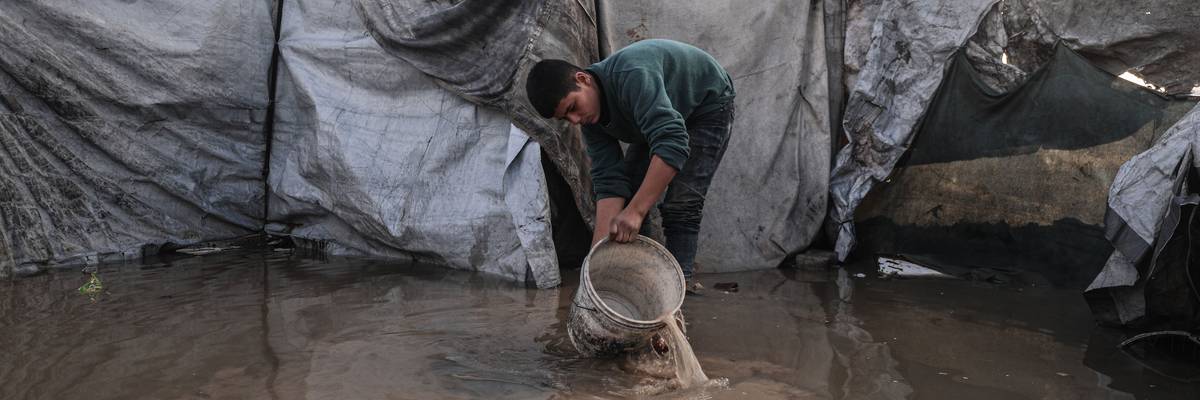
Palestinians struggle with flooding after heavy rain hits the Bureij Refugee Camp in Gaza City, Gaza on December 16, 2025.
Gaza is suffering from "a shelter crisis which runs far deeper than just physical damage."
It's been 10 months since a ceasefire agreement was reached between Israel and Hamas in Gaza, but in addition to continued attacks on the exclave—in which more than 1,250 Palestinians have been killed since last October—households across Gaza are being endangered on a constant basis by "a shelter crisis which runs far deeper than just physical damage" to residential buildings, as the Norwegian Refugee Council said Thursday.
Ninety-four percent of the population—about 1.98 million people—are in need of shelter-related aid in order to "live safely and with dignity," said the group, "including fuel, energy, and essential household items."
The NRC and the International Organization for Migration lead the Palestine Shelter Cluster, which coordinates humanitarian aid focused on addressing shelter needs in Gaza and the West Bank. The organization's new report, "Exposed on All Sides," describes how funding shortfalls as well as Israel's continued restrictions on shelter materials have left the vast majority of Palestinians in Gaza exposed to "serious health and safety risks."
The Shelter Cluster assessed nearly 2,000 household interviews conducted between June 14-28 in accessible areas in northern Gaza, Gaza City, Deir al-Balah, and Khan Younis.
It categorized the households' severity of needs on a scale of 1-5, with conditions assessed as minimal, stressed, crisis, critical, or catastrophic. More than 4 in 5 households were facing critical or catastrophic conditions, with the families struggling the most described as living in conditions "so poor they were considered a risk to life." Just 12% of households were assessed as being in the least severe categories.
With Israel's bombardment of Gaza damaging or destroying approximately 92% of residential buildings, nearly two-thirds of families interviewed by the Shelter Cluster were living in tents or other makeshift shelters that were meant to be temporary.
"Ten months after the October 2025 ceasefire, most families have lived more than a year in shelters that were never designed for long-term accommodation."
More than half of those households had been living in the same tent for over a year, and more than half of the makeshift housing was in poor or very poor condition. More than 100,000 households are living in shelters with "major deterioration to flooring, walls, and frames," said NRC.
With fuel both unaffordable and difficult to obtain, daily tasks were challenging for the families assessed by the Shelter Cluster. Eighty-four percent of households said their solutions for heating their homes were mostly or entirely ineffective. Nearly 50% of households said they had been burning plastic, tires, garbage, or cardboard in order to prepare food.
"Their use for meal preparation presents serious health risks from toxic smoke and food contamination," reads the report.
Jehan Salim, national coordinator for the Shelter Cluster, emphasized that "a shelter is not adequate simply because it has four walls or a roof."
"Families need to be able to sleep, cook, wash, and keep their children safe inside it," said Salim. "Ten months after the October 2025 ceasefire, most families have lived more than a year in shelters that were never designed for long-term accommodation. The materials needed to repair homes, restore basic services, and provide improved shelters are still not entering Gaza at anything close to the scale required.”
Only 1 in 10 households received shelter materials or basic household assistance in the month prior to the survey, and the Shelter Cluster's partners in Gaza reported "very limited in-country stocks of tents, blankets, or mattresses" in June.
"The entry of shelter materials and equipment also remains constrained by strict and frequently changing entry restrictions. Long advance-notification requirements, repackaging rules, repeated submission processes, and unpredictable approvals can delay or prevent supplies from reaching Gaza, keeping available stocks low and limiting the quality and scale of the response," reads the report.
Israel's "dual-use" restrictions—which claim that everyday items for basic household needs could also be used for violent purposes by Hamas—have contributed to the chronically low supply of "fuel, solar energy equipment, construction and repair materials, heavy machinery, and debris-clearance equipment," said the Shelter Cluster.
"People remain in appalling conditions because Israeli restrictions are preventing even the most basic housing materials from entering Gaza," said Jan Egeland, secretary general of the NRC. "Without a rapid procurement of and access for materials, the coming winter will be catastrophic. Israel must lift its restrictions and allow for predictable entry of shelter materials."
The European Union, United Nations, and World Bank's Gaza Rapid Damage and Needs Assessment (RDNA) report earlier this year found that $26.3 billion was required in the first 18 months following the ceasefire deal to restore essential services, rebuild infrastructure, and support Gaza’s economic recovery. An estimated $71 billion will be needed over the next decade.
In May, the UN Office for the Coordination of Humanitarian Affairs reported that its 2026 flash appeal for $4 billion was only 12% funded.
"Funding levels must be increased," said Egeland, "so that Palestinians families can get out of decaying temporary shelters and into something that provides more protection from the elements."
Dear Common Dreams reader, It’s been nearly 30 years since I co-founded Common Dreams with my late wife, Lina Newhouser. We had the radical notion that journalism should serve the public good, not corporate profits. It was clear to us from the outset what it would take to build such a project. No paid advertisements. No corporate sponsors. No millionaire publisher telling us what to think or do. Many people said we wouldn't last a year, but we proved those doubters wrong. Together with a tremendous team of journalists and dedicated staff, we built an independent media outlet free from the constraints of profits and corporate control. Our mission has always been simple: To inform. To inspire. To ignite change for the common good. Building Common Dreams was not easy. Our survival was never guaranteed. When you take on the most powerful forces—Wall Street greed, fossil fuel industry destruction, Big Tech lobbyists, and uber-rich oligarchs who have spent billions upon billions rigging the economy and democracy in their favor—the only bulwark you have is supporters who believe in your work. But here’s the urgent message from me today. It's never been this bad out there. And it's never been this hard to keep us going. At the very moment Common Dreams is most needed, the threats we face are intensifying. We need your support now more than ever. We don't accept corporate advertising and never will. We don't have a paywall because we don't think people should be blocked from critical news based on their ability to pay. Everything we do is funded by the donations of readers like you. When everyone does the little they can afford, we are strong. But if that support retreats or dries up, so do we. Will you donate now to make sure Common Dreams not only survives but thrives? —Craig Brown, Co-founder |
It's been 10 months since a ceasefire agreement was reached between Israel and Hamas in Gaza, but in addition to continued attacks on the exclave—in which more than 1,250 Palestinians have been killed since last October—households across Gaza are being endangered on a constant basis by "a shelter crisis which runs far deeper than just physical damage" to residential buildings, as the Norwegian Refugee Council said Thursday.
Ninety-four percent of the population—about 1.98 million people—are in need of shelter-related aid in order to "live safely and with dignity," said the group, "including fuel, energy, and essential household items."
The NRC and the International Organization for Migration lead the Palestine Shelter Cluster, which coordinates humanitarian aid focused on addressing shelter needs in Gaza and the West Bank. The organization's new report, "Exposed on All Sides," describes how funding shortfalls as well as Israel's continued restrictions on shelter materials have left the vast majority of Palestinians in Gaza exposed to "serious health and safety risks."
The Shelter Cluster assessed nearly 2,000 household interviews conducted between June 14-28 in accessible areas in northern Gaza, Gaza City, Deir al-Balah, and Khan Younis.
It categorized the households' severity of needs on a scale of 1-5, with conditions assessed as minimal, stressed, crisis, critical, or catastrophic. More than 4 in 5 households were facing critical or catastrophic conditions, with the families struggling the most described as living in conditions "so poor they were considered a risk to life." Just 12% of households were assessed as being in the least severe categories.
With Israel's bombardment of Gaza damaging or destroying approximately 92% of residential buildings, nearly two-thirds of families interviewed by the Shelter Cluster were living in tents or other makeshift shelters that were meant to be temporary.
"Ten months after the October 2025 ceasefire, most families have lived more than a year in shelters that were never designed for long-term accommodation."
More than half of those households had been living in the same tent for over a year, and more than half of the makeshift housing was in poor or very poor condition. More than 100,000 households are living in shelters with "major deterioration to flooring, walls, and frames," said NRC.
With fuel both unaffordable and difficult to obtain, daily tasks were challenging for the families assessed by the Shelter Cluster. Eighty-four percent of households said their solutions for heating their homes were mostly or entirely ineffective. Nearly 50% of households said they had been burning plastic, tires, garbage, or cardboard in order to prepare food.
"Their use for meal preparation presents serious health risks from toxic smoke and food contamination," reads the report.
Jehan Salim, national coordinator for the Shelter Cluster, emphasized that "a shelter is not adequate simply because it has four walls or a roof."
"Families need to be able to sleep, cook, wash, and keep their children safe inside it," said Salim. "Ten months after the October 2025 ceasefire, most families have lived more than a year in shelters that were never designed for long-term accommodation. The materials needed to repair homes, restore basic services, and provide improved shelters are still not entering Gaza at anything close to the scale required.”
Only 1 in 10 households received shelter materials or basic household assistance in the month prior to the survey, and the Shelter Cluster's partners in Gaza reported "very limited in-country stocks of tents, blankets, or mattresses" in June.
"The entry of shelter materials and equipment also remains constrained by strict and frequently changing entry restrictions. Long advance-notification requirements, repackaging rules, repeated submission processes, and unpredictable approvals can delay or prevent supplies from reaching Gaza, keeping available stocks low and limiting the quality and scale of the response," reads the report.
Israel's "dual-use" restrictions—which claim that everyday items for basic household needs could also be used for violent purposes by Hamas—have contributed to the chronically low supply of "fuel, solar energy equipment, construction and repair materials, heavy machinery, and debris-clearance equipment," said the Shelter Cluster.
"People remain in appalling conditions because Israeli restrictions are preventing even the most basic housing materials from entering Gaza," said Jan Egeland, secretary general of the NRC. "Without a rapid procurement of and access for materials, the coming winter will be catastrophic. Israel must lift its restrictions and allow for predictable entry of shelter materials."
The European Union, United Nations, and World Bank's Gaza Rapid Damage and Needs Assessment (RDNA) report earlier this year found that $26.3 billion was required in the first 18 months following the ceasefire deal to restore essential services, rebuild infrastructure, and support Gaza’s economic recovery. An estimated $71 billion will be needed over the next decade.
In May, the UN Office for the Coordination of Humanitarian Affairs reported that its 2026 flash appeal for $4 billion was only 12% funded.
"Funding levels must be increased," said Egeland, "so that Palestinians families can get out of decaying temporary shelters and into something that provides more protection from the elements."
It's been 10 months since a ceasefire agreement was reached between Israel and Hamas in Gaza, but in addition to continued attacks on the exclave—in which more than 1,250 Palestinians have been killed since last October—households across Gaza are being endangered on a constant basis by "a shelter crisis which runs far deeper than just physical damage" to residential buildings, as the Norwegian Refugee Council said Thursday.
Ninety-four percent of the population—about 1.98 million people—are in need of shelter-related aid in order to "live safely and with dignity," said the group, "including fuel, energy, and essential household items."
The NRC and the International Organization for Migration lead the Palestine Shelter Cluster, which coordinates humanitarian aid focused on addressing shelter needs in Gaza and the West Bank. The organization's new report, "Exposed on All Sides," describes how funding shortfalls as well as Israel's continued restrictions on shelter materials have left the vast majority of Palestinians in Gaza exposed to "serious health and safety risks."
The Shelter Cluster assessed nearly 2,000 household interviews conducted between June 14-28 in accessible areas in northern Gaza, Gaza City, Deir al-Balah, and Khan Younis.
It categorized the households' severity of needs on a scale of 1-5, with conditions assessed as minimal, stressed, crisis, critical, or catastrophic. More than 4 in 5 households were facing critical or catastrophic conditions, with the families struggling the most described as living in conditions "so poor they were considered a risk to life." Just 12% of households were assessed as being in the least severe categories.
With Israel's bombardment of Gaza damaging or destroying approximately 92% of residential buildings, nearly two-thirds of families interviewed by the Shelter Cluster were living in tents or other makeshift shelters that were meant to be temporary.
"Ten months after the October 2025 ceasefire, most families have lived more than a year in shelters that were never designed for long-term accommodation."
More than half of those households had been living in the same tent for over a year, and more than half of the makeshift housing was in poor or very poor condition. More than 100,000 households are living in shelters with "major deterioration to flooring, walls, and frames," said NRC.
With fuel both unaffordable and difficult to obtain, daily tasks were challenging for the families assessed by the Shelter Cluster. Eighty-four percent of households said their solutions for heating their homes were mostly or entirely ineffective. Nearly 50% of households said they had been burning plastic, tires, garbage, or cardboard in order to prepare food.
"Their use for meal preparation presents serious health risks from toxic smoke and food contamination," reads the report.
Jehan Salim, national coordinator for the Shelter Cluster, emphasized that "a shelter is not adequate simply because it has four walls or a roof."
"Families need to be able to sleep, cook, wash, and keep their children safe inside it," said Salim. "Ten months after the October 2025 ceasefire, most families have lived more than a year in shelters that were never designed for long-term accommodation. The materials needed to repair homes, restore basic services, and provide improved shelters are still not entering Gaza at anything close to the scale required.”
Only 1 in 10 households received shelter materials or basic household assistance in the month prior to the survey, and the Shelter Cluster's partners in Gaza reported "very limited in-country stocks of tents, blankets, or mattresses" in June.
"The entry of shelter materials and equipment also remains constrained by strict and frequently changing entry restrictions. Long advance-notification requirements, repackaging rules, repeated submission processes, and unpredictable approvals can delay or prevent supplies from reaching Gaza, keeping available stocks low and limiting the quality and scale of the response," reads the report.
Israel's "dual-use" restrictions—which claim that everyday items for basic household needs could also be used for violent purposes by Hamas—have contributed to the chronically low supply of "fuel, solar energy equipment, construction and repair materials, heavy machinery, and debris-clearance equipment," said the Shelter Cluster.
"People remain in appalling conditions because Israeli restrictions are preventing even the most basic housing materials from entering Gaza," said Jan Egeland, secretary general of the NRC. "Without a rapid procurement of and access for materials, the coming winter will be catastrophic. Israel must lift its restrictions and allow for predictable entry of shelter materials."
The European Union, United Nations, and World Bank's Gaza Rapid Damage and Needs Assessment (RDNA) report earlier this year found that $26.3 billion was required in the first 18 months following the ceasefire deal to restore essential services, rebuild infrastructure, and support Gaza’s economic recovery. An estimated $71 billion will be needed over the next decade.
In May, the UN Office for the Coordination of Humanitarian Affairs reported that its 2026 flash appeal for $4 billion was only 12% funded.
"Funding levels must be increased," said Egeland, "so that Palestinians families can get out of decaying temporary shelters and into something that provides more protection from the elements."