SUBSCRIBE TO OUR FREE NEWSLETTER
Daily news & progressive opinion—funded by the people, not the corporations—delivered straight to your inbox.
5
#000000
#FFFFFF
To donate by check, phone, or other method, see our More Ways to Give page.
Daily news & progressive opinion—funded by the people, not the corporations—delivered straight to your inbox.

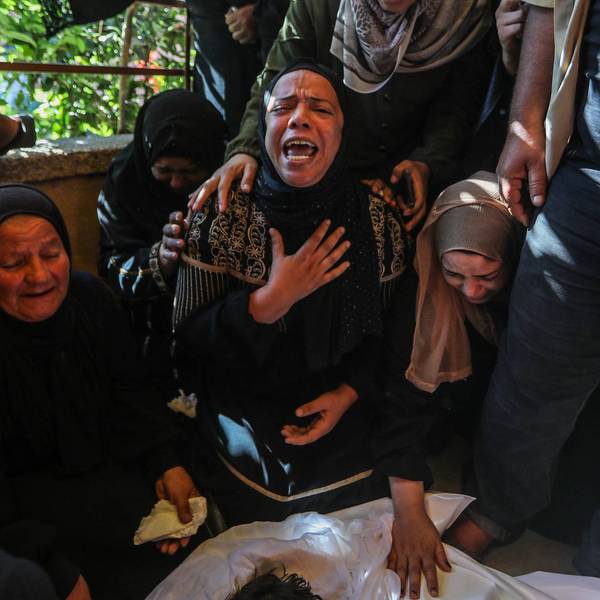
The body of 9-year-old Ritaj Reyhan, who was killed in an Israeli attack on the northern Gaza Strip, is taken from the morgue of al-Shifa Hospital for funeral prayers and burial in Gaza City on April 9, 2026.
"This is not peace for children in Gaza," said one humanitarian leader. "The ceasefire agreement has not translated into meaningful protection for children or created conditions for recovery."
Five leading humanitarian organizations that have spent two-and-a-half years advocating for Palestinians suffering under Israel's US-backed onslaught in Gaza released an analysis Thursday of the conditions on the ground six months into a so-called "ceasefire," and their message was clear: the Trump administration's 20-point peace plan is "failing" to end the devastation of the exclave.
The Danish Refugee Council, Norwegian Refugee Council, Oxfam, Refugees International, and Save the Children led the assessment that's detailed in the groups' "Humanitarian Scorecard," released exactly six months after the truce was called.
As Common Dreams has reported, Israeli strikes in Gaza did not halt after the ceasefire agreement was reached in October, and at least 700 Palestinians have been killed in the past six months, including more than 180 children.
“At least two children a day have been killed or injured in the six months since the ceasefire for Gaza was agreed,” said Save the Children International CEO Inger Ashing. "This is not peace for children in Gaza. The ceasefire agreement has not translated into meaningful protection for children or created conditions for recovery."
Alarmingly, despite the continuation of Israeli attacks, the groups found that the category of "ceasefire and civilian protection" was the area in which the truce agreement has been closest to success. The scorecard rated civilian protection two points out of four and said it is currently in a "fragile" but not "failing" state. While attacks have continued, the groups said, "sustained bombardment" has halted.
The other three areas the scorecard rated—humanitarian aid access, reconstruction and economic development, and freedom of movement of return—are all "failing" to be implemented under the ceasefire deal that President Donald Trump said would begin a "new day" in Gaza.
Israel and the "Board of Peace" Trump established have especially failed to ensure access to humanitarian aid, with the scorecard rating that category zero out of 10 points.
There are still fewer than 100 aid trucks delivering aid each day to a population that was almost entirely cut off from relief for two years, causing more than 360 people, including at least 130 children, to starve to death before the ceasefire deal was reached. The 20-point peace plan had indicated there should be at least 600 aid trucks entering Gaza daily and that border crossings would be reopened, but the Rafah and Jordan crossings are still "effectively closed," and only a Kerem Shalom crossing is open for aid.
"Even [the ceasefire's] humanitarian provisions—the most straightforward to implement—remain obstructed," said Ashing. "We are ready to scale up and support the people of Gaza, but we must be allowed to do our jobs.”
Israel is still restricting deliveries of what it calls "dual-use" materials that the Israeli government claims could be used as weapons; the list of banned items has included scissors in medical kits, anesthetics, shelter supplies, cancer medicines, and maternity kits. Fuel is also still "severely restricted," the scorecard reads.
“Six months into the so-called ceasefire in Gaza, we are seeing a continuation of the designed deprivation that we saw throughout the hostilities,” said Refugees International president Jeremy Konyndyk. “Palestinians are experiencing severe malnutrition and preventable deaths every day because many cannot reliably access basic food or services. Both the terms of the ceasefire deal and the core tenets of international humanitarian law require that humanitarian goods enter Gaza, and that humanitarians can do their jobs to save lives. The deal signed last year rightly committed to this—it is time to deliver on those commitments.”
With Israel allowing "only a handful of traders to import supplies and goods" and requiring "exorbitant 'coordination fees' for every truck," families in Gaza are also facing "exceedingly high prices on vital goods and supplies," the scorecard reads. Food items are anywhere from 3% to 233% more expensive than they were before Israel began attacking Gaza in retaliation for a Hamas-led attack.
The 20-point plan also pledged to redevelop Gaza "for the benefit of the people of Gaza, who have suffered more than enough," with "a Trump economic development plan to rebuild and energize Gaza" being created by a panel of experts "who have helped birth some of the thriving modern miracle cities in the Middle East.” A special economic zone (SEZ) with preferred tariff and access rates would also be established.
Six months later, the SEZ has yet to be created, and no formal development plan has been convened, the humanitarian groups found.
The World Bank created a new Financial Intermediary Fund (FIF) called the Gaza Reconstruction and Development (GRAD) fund in coordination with the Board of Peace, but its role is only as a limited trustee, with no responsibility for how funds are spent," reads the scorecard.
The category of freedom of movement was rated one out of six points, with credit given for the fact that some Palestinians have been able to reenter Gaza with the limited reopening of the Rafah crossing in recent weeks.
Other than that, "most of the population" is still displaced after 90% of Gaza residents were forced to flee their homes, and most are unable to leave or return to Gaza. Returns are not permitted at all beyond the Yellow Line marking the Israeli "buffer zone" established by the ceasefire, and there is also a "major backlog of people" awaiting medical evacuations, with some people dying while they wait for care.
“Six months into the ceasefire, Palestinians in Gaza are still facing a daily struggle to survive. President Trump promised to lead an extraordinary recovery and declared a ‘new day’ for Gaza. Instead, his plan for peace is stalling and his attention has turned away from the crisis,” said Oxfam America president and CEO Abby Maxman.
"Palestinians are still experiencing more of the same: going to bed hungry in flooded tents, facing long lines for clean water, and succumbing to diseases and injuries without a healthcare system or basic medical supplies," said Maxman. "All while the government of Israel drops bombs and cuts off vital, lifesaving assistance with US support. We cannot look away—Palestinians in Gaza need our support and pressure on our leaders to deliver on the promise of peace now more than ever.”
Dear Common Dreams reader, It’s been nearly 30 years since I co-founded Common Dreams with my late wife, Lina Newhouser. We had the radical notion that journalism should serve the public good, not corporate profits. It was clear to us from the outset what it would take to build such a project. No paid advertisements. No corporate sponsors. No millionaire publisher telling us what to think or do. Many people said we wouldn't last a year, but we proved those doubters wrong. Together with a tremendous team of journalists and dedicated staff, we built an independent media outlet free from the constraints of profits and corporate control. Our mission has always been simple: To inform. To inspire. To ignite change for the common good. Building Common Dreams was not easy. Our survival was never guaranteed. When you take on the most powerful forces—Wall Street greed, fossil fuel industry destruction, Big Tech lobbyists, and uber-rich oligarchs who have spent billions upon billions rigging the economy and democracy in their favor—the only bulwark you have is supporters who believe in your work. But here’s the urgent message from me today. It's never been this bad out there. And it's never been this hard to keep us going. At the very moment Common Dreams is most needed, the threats we face are intensifying. We need your support now more than ever. We don't accept corporate advertising and never will. We don't have a paywall because we don't think people should be blocked from critical news based on their ability to pay. Everything we do is funded by the donations of readers like you. When everyone does the little they can afford, we are strong. But if that support retreats or dries up, so do we. Will you donate now to make sure Common Dreams not only survives but thrives? —Craig Brown, Co-founder |
Five leading humanitarian organizations that have spent two-and-a-half years advocating for Palestinians suffering under Israel's US-backed onslaught in Gaza released an analysis Thursday of the conditions on the ground six months into a so-called "ceasefire," and their message was clear: the Trump administration's 20-point peace plan is "failing" to end the devastation of the exclave.
The Danish Refugee Council, Norwegian Refugee Council, Oxfam, Refugees International, and Save the Children led the assessment that's detailed in the groups' "Humanitarian Scorecard," released exactly six months after the truce was called.
As Common Dreams has reported, Israeli strikes in Gaza did not halt after the ceasefire agreement was reached in October, and at least 700 Palestinians have been killed in the past six months, including more than 180 children.
“At least two children a day have been killed or injured in the six months since the ceasefire for Gaza was agreed,” said Save the Children International CEO Inger Ashing. "This is not peace for children in Gaza. The ceasefire agreement has not translated into meaningful protection for children or created conditions for recovery."
Alarmingly, despite the continuation of Israeli attacks, the groups found that the category of "ceasefire and civilian protection" was the area in which the truce agreement has been closest to success. The scorecard rated civilian protection two points out of four and said it is currently in a "fragile" but not "failing" state. While attacks have continued, the groups said, "sustained bombardment" has halted.
The other three areas the scorecard rated—humanitarian aid access, reconstruction and economic development, and freedom of movement of return—are all "failing" to be implemented under the ceasefire deal that President Donald Trump said would begin a "new day" in Gaza.
Israel and the "Board of Peace" Trump established have especially failed to ensure access to humanitarian aid, with the scorecard rating that category zero out of 10 points.
There are still fewer than 100 aid trucks delivering aid each day to a population that was almost entirely cut off from relief for two years, causing more than 360 people, including at least 130 children, to starve to death before the ceasefire deal was reached. The 20-point peace plan had indicated there should be at least 600 aid trucks entering Gaza daily and that border crossings would be reopened, but the Rafah and Jordan crossings are still "effectively closed," and only a Kerem Shalom crossing is open for aid.
"Even [the ceasefire's] humanitarian provisions—the most straightforward to implement—remain obstructed," said Ashing. "We are ready to scale up and support the people of Gaza, but we must be allowed to do our jobs.”
Israel is still restricting deliveries of what it calls "dual-use" materials that the Israeli government claims could be used as weapons; the list of banned items has included scissors in medical kits, anesthetics, shelter supplies, cancer medicines, and maternity kits. Fuel is also still "severely restricted," the scorecard reads.
“Six months into the so-called ceasefire in Gaza, we are seeing a continuation of the designed deprivation that we saw throughout the hostilities,” said Refugees International president Jeremy Konyndyk. “Palestinians are experiencing severe malnutrition and preventable deaths every day because many cannot reliably access basic food or services. Both the terms of the ceasefire deal and the core tenets of international humanitarian law require that humanitarian goods enter Gaza, and that humanitarians can do their jobs to save lives. The deal signed last year rightly committed to this—it is time to deliver on those commitments.”
With Israel allowing "only a handful of traders to import supplies and goods" and requiring "exorbitant 'coordination fees' for every truck," families in Gaza are also facing "exceedingly high prices on vital goods and supplies," the scorecard reads. Food items are anywhere from 3% to 233% more expensive than they were before Israel began attacking Gaza in retaliation for a Hamas-led attack.
The 20-point plan also pledged to redevelop Gaza "for the benefit of the people of Gaza, who have suffered more than enough," with "a Trump economic development plan to rebuild and energize Gaza" being created by a panel of experts "who have helped birth some of the thriving modern miracle cities in the Middle East.” A special economic zone (SEZ) with preferred tariff and access rates would also be established.
Six months later, the SEZ has yet to be created, and no formal development plan has been convened, the humanitarian groups found.
The World Bank created a new Financial Intermediary Fund (FIF) called the Gaza Reconstruction and Development (GRAD) fund in coordination with the Board of Peace, but its role is only as a limited trustee, with no responsibility for how funds are spent," reads the scorecard.
The category of freedom of movement was rated one out of six points, with credit given for the fact that some Palestinians have been able to reenter Gaza with the limited reopening of the Rafah crossing in recent weeks.
Other than that, "most of the population" is still displaced after 90% of Gaza residents were forced to flee their homes, and most are unable to leave or return to Gaza. Returns are not permitted at all beyond the Yellow Line marking the Israeli "buffer zone" established by the ceasefire, and there is also a "major backlog of people" awaiting medical evacuations, with some people dying while they wait for care.
“Six months into the ceasefire, Palestinians in Gaza are still facing a daily struggle to survive. President Trump promised to lead an extraordinary recovery and declared a ‘new day’ for Gaza. Instead, his plan for peace is stalling and his attention has turned away from the crisis,” said Oxfam America president and CEO Abby Maxman.
"Palestinians are still experiencing more of the same: going to bed hungry in flooded tents, facing long lines for clean water, and succumbing to diseases and injuries without a healthcare system or basic medical supplies," said Maxman. "All while the government of Israel drops bombs and cuts off vital, lifesaving assistance with US support. We cannot look away—Palestinians in Gaza need our support and pressure on our leaders to deliver on the promise of peace now more than ever.”
Five leading humanitarian organizations that have spent two-and-a-half years advocating for Palestinians suffering under Israel's US-backed onslaught in Gaza released an analysis Thursday of the conditions on the ground six months into a so-called "ceasefire," and their message was clear: the Trump administration's 20-point peace plan is "failing" to end the devastation of the exclave.
The Danish Refugee Council, Norwegian Refugee Council, Oxfam, Refugees International, and Save the Children led the assessment that's detailed in the groups' "Humanitarian Scorecard," released exactly six months after the truce was called.
As Common Dreams has reported, Israeli strikes in Gaza did not halt after the ceasefire agreement was reached in October, and at least 700 Palestinians have been killed in the past six months, including more than 180 children.
“At least two children a day have been killed or injured in the six months since the ceasefire for Gaza was agreed,” said Save the Children International CEO Inger Ashing. "This is not peace for children in Gaza. The ceasefire agreement has not translated into meaningful protection for children or created conditions for recovery."
Alarmingly, despite the continuation of Israeli attacks, the groups found that the category of "ceasefire and civilian protection" was the area in which the truce agreement has been closest to success. The scorecard rated civilian protection two points out of four and said it is currently in a "fragile" but not "failing" state. While attacks have continued, the groups said, "sustained bombardment" has halted.
The other three areas the scorecard rated—humanitarian aid access, reconstruction and economic development, and freedom of movement of return—are all "failing" to be implemented under the ceasefire deal that President Donald Trump said would begin a "new day" in Gaza.
Israel and the "Board of Peace" Trump established have especially failed to ensure access to humanitarian aid, with the scorecard rating that category zero out of 10 points.
There are still fewer than 100 aid trucks delivering aid each day to a population that was almost entirely cut off from relief for two years, causing more than 360 people, including at least 130 children, to starve to death before the ceasefire deal was reached. The 20-point peace plan had indicated there should be at least 600 aid trucks entering Gaza daily and that border crossings would be reopened, but the Rafah and Jordan crossings are still "effectively closed," and only a Kerem Shalom crossing is open for aid.
"Even [the ceasefire's] humanitarian provisions—the most straightforward to implement—remain obstructed," said Ashing. "We are ready to scale up and support the people of Gaza, but we must be allowed to do our jobs.”
Israel is still restricting deliveries of what it calls "dual-use" materials that the Israeli government claims could be used as weapons; the list of banned items has included scissors in medical kits, anesthetics, shelter supplies, cancer medicines, and maternity kits. Fuel is also still "severely restricted," the scorecard reads.
“Six months into the so-called ceasefire in Gaza, we are seeing a continuation of the designed deprivation that we saw throughout the hostilities,” said Refugees International president Jeremy Konyndyk. “Palestinians are experiencing severe malnutrition and preventable deaths every day because many cannot reliably access basic food or services. Both the terms of the ceasefire deal and the core tenets of international humanitarian law require that humanitarian goods enter Gaza, and that humanitarians can do their jobs to save lives. The deal signed last year rightly committed to this—it is time to deliver on those commitments.”
With Israel allowing "only a handful of traders to import supplies and goods" and requiring "exorbitant 'coordination fees' for every truck," families in Gaza are also facing "exceedingly high prices on vital goods and supplies," the scorecard reads. Food items are anywhere from 3% to 233% more expensive than they were before Israel began attacking Gaza in retaliation for a Hamas-led attack.
The 20-point plan also pledged to redevelop Gaza "for the benefit of the people of Gaza, who have suffered more than enough," with "a Trump economic development plan to rebuild and energize Gaza" being created by a panel of experts "who have helped birth some of the thriving modern miracle cities in the Middle East.” A special economic zone (SEZ) with preferred tariff and access rates would also be established.
Six months later, the SEZ has yet to be created, and no formal development plan has been convened, the humanitarian groups found.
The World Bank created a new Financial Intermediary Fund (FIF) called the Gaza Reconstruction and Development (GRAD) fund in coordination with the Board of Peace, but its role is only as a limited trustee, with no responsibility for how funds are spent," reads the scorecard.
The category of freedom of movement was rated one out of six points, with credit given for the fact that some Palestinians have been able to reenter Gaza with the limited reopening of the Rafah crossing in recent weeks.
Other than that, "most of the population" is still displaced after 90% of Gaza residents were forced to flee their homes, and most are unable to leave or return to Gaza. Returns are not permitted at all beyond the Yellow Line marking the Israeli "buffer zone" established by the ceasefire, and there is also a "major backlog of people" awaiting medical evacuations, with some people dying while they wait for care.
“Six months into the ceasefire, Palestinians in Gaza are still facing a daily struggle to survive. President Trump promised to lead an extraordinary recovery and declared a ‘new day’ for Gaza. Instead, his plan for peace is stalling and his attention has turned away from the crisis,” said Oxfam America president and CEO Abby Maxman.
"Palestinians are still experiencing more of the same: going to bed hungry in flooded tents, facing long lines for clean water, and succumbing to diseases and injuries without a healthcare system or basic medical supplies," said Maxman. "All while the government of Israel drops bombs and cuts off vital, lifesaving assistance with US support. We cannot look away—Palestinians in Gaza need our support and pressure on our leaders to deliver on the promise of peace now more than ever.”