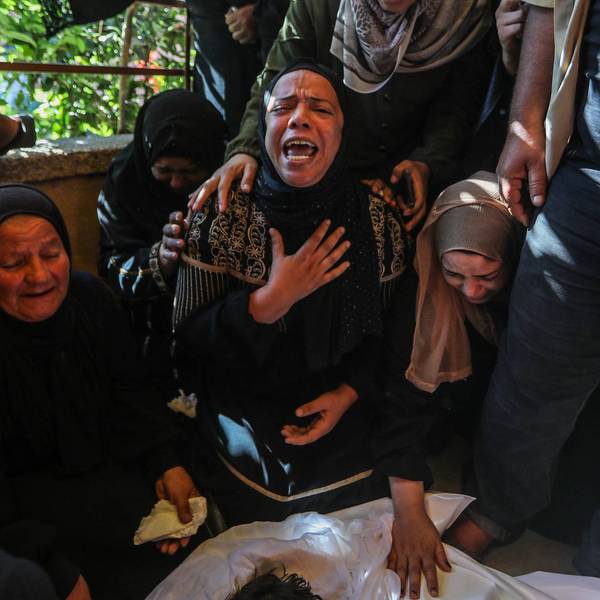
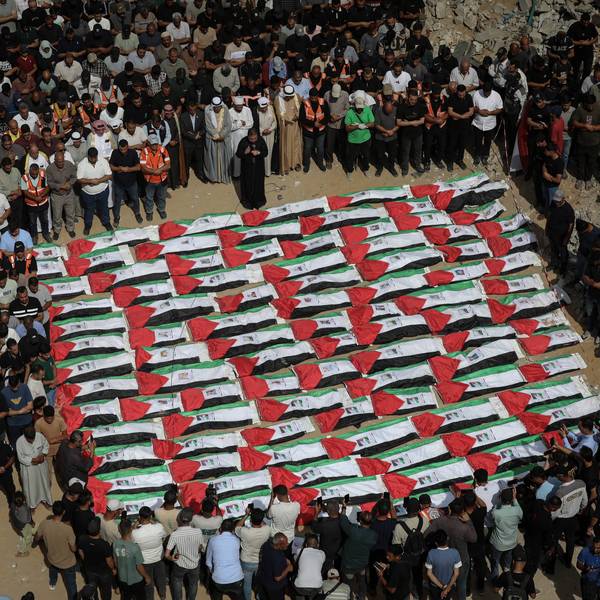
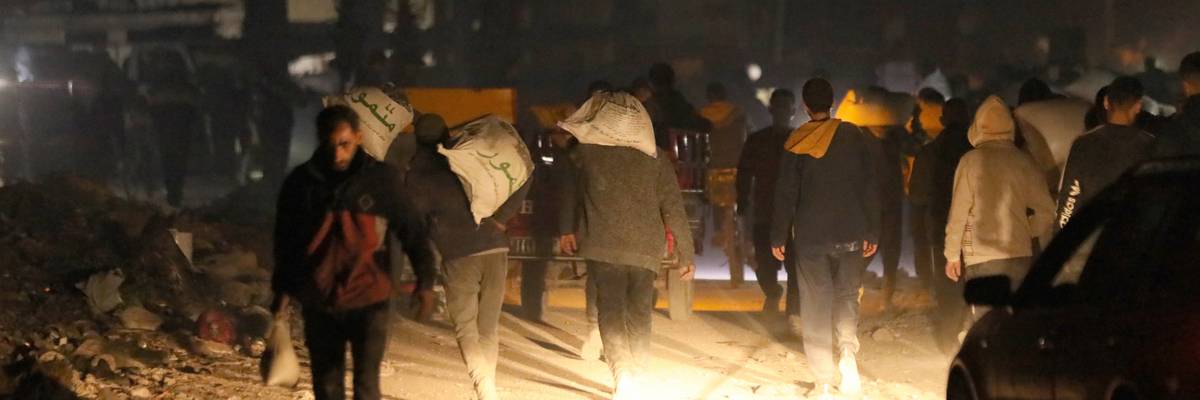
Palestinians receive humanitarian aid supplies brought by trucks to Gaza City on March 13, 2024.
'Another Flour Massacre': IDF Reportedly Kills 20 Waiting for Aid in Northern Gaza
"Our governments did nothing to hold Israel accountable last time it attacked desperate hungry people seeking aid in Gaza," said one aid campaigner. "So why wouldn't it do the exact same thing again?"
Gaza health officials said Thursday that Israeli forces killed at least 20 people and injured over 150 more as they waited for humanitarian aid in the northern part of the Palestinian enclave, where deliveries of food, medicine, and other necessities have become virtually impossible due to Israel's persistent obstruction and attacks.
Mohammed Ghurab, the director of emergency services at a hospital in the area, told AFP that there were "direct shots by the occupation forces" at people waiting for a truck carrying food. Northern Gaza is in the grip of famine-like conditions, and desperate people there have resorted to eating weeds and livestock feed amid Israel's suffocating blockade.
Dozens of people, including children, have died of starvation and dehydration in northern Gaza in recent weeks.
Thursday's attack took place at the Kuwaiti Roundabout in Gaza City, according to the territory's health ministry, which said nearby hospitals were "unable to deal with" the influx of wounded patients.
Horrific video footage posted to social media shows bloody bodies lying motionless amid debris. Middle East Eye reported that "a truck transporting aid into Gaza" later "collided with a vehicle carrying victims" of Thursday's attack to a hospital.
"Eyewitnesses said the area was struck by what they said sounded like tank or artillery fire," CNN reported. "The incident at the Kuwaiti Roundabout followed earlier violence at the same site on Wednesday, where large crowds were waiting for a food distribution. At least seven people were killed and 86 others injured after Israeli troops opened fire."
A day earlier, Israel allowed an aid convoy to enter Gaza's north directly through an Israeli border crossing for the first time since the Hamas-led October 7 attack.
Breaking: ANOTHER FLOUR MASSACRE AS ISRAELI DRONES, WARPLANES AND TANKS FIRE AT CIVILIANS WAITING FOR FLOUR ON TRUCKS
Dozens killed and many injured. #FlourMassacre
*NSFW pic.twitter.com/gDtMn8tpCQ
— Sulaiman Ahmed (@ShaykhSulaiman) March 14, 2024
Ziad Saeed Madoukh, who was shot in the foot during Thursday's attack, told the Euro-Mediterranean Human Rights Monitor that Israeli forces started "heavily firing live ammunition towards the crowd of civilians as soon as aid trucks approached" the roundabout.
"Another survivor of today's massacre, Ibrahim Al-Najjar, was shot in the hand by Israeli forces," the rights group said. "Al-Najjar told Euro-Med Monitor's team that he tried to get a bag of flour for his children at the Kuwait Roundabout, but that he and others were subjected to live ammunition and artillery shells despite gathering in an area previously designated as safe by Israel's army."
The Israel Defense Forces (IDF) denied attacking Gazans at the aid distribution point and said it was "analyzing" the incident.
Thursday's bloodshed drew comparisons to the February 29 attack in which Israeli forces opened fire on crowds of starving Gazans trying to get their hands on bags of flour. The attack was later dubbed the "flour massacre."
The Israeli military
claimed that most of the deaths were caused by a stampede, but testimony from witnesses and hospital officials as well as bullets found at the scene refuted that narrative.
"Our governments did nothing to hold Israel accountable last time it attacked desperate hungry people seeking aid in Gaza," said Rohan Talbot, director of advocacy and campaigns at Medical Aid for Palestinians. "So why wouldn't it do the exact same thing again?"
Prior to Thursday's attack—described as "another flour massacre"—Gaza authorities estimated that Israeli forces had killed at least 400 people waiting for humanitarian aid deliveries. Between mid-January and the end of February, the United Nations documented at least 14 instances of Israeli forces opening fire on crowds gathered to receive humanitarian aid.
"This is something that is preventable and shouldn't be happening," Shaina Low, communications adviser for the Norwegian Refugee Council, told Al Jazeera.
Asked Wednesday about Israel's repeated attacks on Palestinians awaiting aid, U.S. State Department spokesperson Matthew Miller
said that "we want to see it investigated promptly, and, if appropriate, see accountability."
"We also press them to take measures to keep it from happening again," said Miller, who did not warn of any consequences for Israel's military if it continues to massacre desperate civilians.
A group of senators
warned earlier this week that it is a violation of U.S. law to arm a government that is obstructing the delivery of humanitarian assistance.
We are at a crossroads
This country and this world are at a monumental crossroads. In a few short weeks, US voters will have an opportunity to beat back the forces of fascism and confront the billionaires who are rigging the economy, our media system, and our democracy, making it increasingly impossible for ordinary people to get by. We’re not just talking about the election. We’re talking about what must be done once these fascist elements are vanquished from power. We need a bolder set of solutions than what either major party has so far been willing to offer and a working-class movement ready to fight like hell for it. Trump didn't emerge from nowhere. The conditions that fueled MAGA authoritarianism were created by decades of radical neoliberal economic policies and a corrupt political system dominated by corporate interests. They slashed taxes on the super-rich, promising that the benefits would trickle down. They said giveaways to the corporate titans would make life more affordable for the rest of us. It was all bullshit. And when a bitter, betrayed populace searches for someone to blame, right-wing demagogues have little trouble finding scapegoats. People know when they're being lied to, but you won't hear any of this from the corporate media. Only independent journalism—powered and funded by people who believe in building a better world—can deliver truly trustworthy daily news. Our Fall Campaign is underway, and we need your help. To power our newsroom through the rest of the year, we need to raise $125,000 by midnight on October 31. So if you share our vision, please contribute whatever you can to sustain our work. |
Gaza health officials said Thursday that Israeli forces killed at least 20 people and injured over 150 more as they waited for humanitarian aid in the northern part of the Palestinian enclave, where deliveries of food, medicine, and other necessities have become virtually impossible due to Israel's persistent obstruction and attacks.
Mohammed Ghurab, the director of emergency services at a hospital in the area, told AFP that there were "direct shots by the occupation forces" at people waiting for a truck carrying food. Northern Gaza is in the grip of famine-like conditions, and desperate people there have resorted to eating weeds and livestock feed amid Israel's suffocating blockade.
Dozens of people, including children, have died of starvation and dehydration in northern Gaza in recent weeks.
Thursday's attack took place at the Kuwaiti Roundabout in Gaza City, according to the territory's health ministry, which said nearby hospitals were "unable to deal with" the influx of wounded patients.
Horrific video footage posted to social media shows bloody bodies lying motionless amid debris. Middle East Eye reported that "a truck transporting aid into Gaza" later "collided with a vehicle carrying victims" of Thursday's attack to a hospital.
"Eyewitnesses said the area was struck by what they said sounded like tank or artillery fire," CNN reported. "The incident at the Kuwaiti Roundabout followed earlier violence at the same site on Wednesday, where large crowds were waiting for a food distribution. At least seven people were killed and 86 others injured after Israeli troops opened fire."
A day earlier, Israel allowed an aid convoy to enter Gaza's north directly through an Israeli border crossing for the first time since the Hamas-led October 7 attack.
Breaking: ANOTHER FLOUR MASSACRE AS ISRAELI DRONES, WARPLANES AND TANKS FIRE AT CIVILIANS WAITING FOR FLOUR ON TRUCKS
Dozens killed and many injured. #FlourMassacre
*NSFW pic.twitter.com/gDtMn8tpCQ
— Sulaiman Ahmed (@ShaykhSulaiman) March 14, 2024
Ziad Saeed Madoukh, who was shot in the foot during Thursday's attack, told the Euro-Mediterranean Human Rights Monitor that Israeli forces started "heavily firing live ammunition towards the crowd of civilians as soon as aid trucks approached" the roundabout.
"Another survivor of today's massacre, Ibrahim Al-Najjar, was shot in the hand by Israeli forces," the rights group said. "Al-Najjar told Euro-Med Monitor's team that he tried to get a bag of flour for his children at the Kuwait Roundabout, but that he and others were subjected to live ammunition and artillery shells despite gathering in an area previously designated as safe by Israel's army."
The Israel Defense Forces (IDF) denied attacking Gazans at the aid distribution point and said it was "analyzing" the incident.
Thursday's bloodshed drew comparisons to the February 29 attack in which Israeli forces opened fire on crowds of starving Gazans trying to get their hands on bags of flour. The attack was later dubbed the "flour massacre."
The Israeli military
claimed that most of the deaths were caused by a stampede, but testimony from witnesses and hospital officials as well as bullets found at the scene refuted that narrative.
"Our governments did nothing to hold Israel accountable last time it attacked desperate hungry people seeking aid in Gaza," said Rohan Talbot, director of advocacy and campaigns at Medical Aid for Palestinians. "So why wouldn't it do the exact same thing again?"
Prior to Thursday's attack—described as "another flour massacre"—Gaza authorities estimated that Israeli forces had killed at least 400 people waiting for humanitarian aid deliveries. Between mid-January and the end of February, the United Nations documented at least 14 instances of Israeli forces opening fire on crowds gathered to receive humanitarian aid.
"This is something that is preventable and shouldn't be happening," Shaina Low, communications adviser for the Norwegian Refugee Council, told Al Jazeera.
Asked Wednesday about Israel's repeated attacks on Palestinians awaiting aid, U.S. State Department spokesperson Matthew Miller
said that "we want to see it investigated promptly, and, if appropriate, see accountability."
"We also press them to take measures to keep it from happening again," said Miller, who did not warn of any consequences for Israel's military if it continues to massacre desperate civilians.
A group of senators
warned earlier this week that it is a violation of U.S. law to arm a government that is obstructing the delivery of humanitarian assistance.
Gaza health officials said Thursday that Israeli forces killed at least 20 people and injured over 150 more as they waited for humanitarian aid in the northern part of the Palestinian enclave, where deliveries of food, medicine, and other necessities have become virtually impossible due to Israel's persistent obstruction and attacks.
Mohammed Ghurab, the director of emergency services at a hospital in the area, told AFP that there were "direct shots by the occupation forces" at people waiting for a truck carrying food. Northern Gaza is in the grip of famine-like conditions, and desperate people there have resorted to eating weeds and livestock feed amid Israel's suffocating blockade.
Dozens of people, including children, have died of starvation and dehydration in northern Gaza in recent weeks.
Thursday's attack took place at the Kuwaiti Roundabout in Gaza City, according to the territory's health ministry, which said nearby hospitals were "unable to deal with" the influx of wounded patients.
Horrific video footage posted to social media shows bloody bodies lying motionless amid debris. Middle East Eye reported that "a truck transporting aid into Gaza" later "collided with a vehicle carrying victims" of Thursday's attack to a hospital.
"Eyewitnesses said the area was struck by what they said sounded like tank or artillery fire," CNN reported. "The incident at the Kuwaiti Roundabout followed earlier violence at the same site on Wednesday, where large crowds were waiting for a food distribution. At least seven people were killed and 86 others injured after Israeli troops opened fire."
A day earlier, Israel allowed an aid convoy to enter Gaza's north directly through an Israeli border crossing for the first time since the Hamas-led October 7 attack.
Breaking: ANOTHER FLOUR MASSACRE AS ISRAELI DRONES, WARPLANES AND TANKS FIRE AT CIVILIANS WAITING FOR FLOUR ON TRUCKS
Dozens killed and many injured. #FlourMassacre
*NSFW pic.twitter.com/gDtMn8tpCQ
— Sulaiman Ahmed (@ShaykhSulaiman) March 14, 2024
Ziad Saeed Madoukh, who was shot in the foot during Thursday's attack, told the Euro-Mediterranean Human Rights Monitor that Israeli forces started "heavily firing live ammunition towards the crowd of civilians as soon as aid trucks approached" the roundabout.
"Another survivor of today's massacre, Ibrahim Al-Najjar, was shot in the hand by Israeli forces," the rights group said. "Al-Najjar told Euro-Med Monitor's team that he tried to get a bag of flour for his children at the Kuwait Roundabout, but that he and others were subjected to live ammunition and artillery shells despite gathering in an area previously designated as safe by Israel's army."
The Israel Defense Forces (IDF) denied attacking Gazans at the aid distribution point and said it was "analyzing" the incident.
Thursday's bloodshed drew comparisons to the February 29 attack in which Israeli forces opened fire on crowds of starving Gazans trying to get their hands on bags of flour. The attack was later dubbed the "flour massacre."
The Israeli military
claimed that most of the deaths were caused by a stampede, but testimony from witnesses and hospital officials as well as bullets found at the scene refuted that narrative.
"Our governments did nothing to hold Israel accountable last time it attacked desperate hungry people seeking aid in Gaza," said Rohan Talbot, director of advocacy and campaigns at Medical Aid for Palestinians. "So why wouldn't it do the exact same thing again?"
Prior to Thursday's attack—described as "another flour massacre"—Gaza authorities estimated that Israeli forces had killed at least 400 people waiting for humanitarian aid deliveries. Between mid-January and the end of February, the United Nations documented at least 14 instances of Israeli forces opening fire on crowds gathered to receive humanitarian aid.
"This is something that is preventable and shouldn't be happening," Shaina Low, communications adviser for the Norwegian Refugee Council, told Al Jazeera.
Asked Wednesday about Israel's repeated attacks on Palestinians awaiting aid, U.S. State Department spokesperson Matthew Miller
said that "we want to see it investigated promptly, and, if appropriate, see accountability."
"We also press them to take measures to keep it from happening again," said Miller, who did not warn of any consequences for Israel's military if it continues to massacre desperate civilians.
A group of senators
warned earlier this week that it is a violation of U.S. law to arm a government that is obstructing the delivery of humanitarian assistance.