SUBSCRIBE TO OUR FREE NEWSLETTER
Daily news & progressive opinion—funded by the people, not the corporations—delivered straight to your inbox.
5
#000000
#FFFFFF
To donate by check, phone, or other method, see our More Ways to Give page.
Daily news & progressive opinion—funded by the people, not the corporations—delivered straight to your inbox.
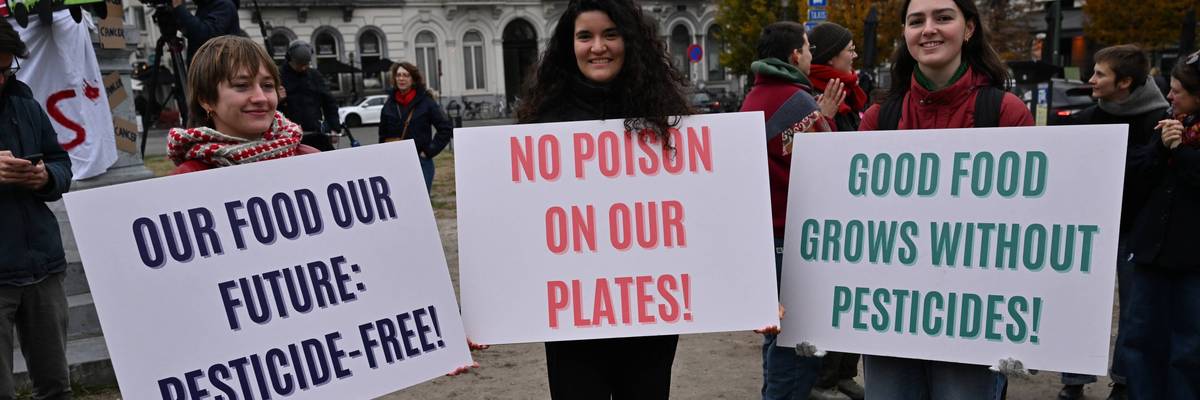
Protesters hold placards during a demonstration against the "pesticides omnibus," a reform proposal presented by the European Commission, near the European Parliament, in Brussels, Belgium on November 4, 2026.
"It has never been clearer that agrochemical corporations have too much influence in government, and that unchecked pesticide use has created an urgent public health crisis."
The Take Down Pesticides coalition announced on Monday is calling for a global "agricultural shift away from petroleum-derived pesticides and towards proven organic and agroecological alternatives," with a particular focus on paraquat, a weedkiller "already banned in over 70 countries and linked to Parkinson's disease, thyroid cancer, and neurological harm to children."
The coalition—which includes Alianza Nacional de Campesinas, Coming Clean, Pesticide Action & Agroecology Network (PAN), and dozens of other organizations—wants policymakers worldwide to crack down on pesticides, but its first public statement highlights actions under US President Donald Trump, who has repeatedly betrayed his campaign promise to "Make America Healthy Again."
"This year, the Supreme Court sided with multibillion-dollar pesticide companies over people who have been harmed by their products," the groups said. "The Environmental Protection Agency continues to greenlight pesticides linked to cancer, Parkinson's disease, birth defects, and neurological harm to children. The US president has attempted to intervene in markets and boost the production of a pesticide linked to cancer, at the bidding of the company who makes it. And Congress has slashed food assistance for needy families, while incentivizing even more pesticide use."
"It has never been clearer that agrochemical corporations have too much influence in government, and that unchecked pesticide use has created an urgent public health crisis," the coalition continued, highlighting the heightened risks for farmers and farmworkers as well as public demand for outlawing dangerous pesticides. "States are starting to take back power, and protect their own residents from pesticides. More than 13 states have introduced legislation to ban or restrict paraquat, a toxic weedkiller that has shortened too many lives. One of those states, Vermont, became the first to ban it."
While recognizing that "banning one pesticide is not enough to protect the health of the farmworkers, farmers, and rural communities regularly exposed to multiple pesticides," the coalition explained that "ending paraquat use is an opportunity for farmers to get off the pesticide treadmill, and adopt organic and agroecological practices, instead of reaching for a replacement herbicide. Banning paraquat would send a powerful signal that agriculture cannot continue as usual."
PAN organizing lead Cristobal Lagunas said that "through our work, we meet people and hear stories of farmers and farmworkers who have been harmed by pesticides. People who sprayed pesticides for years and later developed cancer, Parkinson's, or other chronic conditions, people who were exposed while pregnant and whose children suffered developmental and neurological harm, and people who live near farms and experienced pesticide drift and are now afraid of what the future holds."
"Unfortunately these are not rare exceptions; these are regular occurrences in a system designed to take advantage of our most vulnerable communities," Lagunas stressed. "Our food system has let science, regulation, and compassion fall behind corporate profit. It’s time to foster a food system built on justice, transparency, and resiliency."
Hormis Bedolla, initiative coordinator for pesticides and environmental justice at Alianza Nacional de Campesinas, declared: "Pesticides are not combating insects and pests... They are poisoning and killing us. The idea of creating perfect fruit is not worth our health nor our lives."
Launched during the latest United Nations Climate Change Conference, the coalition also highlighted that "virtually all synthetic pesticides are derived from fossil fuels, and are manufactured in polluting facilities that harm community health. Fossil fuel-based pesticides contribute to the climate crisis—and should not be falsely marketed as a sustainability tool. Pesticides strip the soil of nutrients, reduce biological diversity, and inhibit soils from sequestering carbon."
The groups argued that "organic and agroecological practices of controlling weeds and other pests can be scaled up and widely adopted, if we have the political will to invest in them. We call on the public to continue to demand affordable food free from pesticides. We call on state lawmakers to prohibit paraquat and other toxic pesticides."
With Democrats set to take control of the US Senate and House of Representatives in January, after decisive wins against Trump's party in the midterms, "we call on members of Congress to resist agrochemical lobbying, reject campaign contributions from pesticide companies, and prioritize people’s health over corporate profits," the coalition continued.
"We call on state and local policymakers to prohibit the use of synthetic pesticides on lands that they manage," it added. "And we call on farmers to stand up to agrochemical companies, and demand federal, state, and local support for adopting organic and agroecological growing practices. Together, we can take down pesticides."
Other coalition members include Friends of the Earth US, Earthjustice, and the Center for Food Safety—whose legislative and policy coordinator, Reagan Ferris, noted that the group has long "championed the rights of farmworkers, consumers, endangered species, and the planet by challenging government policies permitting the overuse of toxic pesticides."
"Pesticides are a poisonous false promise that harm people, contaminate our food, and irreparably pollute the water, soil, and air," Ferris said. "A new agriculture for the 21st century is not only possible, but essential, to ensure a regenerative, healthful food system."
This country and this world are at a monumental crossroads. US voters have an opportunity to beat back the forces of fascism and confront the billionaires who are rigging the economy, our media system, and our democracy, making it increasingly impossible for ordinary people to get by. We’re not just talking about the election. We’re talking about what must be done once these fascist elements are vanquished from power. We need a bolder set of solutions than what either major party has so far been willing to offer and a working-class movement ready to fight like hell for it. Trump didn't emerge from nowhere. The conditions that fueled MAGA authoritarianism were created by decades of radical neoliberal economic policies and a corrupt political system dominated by corporate interests. They slashed taxes on the super-rich, promising that the benefits would trickle down. They said giveaways to the corporate titans would make life more affordable for the rest of us. It was all bullshit. And when a bitter, betrayed populace searches for someone to blame, right-wing demagogues have little trouble finding scapegoats. People know when they're being lied to, but you won't hear any of this from the corporate media. Only independent journalism—powered and funded by people who believe in building a better world—can deliver truly trustworthy daily news. If you share our vision, please contribute whatever you can to sustain our work. |
The Take Down Pesticides coalition announced on Monday is calling for a global "agricultural shift away from petroleum-derived pesticides and towards proven organic and agroecological alternatives," with a particular focus on paraquat, a weedkiller "already banned in over 70 countries and linked to Parkinson's disease, thyroid cancer, and neurological harm to children."
The coalition—which includes Alianza Nacional de Campesinas, Coming Clean, Pesticide Action & Agroecology Network (PAN), and dozens of other organizations—wants policymakers worldwide to crack down on pesticides, but its first public statement highlights actions under US President Donald Trump, who has repeatedly betrayed his campaign promise to "Make America Healthy Again."
"This year, the Supreme Court sided with multibillion-dollar pesticide companies over people who have been harmed by their products," the groups said. "The Environmental Protection Agency continues to greenlight pesticides linked to cancer, Parkinson's disease, birth defects, and neurological harm to children. The US president has attempted to intervene in markets and boost the production of a pesticide linked to cancer, at the bidding of the company who makes it. And Congress has slashed food assistance for needy families, while incentivizing even more pesticide use."
"It has never been clearer that agrochemical corporations have too much influence in government, and that unchecked pesticide use has created an urgent public health crisis," the coalition continued, highlighting the heightened risks for farmers and farmworkers as well as public demand for outlawing dangerous pesticides. "States are starting to take back power, and protect their own residents from pesticides. More than 13 states have introduced legislation to ban or restrict paraquat, a toxic weedkiller that has shortened too many lives. One of those states, Vermont, became the first to ban it."
While recognizing that "banning one pesticide is not enough to protect the health of the farmworkers, farmers, and rural communities regularly exposed to multiple pesticides," the coalition explained that "ending paraquat use is an opportunity for farmers to get off the pesticide treadmill, and adopt organic and agroecological practices, instead of reaching for a replacement herbicide. Banning paraquat would send a powerful signal that agriculture cannot continue as usual."
PAN organizing lead Cristobal Lagunas said that "through our work, we meet people and hear stories of farmers and farmworkers who have been harmed by pesticides. People who sprayed pesticides for years and later developed cancer, Parkinson's, or other chronic conditions, people who were exposed while pregnant and whose children suffered developmental and neurological harm, and people who live near farms and experienced pesticide drift and are now afraid of what the future holds."
"Unfortunately these are not rare exceptions; these are regular occurrences in a system designed to take advantage of our most vulnerable communities," Lagunas stressed. "Our food system has let science, regulation, and compassion fall behind corporate profit. It’s time to foster a food system built on justice, transparency, and resiliency."
Hormis Bedolla, initiative coordinator for pesticides and environmental justice at Alianza Nacional de Campesinas, declared: "Pesticides are not combating insects and pests... They are poisoning and killing us. The idea of creating perfect fruit is not worth our health nor our lives."
Launched during the latest United Nations Climate Change Conference, the coalition also highlighted that "virtually all synthetic pesticides are derived from fossil fuels, and are manufactured in polluting facilities that harm community health. Fossil fuel-based pesticides contribute to the climate crisis—and should not be falsely marketed as a sustainability tool. Pesticides strip the soil of nutrients, reduce biological diversity, and inhibit soils from sequestering carbon."
The groups argued that "organic and agroecological practices of controlling weeds and other pests can be scaled up and widely adopted, if we have the political will to invest in them. We call on the public to continue to demand affordable food free from pesticides. We call on state lawmakers to prohibit paraquat and other toxic pesticides."
With Democrats set to take control of the US Senate and House of Representatives in January, after decisive wins against Trump's party in the midterms, "we call on members of Congress to resist agrochemical lobbying, reject campaign contributions from pesticide companies, and prioritize people’s health over corporate profits," the coalition continued.
"We call on state and local policymakers to prohibit the use of synthetic pesticides on lands that they manage," it added. "And we call on farmers to stand up to agrochemical companies, and demand federal, state, and local support for adopting organic and agroecological growing practices. Together, we can take down pesticides."
Other coalition members include Friends of the Earth US, Earthjustice, and the Center for Food Safety—whose legislative and policy coordinator, Reagan Ferris, noted that the group has long "championed the rights of farmworkers, consumers, endangered species, and the planet by challenging government policies permitting the overuse of toxic pesticides."
"Pesticides are a poisonous false promise that harm people, contaminate our food, and irreparably pollute the water, soil, and air," Ferris said. "A new agriculture for the 21st century is not only possible, but essential, to ensure a regenerative, healthful food system."