
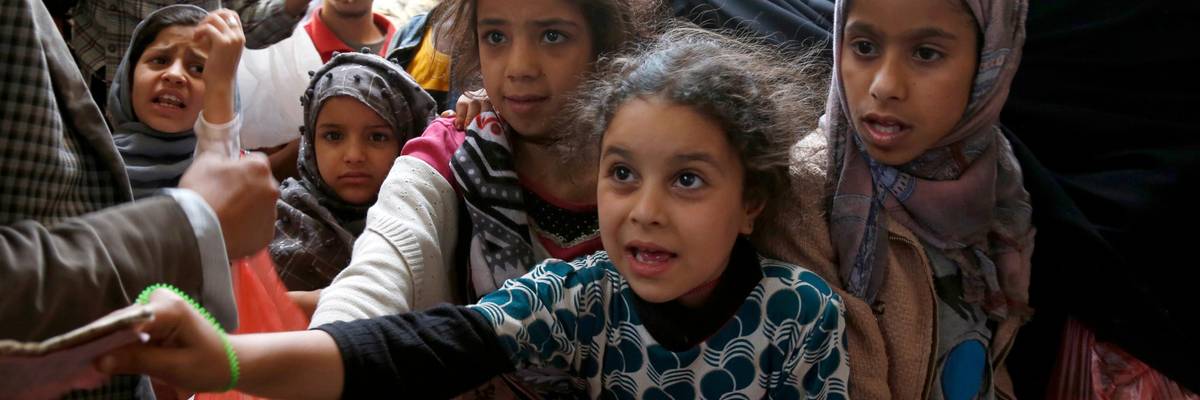
Yemeni children affected by years of war, the climate emergency, and the Covid-19 pandemic wait to receive food at a charity kitchen in the capital city of Sana'a on June 29, 2021. (Photo: Mohammed Hamoud/Getty Images)
Oxfam Report Shows 11 People Are Dying of Hunger Every Minute--Outpacing Covid Fatalities
"To prevent unnecessary deaths and millions more people being pushed to extreme poverty and hunger, governments... must simultaneously build fairer and more sustainable food systems and support social protection programs."
As many as 11 people around the world are dying of hunger and malnutrition every minute--outpacing Covid-19 deaths--according to a report published Friday by the international charity Oxfam.
The report (pdf), entitled The Hunger Virus Multiplies: Deadly Recipe of Conflict, Covid-19, and Climate Accelerate World Hunger, says that a year-and-a-half into the coronavirus pandemic, "deaths from hunger are outpacing" those from the virus.
"Ongoing conflict, combined with the economic disruptions of the pandemic and an escalating climate crisis, has deepened poverty and catastrophic food insecurity in the world's hunger hot spots and established strongholds in new epicenters of hunger," it states.
The report continues:
Conflict was the single-largest driver of hunger since the pandemic began, the primary factor pushing nearly 100 million people in 23 conflict-torn countries to crisis or worse levels of food insecurity. Despite calls for a global cease-fire to allow the world to focus its attention on battling the pandemic, conflict has gone largely unabated.
Even as governments had to find massive new resource flows to fight the coronavirus, global military spending rose by 2.7% last year--the equivalent of $51 billion--enough to cover the $7.9 billion 2021 U.N. humanitarian food security appeal six-and-a-half times over. Arms sales spiraled in some of the most conflict-torn countries battered by hunger. For instance, Mali increased its arms purchases by 669% since violence escalated in 2012.
Overall, around 155 million people in 55 countries are facing crisis levels of food insecurity or worse, the report states. Some of the nations hardest-hit by hunger include Ethiopia, Madagascar, South Sudan, and Yemen. More than half a million people in these countries are facing famine-like conditions--an increase of 500% since the pandemic began.
The climate emergency "was the third significant driver of global hunger this year," the report states. "Nearly 400 weather-related disasters, including record-breaking storms and flooding, continued to intensify for millions across Central America, Southeast Asia, and the Horn of Africa, where communities were already battered by the effects of conflict and Covid-19-related poverty."
"Women and girls are especially affected, too often eating last and eating least."
--Gabriela Bucher, Oxfam
"Meanwhile, the rich continued to get richer during the pandemic," the paper notes. "The wealth of the 10 richest people (nine of whom are men) increased by $413 billion last year--enough to cover the entire U.N. humanitarian appeal for 2021 more than 11 times over."
The report is referring to the world body's December 2020 appeal for $35 billion to meet humanitarian needs around the world in 2021.
Oxfam executive director Gabriela Bucher said in a statement that "informal workers, women, displaced people, and other marginalized groups are hit hardest by conflict and hunger. Women and girls are especially affected, too often eating last and eating least. They face impossible choices, like having to choose between traveling to the market and risking getting physically or sexually assaulted, or watching their families go hungry."
"Governments must stop conflict from continuing to fuel catastrophic hunger and instead ensure aid agencies reach those in need," Bucher continued. "Donor governments must immediately and fully fund the U.N.'s humanitarian appeal to help save lives now. Security Council members must also hold to account all those who use hunger as a weapon of war."
"To prevent unnecessary deaths and millions more people being pushed to extreme poverty and hunger, governments must stop this deadly disease; a People's Vaccine has never been more urgent," she added. "They must simultaneously build fairer and more sustainable food systems and support social protection programs."
We are at a crossroads
This country and this world are at a monumental crossroads. In a few short weeks, US voters will have an opportunity to beat back the forces of fascism and confront the billionaires who are rigging the economy, our media system, and our democracy, making it increasingly impossible for ordinary people to get by. We’re not just talking about the election. We’re talking about what must be done once these fascist elements are vanquished from power. We need a bolder set of solutions than what either major party has so far been willing to offer and a working-class movement ready to fight like hell for it. Trump didn't emerge from nowhere. The conditions that fueled MAGA authoritarianism were created by decades of radical neoliberal economic policies and a corrupt political system dominated by corporate interests. They slashed taxes on the super-rich, promising that the benefits would trickle down. They said giveaways to the corporate titans would make life more affordable for the rest of us. It was all bullshit. And when a bitter, betrayed populace searches for someone to blame, right-wing demagogues have little trouble finding scapegoats. People know when they're being lied to, but you won't hear any of this from the corporate media. Only independent journalism—powered and funded by people who believe in building a better world—can deliver truly trustworthy daily news. Our Fall Campaign is underway, and we need your help. To power our newsroom through the rest of the year, we need to raise $125,000 by midnight on October 31. So if you share our vision, please contribute whatever you can to sustain our work. |
As many as 11 people around the world are dying of hunger and malnutrition every minute--outpacing Covid-19 deaths--according to a report published Friday by the international charity Oxfam.
The report (pdf), entitled The Hunger Virus Multiplies: Deadly Recipe of Conflict, Covid-19, and Climate Accelerate World Hunger, says that a year-and-a-half into the coronavirus pandemic, "deaths from hunger are outpacing" those from the virus.
"Ongoing conflict, combined with the economic disruptions of the pandemic and an escalating climate crisis, has deepened poverty and catastrophic food insecurity in the world's hunger hot spots and established strongholds in new epicenters of hunger," it states.
The report continues:
Conflict was the single-largest driver of hunger since the pandemic began, the primary factor pushing nearly 100 million people in 23 conflict-torn countries to crisis or worse levels of food insecurity. Despite calls for a global cease-fire to allow the world to focus its attention on battling the pandemic, conflict has gone largely unabated.
Even as governments had to find massive new resource flows to fight the coronavirus, global military spending rose by 2.7% last year--the equivalent of $51 billion--enough to cover the $7.9 billion 2021 U.N. humanitarian food security appeal six-and-a-half times over. Arms sales spiraled in some of the most conflict-torn countries battered by hunger. For instance, Mali increased its arms purchases by 669% since violence escalated in 2012.
Overall, around 155 million people in 55 countries are facing crisis levels of food insecurity or worse, the report states. Some of the nations hardest-hit by hunger include Ethiopia, Madagascar, South Sudan, and Yemen. More than half a million people in these countries are facing famine-like conditions--an increase of 500% since the pandemic began.
The climate emergency "was the third significant driver of global hunger this year," the report states. "Nearly 400 weather-related disasters, including record-breaking storms and flooding, continued to intensify for millions across Central America, Southeast Asia, and the Horn of Africa, where communities were already battered by the effects of conflict and Covid-19-related poverty."
"Women and girls are especially affected, too often eating last and eating least."
--Gabriela Bucher, Oxfam
"Meanwhile, the rich continued to get richer during the pandemic," the paper notes. "The wealth of the 10 richest people (nine of whom are men) increased by $413 billion last year--enough to cover the entire U.N. humanitarian appeal for 2021 more than 11 times over."
The report is referring to the world body's December 2020 appeal for $35 billion to meet humanitarian needs around the world in 2021.
Oxfam executive director Gabriela Bucher said in a statement that "informal workers, women, displaced people, and other marginalized groups are hit hardest by conflict and hunger. Women and girls are especially affected, too often eating last and eating least. They face impossible choices, like having to choose between traveling to the market and risking getting physically or sexually assaulted, or watching their families go hungry."
"Governments must stop conflict from continuing to fuel catastrophic hunger and instead ensure aid agencies reach those in need," Bucher continued. "Donor governments must immediately and fully fund the U.N.'s humanitarian appeal to help save lives now. Security Council members must also hold to account all those who use hunger as a weapon of war."
"To prevent unnecessary deaths and millions more people being pushed to extreme poverty and hunger, governments must stop this deadly disease; a People's Vaccine has never been more urgent," she added. "They must simultaneously build fairer and more sustainable food systems and support social protection programs."